TheCEOVerse • Digital Edition
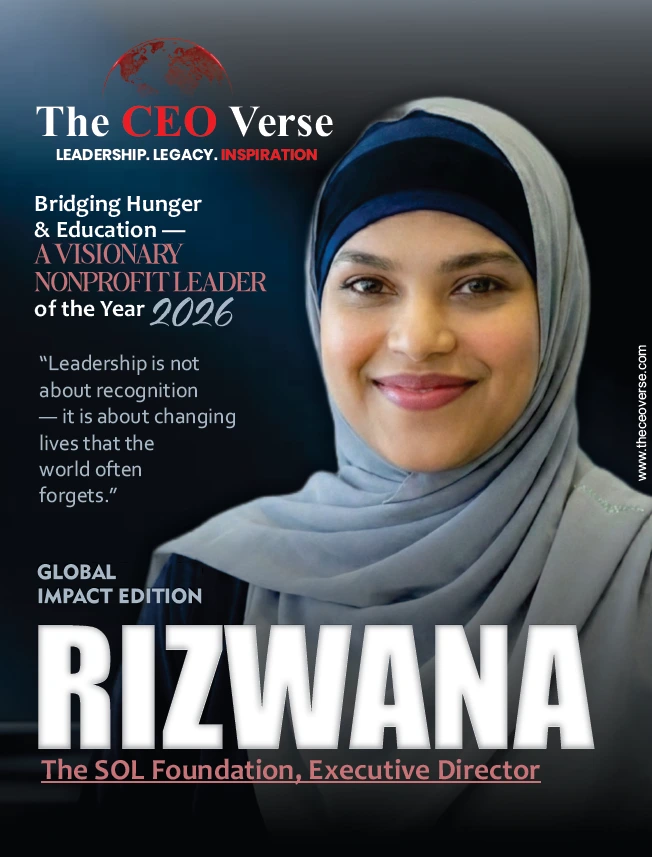
“Bridging Hunger & Education — A Visionary Nonprofit Leader of the Year 2026”
Cover story
Rizwana
Featured Profile - Rizwana
The Sun That Stays
Rizwana’s path to leading The SOL Foundation was never a straight line—it was built on witnessing a gap and deciding to fill it.
Early in her career, she saw firsthand how hunger and lack of education trap families in cycles that span generations. Children were missing school not because they didn’t value learning, but because they were hungry or needed to work to help their families survive. That reality stayed with her, and it followed her until she decided to do something about it.
She began by volunteering with grassroots organizations, learning directly from the communities traditional aid had only partially reached. What became clear was that food programs and education initiatives almost never worked together—donors funded one without seeing the other, and families were left in the gap between them. She believed there had to be a better way, and that conviction led her to found The SOL Foundation, a 501(c)(3) nonprofit built on one idea: no child should have to choose between a meal and an education.
SOL started small — local partnerships, community-designed programs, deliberate growth. Earning trust took longer than building infrastructure. Scaling responsibly and securing sustainable funding tested the organization more than once. But each challenge reinforced what Rizwana already believed: solutions built with communities hold, and solutions delivered to them don’t. Today SOL operates across multiple regions, with school retention rates rising, nutrition improving, and families building pathways out of poverty that they didn’t have before.
Her greatest accomplishment, she says, isn’t a title. It’s knowing that a child who was once hungry is now in a classroom—because a community chose to invest in both their present and their future.
Principles Behind the Work
Rizwana’s leadership has always started from the same place: listen before you act.
Before SOL launches anything in a new region, the team goes in with questions, not answers. SOL partners with local leaders to shape every program, hires from within the community, and builds solutions around what actually exists in that place—not what worked somewhere else. This produces ownership, and ownership is what makes a program survive long after external support steps back. She is equally clear about what gets measured—school attendance, literacy rates, nutrition levels, and family stability over time, not output counts that look good in reports but don’t tell you whether anything real changed. Build for impact first, then scale. Not the other way around. Running through everything is a commitment to sharing data openly, including failures, because credibility built on honest reporting outlasts credibility built on managed appearances.
The Moments That Defined the Journey
Founding SOL was the first milestone—and, in many way the hardest. Building a functioning institution from a conviction meant earning donor trust from nothing, assembling a team genuinely aligned around the mission, and establishing the credibility to operate in vulnerable communities.
The real proof came when the model held beyond the first community. Replicating the program across new regions tested whether the approach was a system or a fortunate circumstance. Attendance rose, nutrition improved, and communities that had been framed as aid recipients were running their own programs. Forbes Councils gave her a wider stage, which she used not to promote SOL but to push the sector’s conversation from charity toward systems change—influence that reaches further than any single program can.
The milestone she returns to most, though, has no announcement attached to it. It’s every time a parent says their child is in school instead of working. Every time a family no longer fears tomorrow’s meal.
How She Leads
Rizwana leads from empathy—she doesn’t lose sight of the people behind the numbers. But she has learned that empathy without structure doesn’t build things that last. Alongside the care sits discipline: listening before acting, measuring results honestly, and making hard calls that protect long-term outcomes even when short-term optics push the other way.
Resilience has been just as necessary. The sector doesn’t run short of setbacks—funding gaps, logistical failures, and the persistent awareness that urgent needs remain unmet. She has stayed focused through all of it by treating obstacles as information rather than a verdict. And what has kept her anchored through everything is conviction — a clear belief that hunger and lack of education are solvable problems, but only if the sector is willing to challenge how it has always operated.
What SOL Actually Does Differently
SOL’s flagship program pairs daily nutritious meals with access to safe learning spaces—addressing both barriers keeping children out of school at the same time. A hungry child cannot focus. A child who has to work cannot attend. Treating these separately produces results that are, at best, partial.
What gives the model staying power is where the food comes from. Ingredients are sourced from local farmers, community members are trained to manage gardens, and the local economy benefits from the program rather than being bypassed by it. Every program is co-designed with local leaders and measured against outcomes the community itself cares about. About school retention, household resilience, nutrition levels—all reported openly to donors and partners.
“We don’t measure success by meals delivered. We measure it by classrooms filled—and by communities that no longer need us.”
Work in Progress
On the ground right now, SOL is launching new partnerships in underserved regions where food insecurity is directly suppressing school attendance — each built around local sourcing and community ownership from day one, not added on later.
Running alongside that is a Community Leadership Training Program investing in local members, particularly women, to independently manage gardens, track data, and lead parent engagement. The goal isn’t better-run programs. It’s programs that don’t need SOL to function—because the people inside them understand every part and have full authority to make decisions. A stronger impact measurement platform is also being built to track school retention, literacy gains, and household resilience more precisely, with those findings used to make the case for this approach beyond SOL’s own work.
A Vision Measured by Stepping Back
Rizwana’s five-year vision for SOL isn’t about building something larger. It’s about building toward a point where the Foundation is less needed—and making sure that point actually arrives.
Growth will stay deliberate, entering new regions only where strong local partners and proper infrastructure already exist. SOL’s models will be open-sourced, other organizations trained in community-led implementation, and policy engagement will become more central to the work. Success, in her framing, is other groups adopting the approach because it works — not because SOL told them to.
The deepest measure remains an exit. She wants the first communities SOL has worked with to fully own and operate their programs, with data showing children thriving long after the Foundation stepped back. It’s an unusual definition of success for a nonprofit. It’s also, she says, the only honest one.
What the Obstacles Taught Her
The sector’s resistance to integration was the first real test. Donors had always funded hunger and education separately, and questioning that structure met skepticism. Rizwana didn’t argue the philosophy—she ran small pilots, documented every outcome carefully, and let results make the case. Data moved skeptics into partners in a way advocacy hadn’t managed.
Building trust in new communities came next, and it was a slower lesson. External programs arriving with solutions meet justified resistance, and SOL learned to stop arriving with solutions. The team goes in with questions, hires locally, and co-designs rather than delivers. That patience produced programs that genuinely held. Funding was a constant pressure—long-term work doesn’t fit neatly into short grant cycles, and the mismatch tested SOL’s sustainability more than once. Diversifying revenue, aligning with donors committed to systemic outcomes, and building local supply chains that reduced external dependency were all part of the answer.
The lesson running through all of it was the same: progress in this kind of work comes from listening better, not pushing harder.
What She Tells People Starting Out
She says fall in love with the problem, not your solution. Getting attached to a particular approach is one of the most common ways well-intentioned work goes wrong. The leaders who create lasting change stay genuinely curious — spending more time listening than presenting, and willing to change direction when reality doesn’t match the assumption they started with.
Build credibility before scale. Trust is earned through unglamorous work—understanding the details, measuring honestly even when results disappoint, sharing failures rather than managing how they look. In humanitarian work especially, credibility is the only currency that compounds reliably. And choose mission over ego every time. Hire people stronger than you where it counts. Partner when it serves the work better than competing. Step back when someone else should lead. The goal isn’t to be the central figure in the story — it’s to change things for the people who need it changed.
The Seed of Life
SOL stands for the Seed of Life Foundation. In several languages, sol means sun — light, warmth, the condition under which things grow. The name was chosen deliberately. What SOL brings to communities isn’t just resources. It’s the conditions under which people can sustain themselves without needing the Foundation present.
The story begins with a problem Rizwana couldn’t stop seeing: parents in too many communities making an impossible daily calculation — school or work, a meal or a future. When hunger and lack of education meet, poverty doesn’t just persist — it deepens and passes down. SOL was built to break that cycle at its root, refusing to treat these as problems that can be solved one at a time. It builds systems communities own, so that one day, the delivery is no longer necessary.
That’s what the name stands for: dignity, opportunity, and solutions that leave something behind worth keeping.
Rizwana is the executive director of The SOL Foundation, a 501(c)(3) nonprofit dedicated to breaking cycles of poverty by combining food security and educational access through community-owned programs. She holds an MBA and is an alumna of Cornell University and has been recognized as an Entrepreneur Women USA honoree for 2024 and 2025. Under her leadership, The SOL Foundation was named Nonprofit of the Year 2025 by the Stevie Awards in both the UK and the USA. Rizwana was further honored as Women of the Year 2025 USA by the Stevie Awards, and in 2026 was named a Global Top 100 Leader Disruptor by Top 100 CEO.