
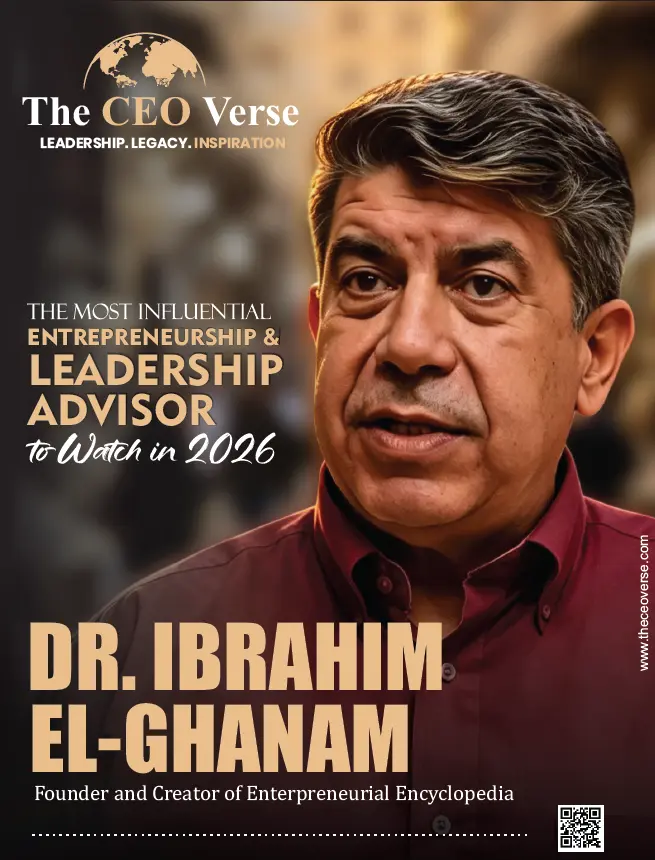
TheCEOVerse • Digital Edition
“The Most Influential Entrepreneurship & Leadership Advisor to Watch in 2026”
Cover story
Dr. Ibrahim El-Ghanam
Featured Profile - Dr. Ibrahim El-Ghanam
From Concrete to Concepts
Dr. Ibrahim El-Ghanam spent the first half of his professional life building structures that could be measured in concrete and steel. The second half has been devoted to building something far less tangible, yet potentially far more enduring: knowledge, leadership, and opportunity.
Born in Cairo in 1962, El-Ghanam studied architecture during a period of rapid national development. Egypt was expanding its cities, infrastructure, and public facilities, and he was drawn to a profession centered on creating structures that would serve communities for generations. Architecture taught him lessons that continue to shape his work today: every lasting achievement depends on strong foundations, careful planning, and a clear understanding of the environment in which it is built.
As his career progressed, however, he began noticing a different kind of structural challenge.
In conversations with aspiring entrepreneurs and small business owners, he repeatedly encountered talented, hardworking individuals whose ventures failed despite promising ideas and remarkable determination. Their difficulties rarely stemmed from a lack of ambition. More often, they lacked practical guidance, appropriate systems, and business frameworks that reflected the realities of their own environment.
That realization gradually redirected his career.
The strongest structures, he concluded, are not always physical. They are built through knowledge, capable people, resilient organizations, and a sense of purpose that continues long after individual projects have ended.
Over the past four decades, El-Ghanam has served as an Associate Professor at Al Ahram Canadian University, Senior Consultant to the Egyptian Banking Institute and the Central Bank of Egypt, and advisor to government agencies, universities, financial institutions, and international development organizations. Along the way, he has worked with thousands of entrepreneurs, helping them transform ideas into sustainable enterprises while continually learning from their own experiences.
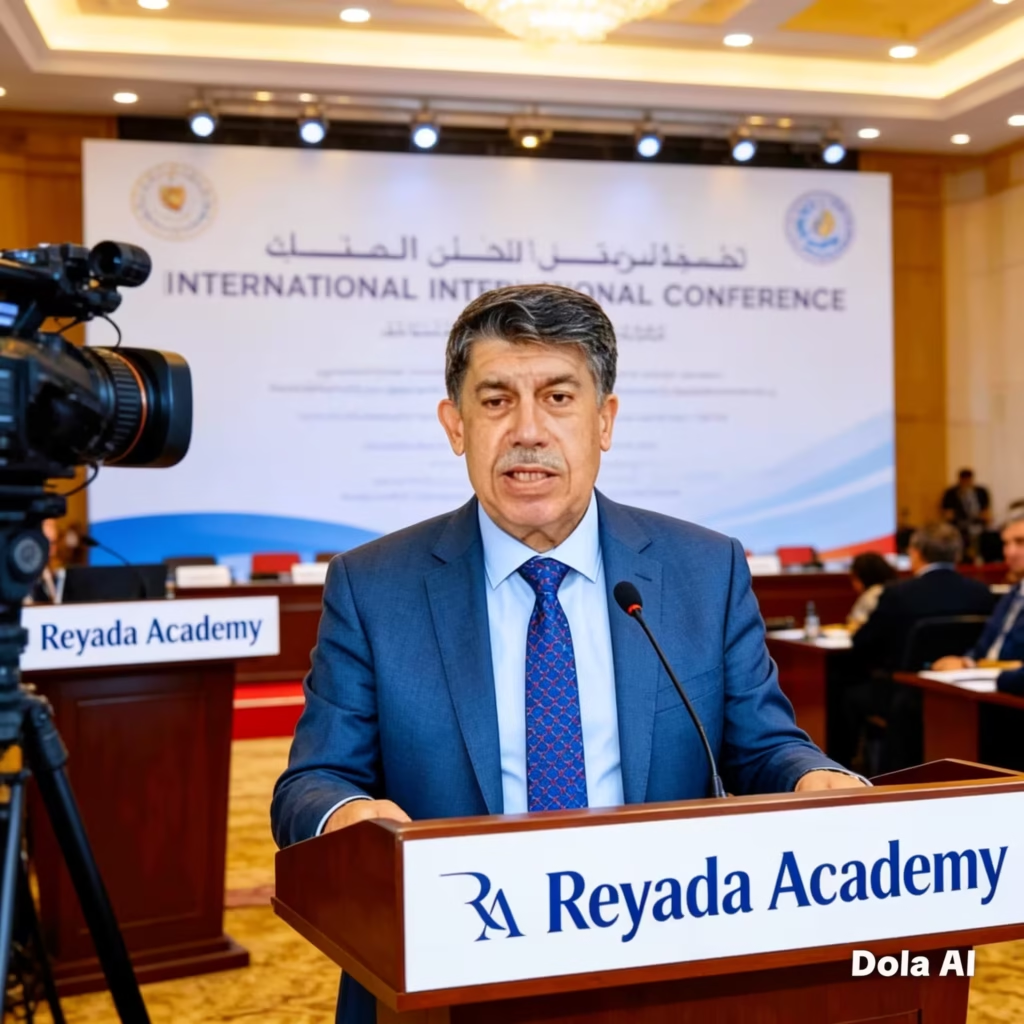
Today, through Reyada Academy for Leadership & Entrepreneurship Development, he continues that mission while leading an ambitious not-for-profit initiative dedicated to making practical entrepreneurial knowledge freely accessible to anyone who wants to build a stronger business.
Global Models Met Local Reality
The experience that most profoundly reshaped El-Ghanam’s professional philosophy did not come from success. It came from failure.
Early in his transition from architecture to enterprise development, he introduced internationally respected business frameworks from Europe and North America into entrepreneurship programs across Egypt. On paper, the models were comprehensive, evidence-based, and widely successful.
In practice, they consistently fell short.
The problem was not the quality of the frameworks but the assumptions behind them. They had been designed for business environments with different financial systems, institutional structures, and commercial cultures. They did not fully reflect local payment practices, informal business networks, limited access to capital, or the deeply personal relationships that often influence commercial decisions as much as formal agreements.
Rather than forcing entrepreneurs to fit imported models, El-Ghanam began asking a different question: How do successful businesses actually grow in this environment, and how can that reality become the starting point for better solutions?
The search for answers took him far beyond classrooms and conference rooms. He spent months listening rather than teaching—visiting workshops, rural communities, local markets, and home-based enterprises across Upper Egypt.
He met weavers preserving traditional craftsmanship while reaching new markets through digital platforms. He worked alongside farmers adapting generations-old practices to changing environmental conditions. He listened to young entrepreneurs managing entire businesses from little more than a smartphone and an unwavering determination to succeed.
Those experiences transformed his approach.
Instead of beginning with theory and expecting reality to adapt, he began with reality itself. Global knowledge remained valuable, but only when interpreted through local experience and practical application.
As this work evolved, another challenge quietly emerged alongside this transformation.
For several years, El-Ghanam has been developing a comprehensive open-access knowledge initiative with almost no external funding, no marketing budget, and no paid team. What many would consider a limitation became one of the project’s greatest strengths. Operating independently has encouraged disciplined priorities, eliminated unnecessary complexity, and ensured that every decision remains focused on creating practical value rather than satisfying external expectations.
For El-Ghanam, meaningful work has never depended on abundant resources. It has depended on clarity of purpose, consistent effort, and the willingness to keep building long after initial enthusiasm fades.
The Model That Refused to Be Imported
The lessons El-Ghanam gathered from years of observation gradually evolved into a principle that now defines his work: relevance over replication.
Rather than importing business models designed for different markets, he believes effective entrepreneurship begins by understanding local realities and then adapting global best practices to fit them. Lasting solutions are built from the ground up, not imposed from the top down.
This philosophy became the foundation of the El-Mobadara Model, a four-phase framework that guides entrepreneurs through assessment, adaptation, implementation, and continuous learning. Instead of offering a one-size-fits-all formula, the model encourages entrepreneurs to understand their starting conditions, evaluate available resources, and develop strategies that reflect their own economic, cultural, and institutional environments.
Over the years, the framework has been adopted by government agencies, commercial banks, universities, and international development organizations, supporting the development of thousands of small and medium-sized enterprises across Egypt.
Another area that distinguishes El-Ghanam’s work is his emphasis on the human side of entrepreneurship.
Long before entrepreneur wellbeing became a widely discussed topic, he was exploring the impact of decision fatigue, burnout, chronic stress, and leadership resilience on business performance. His programs recognize that sustainable businesses depend not only on sound financial models but also on the physical, emotional, and mental wellbeing of the people leading them.
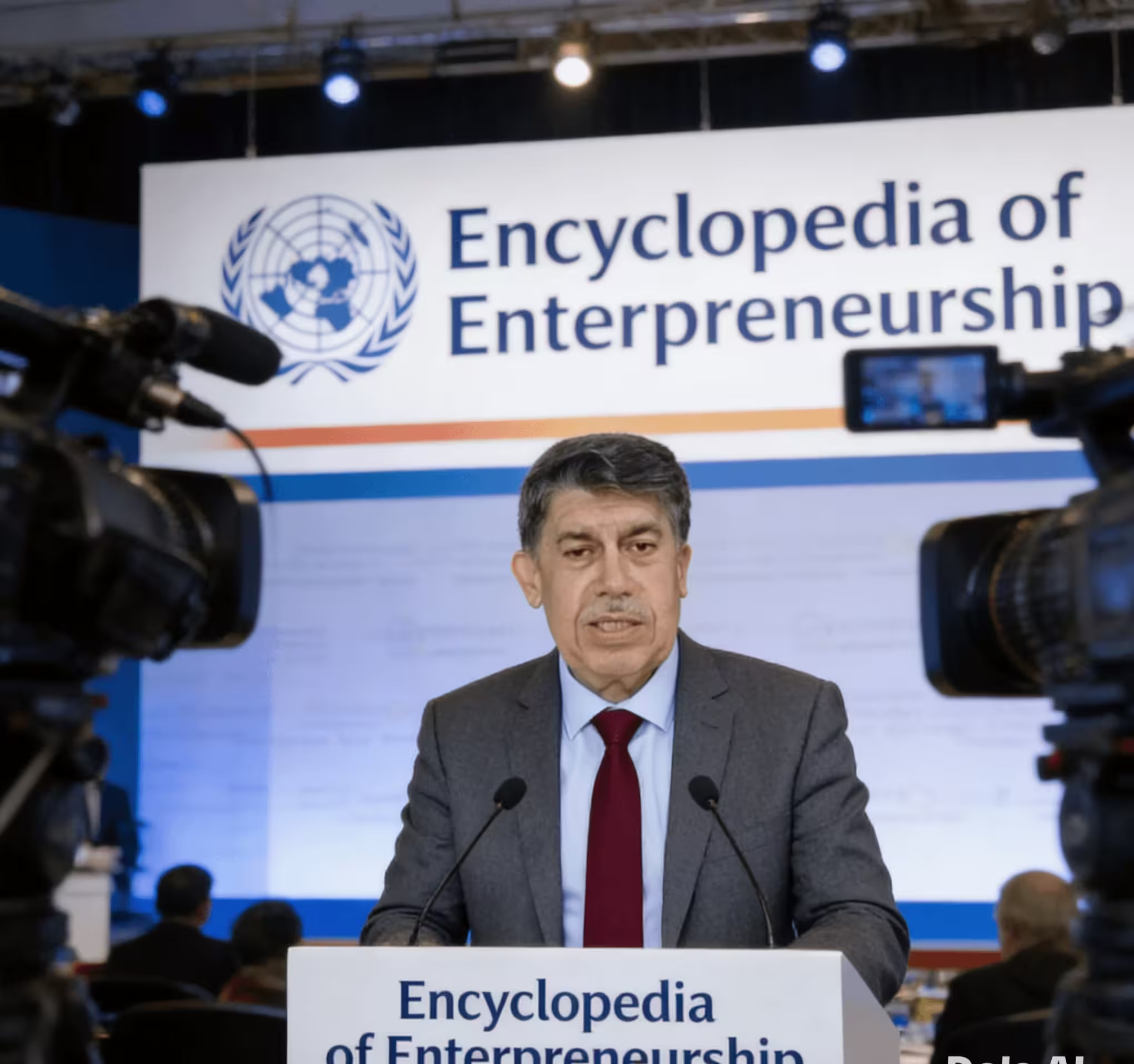
Alongside these initiatives, he continues developing an open-access knowledge platform that captures more than four decades of practical experience. Rather than documenting success stories alone, it also examines business failures, recurring mistakes, and the often-overlooked factors that determine whether an enterprise survives periods of uncertainty.
Leadership Is Making Everyone Else Smarter
El-Ghanam rarely describes leadership in terms of authority or position.
Instead, he defines it as creating environments where people become more capable, more confident, and more effective than they believed possible.
“Leadership is not about being the smartest person in the room,” he often says. “It is about helping everyone else become smarter.”
That philosophy has shaped every stage of his career.
The El-Mobadara Model was never developed in isolation. It evolved through continuous dialogue with entrepreneurs, educators, financial institutions, and community organizations. Ideas were refined through practical experience, tested in diverse environments, and strengthened through constant feedback from the people expected to use them.
This collaborative approach has also shaped Reyada Academy.
Over the years, more than 250 master trainers and institutional leaders have completed advanced development programs under El-Ghanam’s guidance. Many now lead entrepreneurship and leadership initiatives within universities, financial institutions, government agencies, and development organizations, adapting the frameworks to meet the needs of their own communities.
For El-Ghanam, this multiplier effect represents one of leadership’s greatest achievements. Success is not measured by how much one individual accomplishes, but by how many others are equipped to continue the work independently.
The same philosophy guides the Academy’s knowledge initiatives. Built through collaboration rather than commercial investment, they continue to attract educators, practitioners, and volunteers from more than 20 countries, united by a shared belief that practical entrepreneurial knowledge should be accessible to everyone.
The Program That Looked Right on Paper
One of El-Ghanam’s most valuable lessons came from a program that appeared flawless in design.
Academically rigorous, carefully structured, and based on internationally recognized methodologies, it met every professional standard. Yet despite its strengths, participation declined, implementation remained limited, and many participants struggled to apply what they had learned.
The experience forced him to confront an uncomfortable reality.
He had designed the program around what experts believed entrepreneurs needed rather than around the challenges entrepreneurs actually faced.
That insight became a lasting principle.
Practical relevance will always outperform theoretical perfection.
A straightforward solution that people can implement consistently creates far greater impact than an elegant framework that remains confined to reports and presentations.
The experience also reshaped his understanding of growth.
Many initiatives generate enthusiasm during their launch only to lose momentum within a short period because they prioritize visibility over sustainability. Today, El-Ghanam evaluates success differently. He is less interested in how quickly an initiative expands than in whether it continues creating value years after its introduction.
This perspective has reinforced another deeply held belief:
“You cannot save everyone. But you can build systems that help people save themselves.”
Rather than creating dependency, he seeks to strengthen capability. The objective is not to solve problems on behalf of entrepreneurs, but to provide the knowledge, frameworks, and confidence that enable them to solve future challenges independently.
An Asset That Never Depreciates
Although his professional life has been shaped by architecture, entrepreneurship, and education, El-Ghanam traces his deepest values to a much earlier influence—his father.
He often recalls a simple lesson that has remained with him throughout his career:
“Integrity is the only asset that never depreciates.”
It is a principle that continues to influence every decision he makes.
Professional success achieved without integrity has little lasting value. Trust, once lost, is difficult to rebuild. For El-Ghanam, honesty, transparency, and consistency have always been more important than rapid recognition or short-term achievement.
His education, however, did not come from family alone.
Thousands of entrepreneurs across Egypt have become his greatest teachers.
He remembers the weaver in Luxor who strengthened an entire community by choosing cooperation over competition. The farmer in Sohag who transformed exhausted land through persistence and innovation. The young entrepreneur in Minya who chose to create opportunities at home rather than leave in search of them elsewhere.
Their experiences reinforced a lesson that no textbook could fully teach:
People rarely need perfect advice. They need practical guidance they can trust, delivered with honesty, humility, and respect for the realities they face every day.
Equally important are the lessons learned from businesses that quietly disappeared.
Many entrepreneurs never lacked commitment or determination. They simply lacked timely guidance, practical knowledge, or someone who could help them recognize problems before they became irreversible.
Those untold stories continue to inspire El-Ghanam’s work, reminding him that understanding failure is often just as valuable as celebrating success.
Foundations Deep Before Ambitions High
Asked what advice he gives aspiring entrepreneurs, Dr. Ibrahim El-Ghanam rarely begins by discussing funding, technology, or rapid growth.
He starts with a much simpler question:
What meaningful problem are you trying to solve?
Too many businesses begin with a product and then search for customers. In his experience, the most sustainable enterprises take the opposite approach. They begin by understanding people’s daily challenges and then develop solutions that create genuine value.
“The market rewards businesses that solve real problems,” he says. “Everything else follows.”
His second message is equally direct.
Growth without resilience is not sustainable growth—it is simply greater exposure to risk.
Over four decades of working with entrepreneurs, he has seen businesses expand rapidly only to struggle because their leadership, financial discipline, operating systems, or organizational culture failed to grow at the same pace.
For that reason, he encourages entrepreneurs to invest in the foundations that cannot always be seen: integrity, sound decision-making, personal wellbeing, capable teams, and a culture of continuous learning.
He also believes entrepreneurs should study failure with the same discipline that they study success. Success often reveals what worked in one situation. Failure explains what must never be ignored again.
Perhaps his most practical advice is to remain grounded in local realities while maintaining a global outlook.
International ideas can be valuable, but copying another organization’s journey rarely produces lasting results. Every entrepreneur must understand the environment in which they operate and build solutions that reflect their own market, culture, and opportunities.
A Megaphone, Not a Milestone
Recognition, El-Ghanam insists, has never been the destination.
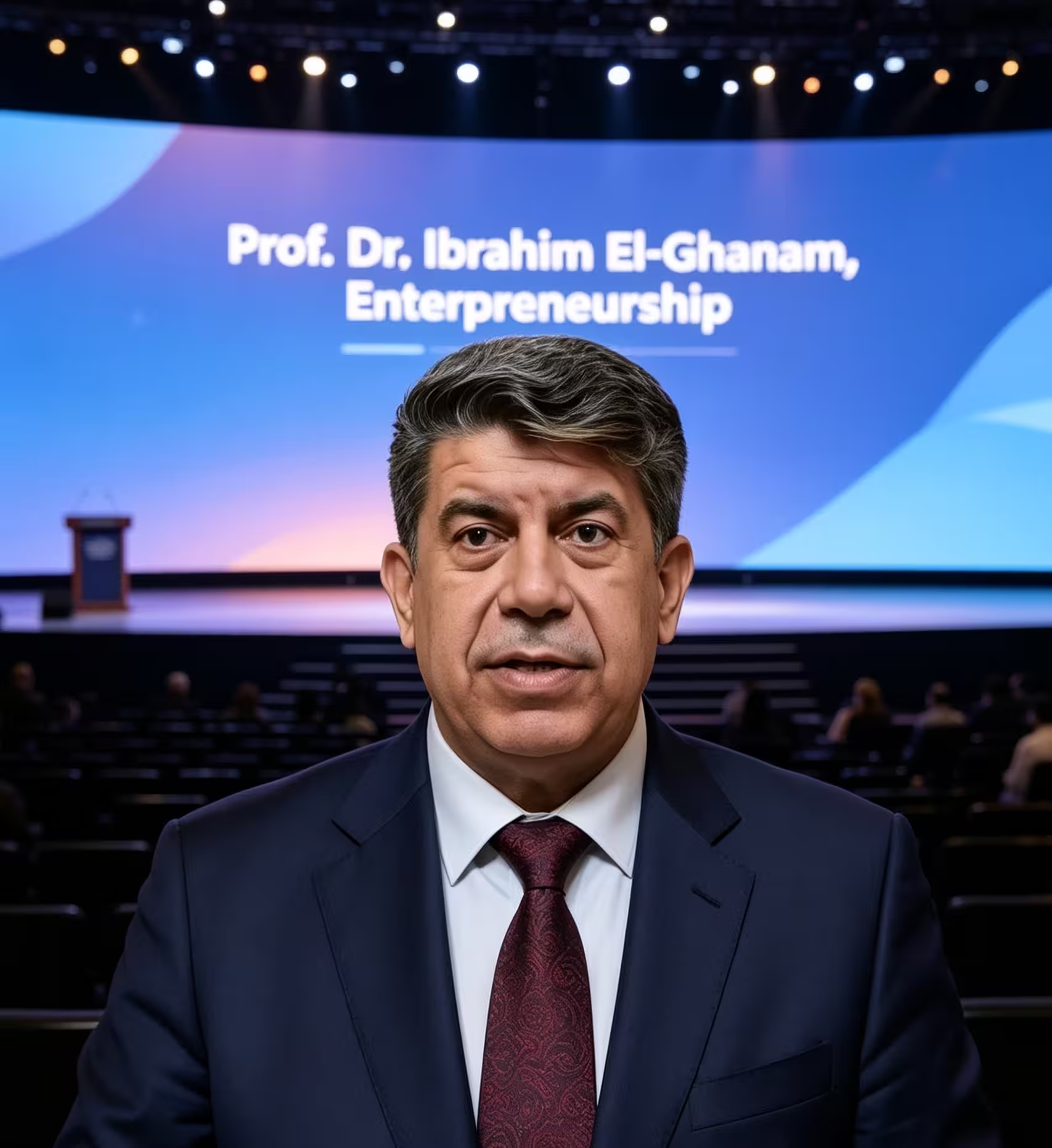
He views honors such as this feature not as milestones, but as opportunities to amplify ideas that deserve wider attention.
Those ideas are remarkably consistent throughout his work: entrepreneurship should be practical rather than theoretical; leadership should empower rather than control; and knowledge should be shared rather than restricted.
Greater visibility, he hopes, will encourage more educators, practitioners, researchers, and entrepreneurs to contribute their experience, strengthen existing frameworks, and expand access to practical business knowledge for future generations.
For him, recognition carries responsibility.
Every new audience represents another opportunity to encourage thoughtful leadership, inspire collaboration, and demonstrate that meaningful impact does not always require extraordinary resources.
The work itself remains unchanged.
Continue improving.
Continue documenting.
Continue serving.
Legacy Is What You Enable Others to Build
When asked how he measures success, El-Ghanam rarely mentions awards, titles, or public recognition.
Instead, he speaks about people.
Success, in his view, is measured by the number of individuals who become more capable, more confident, and more independent because of something they learned or experienced through his work.
He believes the strongest organizations are those that eventually become larger than the people who created them.
Knowledge should continue evolving.
Frameworks should continue improving.
Communities should continue learning.
Leadership should create more leaders.
That philosophy explains why so much of his work has focused on building systems that others can adapt, improve, and carry forward long into the future.
His ambition has never been to create dependence on one individual.
It has been to make that individual increasingly unnecessary.
The Work That Needed Almost Nothing to Begin
People often ask what made such an ambitious knowledge initiative possible.
They expect to hear about major grants, institutional funding, or significant financial backing.
Instead, the answer is surprisingly simple.
Conviction.
Volunteer effort.
Persistence.
Years of disciplined work carried out during evenings, weekends, and every available opportunity.
For El-Ghanam, limited resources were never the defining challenge. The greater challenge was remaining committed to a vision whose value would be measured over decades rather than months.
Ironically, beginning with very little became one of the initiative’s greatest strengths. Without commercial pressure or external agendas, every decision could remain guided by a single question:
Will this genuinely help entrepreneurs build stronger, more sustainable businesses?
That question continues to shape every article, every framework, and every contribution.
His message to the next generation reflects the same philosophy that has guided his own journey.
You do not need perfect conditions to begin.
You do not need extraordinary resources.
You do not need permission.
Start where you are.
Use what you have.
Solve one meaningful problem well.
The strongest movements rarely begin with abundant resources. They begin with one person who chooses to create value for others—and refuses to stop.
More than four decades after leaving architecture behind, Dr. Ibrahim El-Ghanam still considers himself a builder.
The materials have changed.
Concrete has given way to knowledge.
Buildings have become people, institutions, and ideas.
Yet the purpose remains exactly the same: to create strong foundations that continue supporting others long after the builder has stepped aside.