TheCEOVerse • Digital Edition
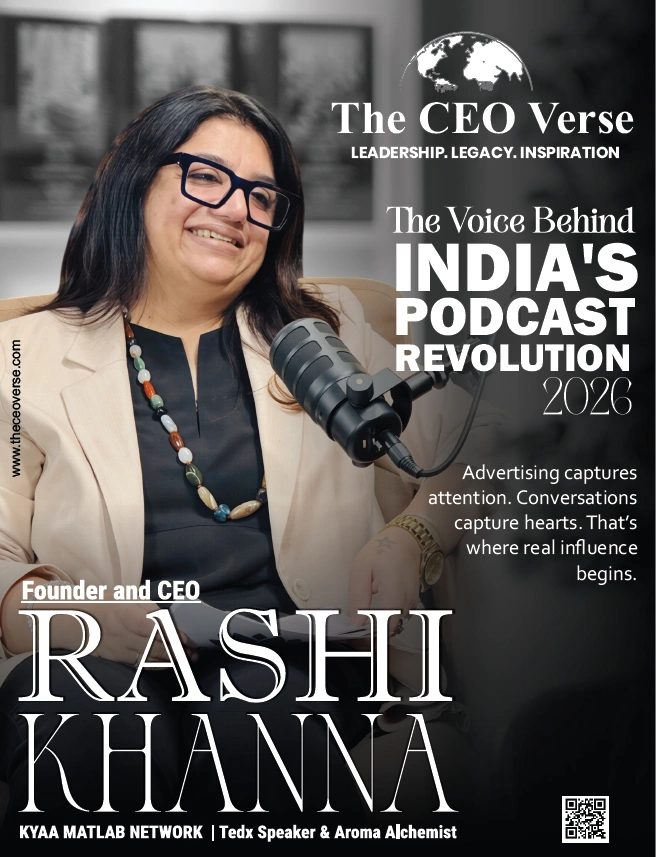
“The Voice Behind India’s Podcast Revolution 2026”
Cover story
Rashi Khanna
Featured Profile - Rashi Khanna
The Human Story Connecting Every Venture
Rashi Khanna has built across branding, podcasting, counselling, philanthropy, and media. On paper, that reads like five different careers. She doesn’t see it that way. Every one of these fields, for her, has been a different route to the same destination of understanding people.
The shift happened quietly, over two decades. She started out helping brands communicate. Somewhere in that process she noticed something that changed her direction: people don’t remember advertisements. They remember conversations that made them feel understood. That single realisation became the seed for KYAA MATLAB NETWORK, a podcast platform where entrepreneurs, artists, policymakers, and educators could talk without a sales pitch attached.
Becoming a NIMHANS-certified Lay Counsellor pushed that realisation further. Listening, she found, wasn’t a soft skill sitting on the side of business. It was the whole business. Sometimes people aren’t looking for advice. They simply want someone to hear them without judgment, and that lesson eventually led her to create EMPATHE, shaping the way she leads every venture since. The same belief carries into the Ra by Rashi Foundation, where the focus stayed on opportunity over charity, for women entrepreneurs, SMEs, MSMEs, creators, and persons with disabilities.
Khanna doesn’t measure her journey by the number of companies she’s built or the projects she’s completed. She measures it by the people she’s met, the conversations she’s been part of, and the moments someone tells her a conversation changed how they think. If there’s one thread connecting everything she’s done, it’s this: she wants people to know their story matters, because sometimes being heard can change a person’s life.
Views Fade, The Right Conversation Stays
Anyone can make content today. That was never the hard part. The hard part is making something people actually carry with them.
Khanna thinks the moment has an odd contradiction built into it, where people are overwhelmed with information but hungry for authenticity at the same time. They don’t want another video or another podcast added to the pile. They want something that feels real, even if it’s rougher around the edges.
At KYAA MATLAB NETWORK, the production process doesn’t begin with a virality question. It begins with a different one: why does this conversation deserve to exist. That single filter, Khanna says, changes everything downstream, from who gets booked to what gets asked to what gets cut.
Her counselling background bleeds into this too. People rarely remember exact words. They remember how a conversation made them feel. So the team doesn’t chase polish. The stories people actually remember aren’t always the most polished ones, they’re the honest ones, the conversations where someone shares a failure, admits a fear, or talks openly about the lessons success never teaches.
The proof isn’t in analytics. It’s in messages that arrive months after an episode airs, someone starting a business, someone finding hope on a bad week. Visibility may help people notice you, but authenticity is what makes them stay. Long after trends disappear and algorithms change, people remember stories that made them feel seen, understood, and inspired, and that, for Khanna, is where real impact actually begins.
The Myth That Podcasting Is Just Another Marketing Activity
There’s a persistent myth Khanna keeps running into, that a podcast is a marketing checkbox. She rejects it outright. To her, it’s closer to a long-term credibility investment than a content calendar item.
At KYAA MATLAB NETWORK, the internal question isn’t about download numbers. It’s whether a conversation built trust, taught someone something, or let an audience understand who a brand actually is. Numbers matter. They’re just not the whole story.
Customers today buy expertise and values as much as products. A podcast gives a brand room to talk without constantly selling, something a thirty-second ad was never built to do. Khanna has watched founders use episodes to document their own journey, companies use them to preserve institutional knowledge, and leaders use them to reach teams in ways memos never could.
That’s when the framing shifted for her. A podcast isn’t content. It’s intellectual property that keeps producing value long after publish day. Organisations, she believes, need to stop asking whether something will go viral and start asking whether it’ll still be valuable a year from now, a small shift in the question that changes everything downstream of it.
The future of business communication, in her view, isn’t about speaking more. It’s about communicating with honesty, consistency, and purpose. When an organisation actually embraces that, podcasting stops being a content strategy and becomes something closer to a business asset, one that keeps building trust for years after the episode itself is forgotten.
Leadership Built On Understanding, Not Authority
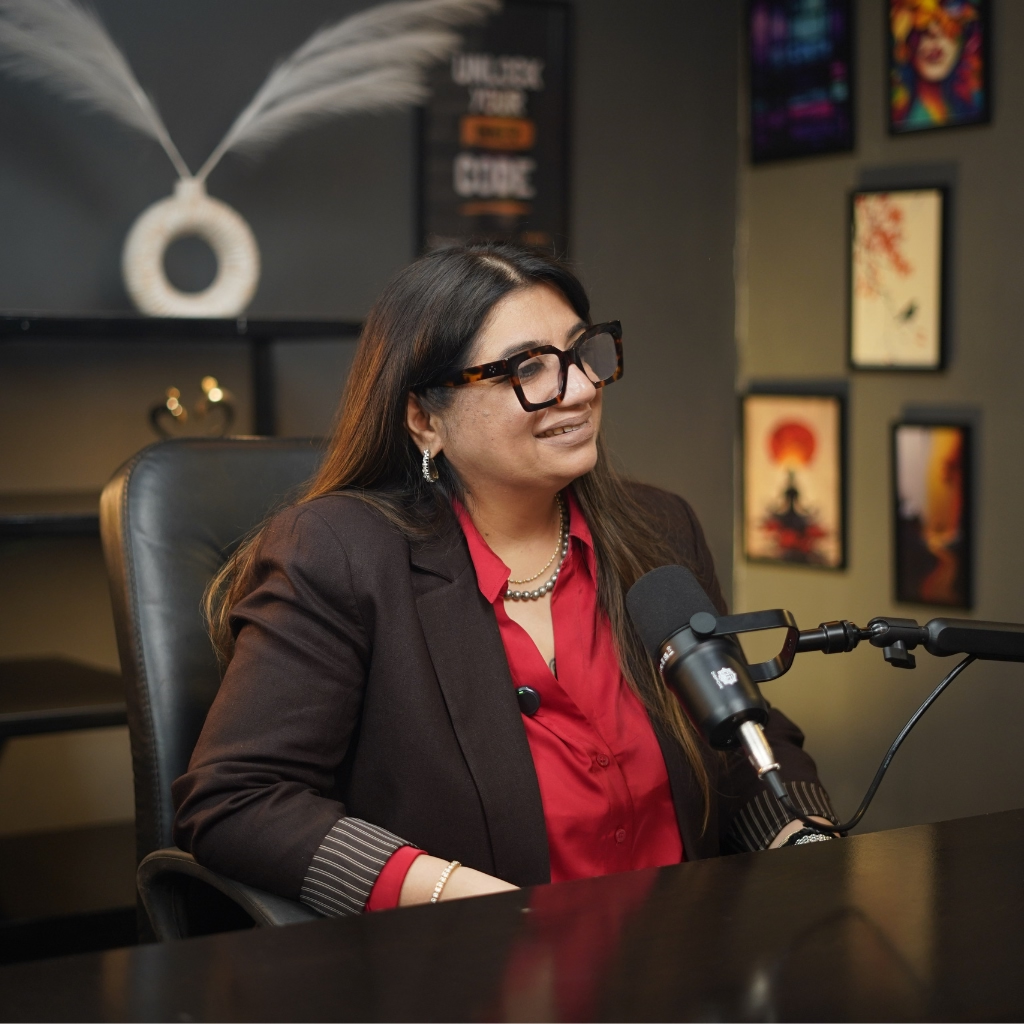
Becoming a NIMHANS-certified Lay Counsellor changed Khanna in ways she didn’t fully expect going in. It didn’t just make her a better listener. It made her a better entrepreneur and, by her own account, a better human being first.
Every business conversation, in her view, is a human conversation before anything else. Behind every client, investor, or employee is someone carrying their own pressures. Once that becomes obvious, transactions start looking like relationships.
She doesn’t walk into a negotiation trying to win. She walks in trying to leave trust intact on both sides. Deals built on respect, in her experience, simply outlast deals built on pressure.
Counselling taught her something leaders often resist, that the best response isn’t always the fastest one. Sometimes it’s a pause. Sometimes it’s noticing what wasn’t said out loud. That instinct shaped the culture at KYAA MATLAB NETWORK, where feedback is expected to be honest, not careful.
None of this erases the hard calls. There have been opportunities she’s said no to, decisions that weren’t comfortable. In those moments she leans on logic and empathy together. Numbers matter. So do people. Emotional intelligence, she says plainly, is a leadership skill, not a soft one. Businesses grow because of strategy, she’ll add, but they sustain themselves because of trust, and trust is always built person to person, never at scale.
Brilliant At Building, Awkward At Telling
One thing Khanna has noticed over the years, across every field she’s worked in, is that most founders are brilliant at building their businesses but not very comfortable talking about themselves. Across Ra by Rashi Foundation, Upodd UAE, iStoryy, and KYAA MATLAB NETWORK, she’s sat across from entrepreneurs at every stage, and most of them undersell their own story simply because they’ve lived it every day. What feels routine to a founder can be the exact thing that moves someone else.
There’s a fear underneath this too. Talking about failure feels risky, like it might chip away at credibility. Khanna has found the opposite to be true. Nobody connects with a founder’s highlight reel. They connect with what kept that founder going when the highlight reel wasn’t happening yet.
At KYAA MATLAB NETWORK, she’s had the privilege of recording conversations with entrepreneurs, policymakers, researchers, artists, and business leaders. What she’s learned, sitting across from all of them, is that the best conversations happen the moment people stop trying to sound impressive and simply start being themselves.
Her role in these conversations isn’t to narrate someone’s journey for them. It’s to ask the question that lets them find it themselves.
A product can be copied. A pricing model can be reverse-engineered. A founder’s story can’t be. Told honestly, it becomes one of the few assets in a business that competitors simply can’t replicate.
The Leaders People Trust Are Rarely The Loudest
Across entrepreneurs, students, policymakers, and artists, Khanna has clocked a pattern. The leaders who earn the most trust aren’t the loudest in the room. They’re the most consistent.
They don’t shift their values depending on who’s watching. They’re willing to say they don’t know something. Khanna reads that as strength, not a gap, since humility, in her experience, tends to be underrated in rooms full of people trying to look certain.
Her counselling work reinforced something she now treats as fact in business too: people don’t just want competent leaders. They want leaders who listen. Trust tends to follow that on its own.
Through KYAA MATLAB NETWORK, Khanna has met remarkable individuals from every walk of life, and one quality connects nearly all of them regardless of how far they’ve climbed: they never stop being curious. No matter how successful they become, they stay willing to learn from someone else’s experience, treating every conversation as a chance to pick up something they didn’t already know.
If she had to name the traits worth deliberately building for the next generation of leaders, they’d be empathy, authenticity, curiosity, adaptability, and a strong sense of purpose. Technical skills, in her view, will keep shifting under everyone’s feet as tools and industries evolve, these human qualities won’t. For Khanna, leadership was never about how many people report to someone, or how much formal influence they hold on paper. It’s about the environment they create around them. If people leave a room feeling more confident, more valued, and more capable than when they walked in, that’s what leading well actually looks like, and it’s the kind of leader she keeps trying to be, session after session.

Confidence Was Always The Real Curriculum
Khanna has run workshops through BookMyShow, at premier management institutes, and for early-stage creators. She doesn’t walk into any of them thinking of herself as a teacher. She thinks of it as starting a conversation that outlasts the room.
Technical skill is available everywhere, in courses, books, and tutorials. What’s harder to find is someone believing their own story is worth telling in the first place. That belief gap is what she’s actually trying to close.
She wants participants to leave with more confidence than they walked in with, not just the confidence to speak on a stage or in front of a camera, but the confidence to simply be themselves. People spend so much time comparing their own experience to someone else’s highlight reel that they forget their own experience has value on its own terms.
She doesn’t only bring success stories into a session. She brings the setbacks too, her own doubts, the parts of building KYAA MATLAB NETWORK that didn’t go the way she’d planned. People respond to that more than they respond to a polished case study.
If someone walks out of a session believing they finally have the courage to ask better questions, tell their story authentically, or take the first step toward something they’ve been postponing for months, Khanna considers that workshop to have done its job. The feedback that stays with her isn’t about slide design. It’s someone telling her, afterward, that they never thought their story mattered until that session. That’s the actual metric.
Learning To Ask Better Questions Before Telling Your Story
KYAA MATLAB Voice Network, India’s first professional podcast school, came out of a specific observation, that talented people with real ideas simply didn’t know how to say them out loud.
So the school was never built around production alone. It teaches how to ask better questions, build a personal brand, and speak with some confidence behind it. Podcasting isn’t something anyone masters by reading a textbook chapter on it. It’s learned by having actual conversations, making mistakes on air, listening back carefully to what didn’t work, and improving with every single episode, a slow, repetitive process with no shortcut around it. That’s precisely why experiential learning sits at the heart of everything KYAA MATLAB Voice Network does, rather than a curriculum built around lectures and theory.
What she likes most about the format is that its underlying skills transfer everywhere. Patience. Curiosity. Empathy. Critical thinking. The confidence to express an idea clearly instead of hedging it into something vague. Those, in Khanna’s view, are qualities every leader needs today, regardless of whether they ever record a single episode.
As AI absorbs more of the repetitive tasks in media production, she expects these human skills to matter more, not less. The hope isn’t to produce podcasters. It’s to produce better listeners who understand their voice carries further than they think.
Every Chapter Taught What The Others Couldn’t
Entrepreneurship, media, counselling, investing, social impact, Khanna has never treated these as separate tracks. Each one taught her something about people that the others simply couldn’t.
Entrepreneurship taught resilience, mostly by not going according to plan. Building KYAA MATLAB NETWORK taught her the weight a single conversation can carry. Counselling taught her to listen without rushing to judge, a habit that now shapes how she negotiates and leads. Ra by Rashi Foundation showed her that success means more when it opens a door for someone else. Thrive Business Networking Ecosystem showed her how one introduction can redirect a business entirely.
Investing changed her lens too. She’s stopped looking only at business models. She looks at the person running them, since integrity and the willingness to learn tend to outlast any single good idea.
If there’s a single thread across all of it, it’s this: leadership was never about title. It’s about trust, earned slowly, and leaving people better than she found them.
Building An Audience Is Easy, Building Trust Is Not
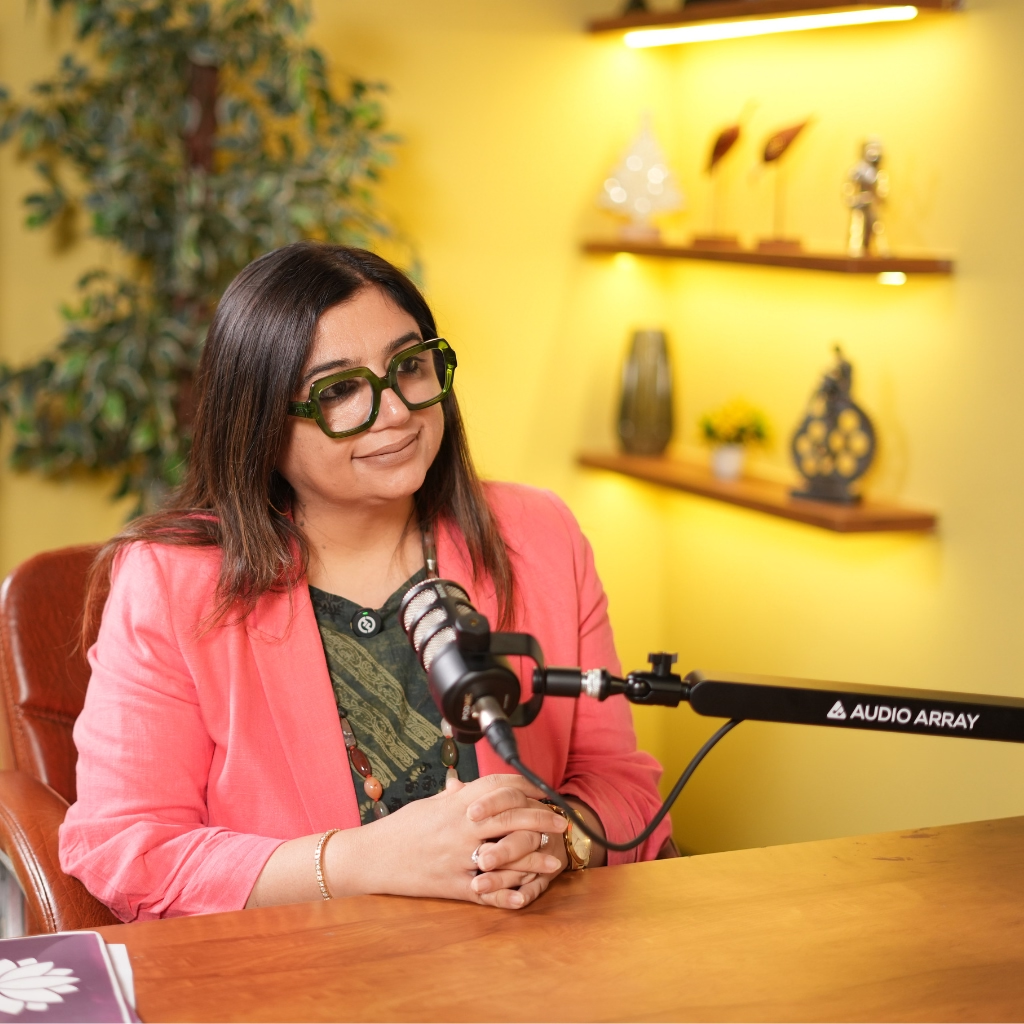
Building a following has gotten easier every year. Building trust hasn’t gotten any easier at all, and Khanna thinks that gap is where the real work sits now.
Her first principle is purpose over attention. Before publishing anything, she asks whether it will actually help someone or just add to the noise. The second is authenticity, since audiences don’t expect perfection, they expect honesty, and sharing setbacks alongside wins tends to land harder than a curated highlight reel ever does.
The third is responsibility. Every piece of content has some chance of shaping someone’s decision, which she thinks comes with an obligation to verify and to consider impact before publishing. Empathy sits underneath all three, since behind every view or comment is an actual person, not a metric.
Trends move on. Platforms change. Algorithms get rewritten every quarter. What doesn’t change is how someone felt after talking to you. Influence, in the end, isn’t about being famous. It’s about being trusted, and trust gets built quietly, one consistent decision at a time.
Authenticity Lives In The Pauses AI Can’t Understand
Khanna treats AI as one of the more useful tools to land in media in years, faster research, faster editing, faster translation. It’s freed up time for ideas instead of repetitive production work.
But it stays a tool, in her framing, not a replacement. The stories people actually remember were rarely the best-written ones. They were the ones that were lived. AI can help structure a narrative. It can’t have gone through heartbreak, failure, or the specific relief of finally getting something right after a long run of not.
Authenticity, in her experience, lives in the pauses, the imperfections, the parts a script wouldn’t include. No model has lived through those, so no model can fully reproduce them.
The future she’s picturing isn’t humans against AI. It’s AI used well, without losing the human part of the exchange. Technology can carry a voice further. It still can’t decide what that voice means.
Awards Fade, How You Made People Feel Stays
Khanna doesn’t want to be remembered for the ventures, KYAA MATLAB NETWORK, KYAA MATLAB Voice Network, Ra by Rashi Foundation, Thrive Business Networking Ecosystem. She wants to be remembered for who those ventures helped.
Every one of them, she says, grew out of the same belief: one honest conversation can shift the direction of someone’s life. Across the entrepreneurs, artists, and students she’s worked with, it’s rarely their success that stays with her. It’s their willingness to keep going before anyone else believed in them.
She’s had her own stretches of doubt, nights of wondering if she was doing enough. Those stretches taught her that building a business and becoming a better person were never two separate projects.
If someone tells her, years from now, that her podcast gave them hope, that her mentorship helped them take a first step, or that she made them believe their own story was worth telling, she doesn’t think she could ask for a greater achievement than that.
Awards fade. Businesses evolve. Platforms get replaced. What survives all of it is simpler: how you made someone feel. If her career leaves anything behind, she’d want it to be that every person has a story worth telling, and someone should be willing to ask.