TheCEOVerse • Digital Edition
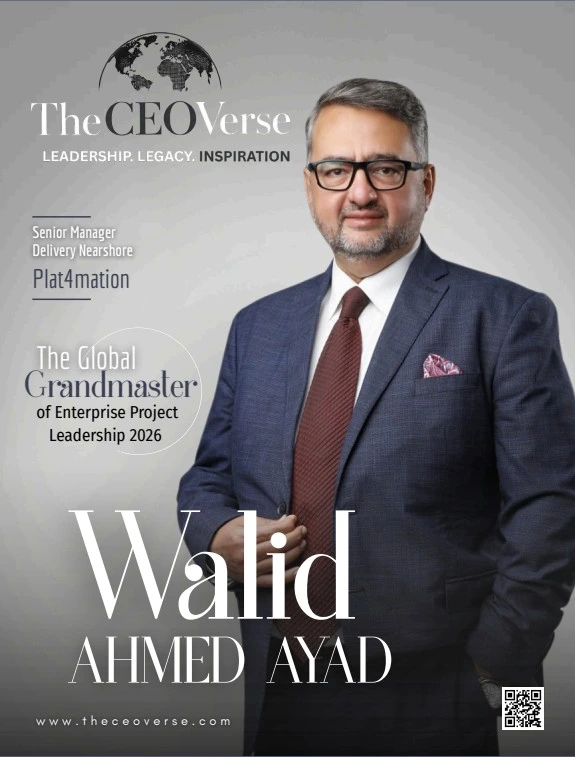
“The Global Grandmaster of Enterprise Project Leadership – 2026”
Cover story
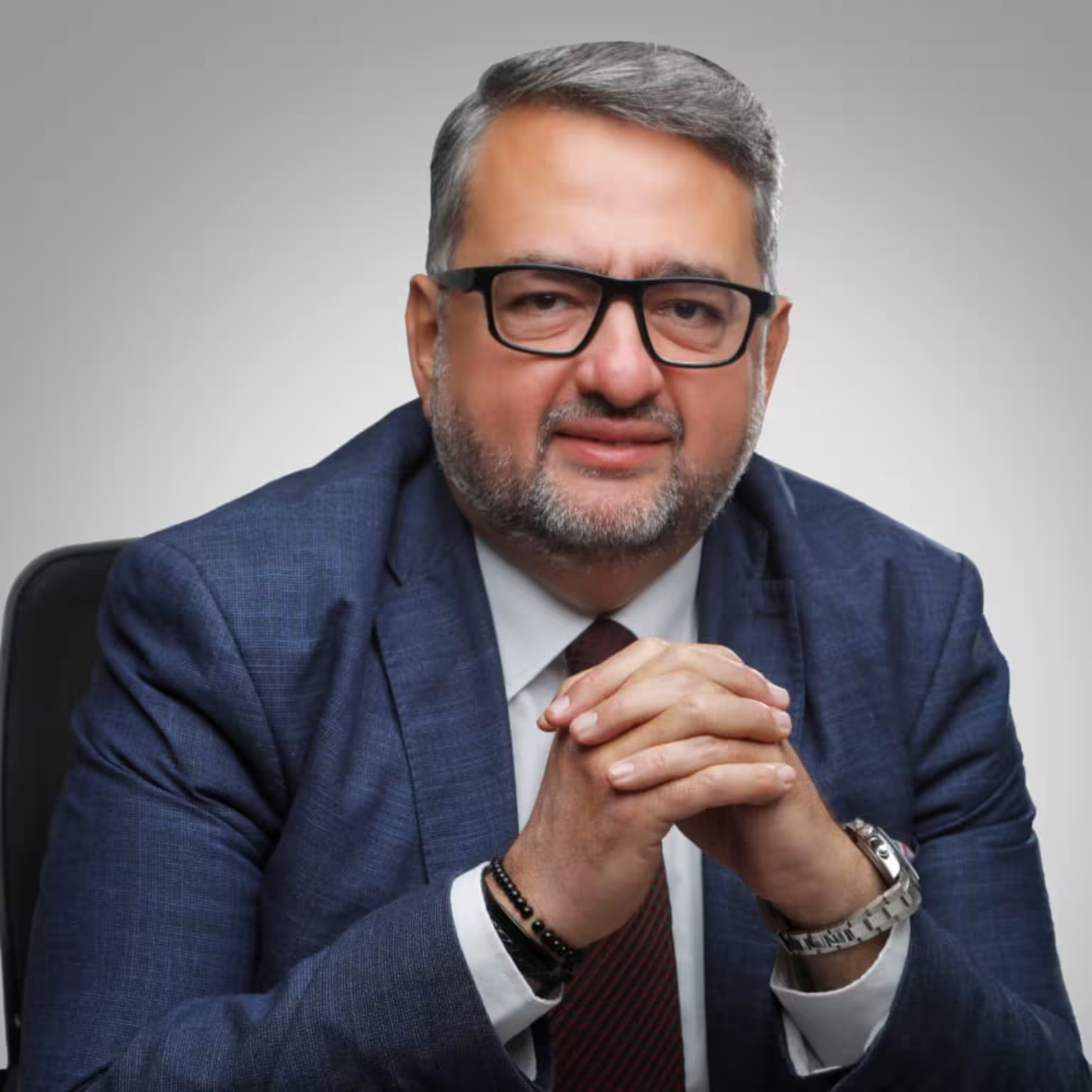
Walid Ahmed Ayad
Featured Profile - Walid Ahmed Ayad
Success is never just about what you achieve, but about how you lift others along the way.
Different Borders, One Standard of Leadership
Walid Ahmed Ayad’s career did not begin with a plan for global reach. It began at a local IT company, an ordinary first step that gave no hint of where the next three decades would lead. From there he moved to Siemens, into the railway industry, a sector built on precision and long timelines rather than speed. It was 1998, at Lucent Technologies, that the shape of his career actually changed. That was where he stepped into the role of Project Manager for the first time, and where the pattern that would define him took hold.
Ericsson followed. So did other companies, other sectors, other countries. He worked across nationalities and industries, collecting not just titles but courses, diplomas, and certifications along the way. The résumé could have stood on its own by then. Ayad kept adding to it anyway. He still is.
What stands out is not any single company on that list. Telecom, railway, banking, each demanded a different read on leadership, and he adjusted every time without losing what he held himself to underneath it.
The Four Years That Never Made the Résumé
Between 2013 and 2017, Ayad left the structure of employment behind and went freelance, a decision that would not show up on any LinkedIn summary. The move was forced less by ambition and more by personal circumstance. What followed was, in his own words, one of the hardest stretches of his life.
Financially and mentally, the period tested him. There is no polished way to describe four years of that kind of pressure, and he does not attempt one. What he does say is who got him through it: his wife, his kids, a handful of friends, and family members who stayed close when things were uncertain. That support did not just help him survive the period. It shaped the version of him that came out the other side, one he describes as stronger than before.
No Framework Was Built for Every Reality
Ask Ayad what makes his approach different, and the answer is not a single methodology. It is the refusal to commit to just one. He blends Scrum, PMO governance, and Theory of Constraints, not as a fixed formula but as a flexible toolkit he adjusts depending on where he is working, whether that is telecom, IT, banking, or consulting. Instead of forcing teams into one mold, he builds systems that flex with context.
There is a second layer to how he operates, and it has less to do with process and more to do with communication. In executive interviews and stakeholder conversations, Ayad frames achievements as stories of transformation rather than lists of completed tasks. That choice makes impact tangible in a way spreadsheets rarely manage.The third piece is scale. He is not interested in one-off wins that look good in a single quarter and disappear after. He designs improvements built to be replicated across teams and geographies, because that is the difference, in his view, between good project delivery and lasting organizational change.
When the Numbers Were Right and Still Not Enough
Early in his career, Ayad led a major transformation project with sharp focus on process efficiency and technical delivery. The frameworks were solid. The KPIs looked strong on paper. By most conventional measures, it should have worked.
It did not, not the way it was supposed to. He had underestimated how much resistance and anxiety people feel when their routines, their roles, or their sense of control are disrupted. Adoption lagged. Morale dipped. A project meant to be a showcase success turned instead into a slow climb back to credibility.
The lesson stayed with him. No amount of technical brilliance compensates for neglecting empathy and communication, he says now, and he carries four specific principles forward from that experience. Change management is about trust, and people need to feel heard rather than simply managed. Narratives matter more than numbers, because explaining why a change benefits someone personally lands harder than any dashboard. Pacing is strategic, since moving too fast breaks alignment and moving too slow drains momentum. And leaders, he believes, must be willing to model vulnerability, because admitting missteps openly builds credibility in a way pretending perfection never does.
The People Who Believed Before the Results Arrived
No one builds a career like this alone, and Ayad is direct about who stood behind his. Mentors in delivery and operations pushed him to think past frameworks and see transformation as a human story rather than a purely technical exercise, connecting strategy with empathy long before that connection was obvious to him.
Colleagues across telecom, IT, banking, and consulting gave him something harder to earn than advice. They gave him trust, backing him to lead initiatives even when the path forward was not clear. That confidence is what gave him the room to experiment and refine the hybrid delivery models he now relies on.
And then there is family. His wife, daughter, and son have been, in his description, a grounding force throughout. Their support was a reminder that resilience is not only a professional trait. It is personal too, and they were there through both the setbacks and the wins, in equal measure.
Clients Who Co-Owned The Journey, Not Outsourced It
Partnerships, for Ayad, are not a soft add-on to delivery work. They are often where the real breakthroughs happen. Cross-functional teams, where IT, business, and operations leaders sit side by side rather than in separate lanes, solve problems faster and more creatively than any siloed group manages alone.
The clients who matter most to him are the ones who treat a project as something to co-own, not something to hand off and forget. When stakeholders believe in the process instead of merely commissioning it, adoption gets smoother and results hold up longer. Mentorship networks played a similar role, pushing him past the temptation to settle for good enough and forcing him to refine and scale his frameworks across industries.
Even outside the office, he counts his wife and daughter as part of that same team, a source of resilience on the days when professional pressure alone would not have been enough.
Stay Curious, Build Relationships, Own the Journey
Asked what he would tell someone just starting out, Ayad does not reach for platitudes. Technical expertise opens doors, he says, but relationships are what keep them open. Skills get you in the room. People keep you there.
He tells younger professionals to stay curious longer than they stay comfortable, because growth happens at the edge of what a person does not yet know, not in the space where they already feel settled. He also pushes back against the instinct to simply list accomplishments. Own your narrative, he says. Tell the story of how you made a difference, not just what you did.
The last piece of his advice is the one he seems to hold closest. Resilience beats perfection. Everyone stumbles at some point. How a person rises from that will define them far more than the fall itself ever could.
Recognition That Extends Beyond the Career
For Ayad, this recognition is not a finish line, and he is careful to separate what it means professionally from what it means at home. Professionally, it functions as proof that transformation is not theory but lived practice, strengthening his voice in executive conversations and making it easier to influence strategy across sectors. It also opens a platform for broader impact, mentoring others, shaping industry conversations, and expanding into new domains like manufacturing and regional innovation. Success, he notes, tends to attract the right kind of partners, ones who see recognition like this as validation and become more willing to co-create ambitious work.
Personally, the milestone carries different weight. It is a reminder to his wife, daughter, and son that perseverance pays off, becoming part of the family story rather than just his own professional one. It is also humbling in a way that keeps him anchored in empathy, aware that the road ahead will demand even more balance between ambition and humanity. He does not treat it as a moment to rest. The real question it raises for him is simpler and larger: what bigger story can be written next.
Achievement Marks The Journey. Impact Defines It
If there is one idea Ayad wants people to walk away with, it is this. Every milestone is built on the shoulders of mentors, teams, and family who believed early, and impact is never a solo achievement no matter how it gets credited.
Setbacks, in his view, are not detours from the journey. They are the shaping forces that make the eventual victories mean something. Legacy, he argues, is human rather than numerical. Numbers fade. What endures is the way a person made others feel: respected, inspired, empowered.
Recognition itself is not the destination. It is a reminder to keep the compass steady, to aim higher, stay grounded, and keep weaving purpose into progress.
Beyond the Career: The Thinking That Connected It All
There is a piece of Ayad’s story that rarely fits neatly into a standard leadership profile, and he chooses to name it directly. His movement between telecom, IT, banking, and consulting, and now into manufacturing, was not simply adaptability. It was a deliberate choice to keep seeking complexity, a way of proving that transformation principles scale across industries rather than staying locked to one.
He has also built a specific skill around narrative itself, turning technical impact into stories that hold attention, whether in an executive interview or a family celebration. That ability to translate numbers into meaning runs through nearly everything else in his career.
Family remains the anchor underneath all of it. Recognition and success, he says, are inseparable from the love and support of his wife, daughter, and son, a grounding force that professional narratives often leave out entirely. And where most look back at a body of work, Ayad is already looking forward, drawn to AI-driven voice intelligence in regional markets as the next place his curiosity wants to go.
In his own words, the piece that might be missing from any single answer is this: his journey is proof that transformation is not a single act, but a continuous practice, one that blends frameworks, people, and purpose into impact that lasts.