TheCEOVerse • Digital Edition
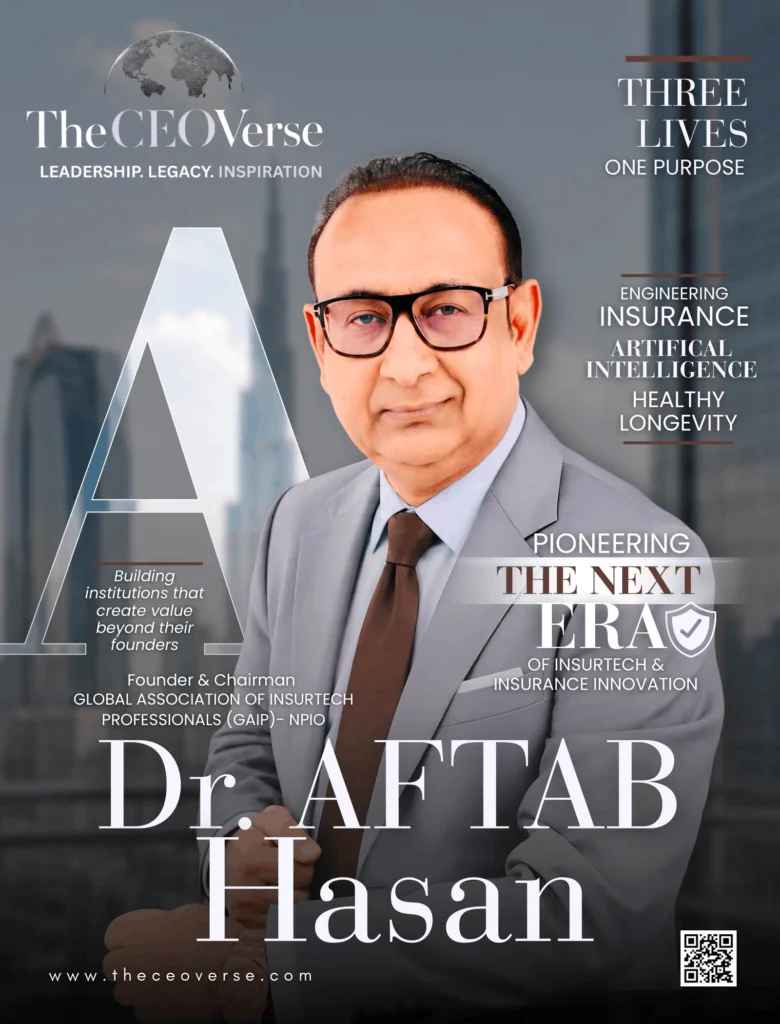
“Pioneering The Next Era Of Insurtech & Insurance Innovation”
Cover story
Dr. Aftab Hasan
Featured Profile - Dr. Aftab Hasan
THREE LIVES. ONE PURPOSE.
An Exclusive Conversation with Dr. AFTAB Hasan
From Engineering and Global Enterprise to Insurance, Artificial Intelligence and Healthy Longevity
EDITOR’S INTRODUCTION
Some careers are measured by promotions, titles or financial success. Others are defined by the industries they transform and the institutions they leave behind. Dr. Aftab Hasan belongs firmly to the latter category.
Few business leaders successfully reinvent themselves once in a lifetime. Fewer still accomplish it twice. Dr. Hasan has done it three times – first as an engineer and entrepreneur in the energy, marine and infrastructure sectors; then as an internationally recognized leader in insurance, reinsurance and financial services; and today as the founder of an ambitious AI-enabled HealthTech initiative focused on healthy longevity.
Across more than three decades, his professional journey has consistently anticipated change rather than reacted to it. Whether establishing engineering ventures across the Gulf and India, founding a DFSA-regulated reinsurance brokerage in Dubai International Financial Centre, creating an international platform for InsurTech collaboration through the Global Association of InsurTech Professionals (GAIP), or pioneering technology-driven approaches to preventive wellness and population health, one theme has remained remarkably consistent – building institutions that create lasting value.
Today, Dr. Hasan serves as Founder and Chairman of Risk Exchange (DIFC) Limited, Founder and Chairman of the Global Association of InsurTech Professionals (GAIP), Chief Executive Officer of Arya Insurance Brokerage Company, Secretary General of the Insurance Business Group under Dubai Chambers, and Founder of Arabian Life Longevity HealthTech DIFC Ltd. – an AI-enabled HealthTech company supporting the future of healthy longevity.
Yet despite an impressive list of achievements and international recognitions, what distinguishes Dr. Hasan most is not the diversity of his career but the consistency of his purpose. Every chapter of his professional life has been guided by a simple belief: businesses should do more than generate profits – they should solve meaningful problems, create opportunities for others and contribute positively to society.
In this exclusive conversation, Dr. Hasan reflects on a journey spanning engineering, entrepreneurship, insurance, artificial intelligence and healthy longevity, sharing the philosophy, experiences and values that continue to shape his vision for the future.
Q1. Looking back over your remarkable career, it appears you have lived three distinct professional lives – engineering, insurance and now artificial intelligence-driven healthy longevity. Did you ever imagine your journey would evolve this way?
Not at all. If someone had told me at the beginning of my career that one day, I would be involved in engineering, insurance, reinsurance, artificial intelligence and healthy longevity, I probably would not have believed them. Like many young professionals, I began with a very straightforward ambition: to become a competent engineer, build meaningful projects and establish myself through hard work and professional excellence.
As life unfolded, however, I realized that careers are rarely linear. Every experience introduces new opportunities, new perspectives and, if we are willing to embrace them, entirely new directions. Looking back today, I no longer see my career as three unrelated chapters. I see it as one continuous journey, where each stage prepared me for the next.
Engineering gave me the discipline to analyze problems systematically and to appreciate the importance of precision, planning and execution. Those early years also gave me the confidence to become an entrepreneur. Establishing engineering, marine, shipping and oil and gas ventures across the Gulf and India exposed me to international business at an early stage of my career. Working independently on some projects and in joint venture with highly respected international companies on others taught me not only the technical aspects of project delivery but also the importance of trust, partnership and long-term relationships.
As my businesses expanded, I began to recognize that every major project carried risks far beyond engineering itself. Financial exposures, contractual obligations, operational challenges and business continuity all depended upon effective risk management. That realization gradually introduced me to the insurance industry, which I soon discovered was far more than simply transferring risk. At its best, insurance enables economic growth, protects investments and provides confidence for businesses to innovate and expand.
Over time, what began as an interest developed into a lifelong passion. I immersed myself in the discipline of insurance, reinsurance and risk management, pursuing professional education while building relationships across the global insurance community. Eventually this journey led to the establishment of Risk Exchange in the Dubai International Financial Centre, creating a platform capable of connecting regional opportunities with international insurance and reinsurance markets.
Today, my work has evolved once again. Artificial intelligence, digital health and healthy longevity may appear very different from engineering or insurance, yet I see them as the natural continuation of everything I have learned over the past three decades. Engineering taught me how systems are built. Insurance taught me how risks are managed. Artificial intelligence is now teaching us how better decisions can be made before those risks materialize. Healthy longevity brings all of these disciplines together in a way that has the potential to improve millions of lives.
When I reflect on my career, therefore, I do not think in terms of changing industries. I think in terms of pursuing opportunities where experience, innovation and purpose intersect. Every chapter has built upon the one before it, and every transition has been guided not by the pursuit of titles or financial success, but by the desire to create meaningful value.
Q2. Reinventing yourself across completely different industries requires courage, adaptability and continuous learning. What has enabled you to evolve successfully while remaining true to your values?
I have always believed that the ability to learn is far more valuable than the ability to know.
Knowledge has a limited lifespan. Technology evolves, industries change, markets fluctuate and business models become obsolete. Curiosity, however, remains timeless. It allows us to adapt, to question assumptions and to discover opportunities that others may overlook. Throughout my career, I have never considered education something that ends with a university degree. Every project, every meeting and every challenge has been another classroom. Whether working with engineers, insurers, regulators, entrepreneurs, government officials or technology innovators, I have tried to remain a student first and a professional second.
That mindset has allowed me to embrace change rather than fear it.
Of course, learning alone is not enough. Every transition also requires a foundation of values that remain constant regardless of the industry in which one works. For me, those values have always been integrity, humility, discipline and respect for people. Integrity builds trust. Trust builds relationships. Relationships create opportunities.
I have found that this principle applies universally, whether negotiating an engineering contract, structuring a complex reinsurance programme or discussing artificial intelligence with technology innovators.
Another lesson I have learned is that reinvention does not mean abandoning your past. On the contrary, every experience accumulates. Engineering continues to influence the way I approach business problems. Insurance influences the way I think about uncertainty. Entrepreneurship continues to shape how I identify opportunities. Artificial intelligence is simply another tool that enables us to solve problems more intelligently.
People sometimes ask whether changing industries was difficult. My answer is that I never consciously set out to change industries. I simply followed opportunities where I believed I could contribute meaningfully. When purpose remains constant, transitions become far less intimidating because every new experience builds naturally upon the previous one.
Perhaps the greatest lesson of all is to remain humble enough to recognize that no individual possesses all the answers. Throughout my career I have been fortunate to work alongside exceptionally talented professionals from many countries and disciplines. Every collaboration has enriched my own understanding and reinforced a philosophy that has guided me for many years: No one alone is smarter than all of us.
That simple belief continues to influence every organization I build and every leadership role I undertake.
Q3. Throughout your career, one theme appears repeatedly – you have built institutions rather than simply businesses. Was that always your vision?
I believe there is an important distinction between building a company and building an institution.
A company may be created to pursue a commercial opportunity. An institution is created to serve a purpose that extends beyond its founder. While businesses measure success through financial performance, institutions are ultimately measured by the value they continue creating long after their founders have stepped aside.
Although I may not have articulated it in those terms during the early years of my career, I realize now that this philosophy has quietly guided many of my decisions.
When I established my engineering ventures, the objective was never simply to execute projects. It was to earn a reputation for reliability, technical excellence and professional integrity. In engineering, your reputation is built one project at a time. Every successful project becomes a reference for the next. Every satisfied client becomes a long-term relationship. That taught me that sustainable growth is founded on trust rather than aggressive expansion.
The same thinking influenced the establishment of Risk Exchange. My objective was not to become another insurance intermediary competing solely on pricing or volume. I wanted to create an organization recognized for professionalism, technical competence and ethical standards—an organisation that clients, insurers, reinsurers and regulators could rely upon with confidence.
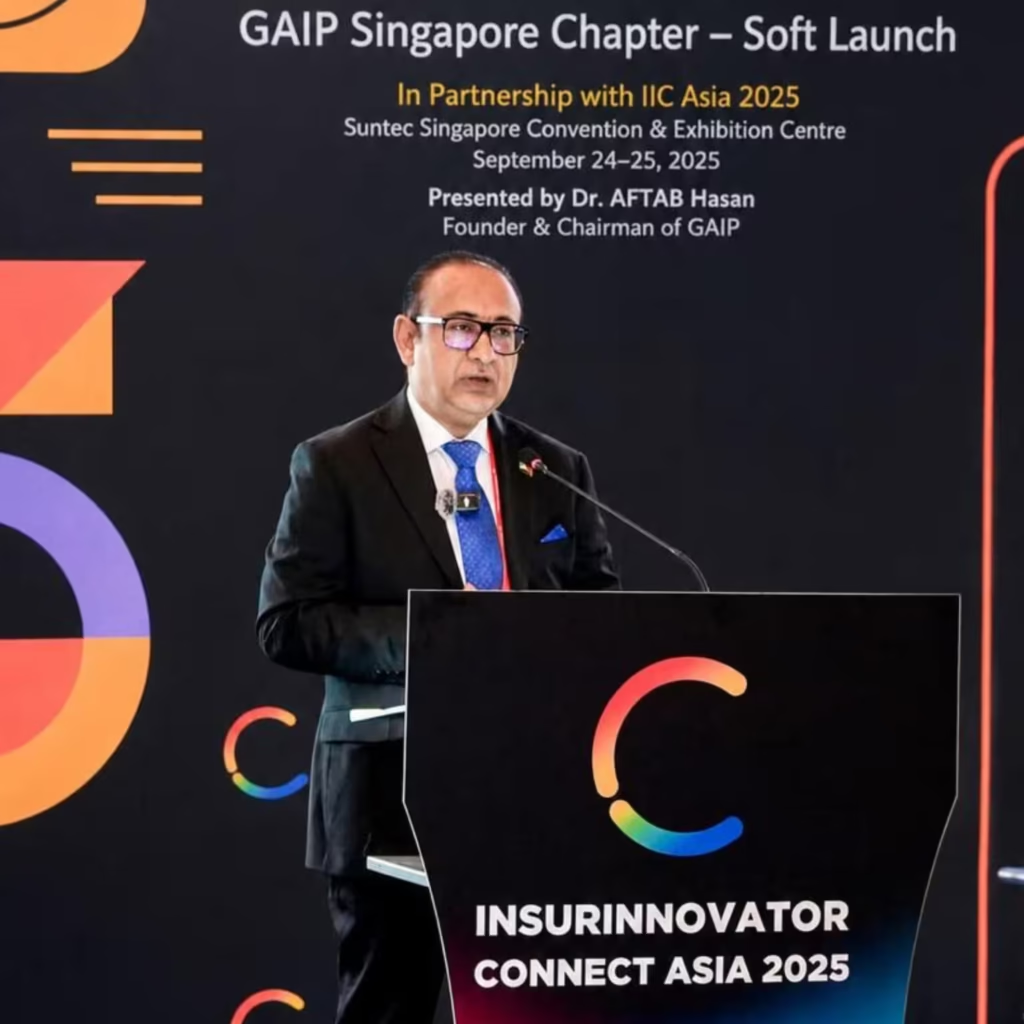
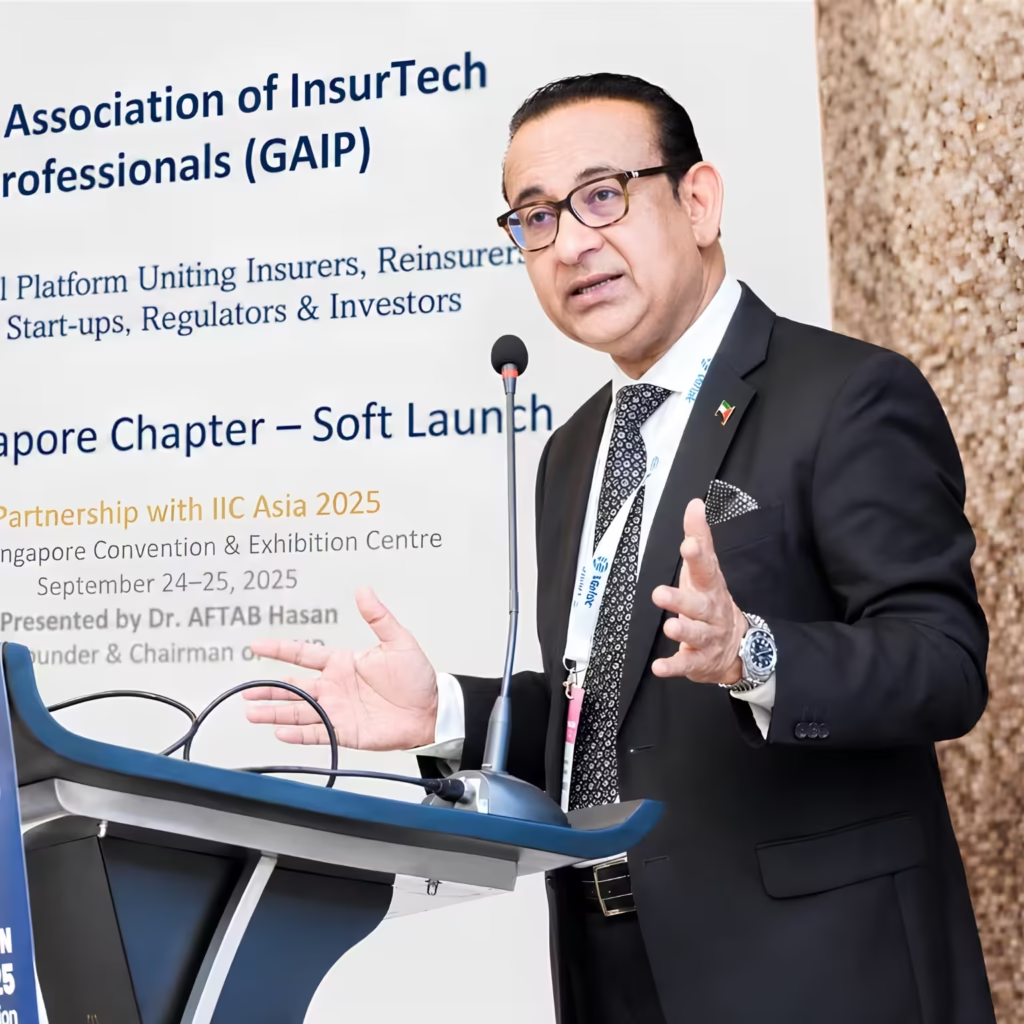
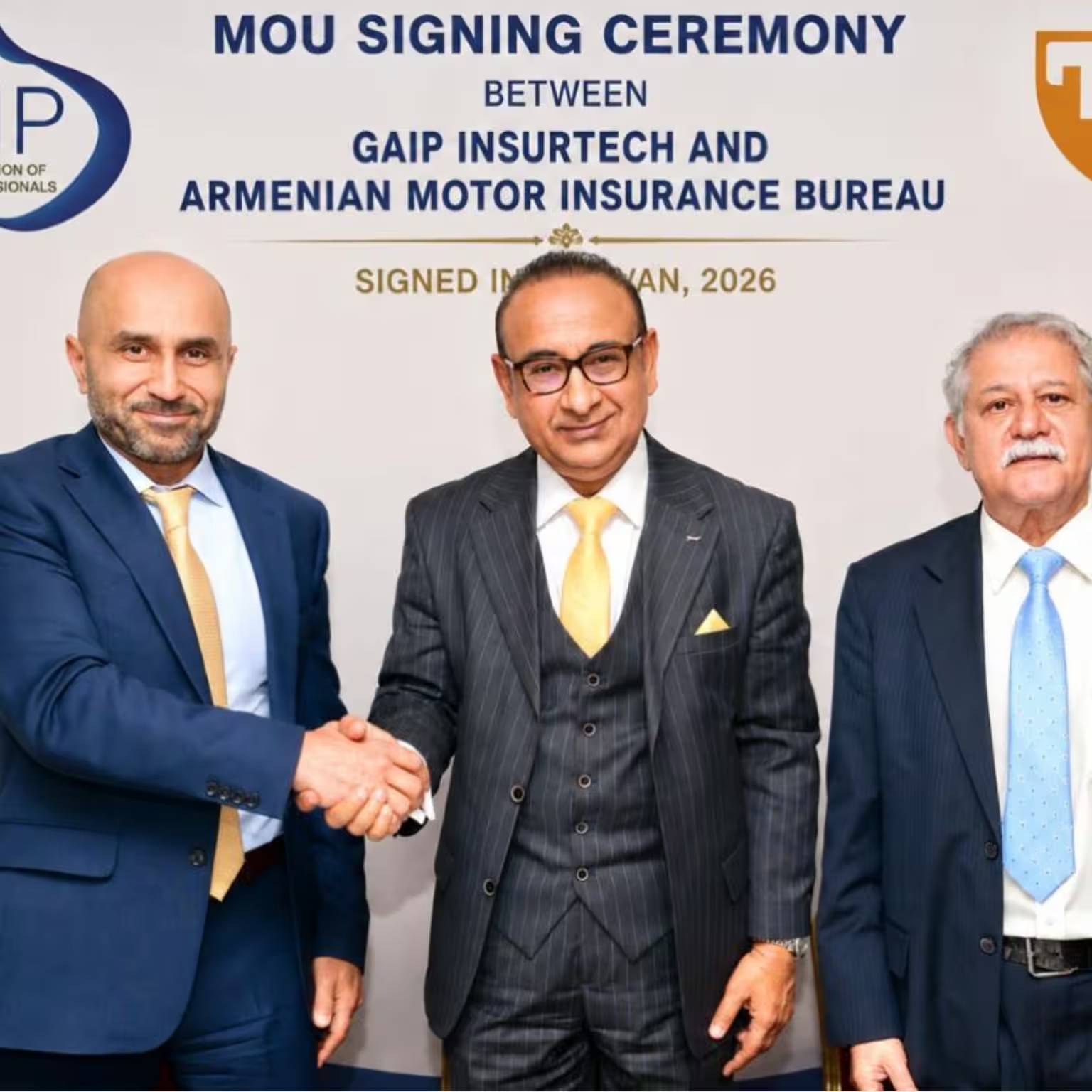
The Global Association of InsurTech Professionals (GAIP) emerged from a similar belief. Around the world, I saw insurers, regulators, technology companies, investors and academic institutions all working towards digital transformation, yet often in isolation. I felt there was a need for an independent platform where knowledge could be shared, partnerships could be formed and innovation could flourish across borders. GAIP was never intended to be simply another association. It was envisioned as a global ecosystem that encourages collaboration and advances the insurance profession.
Today, Arabian Life represents another chapter in that same journey. While it is an AI-enabled HealthTech company, my vision extends far beyond developing software platforms. I hope it will become a catalyst for promoting healthier lifestyles, advancing preventive healthcare, supporting healthy longevity and contributing to public policy discussions around one of the most important demographic challenges of our time.
Looking back, I realize that the industries have changed, but the purpose has remained remarkably consistent. I have always been motivated by the opportunity to build organizations that create long-term value for the communities and industries they serve.
Ultimately, institutions are built on values rather than buildings. They endure because people believe in their purpose.
Q4. Every successful career is shaped by defining moments. Looking back over more than three decades, which milestones have had the greatest impact on your professional journey?
Every stage of my career has contributed something meaningful, but there are a few defining milestones that fundamentally changed the direction of my life.
The first was making the decision to become an entrepreneur at a relatively young age. Establishing engineering, marine and oil and gas businesses across the Gulf and India was both exciting and challenging. Entrepreneurship teaches lessons that no classroom can provide. You quickly learn that uncertainty is part of everyday life. You become responsible not only for your own success but also for the livelihoods of employees, the confidence of clients and the expectations of partners. Those experiences strengthened my resilience and taught me the importance of disciplined decision-making.
The second defining milestone was my transition into insurance and reinsurance. At first glance, engineering and insurance may appear unrelated, but they are connected by a common objective: protecting value. Engineering creates assets; insurance protects them. Once I recognized that connection, I became deeply fascinated by the role insurance plays in enabling economic growth and business confidence. It was this understanding that ultimately led me to establish Risk Exchange within the Dubai International Financial Centre.
A third milestone was undoubtedly the creation of the Global Association of InsurTech Professionals. By that stage of my career, I felt a growing responsibility to contribute beyond my own businesses. The industry was undergoing rapid digital transformation, and I believed there was an opportunity to bring together professionals from around the world to collaborate, exchange knowledge and prepare for the future. Watching GAIP grow into an international platform has been immensely rewarding because its success is measured not by revenue but by the partnerships, conversations and innovations it facilitates.
More recently, my involvement in artificial intelligence and healthy longevity has opened an entirely new chapter. Through Arabian Life, I see an opportunity to contribute to a challenge that affects every society; how to help people live not only longer lives but healthier, more productive and more fulfilling ones. It combines everything I have learned throughout my career: engineering systems, managing risk, leveraging technology and building collaborative ecosystems.
Beyond these professional milestones, there have also been moments of recognition that I deeply value; not because of the awards themselves, but because they reflect the trust and respect of colleagues and industry peers. Every recognition reminds me that leadership carries responsibility. It encourages me to continue contributing, mentoring and supporting the development of future leaders.
If I were asked to identify the single thread connecting all these milestones, it would be this: each represented an opportunity to move beyond personal success and contribute to something larger than myself. That perspective has given meaning to every chapter of my professional journey.
Q5. Your leadership philosophy is often summarized in one sentence: “No one alone is smarter than all of us.” What does that principle mean to you, and how has it shaped your leadership style?
That simple sentence has guided my leadership philosophy for many years because it reflects a fundamental truth that I have observed throughout my career.
No individual, regardless of experience or position, possesses all the answers. The challenges facing organizations today are far too complex to be solved by one person alone. Whether we are discussing engineering, insurance, artificial intelligence or healthcare, meaningful innovation almost always emerges through collaboration.
Early in my entrepreneurial journey, I mistakenly believed that effective leaders were expected to have solutions for every problem. Experience gradually taught me otherwise. The strongest leaders are not those who dominate every discussion; they are those who create an environment where talented people feel encouraged to contribute their ideas openly and confidently.
I have always tried to surround myself with individuals whose expertise exceeds my own in their respective disciplines. Engineers have taught me engineering. Underwriters have expanded my understanding of insurance. Actuaries have helped me appreciate the science of risk. Technology specialists continue to broaden my understanding of artificial intelligence and digital transformation. Medical professionals are now enriching my perspective on healthy longevity. Leadership, therefore, becomes less about demonstrating personal knowledge and more about bringing together complementary expertise.
This philosophy also explains why I enjoy building multidisciplinary teams. Innovation rarely occurs within isolated silos. It often emerges at the intersection of different professions, different cultures and different ways of thinking. When people with diverse experiences collaborate towards a common purpose, entirely new possibilities begin to emerge.
Trust is equally important. Collaboration cannot flourish without mutual respect. I have found that when leaders genuinely listen, acknowledge different perspectives and empower others to make meaningful contributions, organizations become stronger, more resilient and more innovative.
Perhaps that is why I have always preferred the role of an institution builder rather than a central figure. Institutions thrive because leadership is shared, knowledge is exchanged and success is collective. That, in my view, is the essence of sustainable leadership.
As I often remind my colleagues, leadership is not about being the smartest person in the room. It is about bringing together people who, collectively, are smarter than any one individual could ever be.
PART II • BUILDING INSTITUTIONS
Q6. Risk Exchange has become an internationally recognized DFSA-regulated reinsurance brokerage operating from the Dubai International Financial Centre. What inspired you to establish the company, and how has it evolved over the years?
Risk Exchange was never conceived simply as another brokerage. From the very beginning, my ambition was to establish an institution that would be recognized for technical excellence, regulatory integrity and international credibility.
The Dubai International Financial Centre was a natural choice. Over the years, Dubai has established itself as one of the world’s leading international financial centers, connecting the markets of the Middle East, Africa and South Asia with Europe and the rest of the world. The DIFC’s regulatory environment, governed by the Dubai Financial Services Authority, reflects global best practices and provides the confidence required for international financial institutions to operate.
Building a regulated financial services company within such an environment demands patience and discipline. Every policy, every process and every client relationship must be developed carefully. While this requires significant effort, it also creates something far more valuable than rapid growth; it creates trust.
From the outset, we focused on quality rather than size. We deliberately avoided pursuing business simply for the sake of increasing premium volumes. Instead, we concentrated on understanding our clients’ businesses, developing technically sound solutions and maintaining the highest standards of governance and compliance. In our industry, reputation is earned over many years but can be lost overnight. That reality has influenced every decision we have made.
As the company matured, Risk Exchange evolved beyond its traditional brokerage role. Today, we are increasingly involved in advising clients on complex risk management strategies, structured reinsurance programmes, cross-border placements and innovative distribution models. We continue exploring opportunities in specialized underwriting, delegated authority arrangements and Managing General Agency (MGA) structures that respond to changing market needs.
I am particularly proud that Risk Exchange has maintained its entrepreneurial spirit while operating within one of the world’s most respected financial jurisdictions. We have demonstrated that a relatively young organization, guided by strong values and supported by capable professionals, can earn the confidence of international insurers, reinsurers, regulators and clients alike.
For me, Risk Exchange represents more than commercial success. It reflects the belief that trust, professionalism and long-term relationships remain the true foundations of sustainable business.
Q7. The insurance industry is undergoing one of the most significant transformations in its history. How do you see its future, and what role will Artificial Intelligence play in shaping it?
The insurance industry has always evolved alongside society. As economies developed, technologies advanced and new risks emerged, insurance adapted accordingly. Today, however, we are witnessing a transformation unlike anything the industry has experienced before.
Artificial Intelligence is fundamentally changing how we understand, assess and manage risk.
Historically, underwriting relied heavily on historical data, actuarial models and professional judgement. Those principles remain important, but today’s insurers have access to real-time information, predictive analytics and computational capabilities that were unimaginable only a decade ago.
Artificial Intelligence enables us to identify patterns that humans alone might never detect. It helps us assess risks more accurately, process claims more efficiently, detect fraud earlier and personalize insurance solutions according to individual needs. These capabilities will significantly improve customer experience while also strengthening insurers’ financial performance.
However, I believe the greatest contribution of Artificial Intelligence lies elsewhere. Insurance has traditionally focused on compensating people after losses occur. The future of insurance will increasingly focus on helping people avoid those losses in the first place.
Imagine a commercial property where intelligent sensors identify fire hazards before an incident occurs. Imagine transport fleets using predictive analytics to reduce accident frequency. Imagine wearable health technologies enabling insurers to encourage healthier lifestyles while reducing long-term medical costs.
These developments represent a profound shift in philosophy. Insurance is gradually evolving from being primarily reactive to becoming increasingly preventive. Nevertheless, technology alone is not enough.
Artificial Intelligence must always remain accountable, transparent and ethically governed. Algorithms influence decisions affecting people’s health, finances and livelihoods. Therefore, issues such as data privacy, explainable AI, cybersecurity and responsible governance will become just as important as technological innovation itself.
I often remind colleagues that Artificial Intelligence will not replace insurance professionals. Insurance professionals who understand Artificial Intelligence will redefine the future of insurance. Human judgement, empathy, ethical responsibility and professional wisdom remain irreplaceable. Technology should strengthen these qualities, not substitute them.
Ultimately, I believe the insurance organizations that will lead the future are those capable of combining advanced technology with enduring human values.
Q8. In 2024, you founded the Global Association of InsurTech Professionals (GAIP), which has rapidly gained international recognition. What inspired you to establish the organization?
GAIP was born from a simple observation.
Around the world, remarkable innovation was taking place within insurance. Insurers were investing in digital transformation. Technology companies were developing sophisticated solutions. Regulators were encouraging responsible innovation. Universities were expanding research into Artificial Intelligence, cybersecurity and data science.
Yet despite all this progress, many of these conversations were taking place independently. There was very little structured collaboration between the various stakeholders shaping the future of insurance. I felt strongly that the industry needed an independent global platform capable of bringing everyone together.
Not merely to organize conferences. Not merely to exchange business cards. But to facilitate meaningful collaboration. That vision became the foundation upon which the Global Association of InsurTech Professionals was established.
From the beginning, our objective was to create an ecosystem rather than simply another professional association. We wanted insurers, reinsurers, brokers, regulators, technology companies, investors, universities, entrepreneurs and policymakers to participate in the same conversations because genuine innovation rarely emerges from isolated disciplines.
One of the aspects I value most about GAIP is that it is fundamentally future-oriented. Our discussions increasingly extend beyond traditional InsurTech into Artificial Intelligence, digital resilience, climate risk, cybersecurity, sustainability, financial inclusion and now healthy longevity. These themes are interconnected, and the leaders of tomorrow must understand how they influence one another.
Another priority has been education. Technological change is occurring at extraordinary speed, and many professionals understandably feel uncertain about what the future holds. Through conferences, executive forums, professional development initiatives and our academy, we hope to equip current and future leaders with the knowledge and confidence required to thrive in this evolving environment.
Personally, GAIP also represents something very important to me.
As professionals gain experience, there comes a point where building one’s own business is no longer enough. There is a responsibility to contribute to the profession itself.
GAIP is my way of giving back to an industry that has given me so much throughout my career. When I see regulators, CEOs, entrepreneurs, students and technology innovators sharing ideas on the same platform, I am reminded why we established the organization in the first place. Innovation becomes truly powerful when knowledge is shared. And shared knowledge has the power to transform entire industries.
“Innovation grows faster when collaboration becomes stronger.”
Q9. Beyond your entrepreneurial ventures, you have actively contributed to industry development through Dubai Chambers, international forums and public policy initiatives. Why is collaboration between governments and industry so important?
As my career evolved, I gradually came to appreciate that sustainable economic development cannot be achieved by governments or the private sector working independently. The most successful economies are those where policymakers, regulators, businesses, academia and professional institutions work together towards a shared vision.
My own involvement in public-private collaboration began many years ago. During the early stages of Dubai’s remarkable economic transformation, I had the privilege of contributing as a member of steering committees established by the Dubai Department of Economic Development, where industry leaders were invited to share ideas and perspectives on emerging development initiatives. Around the same period, when the Dubai Quality Group was established in February 1994, with Glyn Ashley among its founding Board members, I was honoured to be invited as one of its assessors and examiners, evaluating organizations aspiring to achieve excellence in quality and business performance. These early experiences reinforced my belief that constructive engagement between government and industry can significantly influence long-term economic progress.
Over the years, I have been fortunate to continue contributing through various initiatives, particularly in my role as Secretary General of the Insurance Business Group (IBG) under Dubai Chambers, as well as through international forums and industry platforms. These experiences have further strengthened my conviction that meaningful dialogue is one of the most powerful drivers of innovation.
Governments establish the regulatory framework and long-term national vision. Industry contributes practical experience, technological innovation and market intelligence. Academic institutions provide research and evidence-based thinking. When these perspectives converge, policies become more effective, industries become stronger and societies benefit.
Dubai is perhaps one of the finest examples of this collaborative model.
Over the past two decades, the Emirate has consistently demonstrated that visionary leadership, progressive regulation and active engagement with the private sector can transform an economy. Whether one looks at the Dubai International Financial Centre, Smart Dubai initiatives, formation of the Ministry of Artificial Intelligence or the recent establishment of the Dubai Longevity Authority, each reflects a willingness to anticipate the future rather than simply respond to it.
I have always believed that the private sector has responsibilities beyond commercial success. We should contribute ideas, research and practical solutions that support national priorities. Equally, governments that engage openly with industry gain access to valuable real-world experience, enabling them to develop policies that are both ambitious and practical.
This philosophy has shaped much of my own work. Whether through Risk Exchange, GAIP, Dubai Chambers or various international forums, my objective has always been to encourage meaningful collaboration rather than isolated discussions.
Today’s challenges; Artificial Intelligence, cybersecurity, climate resilience, healthcare transformation and demographic change are simply too complex for any single organization or institution to solve independently.
The future belongs to societies that embrace partnership as a strategic advantage. I believe collaboration is no longer optional. It has become essential.
PART III • HEALTHY LONGEVITY
Q10. Your latest venture, Arabian Life Longevity HealthTech DIFC Ltd., represents a completely new chapter in your career. What inspired you to enter the field of Healthy Longevity?
Many people have asked whether moving into Healthy Longevity represents a dramatic departure from my previous career. Interestingly, I see it very differently. When I look back, I realize that everything I have done over the past thirty-five years has naturally led me here.
Engineering taught me how systems are designed and built. Insurance taught me how uncertainty and risk can be measured, managed and mitigated. Artificial Intelligence is now providing entirely new ways of understanding human behavior, predicting health outcomes and improving decision-making. Healthy Longevity brings these disciplines together.
Around the world, humanity is experiencing one of the greatest demographic transformations in history. Advances in medicine mean that people are living longer than previous generations. Yet many are spending those additional years managing chronic illnesses rather than enjoying healthy, active and productive lives.
To me, this represents one of the defining global challenges of the twenty-first century. The question is no longer simply how long we live. The more meaningful question is how well we live. That distinction changes everything. It shifts the conversation from treatment to prevention. From illness to wellness. From healthcare expenditure to health optimization. Artificial Intelligence is making this transformation possible.
Today we can analyze enormous volumes of health data, identify risk factors earlier, encourage healthier behaviors and empower individuals to make informed lifestyle decisions long before serious illnesses develop. That is precisely the vision behind Arabian Life.
We are developing an AI-enabled HealthTech platform focused on Healthy Longevity, preventive wellness, lifestyle optimization and population health analytics. Our solutions are designed to support employers, insurers, healthcare organizations and institutional partners through intelligent digital platforms that enable better health outcomes and more informed decision-making. Importantly, Arabian Life is not intended to replace healthcare providers.
Our role is to complement existing healthcare ecosystems by helping organizations understand health risks earlier, encourage prevention and improve overall wellbeing through technology and data-driven insights.
For me personally, Arabian Life represents much more than another business venture. It is an opportunity to contribute towards improving quality of life for future generations. Few opportunities in business offer the possibility of combining commercial sustainability with meaningful social impact. Healthy Longevity is one of them.
Q11. Dubai has recently established the Dubai Longevity Authority, reflecting its ambition to become a global leader in Healthy Longevity. How do you see Arabian Life contributing to this national vision?
Dubai has earned international recognition because it consistently thinks beyond the immediate future.
Rather than reacting to global trends, it often seeks to define them. The establishment of the Dubai Longevity Authority is another excellent example of this visionary approach. What impressed me most was that the initiative recognizes longevity not merely as a healthcare issue but as a strategic economic priority. Healthier populations influence workforce productivity. Healthcare expenditure. Insurance models. Economic competitiveness. Urban planning. Education. Innovation.
Virtually every aspect of national development.
Arabian Life was established with this broader perspective in mind. Our ambition is to become an innovation partner supporting this evolving ecosystem. Through Artificial Intelligence, digital health technologies, predictive analytics and enterprise wellness platforms, we hope to contribute practical solutions that enable organizations to improve employee wellbeing, encourage healthier lifestyles and make evidence-based decisions that enhance long-term population health.
Research also forms an important part of our vision. Meaningful innovation occurs when technology companies collaborate closely with healthcare providers, insurers, universities, employers and government institutions. No single organization can solve these challenges independently.
Equally exciting is the opportunity for the insurance industry to redefine its traditional role. Historically, insurers have focused primarily on financing healthcare after illness occurs. In the future, insurers will increasingly become partners in prevention.
Artificial Intelligence will enable insurers to reward healthy behaviors, identify emerging risks earlier and actively contribute towards improving public health outcomes. I believe this represents one of the most significant opportunities facing both the healthcare and insurance industries.
If Arabian Life can contribute, even in a modest way, towards supporting Dubai’s ambition of becoming one of the world’s leading centers for Healthy Longevity, then I will consider that among the most meaningful contributions of my professional life. Ultimately, success should never be measured solely by technological innovation. It should be measured by the number of lives positively influenced through that innovation.
Q12. You have received numerous international awards and recognitions throughout your career. Looking back today, what achievement gives you the greatest personal satisfaction?
I am deeply grateful for every recognition I have received over the years. Awards are humbling because they represent the appreciation of one’s peers, colleagues and professional institutions. I never take them for granted, and I accept each one with gratitude.
However, if I am completely honest, the moments that have given me the greatest satisfaction have never been standing on a stage receiving an award. They have been watching other people succeed. Throughout my career, I have had the privilege of mentoring young emarati professionals, introducing people who later became business partners, helping entrepreneurs refine their ideas and creating platforms where others could grow professionally.
Nothing compares with seeing someone whom you once encouraged become a successful CEO, entrepreneur, regulator or industry leader. Those moments cannot be measured by certificates or trophies. They represent something far more meaningful. I also derive enormous satisfaction from seeing organizations continue to grow independently.
Whether it is Arya Insurance, Risk Exchange, A2R Solutions, GAIP or the initiatives we are now developing through Arabian Life, my greatest hope is that these institutions will continue creating value long after I am no longer actively involved in their day-to-day leadership.
That, to me, is the true measure of success. Perhaps this perspective comes from my engineering background. When engineers complete a bridge, they do not stand on it every day to admire it. Their satisfaction comes from knowing that thousands of people safely cross it for many years afterwards.
Leadership should be no different. Our greatest achievement is creating something that continues serving others.
Not because we remain present… But because we built it on strong foundations.
PART IV • LEGACY & LEADERSHIP
Q13. Every successful entrepreneur experience setback. How have challenges and failures shaped your leadership philosophy?
I often tell young entrepreneurs that if they expect a career without setbacks, they have chosen the wrong profession. Entrepreneurship is, by its very nature, uncertain. Markets change. Projects fail. Economic cycles fluctuate. Unexpected events reshape carefully prepared plans. Every entrepreneur experiences moments of disappointment. I certainly have.
Looking back today, however, I realize that many of the experiences I once regarded as failures eventually became some of my greatest teachers. Success builds confidence. Challenges build wisdom. During my engineering years there were projects that proved far more difficult than anticipated. In business there were investments that did not deliver the expected outcomes.
The insurance industry itself has experienced enormous transformation over the past three decades, requiring continuous adaptation. Every one of those experiences strengthened my resilience. They taught me patience. They taught me humility. Most importantly, they taught me that leadership is tested not during periods of success but during periods of uncertainty. Anyone can lead when everything is going well. Real leadership emerges when circumstances become difficult.
During challenging periods, I have always tried to remain cautiously optimistic without becoming unrealistic. Optimism should never ignore reality. Rather, it should provide the confidence to continue moving forward despite temporary setbacks.
Another important lesson has been the importance of surrounding oneself with capable people. When organizations rely entirely upon one individual, they become vulnerable. Strong teams provide perspective. They challenge assumptions. They identify risks. They offer solutions that no individual could develop alone. Perhaps that is why collaboration has remained central to my leadership philosophy throughout my career. Challenges remind us that we are stronger together than we are individually.
Looking back, I would not remove the difficult chapters from my life even if I could. Without them, I would never have become the leader I am today.
Q14. What advice would you offer young entrepreneurs who aspire to build globally respected organizations?
My first piece of advice would be very simple. Do not chase success. Chase excellence. Success is often influenced by timing, market conditions and circumstances beyond our control. Excellence, however, remains entirely within our control. If you consistently pursue excellence in everything you do, success usually follows naturally.
Secondly, build your reputation before you build your balance sheet. Money can be earned, lost and earned again. Reputation is much harder to rebuild once damaged. Throughout my career, I have found that trust opens more doors than capital. Clients invest in people they trust. Partners collaborate with people they trust. Governments engage with people they trust. Trust is one of the most valuable assets an entrepreneur can possess.
I would also encourage young entrepreneurs never to stop learning. The world today is changing at extraordinary speed. Artificial Intelligence, biotechnology, digital transformation and sustainability are reshaping every industry simultaneously. The leaders of tomorrow will not necessarily be those with the highest qualifications. They will be those who remain curious throughout their lives.
Another important lesson is not to fear beginning modestly. Every great organization once started as an idea. People often admire successful companies without appreciating the years of uncertainty, sacrifice and perseverance that preceded their success. Do not wait for perfect conditions. They rarely exist. Begin. Learn. Adapt. Improve. Repeat.
Finally, and perhaps most importantly never forget why businesses exist. Businesses are not created merely to generate profits. They exist to solve problems. To improve lives. To create opportunities. If profit becomes your only objective, you may build a successful company. If creating value becomes your objective, you have the opportunity to build an enduring institution. That difference is what separates entrepreneurs from institution builders.
Q15. Having lived what, you describe as three professional lives, how would you like your legacy to be remembered?
Legacy is an interesting word. It is not something we can define for ourselves. It is something others recognize after we are gone. As I reflect upon my own journey, I do not think about titles, awards or positions. Those are milestones. They are not destinations. What matters far more is whether I have made a positive difference to the industries and communities I have served. If people remember me as someone who built trusted organizations, encouraged collaboration and helped others discover opportunities they may never have found on their own, I would consider that a meaningful legacy.
If Risk Exchange continues serving clients with integrity. If GAIP continues inspiring innovation across the global insurance industry. If A2R Solutions continues enabling digital transformation and technological excellence across the insurance and financial services sector. If Arabian Life continues advancing healthier, longer and more fulfilling lives through Artificial Intelligence and preventive health innovation. Then those institutions will become my true legacy.
More importantly, I hope people remember the values that guided every chapter of my journey. Integrity. Collaboration. Curiosity. Compassion. Service. These values never change, even when industries do.
At this stage of my life, I find myself asking a different question.
Not, “What more can I achieve?” But, “What more can I contribute?”
That subtle change in perspective has become increasingly important. Achievement is personal. Contribution is lasting.
If one day someone says that I left every industry I served a little stronger than I found it. That I encouraged people to think bigger. That I built institutions instead of simply businesses. That I tried to improve people’s lives through whatever work I undertook. I honestly cannot imagine a greater compliment.
Everything I have attempted throughout my career has been driven by three simple principles:
• Compassion for people.
• Passion for excellence.
• Purpose beyond profit.
If those values continue living through the people I have worked with and the institutions I have helped create, then I will consider my life’s journey to have been worthwhile.
EDITOR’S CLOSING REFLECTION
A Purpose That Endures
As our conversation came to an end, one observation became impossible to ignore.
Dr. AFTAB Hasan’s story is not one of reinvention for its own sake. It is the story of a leader whose purpose has remained remarkably constant while the industries around him have evolved. From engineering and industrial enterprise to insurance, reinsurance, artificial intelligence and healthy longevity, each chapter has built naturally upon the last. Rather than pursuing titles or trends, he has consistently sought opportunities where knowledge, innovation and service intersect. His organizations may operate in different sectors, but they are united by a common philosophy: create lasting value, build trusted institutions and leave every industry stronger than it was found. In an era where leadership is often measured by financial performance alone, Dr. Hasan offers a broader definition of success; one rooted in integrity, collaboration and contribution.
Perhaps his personal philosophy summarizes that journey best: “No one alone is smarter than all of us.”
It is more than a leadership principle. It is the philosophy that has shaped his career, inspired the institutions he has built and continues to define his vision for the future. As the world enters a new era driven by Artificial Intelligence, digital transformation and Healthy Longevity, leaders who combine innovation with humanity will be needed more than ever.
Dr. AFTAB Hasan’s journey suggests that the greatest legacy is not measured by what we build for ourselves, but by what we build for others and by the opportunities we create for future generations.
“No one alone is smarter than all of us.”