TheCEOVerse • Digital Edition
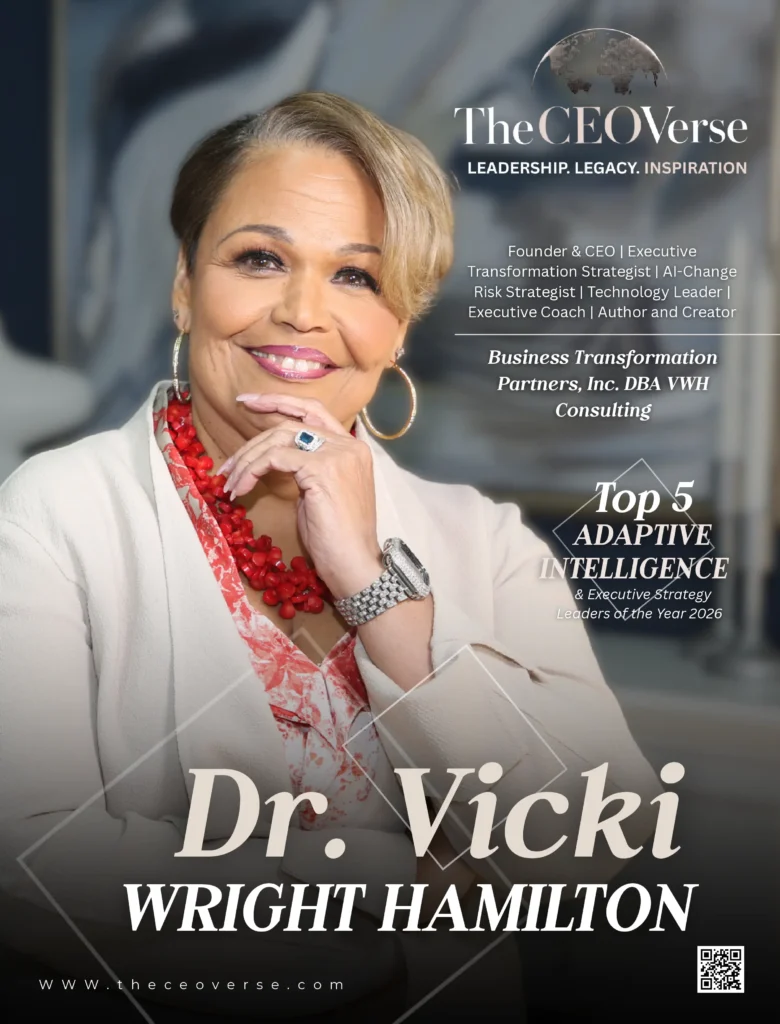
“Top 5 Adaptive Intelligence and Executive Strategy Leaders of the Year 2026”
Cover story
Dr. Vicki Wright Hamilton
Featured Profile - Dr. Vicki Wright Hamilton
The Adaptive Intelligence Advantage
How Dr. Vicki Wright Hamilton Turns Disruption, Technology and Human Complexity into Executive Action
Adaptive Intelligence is the leadership capacity to read what is changing, understand what it means and mobilize the right response before disruption becomes failure. After more than four decades in technology, C-level leadership and enterprise transformation, Dr. Vicki Wright Hamilton has learned that organizations do not fail to adapt because they lack information. They fail when leaders cannot convert disruption into aligned decisions, trusted action and measurable performance.
From Reading People to Reading the Enterprise
Her story did not begin with a framework. It began with a single mother reading a room fast enough to keep a household stable. Bills needed paying. A child needed steadiness. A career needed building, without the luxury of perfect conditions. That season taught her how to separate what is urgent from what is important, and how to move forward without losing the people depending on her.
Technology became her professional home because it rewarded logic and problem solving. Over more than four decades, she rose into senior and C-level leadership roles across major global organizations, leading transformations that touched technology, operations, organizational change and workforce adoption. Technology rarely fails on its own, she came to believe. Transformation fails when leadership intent, decision rights, trust and execution fall out of alignment.
The insight behind Adaptive Intelligence was first named by a psychologist. She took that foundational concept and applied it to her own framework, shaping it into a practical methodology, the ability to read what is changing, understand what it means, make a sound decision and mobilize people around the right response. Single motherhood strengthened her judgment. Technology sharpened her systems thinking. C-level leadership taught her enterprise strategy. Caregiving deepened her empathy. None of it, she says, was separate.
The Position Was Eliminated, She Was Not
She has lost her job three times. The first was an office closure. The second, a company sale. Both were painful but explainable. The third was different. She had performed well, delivered results and built a strong reputation, and her success created tension with her boss. Her role was eliminated anyway.
That third loss forced a reckoning many high-performing leaders eventually face. Excellent work does not guarantee that every environment will celebrate your growth. Sometimes capability exposes insecurity or disrupts a power dynamic instead. She had spent years helping organizations manage change. Now she had to manage the personal fallout of a change that had nothing to do with the quality of her work.
At the same time, she was caregiving for five family members, including one loved one for 26 years and four others concurrently for seven. Coordinating medical information, appointments and emergencies while figuring out her next professional move showed her how quickly a capable executive can become the invisible infrastructure holding both a family and an organization together, absorbing the cost quietly.
Success does not make anyone immune to disruption, she says. Offices close. Companies sell. Leadership relationships change. Titles disappear. Health shifts without warning. But another person’s decision does not get to define the value of your work. She had to separate what happened to her from what was true about her. Her position had been eliminated, not her experience, her judgment or her ability to solve hard problems.
She built VWH Consulting on that distinction, starting with what she now recommends to every leader in transition, a portable value inventory. What problems do people trust you to solve. What have you proven under pressure. Where can that experience create measurable relief. The answer became her work in executive transformation, technology strategy, organizational performance, AI-driven leadership, change leadership and executive coaching.
Her advice is direct. Do not let a closed office, a corporate transaction or an insecure leader become the final narrator of your career. Examine the facts, claim the value you created, and build your next chapter around capabilities no organization can eliminate.
Turning Hidden Friction Into Practical Solutions
Her approach does not start with technology, trends or a preferred solution. It starts with the problem underneath what is visible. For more than a decade she has advised leaders through digital transformation, automation and artificial intelligence, watching the same pattern repeat: heavy investment in platforms, chronic underinvestment in leadership readiness, governance and adoption.
That gap led her to build the Adaptive Intelligence Leadership Model, examining leadership intent, trust, change capacity, cognitive load and execution. She is also developing the AI Change Leadership Gap Index and related executive analytics, designed to measure the distance between an organization’s AI ambition and its actual leadership readiness. These tools, she says, move the conversation from general enthusiasm about AI to evidence-based decisions about ownership, risk, workforce preparedness and value realization.
Some of her work comes directly from lived experience. PeacefulCare.ai grew out of the chaos of caregiving, built to move families from scattered information toward shared visibility and support for the caregiver, not just the person receiving care. Decisions, Decisions: Your Path, Your Growth turns team dynamics into an interactive experience so leaders can see behavioral patterns they usually avoid discussing.
The pattern across her work is consistent. Make the invisible visible, identify the system creating the problem, design a response people can actually use. For anyone trying to innovate, she says, look for what people are still managing through memory, spreadsheets, text messages, anxiety, repetition or silence. Repeated friction is usually an invitation.
The Cost of Being Able to Carry Everything
For years, she was the person who could solve the problem, calm the room and still deliver. That ability created results. It also trained people to bring her what they had never learned to carry themselves. Capability, she learned, can quietly become a liability once you believe being able to carry everything means you should. Her fix was blunt: separate responsibility from rescue. Ask what genuinely requires your judgment, and what just requires a clear standard and someone else’s ownership.
A different lesson came from building VWH Consulting itself. A strong solution does not sell simply because it is valuable. Earlier in her entrepreneurial work, she sometimes spent more energy perfecting an offering than making the problem, urgency and outcome clear to the person buying it. A market cannot reward what it does not understand. Now she tests the message before she overbuilds the solution. Can the intended audience explain the problem, why it matters now and what becomes different after using it. If they cannot, the work is not ready to scale.
Her advice is practical. Audit where your excellence is enabling dependence. Then audit where your expertise is being hidden behind complexity. Sustainable leadership requires boundaries and translation. Your value should strengthen the system, not make the system permanently dependent on your exhaustion.
The People Who Expanded Her Definition of Leadership
Motherhood taught her responsibility with no escape clause. Marriage taught her the value of partnership and letting support into a life built around being strong. Caregiving taught her to listen beyond words and preserve the dignity of people whose independence was shifting.
Professionally, she learned from executives, mentors and clients across decades of transformation work, some through their courage and clarity, others through contrast. She watched what happens when leaders delay hard decisions, withhold context or treat change as a communication campaign instead of a human transition. Every environment became a leadership laboratory.
She was also shaped by the people whose stories she chose to elevate. Through Hidden Stories, Healed Now, Strategic Minds: Making Money Moves and the Ignite podcast, she has listened to business owners and women leaders speak candidly about the decisions and risks behind their success. Her documentary and anthology work with Black single mothers showed her how storytelling moves people from isolation to recognition, and from recognition to possibility.
Build a personal board of truth, she says, not a network of agreement. You need people who can encourage you, challenge your assumptions, open doors, protect your blind spots and remind you who you are when circumstances become loud. The right voices do not simply celebrate your success. They help you become capable of carrying it.

Building Teams Around the Work, Not the Title
No transformation she has led or built happened alone. In enterprise environments, the strongest outcomes came when technology, operations, finance, HR, risk and frontline employees aligned around one business result. Progress slowed the moment each function protected its own activity instead of sharing accountability.
That lesson now shapes how she advises executives on AI. It cannot be governed application by application. Leaders need one operating view of ownership, access, risk and workforce impact. The same principle runs through her own ventures. PeacefulCare.ai depends on technologists, caregivers and trusted community voices. Her podcasts depend on producers and guests willing to have honest conversations. Her board game required translating leadership dynamics into something usable. The documentary and anthology work succeeded for a similar reason, she says. Women were not treated merely as subjects. They became contributors to a larger truth.
She evaluates every partnership against four criteria: clarity, capability, character and contribution. Are we aligned on the outcome. Does each person bring a capability the work truly requires. Is their character consistent with the trust involved. Is the contribution visible and reciprocal. A partnership can look impressive publicly and still fail all four tests privately.
Do not build teams around proximity, popularity or titles, she says. Build them around the work. The right partnership should expand the quality, reach and sustainability of the solution, not merely add names to the announcement.
Building a Career That Can Outlast Change
Her advice to anyone starting out is direct. Build a career and a life that can survive change, because technology will evolve, industries will reorganize and the job someone trained for may not exist in the same form a decade from now. Protection does not come from a single credential. It comes from the ability to learn, think, communicate and solve problems that matter.
Get technically credible, she says, but not technically narrow. Learn how the business makes money, how customers define value, and why people resist change. Volunteer for difficult assignments because complexity builds judgment. Keep a record of outcomes, not for ego, but so the value can be communicated accurately when opportunity or disruption arrives.
Do not become so focused on looking successful that you fail to become useful, she warns. A polished brand without substance eventually gets exposed. But substance without visibility stays overlooked too. Protect your humanity as deliberately as you build your ambition. Achievement without boundaries can become its own kind of captivity. Success should increase your capacity to choose, serve, rest and contribute. It should not require you to disappear inside your responsibilities.
You do not need the entire map, she says. You need strong values, marketable capability, financial awareness, trusted relationships and the courage to make the next responsible move.
Recognition Becomes Responsibility
Being named among TheCEOVerse’s Top 5 Adaptive Intelligence and Executive Strategy Leaders of the Year 2026 recognizes the exact intersection she has spent her career building: executive strategy, organizational performance, technology disruption and human leadership.
She has received other honors over the years, including a Presidential Lifetime Achievement Award. She is grateful for the recognition. She does not treat it as a finish line. Visibility, in her view, creates responsibility.
That responsibility is showing up in two places right now. She is expanding intellectual property built for the AI era, focused on the leadership gaps hidden beneath AI ambition, how work is designed, how decisions are made, how trust holds up when machines increasingly influence outcomes.
She is also continuing to build PeacefulCare.ai, because caregiving is an organizational performance issue as well as a family one. Many leaders and employees are making high-stakes decisions at work while privately coordinating care, managing exhaustion and carrying responsibilities their organizations cannot see. Supporting caregivers is not only compassionate, she says. It is strategically relevant to workforce resilience and performance.
This milestone, she says, strengthens her commitment to turn decades of experience into frameworks, diagnostics, products, media and development opportunities that can scale beyond her individual presence. The next chapter is not about proving she has done the work. It is about ensuring the work changes how leaders prepare for what is coming.

Turning Experience Into Intelligence
You are not required to waste what you have lived through, she says. The disappointment, the caregiving, the reinvention, the corporate success and the job losses are not disconnected chapters. Together they built the lens through which she now sees leadership and solves problems.
She is careful not to romanticize any of it. Some experiences, she says plainly, were unfair, exhausting and costly. She never set out to admire what she survived. She set out to decide that the experience would not have the final word.
When disruption occurs, she pauses long enough to identify what remains: knowledge, faith, values, relationships, credibility, creativity, judgment and the capacity to learn. Then she asks three questions. What is this situation revealing. What decision does it require. What can I build, change or release because I understand the problem differently now. Confusion turns into clarity. Clarity moves people forward. It is not more complicated than that, she says.
Making the Invisible Visible
The most important part of her story, she says, is not the number of roles, products or recognitions. It is the pattern underneath them. Whether she is advising a C-suite executive, building an AI product or helping a business owner find her platform, her method stays the same: diagnose before you prescribe.
Sometimes the hidden issue is a leadership team whose decisions are being undermined by mistrust. Sometimes it is an organization pursuing AI without the governance or workforce capacity to support it. Sometimes it is a caregiver functioning as the entire family operating system. Sometimes it is a business owner with expertise but no platform. Sometimes it is a high-performing woman who has become so responsible for everyone else that she can no longer hear herself.
A missed deadline may be a decision-rights problem. Low AI adoption may be a trust problem. Burnout may be a workload-design problem. Caregiver exhaustion may be a coordination problem. A stagnant business may have a positioning problem, not a product problem. Name the real issue, and relief becomes something you can actually design.
Her work makes hidden conditions visible so people can act on them, she says. That is the thread connecting Adaptive Intelligence, executive strategy, organizational performance, coaching, technology, media and community impact. Her receipts come from boardrooms, family rooms, studios and client work alike. The legacy she wants is not that people were impressed by what she accomplished. It is that they became better equipped to lead, adapt, build and care because she turned what she learned into something they could use.