

TheCEOVerse • Digital Edition
“Christine Colburn: A Visionary Voice in Mental Health & Wellness”
Cover story
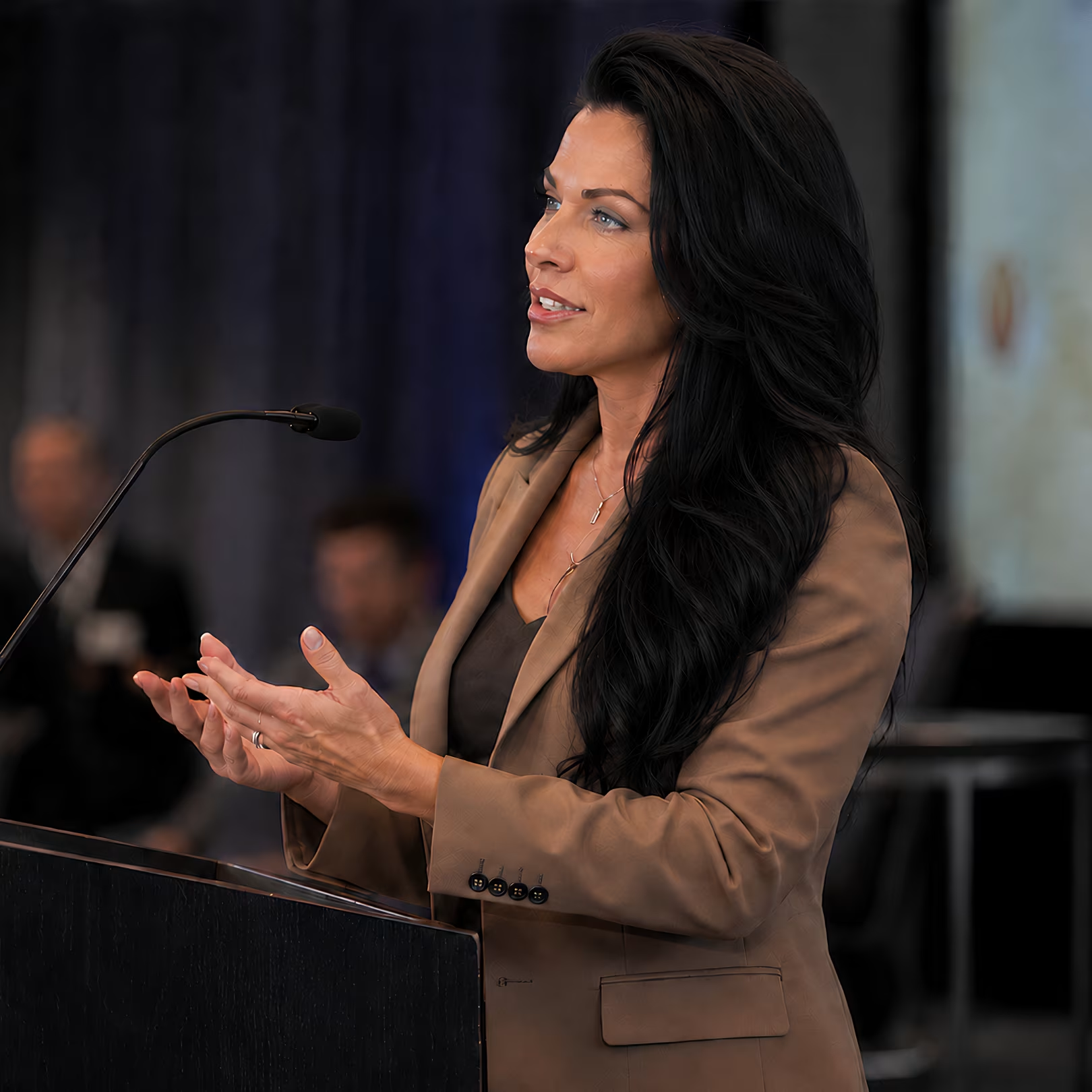
Christine Colburn
Featured Profile - Christine Colburn
Choosing What Comes Next
Christine Colburn on resilience, trauma-informed care, and building a life of purpose one choice at a time
A life rarely changes because of one dramatic moment. More often, it changes through a series of choices that may not look extraordinary at the time. Enrolling in a class. Asking for help. Setting a boundary. Beginning again. Taking one step before confidence has had time to catch up.
For Christine Colburn, LPC, NCC, CCTP, CATP, one of those choices came at twenty-nine. Newly divorced and considering whether to return to school, she found herself thinking about the years ahead. Four years were going to pass regardless of what she decided. She could remain where she was, or she could use those years to begin building something different.
The decision did not come with certainty. It came with questions, responsibilities, and very little support. It also became one of many choices that would eventually lead Colburn to become a trauma therapist, the founder of Beacon of Hope Counseling Services, an advocate for children and families, and a creator of educational resources designed to help people understand themselves with greater compassion.
Her path was not straight, and it was never easy. What makes her story meaningful is not that hardship disappeared. It is that she continued choosing what could come next.
An Education That Changed More Than a Career
Colburn completed her bachelor’s degree in three years. When an academic counselor recognized her potential and encouraged her to continue into graduate school, she listened. That encouragement mattered because higher education had never been part of the future she had been taught to imagine for herself.
She had grown up with the understanding that a woman’s role centered on marriage, children, and caretaking. College and a professional career were not part of that script. When she chose a different path, the response from people close to her was not neutral. She was disowned and accused of abandoning her children, even though she attended classes at night while her children were with their father.
The accusations were painful, but they did not reflect what was actually driving her.
“My children were not being left behind while I pursued something for myself,” Colburn says. “They were at the heart of why I kept going.”
She wanted them to see that becoming a parent did not require a person to stop growing or surrender every dream they once held. She wanted them to understand that age does not determine whether someone is allowed to learn, change direction, or build a different future.
Her children became the reason she kept moving on the nights when she was exhausted, uncertain, or carrying the judgment of others. She wanted greater security for her family, but she also wanted to model something deeper: that fear can be present without being allowed to make every decision.
Returning to school changed more than her career. It helped Colburn begin reclaiming the authority to decide what her own life could become.

A History That Informed Her Work Without Defining It
Long before Colburn had the clinical language to understand grief or trauma, she knew what it meant to live with profound loss. Her mother died by suicide one week before Colburn’s thirteenth birthday. Eighteen years later, she lost her sister to suicide as well. Seven years after her sister’s death, Colburn’s father died from prostate cancer.
Any one of those losses could have become the single defining fact of her life. Colburn does not describe them as experiences she conquered in one moment or left neatly behind. Grief does not work that way. Instead, she speaks about learning to understand how loss shaped her while refusing to give it permanent authority over everything that followed.
Her history gave her insight, but it was her education, training, and years of clinical experience that taught her how to use that insight responsibly. Over nearly two decades in the mental health field, Colburn has worked with individuals across the lifespan, with a particular focus on children and adolescents navigating trauma, anxiety, grief, loss, depression, and challenges with self-esteem.
Eight years of her clinical work were spent serving the Gila River Indian Community. Working with children, families, and community systems strengthened her understanding of trauma-informed and culturally responsive care. It also reinforced an important truth: pain may share common features, but every person’s experience must be understood within the context of their relationships, culture, history, and environment.
That work gave Colburn both the clinical foundation and confidence to establish Beacon of Hope Counseling Services in Gilbert, Arizona. The practice was built from professional experience, careful training, and a conviction shaped by what she had learned personally and clinically: people deserve a place where they can feel heard, understood, and supported without judgment.
The Behavior Is Never the Whole Story
Colburn’s clinical approach begins with curiosity. When a child is defiant, withdrawn, angry, controlling, or unable to calm down, she does not see only a behavior that needs to stop. She asks what the behavior may be communicating.
Children do not always have the words to explain that they feel afraid, rejected, overstimulated, ashamed, or unsafe. Anxiety can look like defiance. Fear can look like anger. Grief can appear as withdrawal or as an intense need to control everything within reach. Correcting the behavior without understanding what is beneath it may stop a moment temporarily, but it does not necessarily teach the child what to do differently next time.
“Communication should come before correction,” Colburn tells parents.
This does not mean removing expectations, boundaries, or consequences. It means considering the order in which adults respond. First, understand what the child may be communicating. Then help the child develop the emotional language and regulation skills that are still missing. From there, adults can respond in a way that holds appropriate limits without using shame as the teacher.
Her work is trauma-informed, strength-based, and family-inclusive. Depending on the needs of the person in front of her, she may incorporate play-based and expressive interventions, sand tray, somatic strategies, trauma-focused cognitive behavioral therapy, solution-focused therapy, or client-centered work. The method is never meant to be more important than the person receiving it.
Whether she is working with a child, helping a parent better understand a difficult behavior, or creating a workbook, Colburn wants people to understand more than what may help. She wants them to understand why it matters and how to use that knowledge in everyday life.

Walking Alongside Without Taking Over
One of Colburn’s most important professional lessons was also one of the most difficult to accept. Early in her career, she believed that caring deeply meant finding the exact words, intervention, or resource that would create another person’s breakthrough. The intention came from compassion, but it placed responsibility for someone else’s healing on her shoulders.
Over time, she came to understand that support and ownership are not the same thing.
“I can walk alongside a client, offer knowledge, and provide honest feedback,” she says. “But I cannot do another person’s healing for them. That does not mean giving up on someone. It means respecting their ability to make choices, build confidence, and take ownership of their life.”
That distinction changed the way she practiced and the way she led. Commitment was no longer measured by how much she could absorb, how many problems she could solve alone, or how depleted she felt at the end of the day. Healthy boundaries became part of remaining compassionate, effective, and emotionally present.
It is a lesson she continues to return to because people in helping professions are often praised for overextending themselves. Colburn believes meaningful care should not require a therapist to take away a client’s agency or abandon her own well-being.
Leadership Grounded in Purpose
During the years Beacon of Hope operated as a group practice, Colburn saw what became possible when clinicians with different strengths worked toward a shared purpose. Together, they were able to serve more children, adults, and families than one clinician could reach alone.
She also learned that building a team was never simply about filling positions. People needed to feel respected, supported, and connected to the purpose behind their work. Clear communication, accountability, trust, and shared values allowed individual strengths to complement one another rather than compete.
That spirit of collaboration extended beyond the practice. Supporting a child or family often required thoughtful coordination with parents, physicians, schools, and other professionals. No single person sees every part of what a client or family is experiencing. When professionals communicate responsibly and remain focused on the client’s needs, gaps become smaller and support becomes more consistent.
Those lessons continue to influence how Colburn approaches leadership and chooses partnerships. Integrity, accessibility, and shared purpose matter more to her than growth for the sake of appearing successful.
Extending Hope Beyond the Counseling Room
Colburn has a natural tendency to finish one goal and immediately begin thinking about the next. Recognition has given her something she does not always give herself: permission to pause long enough to acknowledge how far she has come.
She is grateful for that recognition, but she does not view it as a finish line. She sees visibility as an opportunity to expand the reach of work that began inside the counseling room.
Individual therapy allows her to make a meaningful difference with the clients and families she serves directly. Books, workbooks, parent resources, articles, and professional trainings allow that knowledge to reach people who may never enter her office. Her longer-term vision includes a larger educational platform where individuals, parents, and professionals can access practical, high-quality information that feels understandable, compassionate, and connected to real life.
Parents should be able to understand why an approach matters, not simply be told what to do. Professionals should leave a training with tools they can apply. Individuals should walk away with greater knowledge and more compassion for themselves.
For Colburn, education is another form of advocacy. When people understand what is happening within themselves or their children, they are more able to respond with intention instead of fear, shame, or frustration.
Choosing What Comes Next
When asked what she would tell someone standing at the beginning of an uncertain path, Colburn returns to what she learned at twenty-nine: do not wait until fear disappears before taking the first step.
Confidence often develops after a person begins, not before. A complete plan is not required. People can ask questions, learn from those with more experience, and still choose a route that fits their own life. A different starting point or timeline does not make the outcome less meaningful.
She also encourages people to establish boundaries before exhaustion becomes the price of success. Hard work may be necessary, but depletion is not proof of commitment. Achievement should not require someone to surrender their health, relationships, or the values that made the goal matter in the first place.
Colburn’s life has reshaped what strength means to her. Strength once meant handling everything alone and never admitting when something hurt. Today, she sees strength in asking for help, setting a boundary, beginning again, and continuing even when the outcome is not yet visible.
“What happened to you is part of your story,” she says, “but it does not get to determine the rest of it.”
Healing is not pretending the past did not happen. It is understanding how an experience affected you while recognizing that it does not have to make every future decision. Growth rarely arrives as one cinematic breakthrough. More often, it begins quietly through choices that seem small: speaking honestly, trying again, accepting support, or listening to the part of yourself that fear and doubt had silenced.
This is the belief at the center of Colburn’s work and the life she continues to build. People can grow beyond what they endured without denying that it mattered. They can carry what they have lived through while still creating something different from where they stand today.
Christine Colburn cannot change what happened in her past. She can decide what authority it holds, what lessons she carries forward, and what she chooses to build from it.
And, one choice at a time, she continues choosing what comes next.