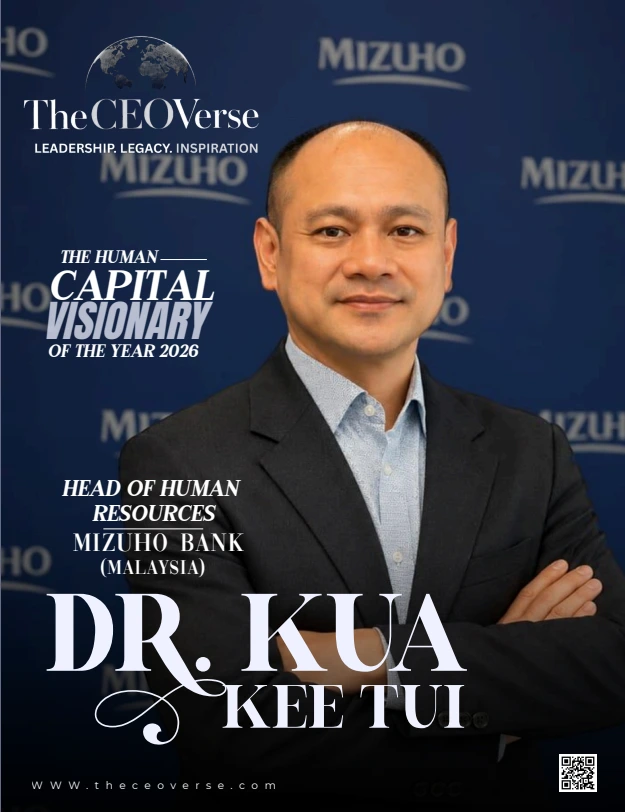
TheCEOVerse • Digital Edition
“The Human Capital Visionary of the Year 2026”
Cover story
Dr. Kua Kee Tui
Featured Profile - Dr. Kua Kee Tui
The Two-Year Discipline That Built a Career
Dr Kua Kee Tui did not build a career around one industry. He built it around a plan, printed and kept somewhere visible, designed to move him into a different role roughly every two years, broadening his exposure and building capabilities the previous role could not give him. It was a simple document, but it did something most career plans never do: it created accountability before opportunity, not after it. Development stopped being something he hoped would happen and became something he was responsible for making happen.
The academic record reflects the same deliberate curiosity. Computer science came first, followed by human development, strategic management, and eventually doctoral research. On paper these look like four unrelated disciplines. In practice, each one gave him a different lens: systems thinking from computer science, an understanding of motivation and stress from human development, a bridge between people decisions and business outcomes from strategic management, and the discipline to test assumptions rather than accept convincing explanations from his doctorate.
The career path followed the same pattern. Teaching came before hospitality. Retail came before property development. Manufacturing, multinational corporations and banking followed before he moved into regional and international HR leadership. Over more than 25 years, his responsibilities have taken him across multiple international markets and cultures, with responsibility for large regional workforces.
There was military discipline behind this too. Commissioned as a Second Lieutenant in the Malaysian Reserve Armed Forces, he learned leadership not through competency frameworks but through preparation, accountability and decision-making under pressure. Years later, reflecting on the career of eight-time world squash champion Datuk Nicol David , he recognised the same principle in a completely different arena: long-term success is rarely sustained by talent alone, but by preparation, discipline, trust in the process, and the willingness to keep going when progress is slow and nobody is applauding.
For Dr Kua, the destination was never a title. It was the deliberate accumulation of experience that could eventually support broader leadership responsibility.
Identity Resilience and the Cost of Belonging
Building an organisation and restructuring one require different kinds of courage. Dr Kua has done both.
At National Bank of Abu Dhabi, he was responsible for building HR governance infrastructure across Malaysia, Hong Kong and China. He also helped develop a multi-year HR transformation strategy during a period of significant organisational growth. The workforce across Malaysia and Hong Kong doubled in 18 months. That was the growth phase. Speed, structure, recruitment, and confidence in continued expansion defined it.
The next phase asked something harder of him. When the business environment shifted and the organisation needed to restructure, the transition was completed without industrial disputes. Structured career support accompanied the restructuring process and helped affected employees explore redeployment and alternative career options. As a result, approximately 60 per cent of affected employees were successfully redeployed.
These outcomes matter to him, but not for the reasons most people assume. Restructuring is usually described through org charts, timelines and financial provisions. Employees experience it differently. They lose a role, sometimes an identity, sometimes a network of relationships built over years.
That experience shaped what Dr Kua now calls identity resilience, a concept he explored in his article Your Job Is Not Your Identity. Is That True? His observation is that some of the most difficult resistance to organisational change can come from highly committed employees whose professional identity has become closely tied to the organisation, role or way of working they have helped build.
He does not believe leaders should avoid difficult decisions. Organisations restructure, integrate, close operations and shift direction because they have to. What matters is whether those decisions remain fair, transparent and human in how they are carried out. Strength, in his definition, is not the ability to push through resistance. It is the ability to stay clear about the objective while understanding what the decision costs the people who have to live with it.
Solving the Problem Nobody Named Correctly
Dr Kua begins most interventions with one question:
Are we solving the real organisational problem or only responding to the most visible symptom?
He has watched organisations respond to high turnover by strengthening recruitment, to declining engagement by adding more activities, to performance problems by adding controls, and to resistance by increasing communication. Each response has value on its own. Together, they can make an organisation extremely efficient at solving the wrong problem.
His doctoral research on job satisfaction, person-environment fit and turnover intention among early-career bankers reinforced this instinct. Employee outcomes are rarely isolated events. They sit inside a relationship between the person, the role, the team and the organisation.
When he joined his current organisation, much of HR’s mandate was concentrated on operational and administrative delivery. Over time, the function expanded its contribution into workforce planning, governance, leadership effectiveness, organisational development, engagement, industrial relations, compliance and culture.
Operating with a lean HR team required choices about where HR could create the greatest organisational value rather than attempting to pursue every attractive initiative.
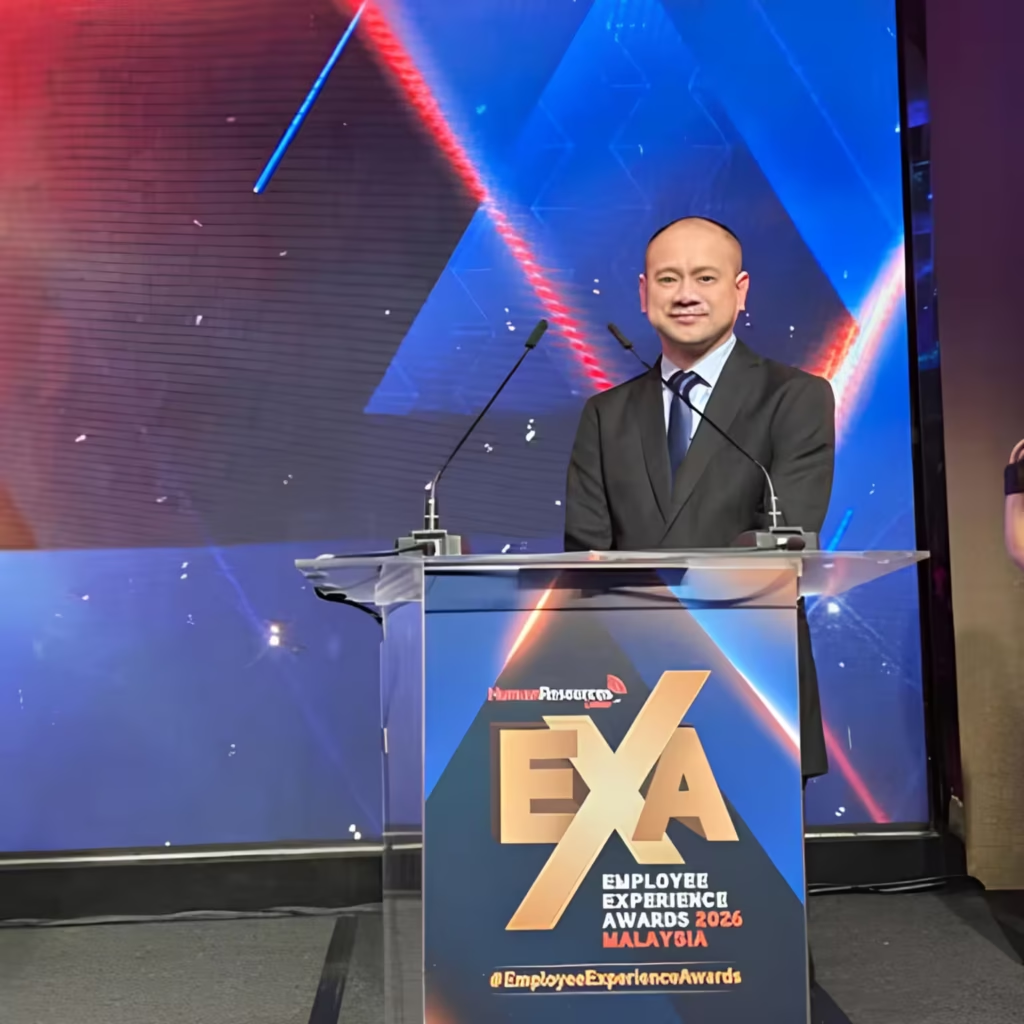
Three consecutive HR Excellence Awards followed: Hybrid Working in 2023, HR Communication Strategy in 2024, and HR Change Management in 2025. These were not variations of the same initiative. Hybrid work asked where and how work should happen. Communication asked for clarity across the organisation. Change management asked whether the organisation could move from intention to adoption.
For Dr Kua, the real measure sits behind the trophies.
Did leaders become more accountable for people decisions?
Did employees get more clarity?
Did HR gain influence over decisions rather than simply administering their consequences?
Persistence That Learns From Every No
One lesson took Dr Kua five years to fully understand:
being logically correct does not make an organisation ready to agree with you.
He once proposed a leadership development intervention he believed was necessary. Management rejected it. He revised it. Management rejected it again. The easy conclusion would have been that leadership simply did not understand the issue. He chose not to take that route.
Instead, he kept gathering evidence, consulting stakeholders and refining the proposal. A larger survey eventually made the capability gaps visible enough to connect them clearly with organisational outcomes. It took five years before the programme was approved and implemented.
Looking back, he also recognises that his earlier proposals placed too much emphasis on the logic of the intervention and not enough on organisational readiness, timing and stakeholder concerns. Rejection, he came to understand, was not merely resistance. It was also information.
Presenting the same proposal for five years straight would not have shown perseverance. It would have shown an unwillingness to learn from rejection. Each unsuccessful attempt had to strengthen the evidence and deepen his understanding of what stakeholders were actually concerned about.
This is also where his view of data-informed leadership took shape, distinct from leadership that is simply data-driven. Data reveals patterns and challenges assumptions, but it does not interpret itself. As he puts it, data without context can mislead, while context without data can become opinion. Leadership maturity is not proven by winning arguments quickly. Sometimes it is proven by staying with a difficult issue long enough to understand why others are not yet convinced.
He Listened for What Silence Was Hiding
Ask Dr Kua who shaped his leadership and he will not name just one person. Different people influenced different stages of his development, some by handing him responsibility before he felt ready, others by challenging his thinking or exposing him to parts of the business HR professionals easily overlook.
International exposure did much of that work. At Maybank, he led HR strategy across Southeast Asia, China, Hong Kong, the Middle East, the United Kingdom and the United States, later expanding into Global Wholesale Banking, post-acquisition integration and major corporate functions, with responsibility for workforces exceeding 3,000 employees and Board-level decision-making. At National Bank of Abu Dhabi, the terrain was different again, another culture, another set of regulatory expectations.
What he took from this is that global leadership is not about applying the same practice everywhere. Fairness, accountability, integrity and performance may travel across borders. How leaders communicate, build trust and exercise authority has to respect cultural and institutional differences.
Employees have shaped his thinking as much as any senior leader. Leaders experience policy through its intention. Employees experience it through implementation. The gap between those two experiences can be significant, and closing it starts with listening. In his Singapore leadership reflections, he argued that genuine listening means staying open to information that might challenge a preferred decision or even reveal a weakness senior management has not yet noticed Silence, he argues, should not automatically be interpreted as agreement. It may reflect agreement, but it can also signal fear, resignation, uncertainty, deference or the belief that speaking up will change nothing.
The Hero Was Never the Whole Story
At his current organisation, a lean HR team supports a mid-sized workforce inside a tightly governed financial services environment.
That context leaves little room for vague priorities. Resources cannot be spread across every attractive idea, so the team has to be disciplined about where HR creates the most value and then deliver consistently.
The three consecutive HR Excellence Awards were not personal wins. They came from a team managing daily operational load while simultaneously strengthening communication, workplace practice, leadership accountability, governance and change capability.
Dr Kua has noticed that organisations tend to celebrate the person presenting the strategy or receiving the award, while much of the work that made the outcome possible stays invisible. The person on stage rarely represents the whole team behind the result.
The same logic applies to line managers, because employees experience culture through how managers allocate work, give feedback, share recognition and handle disagreement. A manager can deliver strong numbers while quietly weakening the organisation, if those results depend on exhausted employees, withheld knowledge or constant escalation. Dr Kua calls this borrowed performance: results that look impressive today while the organisation pays for them later through disengagement, capability gaps or succession risk.
A leader who solves every problem can look indispensable. But if the team cannot function without that leader, what has been built is dependency, not capability. The leader may be the most visible person in the story. The hero was never the whole story.
Building Judgement Beyond Credentials
If a young professional asked Dr Kua for one honest piece of advice, it would be this:
Build judgement, not just credentials.
Qualifications, certifications and professional networks matter, but none of them automatically prepare someone to make a sound decision when information is incomplete, stakeholders disagree, and every available option carries a cost. Judgement is built through experience, reflection, feedback, difficult assignments, and occasionally through a decision that does not work out and the discipline to understand why.
His own two-year career plan was never about changing jobs for the sake of movement. It was a deliberate attempt to expand his understanding of industries, cultures, people and operational challenges. Career development, in his view, should not be measured by how quickly a person moves into a new title or role but by whether a person becomes more capable of handling complexity.
The same principle matters more now, in the age of AI. In his article Will AI Kill Curiosity and Cause a Capability Crisis?, he raised a question few organisations are asking: are they becoming so focused on AI-generated output that they are failing to notice what is happening to the underlying capability of their people? Someone who works through a difficult business problem is not just producing an answer. They are building pattern recognition, contextual understanding and judgement along the way.
If organisations automate too much of that cognitive effort without deliberately redesigning how employees learn, productivity may increase while opportunities to develop judgement and problem-solving capability decline.
His advice to younger professionals is to use AI extensively where it strengthens their work, but never to outsource curiosity, judgement or accountability to it. The future will not belong only to people who get answers fast. It will belong to people who know which questions deserve to be asked, which answers deserve to be challenged, and which decisions they still have to own.
An Award Opens the Door, but It Doesn’t Represent You
2026 brought further recognition. Dr Kua was named a Malaysia Global Leaders Featured Leader and received the Outstanding Human Capital Transformation & Leadership Excellence Award 2026 at Global Icons of Impact Singapore 2026. These recognitions gave him a platform to bring questions from his own HR practice into a broader international conversation.
He sees recognition as part of the journey, not its conclusion. Writing after the Singapore event, he put it plainly:
An award may open the door, but it cannot represent you once you are in the room.
Recognition reflects what has already been achieved. Trust depends on what happens next.
That distinction is shaping the next stage of his career, one increasingly built around contribution beyond formal corporate responsibility. He currently mentors, teaches, serves as an external examiner, judges professional awards and continues his research and writing, work that lets years of organisational experience become useful to other people. As a FutureLab mentor, he supports emerging professionals in leadership, human resources, organisational development, AI and governance. As an external examiner and award judge, he stays connected to academic standards and the wider direction of the profession.
Recognition has not changed where he is headed. It has raised the stakes for what he does next.
Results, Governance, Trust: Held Together, Not Traded Off
For Dr Kua, leadership success is ultimately measured by one question:
Are people, systems and institutions stronger because the leader was there?
Results matter because organisations cannot run on good intentions. Governance matters because decisions need to remain accountable and defensible. Trust matters because people cannot exercise judgement confidently when organisational boundaries are unclear. The challenge is not choosing between these three. It is learning to hold all of them at once.
His experience across growth, integration, restructuring, workforce transformation, leadership development and regulated banking has taught him that the hardest leadership questions rarely offer a clean choice between business performance and people. The real work is finding a responsible path to the organisational objective, one that does not quietly weaken the people and capability the organisation will need later.
This challenge becomes particularly important in regulated organisations, where leaders frequently have to reconcile speed with governance, autonomy with accountability, local realities with regional expectations, and technological experimentation with responsibility for risk.
AI makes these tensions harder to avoid. Technology will continue to improve how analysis and recommendations are produced, but leaders will still have to decide which risks are acceptable, whose perspective has been missed, and which responsibilities cannot be delegated. Technology may transform how decisions are prepared. Leadership remains accountable for what happens after the decision is made.
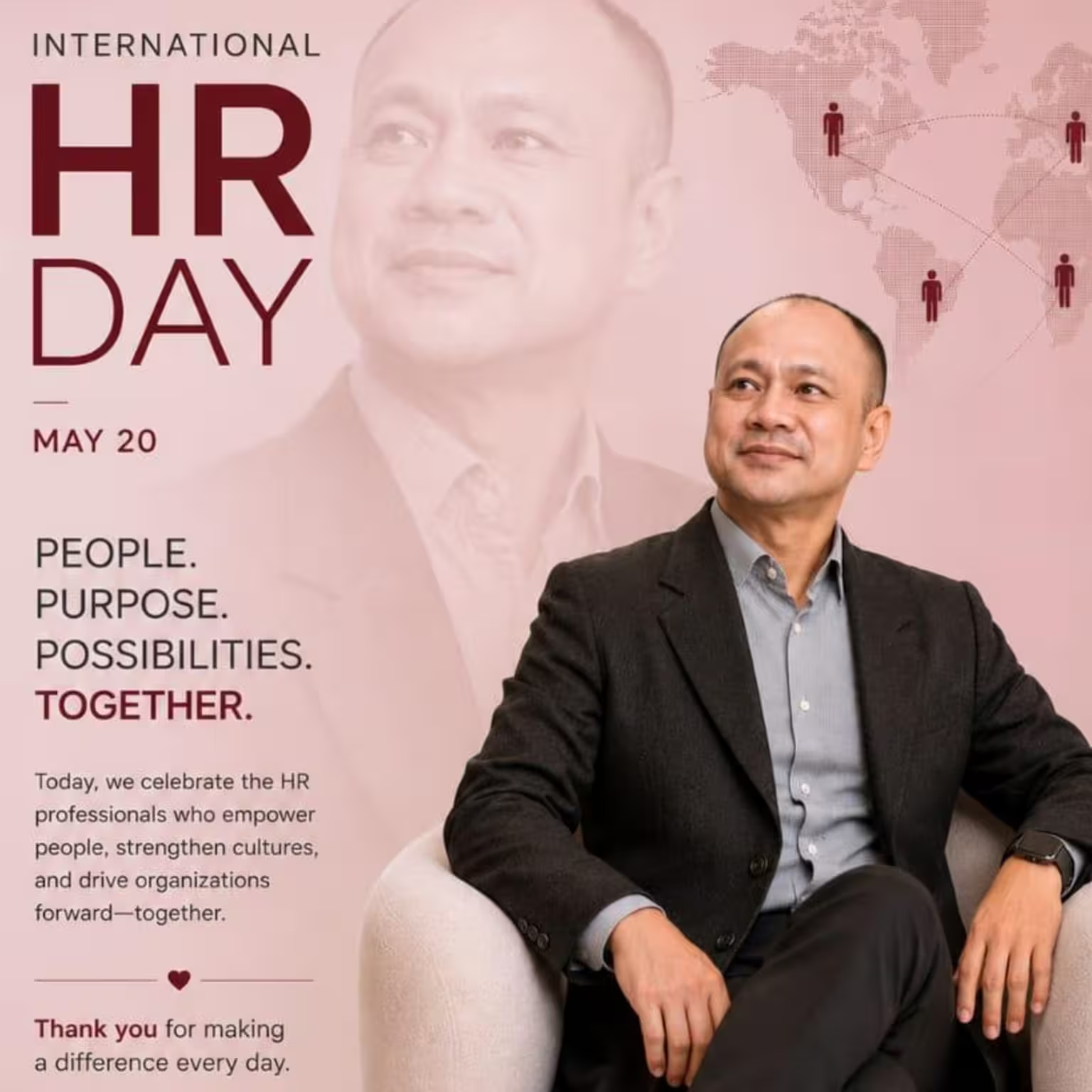
More Capable Without Becoming Less Human
If there is one thread running through Dr Kua’s career, it is the merging of practice with scholarship. He spent most of his working life inside organisations before completing his doctorate, which means his research questions came from practice first, not from theory looking for an application.
Doctoral work sharpened how he evaluates evidence. Professional experience keeps reminding him that evidence has to survive organisational reality. He identifies, without hesitation, as a scholar-practitioner. Corporate experience gives him problems worth studying. Research gives him a disciplined way to question assumptions. Teaching forces him to explain those ideas clearly. Mentoring lets experience become useful to someone else. External examination forces him to ask whether research is actually contributing to knowledge or merely repackaging what is already known.
His practitioner writing and public commentary have grown out of the same questions his leadership journey continues to raise. His work on trust asks how organisations create autonomy without weakening accountability in regulated environments. His writing on AI asks whether productivity gains are quietly eroding the judgement organisations will need later. His work on professional identity asks what happens when change affects not just people’s skills but how they understand their own value. His leadership reflections ask whether leaders genuinely listen, interpret evidence responsibly, and build people who think for themselves instead of waiting for direction from above.
Different questions, one concern underlying all of them :
How do you build organisations that become more capable without becoming less human?
After more than 25 years in HR leadership, Dr Kua does not believe HR’s future will be secured by defending familiar activities or dressing old programmes in new language. HR stays relevant when it helps an organisation make better decisions about people, work, capability, leadership and risk. The next stage of his journey is therefore less about accumulating another title or recognition, and more about converting experience into knowledge, judgement and capability that others can use.
That, to him, is both the purpose and the measure of meaningful leadership.