
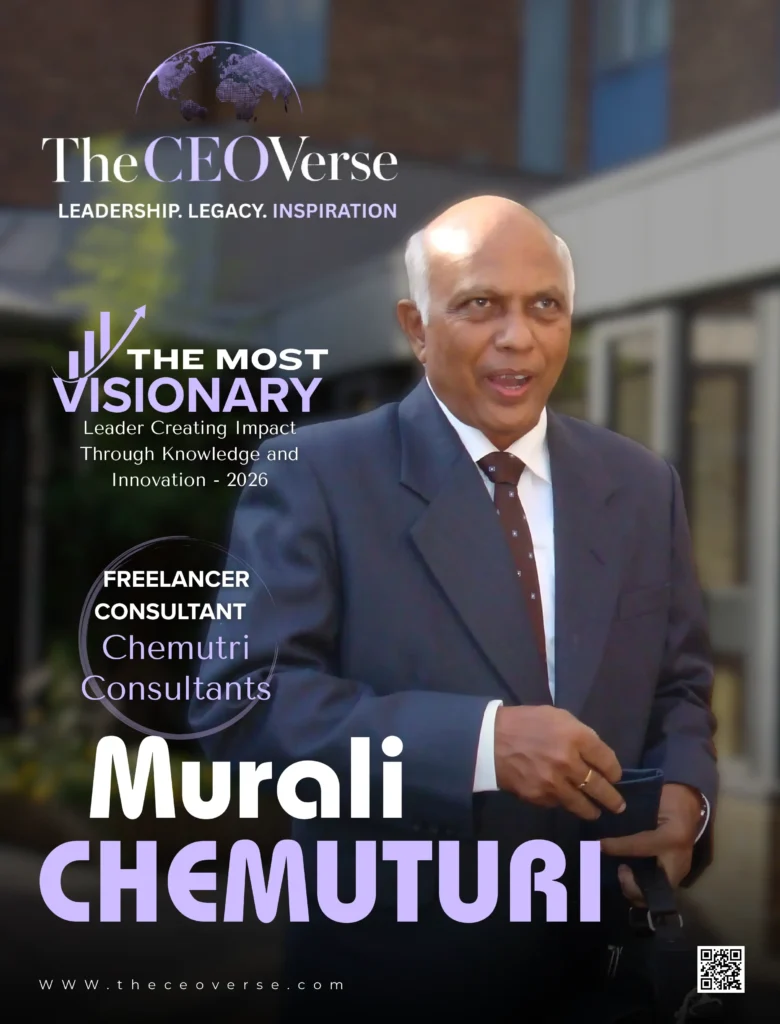
TheCEOVerse • Digital Edition
“The most Visionary Leader Creating Impact Through Knowledge and Innovation—2026”
Cover story
Murali Chemuturi
Featured Profile - Murali Chemuturi
Murali Krishna Chemuturi: A Career Built by Learning, Working, and Giving Back
A technical professional, consultant, author, and lifelong learner whose career was shaped less by opportunity than by what he did when opportunity was limited.
Learning Had to Happen After Work
Murali Krishna Chemuturi grew up in Chityala, a small village in West Godavari, Andhra Pradesh, as the middle child in a family of seven. His father had not completed high school, while his mother had studied only through middle school. Life was centered on the land they worked and the cattle they kept, with little reason to imagine a career far beyond that setting.
Academically, Murali was usually among the top two students in his class. But academic ability alone was never going to be enough. When an opportunity came to join ECIL, Electronics Corporation of India Limited, in Hyderabad as a technical assistant, he took it. With an engineering diploma behind him, he found himself working alongside engineers with considerably more knowledge and experience.
He paid attention. He watched how they worked, absorbed what he could, and kept learning without waiting for someone to formally teach him. Since the working day left little room for education, he used the nights instead. While working full-time, he attended night school and went on to earn a degree in Industrial Engineering, followed by an MBA and a postgraduate diploma in computers.
Three qualifications, built around a full-time job. No one created the time for him. He found it.
The Principles That Outlasted Every Job
Many of Murali’s guiding principles came from places far removed from management theory. His father demonstrated the value of honesty through example rather than instruction. A line from Rabindranath Tagore about tireless striving toward perfection stayed with him. So did a lesson from a Readers Digest article: do something properly, or do not do it at all.
Another lesson came from the agricultural workers he knew while growing up. They routinely took on more than appeared manageable and found a way to complete it. Murali saw something valuable in that willingness to stretch beyond apparent capacity.
His understanding of management developed more gradually. Over time, he came to see that managing people is not simply about supervising them. The real responsibility is to bring their efforts together, remove obstacles, and create the conditions in which a team can actually deliver. Once that understanding took hold, it became one of the foundations of how he worked.
The Work Nobody Wanted Became His Specialty
By the mid-1980s, Murali had developed a reputation for stepping toward difficult situations rather than away from them. When projects failed or problems became complicated, he often volunteered to take them on.
In 1985, he led the introduction of a Computer Aided Design system at ECIL, described as the first of its kind in a Hyderabad manufacturing organization. Two years later, he introduced a PC network-based material management system, again breaking new ground for ECIL and Hyderabad. He also resolved a significant software problem on a defence project after a well-known development company had been unable to solve it.
At TCS, the pattern continued. On one project, he worked for 96 hours with short breaks taken every 24 hours to ensure delivery on schedule. Whether such a schedule should be repeated is another matter. What it demonstrated was his willingness to stay with a difficult problem until the work was finished.
The projects others preferred to avoid became part of the experience that shaped him.
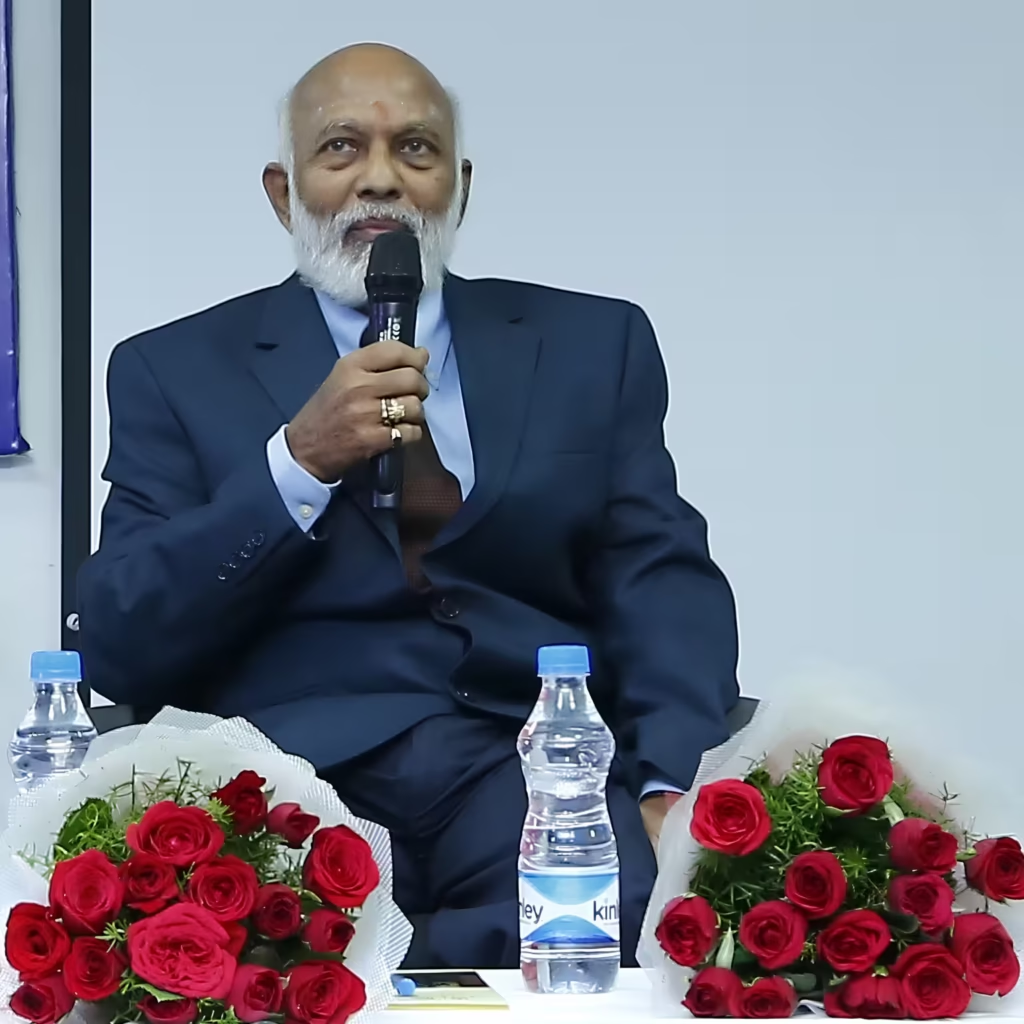
Three Qualities, Repeatedly Tested
Murali identifies three qualities that have carried him through his career: hard work, honesty, and the ability to learn quickly. His list is short, but each quality has been tested repeatedly across decades of professional change.
Technology changed. So did management practices. He updated his technical knowledge through multiple generations of programming and project management, while his understanding of what a manager should be evolved along the way. Rather than resisting every shift, he returned to study, learned what had changed, and adapted.
His honesty was not always convenient. He admits that being candid created problems more than once, but it also helped him out of difficult situations. He never considered himself particularly good at lying and eventually stopped trying to be.
Hard work, he says, was something he inherited from his father. It was not built around dramatic moments but around consistency, the long hours, the continued learning, and the decades of showing up.
Four Decades of Experience Became a Consultancy
In 2001, Murali left corporate employment and established Chemuturi Consultants. By then, he had developed a clear view of what he believed consultancy should not become.
He had seen large consulting organizations send inexperienced graduates into rooms with professionals who had spent years in the field. The gap between book knowledge and practical exposure bothered him. His question was simple: if someone already knows the books, why not bring people who have actually dealt with the problems?
His consultancy grew from the experience he had accumulated himself. Software engineering, process definition, ISO and CMMI certification, problem-solving, training, and project management became part of his professional work across India and the United States.
He developed a model for predicting software testing work and presented it at the Association of Software Engineering Excellence in Texas. At the UK Software Metrics Association in London, he presented a framework focused on customer happiness. He also inaugurated the International Software Measurement and Analysis conference in Mumbai.
His paper on analogy-based estimation was subsequently cited as evidence in the Oracle v. SAP case, a dispute that ultimately ended in a billion-dollar settlement.
The work was never meant to become a performance. The work itself was the evidence.
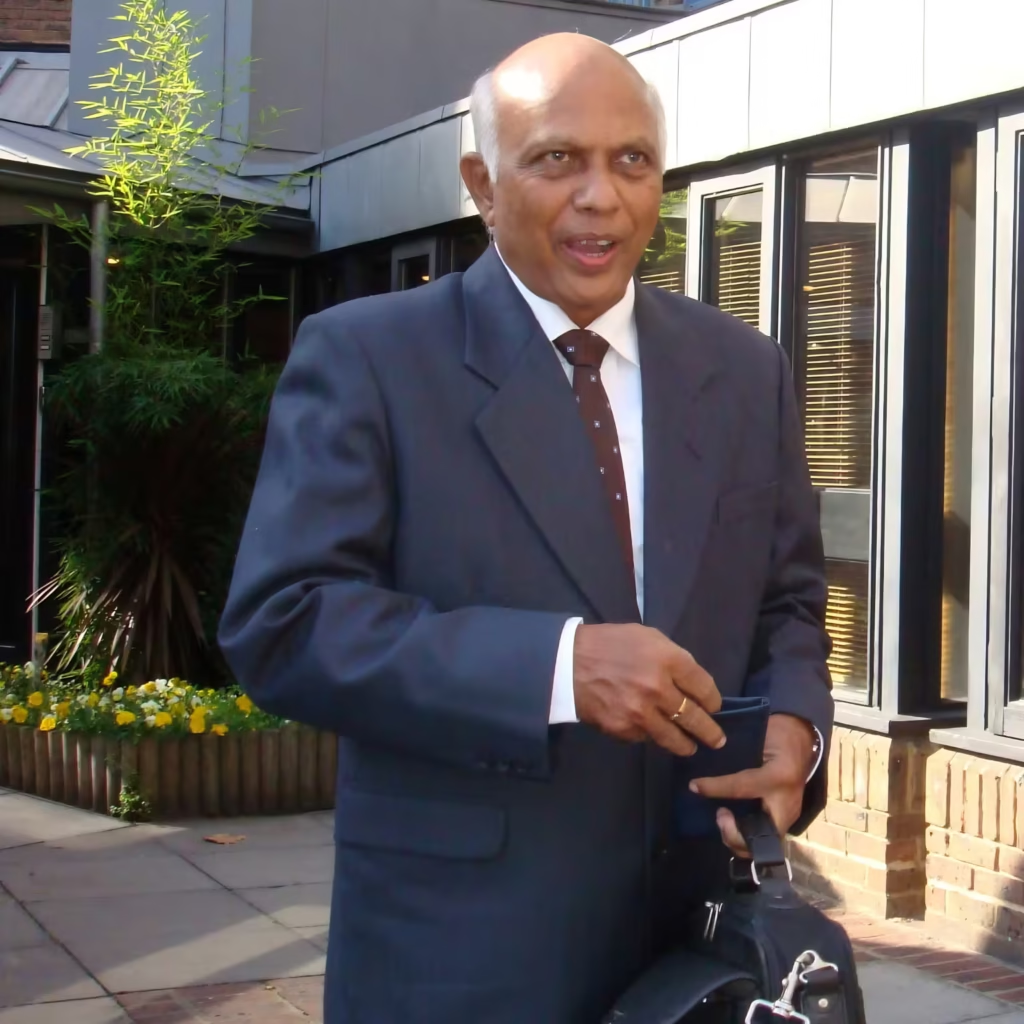
Turning Experience Into Knowledge Others Could Use
Alongside consultancy, Murali kept writing. He authored seven books on information technology, two on management, and another on personality engineering, drawing on years of observing how people behave under pressure rather than simply how they describe themselves.
The purpose was straightforward: take what decades of experience had taught him and make it transferable. Knowledge, if it remained only with the person who acquired it, had limited reach. Writing gave it another life.
That reach eventually extended far beyond what he could have physically accomplished himself. His books became prescribed reading at the postgraduate level in more than 60 universities across over 20 countries. They are held in more than 800 university libraries, including Stanford and Princeton. His book on software quality assurance is also held by CERN.
“My books had gone to places where I could not go. I am a proud producer of knowledge besides being its favourite consumer.”
The sentence captures something fundamental about his approach. His ambition was not simply to accumulate knowledge, but to produce it in a form that could travel beyond him.
A Different Kind of Professional Legacy
At 75, Murali is no longer interested in chasing the market. He is clear that Chemuturi Consultants will not continue after him, and he speaks about that fact without any sense of drama.
He accepts selected assignments when they come his way and continues to mentor younger professionals without charging them. His work has also taken an unexpected turn in recent years: translating ancient Sanskrit texts into English so that their ideas and wisdom can reach readers who might otherwise never encounter them.
His translations have included the Ramayana, Uttara Ramayana, Garuda Purana, Bhagavad Gita, Shanti Parva, Anushasana Parva, and Ashwamedha Parva. He is currently working on the Ashta Geetha, bringing eight Gitas together into a single work.
The man who once spent nights meeting software deadlines is now spending his time on work that demands a very different kind of patience.
His contributions have also extended quietly into the communities and institutions connected to his journey. In his native Chityala, he contributed a cycle parking block to a school. At the Indian Institution of Industrial Engineering, he instituted an annual award recognizing an outstanding industrial engineer selected by the National Headquarters. He also established an award through the Computer Society of India, Hyderabad Chapter, recognizing a young researcher in computer sciences.
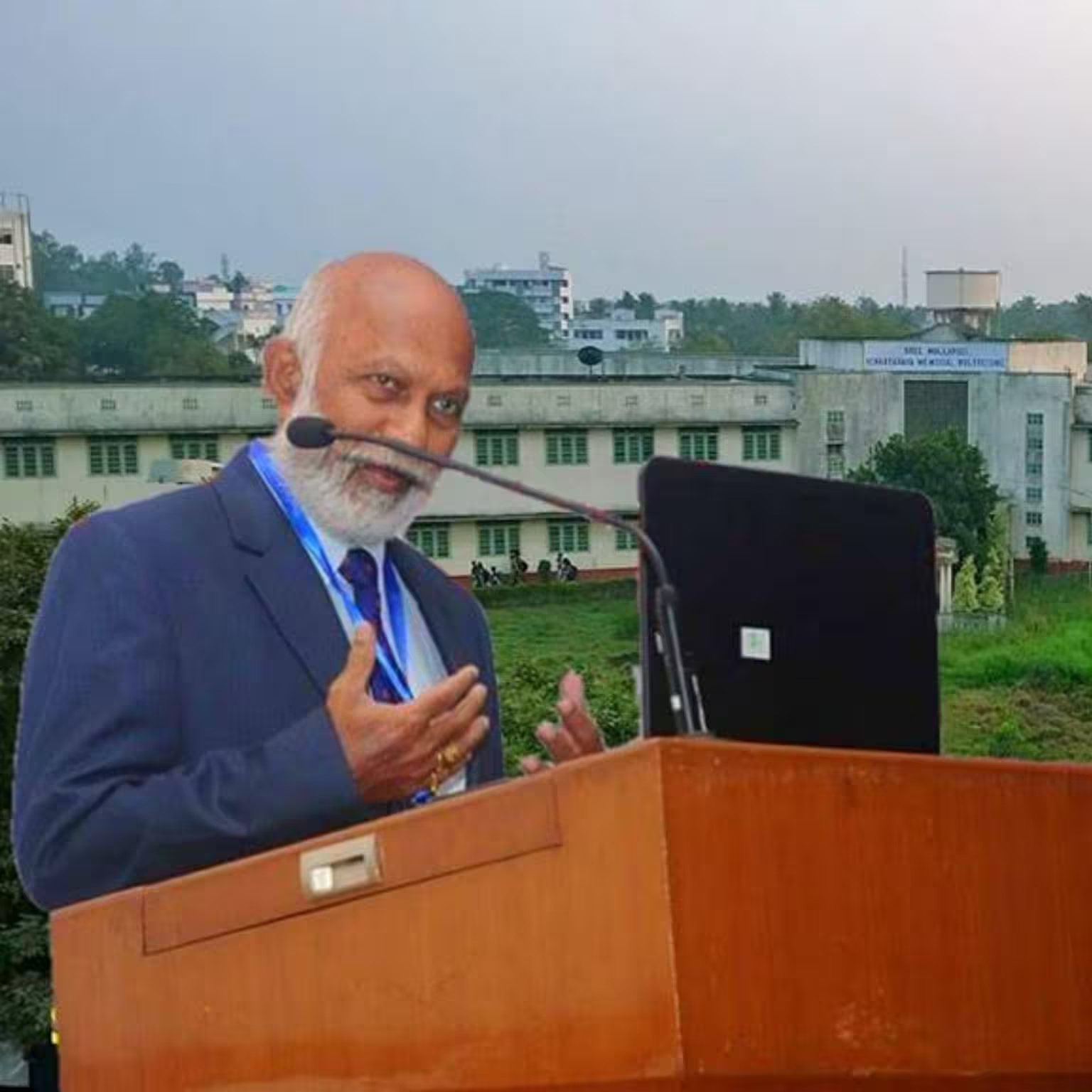
The Constraints Became Part of the Method
Financial limitations were among the earliest obstacles Murali encountered. They restricted access to opportunities before he had even reached the point of considering them. His response was not to wait for circumstances to change, but to find another route, working while studying, attending night school, and building qualifications alongside employment.
Technical challenges presented a different kind of problem. Working at the edge of what was already known often meant that the answer simply did not exist in a textbook. He learned through self-study, seminars, conversations with knowledgeable people, and a willingness to keep looking until something made sense.
The most complicated challenges, however, were often human. Some people want to lead while others create obstacles for those around them. Murali studied personality and psychology seriously enough to eventually write about it himself. His response to difficult personalities remained consistent: keep his head down, control the ego, work honestly, and stay focused on the task.
It was not always the most dramatic approach. It was the one he found reliable.
What Decades of Experience Have Taught Him
His advice to people beginning their careers starts with a warning against chasing titles. Rising quickly without developing the foundation required to sustain that position, he believes, eventually catches up with people. He has seen enough careers to know that advancement without substance rarely lasts.
Honesty, in his view, should not be treated as a professional strategy. It should simply become part of how a person operates. Cutting corners may appear to offer an advantage early, but over time, he believes, those choices have a way of revealing themselves.
Continuous learning is equally non-negotiable. It should not begin only when circumstances force someone to adapt. The learning should already be part of the way a person lives and works. He also encourages people to accept assignments that initially appear too large or complicated. Those are often the situations in which the greatest growth takes place.
For Murali, leadership is not about standing above people and directing them. It is about integrating their efforts and helping the group move forward together.
And alongside knowledge, he believes empathy must grow deliberately as well.
That may be the quietest lesson in a career built around solving problems: knowing more matters, but understanding people matters too.
Murali Krishna Chemuturi is a Freelancer Consultant associated with Chemutri Consultants, with fifty-five years of experience across software engineering, project management, process certification, and organizational problem-solving. He has authored nine books on technology and management, prescribed at the postgraduate level in more than 60 universities across over 20 countries, and held in more than 800 libraries worldwide, including Stanford, Princeton, and CERN. He continues to mentor, consult selectively, and translate ancient Sanskrit texts into English.