
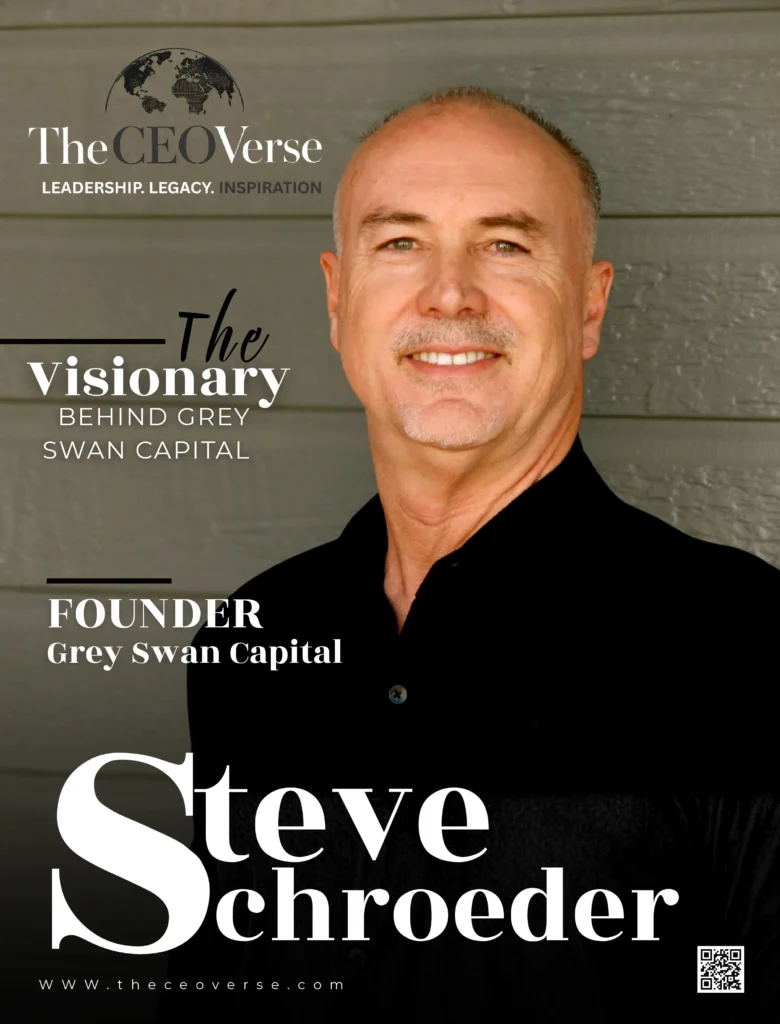
TheCEOVerse • Digital Edition
“The Visionary Behind Grey Swan Capital”
Cover story
Steve Schroeder
Featured Profile - Steve Schroeder
Steve Schroeder: The Entrepreneur Betting on What Comes Next
There is a familiar way to tell the story of an entrepreneur. Start with the company. Add the funding, the milestones, the product, the market opportunity, and perhaps a few impressive numbers. End with a prediction about the future. Steve Schroeder’s story is harder to fit into that template. His career has moved across customer loyalty, mobile technology, fundraising, Bitcoin, decentralized systems, community development, artificial intelligence, real estate, and capital strategy. On the surface, these may look like unrelated chapters. Look more closely, however, and a consistent idea begins to emerge. Schroeder is interested in building systems that give people more agency over money, technology, information, and community. That philosophy now sits behind an increasingly ambitious ecosystem involving Smart Community Technologies, FAAST, DeCoy, NOSTR Fundraising, Grey Swan Capital, and Grey Swan Real Estate. The latest chapter is perhaps the most consequential. In August 2026, Grey Swan Capital announced what it calls “Hedge Fund as a Service,” a membership based model intended to give individuals access to research, education, real estate intelligence, tax tools, and AI powered decision support without putting their assets into a traditional percentage of assets management structure. At the same time, Schroeder is developing Grey Swan Real Estate as something considerably larger than another property marketplace, an AI native operating system intended to connect property intelligence, listings, capital, financing, contractors, tax and legal services, and eventually Bitcoin and emerging eCash infrastructure. For Schroeder, these aren’t separate bets. They are pieces of the same thesis. And that thesis begins with a deceptively simple question:
What if technology were designed to make ordinary people less dependent on the systems around them?
The Entrepreneur Who Looks for the Signal Beneath the Noise
Schroeder’s business philosophy is easiest to understand through the concept behind the name “Grey Swan.”A Black Swan is traditionally associated with an event that is extremely difficult to anticipate. A Grey Swan is different. The possibility is visible. The signals are already there. What remains uncertain is precisely when the consequences will become impossible to ignore. That distinction is important because much of Schroeder’s entrepreneurial career appears to have been built around recognizing changes before they become mainstream. Long before decentralized finance became a familiar phrase, he was working with loyalty systems and alternative approaches to customer engagement. Before Bitcoin became an institutional talking point, he was studying how digital scarcity, payment networks, and property rights could alter the relationship between individuals and money. Schroeder has spent more than two decades in the customer loyalty space, with earlier ventures including Bowling Rewards and Loyal Patron before he launched Smart Community Technologies in 2017 and DeCoy in 2021.The pattern is revealing. He doesn’t appear to approach technology primarily as a gadget or as a fashionable industry category. He approaches it as a set of ingredients. One technology might solve one part of a problem. Another might solve another. The entrepreneurial opportunity lies in combining them. Being aptly called the “Master Chef of Technologies”, a metaphor that captures this approach unusually well. Rather than insisting on inventing every ingredient, the entrepreneur studies what already exists and asks how those ingredients can be composed into something useful. That mindset explains why his portfolio appears so diverse while remaining philosophically coherent.
A Career Shaped by Reinvention
The evolution of Schroeder’s career has not followed a straight line. His earlier work was rooted in customer loyalty and marketing technology. Those industries taught him something that would become increasingly important later that businesses do not operate in isolation. They operate through networks of relationships between companies, customers, communities, incentives, and information. The technology changes. The underlying problem does not. How do you create an incentive for people to participate? How do you make transactions more valuable? How do you help businesses retain customers? How can communities benefit from the economic activity taking place around them? Those questions eventually led Schroeder toward mobile technologies and, later, Bitcoin and decentralized infrastructure. There is a turning point in 2014, when Schroeder collapsed from cardiac arrest during a development meeting shortly after beginning a new professional chapter. He was initially pronounced dead before being transported to hospital and ultimately surviving the event. It is a remarkable episode, but its significance lies in what came afterward. Schroeder has connected entrepreneurship with purpose, service, faith, and the desire to help other people build greater independence. His published work has repeatedly returned to the idea that technology should not simply generate financial returns but it should help people retain ownership and create meaningful economic opportunities. That distinction matters as for Schroeder, innovation is not merely about moving faster but moving toward a new direction.
From Customer Loyalty to Community Infrastructure
Smart Community Technologies represents an important bridge between Schroeder’s earlier entrepreneurial work and the ecosystem he is building today. The company has explored mobile technology, loyalty, fundraising, Bitcoin, Lightning, and community oriented applications. DeCoy, or Decentralized Community Trust and Loyalty, extends that thinking into decentralized customer relationships, while FAAST (Fundraising as a Service Technologies) applies technology to fundraising. NOSTR Fundraising takes the concept further still, combining fundraising with decentralized communication and emerging Bitcoin and eCash technologies. The common thread is participation. Traditional systems frequently place an intermediary between the individual and the economic activity they are trying to access. The intermediary may provide something valuable, but it also controls the rules, the data, the infrastructure, or the transaction. Schroeder’s preferred model is different. He wants the infrastructure to become more open and composable, allowing different technologies to work together while preserving greater control for participants. The philosophy is stated unusually directly in the Grey Swan Real Estate business plan, that profits are important, but the goal is to create them through structures in which buyers, sellers, capital partners, service providers, communities, and the platform can all benefit. That is not a conventional venture capital slogan. It is closer to an architectural principle. Build the incentives correctly, and the economics can reinforce the mission rather than undermine it.
The Problem Schroeder Wants to Attack Next
If there is one industry where Schroeder believes the old architecture is particularly vulnerable, it is real estate. Real estate is enormous, valuable, and deeply fragmented. Yet many of its most important systems remain surprisingly closed. The Grey Swan Real Estate business plan argues that MLS infrastructure remains largely gatekept, while consumers and professionals must navigate a maze of listing platforms, commissions, contractors, lenders, legal providers, tax specialists, and other disconnected services. Schroeder’s response is not to build another Zillow but to rethink what a real estate platform actually is. Grey Swan Real Estate is envisioned as a complete operating system in which properties can be discovered, analyzed, listed, matched, financed, renovated, sold, rented, or converted into notes. AI would continuously evaluate opportunities, buyer and seller propensity, distress signals, and potential exit strategies. In other words, the listing is only the beginning. The real product is the infrastructure around the transaction.

Turning Property Data Into Intelligence
Arkansas Becomes the Laboratory
For all the scale of Schroeder’s ambitions, the initial strategy is strikingly local. Grey Swan Real Estate’s launch strategy centers on Arkansas, particularly the Conway and Clarksville corridors. The reasoning is straightforward. Artificial intelligence is driving an enormous build out of data centers. Data centers need land, electricity, water or alternative cooling systems, infrastructure, construction workers, engineers, suppliers, and eventually a much larger ecosystem of businesses and residents. When billions of dollars of infrastructure arrive in a previously underpriced market, the consequences rarely stop at the project boundary. Housing demand changes.Commercial demand changes. Transportation changes. Employment changes. Tax bases change. Property values can change. The Grey Swan business plan identifies Conway and Clarksville as particularly compelling examples of this dynamic, citing a major data center campus associated with Conway and a Serverfarm project in Clarksville described in the plan as a $6.6 billion to $8 billion development. It argues that these investments can create employment, infrastructure expansion, housing demand, and commercial activity before the wider market fully incorporates those effects into property pricing. That is the Grey Swan strategy in miniature. Don’t wait until a trend becomes obvious. Build the tools where the signal is already visible. Then prove the model locally. Then expand.
The Capital Layer Changes the Equation
A marketplace by itself would make Grey Swan Real Estate interesting. The capital layer makes the concept considerably more ambitious. Schroeder envisions the platform not only as a place where investors discover opportunities, but as an engine capable of sourcing, underwriting, acquiring, improving, and exiting properties at scale using third party capital. This creates a feedback loop. Better intelligence can produce better deal flow. Better deal flow can create more opportunities for capital. More capital can finance more transactions. More transactions generate more information. More information can improve the intelligence layer. The result, if successfully executed, would be something much closer to a financial operating system than a real estate website. That is an important distinction for investors and entrepreneurs watching the project. The ambition isn’t merely to reduce the cost of finding a house. It is to connect information, execution, and capital.
The Challenge to Commission Economics
Perhaps the most immediately disruptive element of Grey Swan Real Estate is also one of the simplest. The proposed economics are intentionally low cost. The business plan outlines a target one time $25 listing fee for licensed agents and a similarly low cost FSBO listing model, while envisioning a membership of approximately $100 per month for users seeking access to more advanced AI search, buyer databases, and related tools. The philosophy is clear that if technology has reduced the marginal cost of publishing, searching, matching, and coordinating information, why should the economic structure of real estate continue to resemble an era when those processes were expensive? The answer, Schroeder argues, is not to eliminate professionals. It is to change where value is captured. Agents, contractors, lenders, title companies, tax professionals, attorneys, investors, landlords, and other participants could remain part of the ecosystem. The difference is that the platform attempts to reduce friction between them. That is why Grey Swan describes itself as an operating system rather than simply a marketplace.
The Same Philosophy Moves Into Finance
The real estate strategy leads naturally into Schroeder’s newest financial proposition. In August 2026, Grey Swan Capital announced “Hedge Fund as a Service,” a membership model intended to provide individuals and families with access to research, education, real estate intelligence, tax tools, community benefits, and AI powered decision support for a flat monthly fee rather than a traditional percentage of assets under management. The proposed pricing is illustrative, with the announcement pointing toward a membership around $99 per month. Consider the contrast. A conventional 2% annual management fee on a $1 million portfolio equals $20,000 a year. Grey Swan’s conceptual alternative is not simply “pay less.” It is learn more and retain control. Members would receive tools and education designed to help them evaluate opportunities and make their own capital-allocation decisions. This is a significant philosophical shift. The conventional financial model often assumes that the professional should permanently retain the expertise while the client permanently retains the money. Schroeder’s model attempts to transfer more of the expertise outward. The client keeps the capital. The platform provides the intelligence. AI becomes the force multiplier.

AI as a Democratizing Force
This may ultimately prove to be one of the most important elements of Schroeder’s vision. For decades, sophisticated financial analysis was expensive because expertise was scarce. Research teams cost money. Analysts cost money. Data cost money. Specialized knowledge was difficult to access. Artificial intelligence changes that equation. It does not eliminate the need for judgment, but it can dramatically reduce the cost of research, pattern recognition, information retrieval, and decision support.Grey Swan Capital’s announcement explicitly frames AI as one reason the traditional justification for permanent high percentage fees is weakening. That argument fits neatly into Schroeder’s broader philosophy. Technology should not simply make institutions more powerful. It should make individuals more capable. That is a subtle but consequential difference.
Ownership Is the Operating Principle
Underlying both Grey Swan Capital and Grey Swan Real Estate is a deeper concern with ownership. The Grey Swan Real Estate plan states the principle plainly, if individuals do not hold the keys, they do not truly own the thing. The document consequently emphasizes cryptographic identity, private relays, multi party custody, and privacy preserving infrastructure for information and capital that requires greater control. This is where Schroeder’s interest in Bitcoin and NOSTR becomes more than a technology preference. It becomes a governance philosophy. Who controls the identity? Who controls the data? Who controls the money? Who controls the communication channel? Who can change the rules? And what happens when a platform becomes so powerful that users can no longer leave? Schroeder’s answer is to favor open protocols and composable infrastructure wherever possible. That philosophy also explains the project’s interest in Nostr-native collaboration tools and local knowledge-graph infrastructure. The Grey Swan plan references open source tools such as Buzz and Graphify as examples of infrastructure that can support human and AI collaboration while keeping identity, history, and knowledge closer to the users and their own systems. The broader idea is sovereignty by design.
From Platform to Ecosystem
The initiatives that Schroeder is building fit together like an ecosystem. Smart Community Technologies provides the broader technology foundation. FAAST applies technology to fundraising. DeCoy explores decentralized community loyalty. NOSTR Fundraising connects communication, incentives, and community support. Grey Swan Capital focuses on capital intelligence and individual empowerment. Grey Swan Real Estate applies the philosophy to one of the world’s largest asset classes. The connective tissue is not the technology itself. It is the belief that economic systems can be redesigned so participants retain more control and receive more of the value they help create. FAAST is particularly revealing in this regard. Grey Swan Capital’s press release describes FAAST as one of the earlier fundraising as a service platforms created specifically for children, special needs communities, and local causes, and presents that experience as part of the intellectual lineage behind the new capital model. The progression is striking.
First: help communities raise money.
Then: help businesses build stronger relationships.
Then: help individuals understand new financial technologies.
Now: help people participate more directly in capital allocation and real estate.
The product categories change. The mission does not.
Profit Is Not the Enemy
Perhaps the most interesting thing about Schroeder’s philosophy is that it does not reject profit. It insists on it. The Grey Swan Real Estate plan repeatedly argues that profits are necessary because independence requires sustainable economics. The objective is not to build a nonprofit version of a technology platform. It is to build a profitable company whose profits arise from creating more value than it extracts. That is a significant distinction. A business that cannot make money cannot remain independent indefinitely. But a business that can make money only by increasing extraction eventually creates incentives to exploit its users. Schroeder is trying to occupy the space between those extremes. The goal is a sustainable enterprise in which lower friction for customers can coexist with attractive economics for the platform and better outcomes for capital partners. The business plan calls this a “win win” structure. It is perhaps the simplest description of the entire Grey Swan thesis.
Building Before the Market Is Ready
The biggest challenge facing Schroeder may also be the most obvious. Ambition is not execution. The systems being proposed are complex. Real estate, finance, tax, legal services, AI, Bitcoin, NOSTR, eCash, capital management, privacy, and marketplace economics each come with their own technical, regulatory, and operational challenges. The Grey Swan roadmap acknowledges this implicitly by starting with a concentrated local deployment. Phase One, covering the current period through the fourth quarter of 2026, calls for completion of the AI dashboard, concentrated property and participant databases in Conway and Clarksville, initial listing tools, controlled capital deployment, and secure coordination infrastructure. Later phases envision broader marketplace expansion, lending and tax integrations, deeper NOSTR Fundraising functionality, Bitcoin related financial products, national expansion, and institutional capital partnerships. This is not a “build everything at once” strategy. It is a tracer bullet strategy. Find a high conviction market. Build the minimum architecture necessary to create real value. Prove that people will use it. Then expand the system. That approach may ultimately be more important than any individual feature.

The Executive as Systems Architect
What makes Steve Schroeder particularly interesting for the next generation of business leadership is that his role increasingly resembles that of a systems architect. He is not simply asking “What company should I build?” He is asking, “What pieces need to exist for an entirely different economic system to function?” That is a much bigger question. It requires thinking simultaneously about technology and incentives, capital and communities, data and privacy, business models and human behavior. It also requires patience. Many of the technologies Schroeder is interested in are still developing. AI is changing the economics of knowledge work. Bitcoin is evolving as both a monetary network and financial infrastructure. NOSTR is experimenting with decentralized communication. eCash and federated systems are exploring new approaches to digital value. Data center investment is reshaping local economies. None of these developments guarantees success. But together, they create an environment in which the old boundaries between technology companies, financial companies, real estate platforms, and community infrastructure are becoming less rigid. That is the environment Schroeder is positioning himself inside.
A Different Definition of Scale
For many CEOs, scale means reaching more customers. For Schroeder, scale appears to mean something broader, that making a better set of tools available to more participants without recreating the centralized structures those tools were designed to replace. That is why the Grey Swan architecture emphasizes composability. The company does not need to own every layer. It can connect good primitives. AI can provide intelligence. NOSTR can provide communication. Bitcoin can provide monetary infrastructure. eCash can potentially provide privacy preserving transfers. Local knowledge graphs can provide organizational memory. Real estate databases can provide market intelligence. Professional networks can provide human execution. Capital can provide the fuel. The platform becomes the connective tissue. That is a fundamentally different philosophy from the traditional “walled garden” approach to technology.
The Grey Swan Is Already Visible
There is a final irony in the story. Schroeder’s entire philosophy is built around identifying Grey Swans, developments whose significance is visible before their ultimate impact is fully understood. Yet his own work could be viewed through precisely that lens. AI is changing the economics of research. Data centers are transforming local real estate markets. Bitcoin is forcing institutions to reconsider digital property and monetary infrastructure. Decentralized protocols are challenging assumptions about identity and platform ownership. Individuals are increasingly asking whether they should outsource every financial decision to an institution. And communities are looking for ways to capture more of the economic value generated around them. None of these trends is secret. The question is what they become when combined. That is where Steve Schroeder is placing his bet.
The Road Ahead
There is no guarantee that Grey Swan Real Estate will become the “operating system” for real estate envisioned in its business plan. Nor does the launch of Hedge Fund as a Service guarantee that consumers will embrace a membership based alternative to traditional asset management. The proposals remain ambitious, and the Grey Swan Real Estate plan itself emphasizes that its arrangements, fees, digital asset products, capital structures, and cross border activities will require legal, tax, and regulatory review. It also explicitly warns that real estate investing carries substantial risk and that the document is a strategic discussion draft rather than an offer of securities or investment advice. But perhaps that is precisely why Schroeder’s story is worth watching. The most consequential entrepreneurs are rarely interesting because they already possess certainty. They are interesting because they recognize uncertainty early enough to build around it. Schroeder sees a world in which AI makes sophisticated intelligence cheaper, in which open protocols make platforms less indispensable, in which digital assets alter ideas of ownership, in which infrastructure investment creates new real estate opportunities, and in which individuals increasingly want to understand and control their own capital. His response is not one product. It is an ecosystem.
The Bet Behind the Grey Swan
In the end, Steve Schroeder’s entrepreneurial journey can be understood as a progression from transactions to systems, from systems to networks, and from networks to empowerment. He began by exploring how businesses could build better relationships with customers. He moved into technologies that could help communities and organizations raise money. He embraced Bitcoin and decentralized infrastructure as tools for rethinking ownership and financial participation. Now he is bringing those ideas into capital and real estate. The common denominator is not Bitcoin. It is not AI. It is not real estate. It is not even technology. It is agency.
Who gets to participate?
Who gets to own?
Who gets access to information?
Who gets to make the decision?
Who captures the value?
And can a profitable company be designed so that its success does not require everyone else to lose?
Those questions are at the heart of the Grey Swan philosophy. For Schroeder, the future of business is not necessarily about building the biggest gatekeeper. It may be about building infrastructure that makes gatekeepers less necessary. That is a considerably harder business to build. It is also a considerably more interesting one. As Grey Swan Capital moves toward its membership model and Grey Swan Real Estate moves from strategic blueprint toward local implementation, Schroeder’s next chapter will provide a real world test of the philosophy he has spent years developing. The experiment is beginning in Conway and Clarksville. The ambition is national. And the underlying bet is that the next great business advantage will not belong exclusively to those who control the largest pools of capital or data.It will belong to those who can see the signal early, connect the right technologies, align the incentives, and give more people the tools to act on what they see.That, ultimately, is Steve Schroeder’s Grey Swan. Not a prediction of the future. A business built around getting ready for it.