
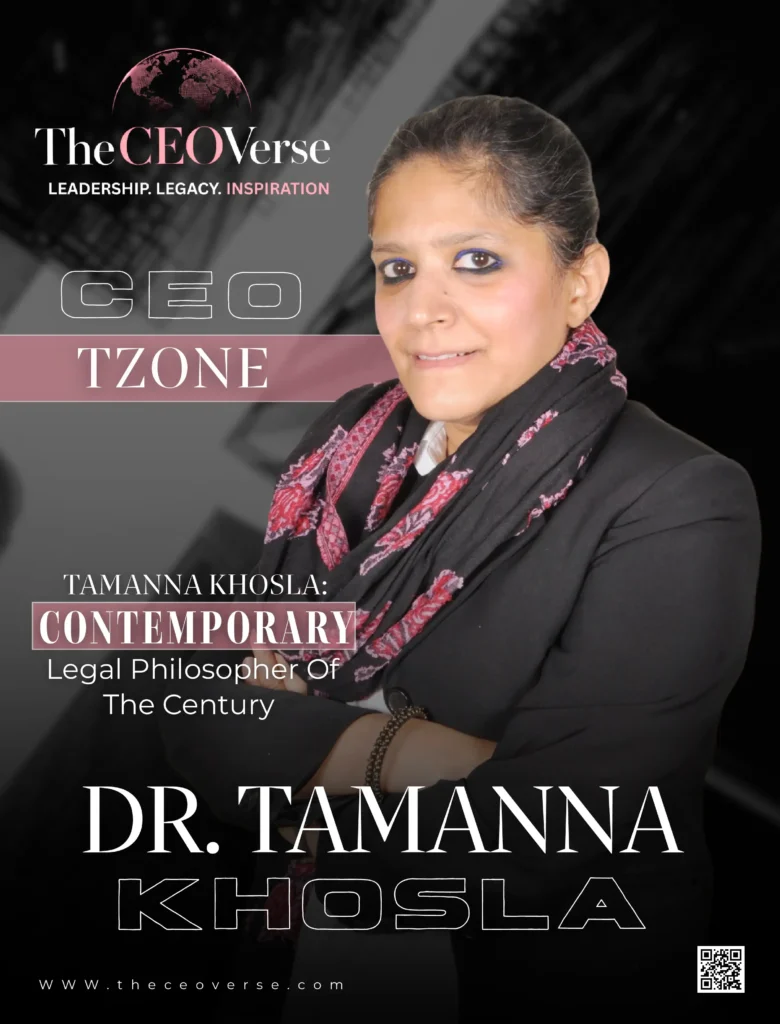
TheCEOVerse • Digital Edition
” Contemporary Legal Philosopher Of The Century”
Cover story
Tamanna Khosla
Featured Profile - Tamanna Khosla
A political philosopher turned legal scholar and institution builder, Dr. Tamanna Khosla has carried her enduring questions around power, freedom, gender, and oppression across an unconventional intellectual journey.
An Unconventional Journey Through Academia, Law, and Ideas
Dr. Tamanna Khosla’s intellectual journey has never followed a conventional academic trajectory. Her earliest interests were directed towards science, yet by her senior secondary years, political science and the humanities had begun to command her attention. At Lady Shri Ram College, her engagement with feminism and international relations developed into a deeper intellectual interest, one that would continue to influence the direction of her career.
Her master’s at Jawaharlal Nehru University further expanded that foundation, bringing politics, gender, oppression, and social structures into sharper focus. By the time she pursued her M.Phil and PhD, law and philosophy had become equally significant to her intellectual pursuits, allowing her to examine questions of society and power through multiple disciplines.
Her doctoral work eventually led to a teaching position at Delhi University. That academic chapter, however, ended unexpectedly. Khosla describes facing hostility within academia that resulted in her removal and subsequently created difficulties in securing another academic position.
The interruption did not bring her intellectual journey to a halt. Instead, it pushed her beyond the conventional boundaries of academia. Over time, she authored ten books, pursued a law degree, and established herself as a public intellectual, legal scholar, feminist thinker, and institution builder. Today, as CEO of TZONE, she continues to operate at the intersection of ideas, leadership, law, and social thought.
Faith as a Foundation for Direction and Resilience
Throughout the different phases of her life, faith has remained an important source of direction for Khosla. Rather than relying exclusively on professional frameworks or analytical models when confronting difficult choices, she has consistently drawn strength from her belief in a higher power and spiritualism.
This belief has provided continuity across periods of uncertainty and transition. At moments when professional circumstances or external expectations could have determined the course of her journey, faith offered an alternative source of clarity and resilience.
It is a foundation that has remained present across both her intellectual pursuits and the personal challenges she has encountered along the way.
An Ability to Observe What Remains Unspoken
Khosla’s approach to people is shaped by a combination of faith in human goodness, trust in God, and a particularly perceptive understanding of human behaviour.
Her ability to read people accurately is perhaps the least visible of these qualities. It does not rely on drawing attention to itself. Instead, it functions quietly, allowing her to observe individuals, understand circumstances, and recognise dynamics that may not always be explicitly communicated.
This instinct for observation has become an important element of her decision-making process. Understanding people, their motivations, and the environments in which they operate allows her to look beyond immediate appearances and approach situations with a broader perspective.
A Mind That Looks for the Solution Before the Question Is Fully Formed
One of the defining characteristics of Khosla’s intellectual approach is her tendency to think beyond the problem immediately presented to her. She believes she can often identify a possible solution before a problem has been completely articulated.
Rather than treating this ability as simple intuition, her intellectual philosophy places continuous learning at its centre. Knowledge, in her view, does not belong exclusively to formal institutions or established disciplines.
People from different countries and generations can offer valuable perspectives. Unexpected situations can reveal important lessons. Even the observation of organisms and the natural world can contribute to a broader understanding of how systems function and evolve.
This openness to learning from virtually every source has shaped a worldview that values observation over limitation and curiosity over rigid intellectual boundaries.

A Research Institution for Minds Beyond Conventional Boundaries
The institution Khosla is working to establish reflects this expansive intellectual philosophy.
The proposed research organisation is intended to bring together what she describes as “nerds and geniuses” from across the world—individuals whose curiosity, intelligence, and unconventional approaches may not always find an appropriate home within traditional academic structures.
Its intended scope extends well beyond a single discipline. Contemporary global challenges would form part of its research agenda, alongside questions reaching into philosophical, legal, social, and even extraterrestrial possibilities.
At the same time, the institution would examine oppression through multiple dimensions, including race, class, gender, geography, and broader social structures. The objective is to develop new philosophical and legal frameworks capable of engaging with questions that existing systems may not adequately address.
The vision is ultimately one of intellectual freedom: a space where unconventional thinkers can challenge established assumptions, connect ideas across disciplines, and explore questions without being confined by traditional boundaries.
Building the Resources Required for Intellectual Freedom
Turning such an ambitious vision into reality requires more than intellectual capital. It requires financial independence and sustained resources.
Over the coming five years, Khosla’s focus is therefore expected to remain strongly connected to building the financial foundation necessary to establish the institution and bring the right people into its fold.
The purpose of funding is not expansion for its own sake. It is about creating an environment in which talented individuals can devote themselves to meaningful work without financial limitations becoming a constant obstacle.
For Khosla, resources are directly connected to intellectual freedom. A capable thinker should not be prevented from pursuing a significant question simply because the infrastructure, funding, or support required to investigate it is unavailable.
The model she envisions is therefore built around three essential elements: secure the financial foundation, bring together exceptional minds, and provide them with the freedom and resources required to concentrate on meaningful work.
A Journey Marked by Resistance and Perseverance
Khosla’s experiences with resistance have extended beyond academia. Her account of her journey includes experiences of severe oppression within her family, Indian society, and academic environments, circumstances that she says continued across decades.
Navigating these challenges as a woman, often without the support she needed from those around her, became an important part of her personal and intellectual evolution.
Yet the narrative of her journey is not defined solely by resistance. It is equally shaped by perseverance. Through circumstances that repeatedly challenged her ability to move forward, she continued developing her intellectual work, expanding her knowledge, writing, studying law, and building a professional identity beyond the institutions that had once defined her career.
At the centre of that resilience has remained her faith in God, which she identifies as her most enduring source of support.
Learning From Excellence Without Losing Individuality
Khosla’s philosophy of influence is rooted in a distinction between learning and imitation.
Excellence, in her view, should not create envy. Those who demonstrate exceptional intelligence, achievement, or capability can instead become sources of learning. Their work can be studied, their journeys understood, and their methods examined for the lessons they offer.
But learning should ultimately lead back to individuality.
Another person’s work belongs to them, and genuine intellectual growth requires developing an independent path rather than reproducing someone else’s. The objective is not to become another version of an accomplished individual, but to use exposure to excellence as a foundation for creating something original.
Her perspective on financial resources follows a similar principle. Money is necessary for building institutions, supporting people, and transforming ambitious ideas into functioning realities. Yet financial gain should not become the central purpose of an initiative whose deeper objective is freedom and egalitarianism.
For Khosla, exceptional thinkers deserve more than recognition. They deserve access to resources, intellectual independence, and the freedom to pursue difficult questions without unnecessary restrictions.
That philosophy sits at the heart of the institution she hopes to build and reflects the larger intellectual journey she has pursued throughout her career—one shaped by curiosity, resistance, faith, independent thought, and an enduring commitment to questioning the structures that define society.