
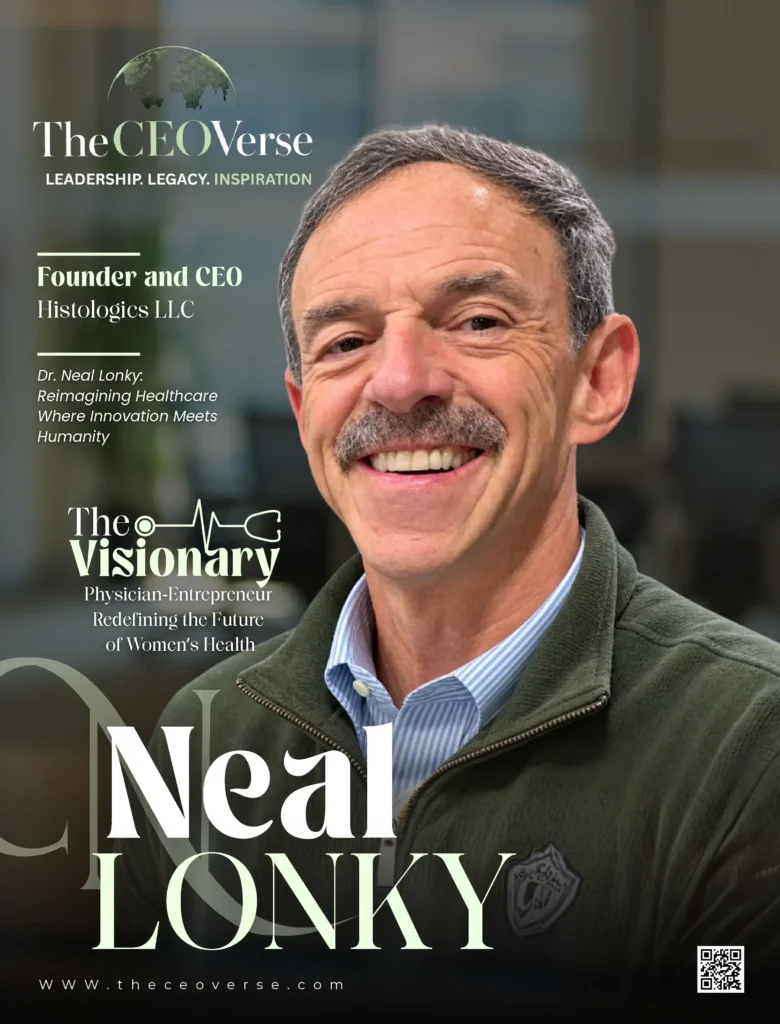
TheCEOVerse • Digital Edition
“The Visionary Physician-Entrepreneur Redefining the Future of Women’s Health”
Cover story
Neal Lonky
Featured Profile - Neal Lonky
Dr. Neal Lonky: Reimagining Healthcare Where Innovation Meets Humanity
Medicine has always advanced through remarkable discoveries. Yet, the greatest breakthroughs seldom begin inside laboratories alone. More often, they emerge from individuals willing to question accepted norms, challenge systemic inefficiencies, and redefine what better healthcare should look like, not merely for physicians or institutions, but for every patient navigating an increasingly complex healthcare ecosystem.
In an era where healthcare conversations are increasingly dominated by artificial intelligence, precision medicine, predictive analytics, and digital transformation, it is easy to become captivated by technological possibilities. Dr. Lonky offers a markedly different perspective. He believes innovation earns its significance only when it creates measurable improvements in the lives of patients while remaining accessible, compassionate, and sustainable within the broader healthcare continuum.
Seeing Healthcare as an Integrated Ecosystem
Rather than viewing healthcare through a single professional lens, he has spent decades operating simultaneously as physician, researcher, educator, entrepreneur, inventor, and executive leader. Each role has offered a unique understanding of healthcare’s strengths and shortcomings. Collectively, they have enabled him to recognize something many specialists overlook: that medical excellence is rarely the result of one breakthrough alone. Instead, it emerges through thoughtful coordination between clinical evidence, technological innovation, healthcare economics, policy, physician adoption, and, above all, the patient experience.
This integrated thinking has become increasingly relevant as healthcare systems worldwide grapple with rising costs, aging populations, physician shortages, fragmented care pathways, and accelerating technological disruption.
Innovation Without Losing the Human Touch
For many innovators, disruption itself is often celebrated as success. Dr. Lonky approaches disruption with greater restraint. His philosophy acknowledges that transformative ideas inevitably challenge established systems. Yet successful innovation is not measured by how dramatically it overturns existing practices, but by how effectively it improves outcomes without creating unnecessary barriers for patients or providers. When innovation becomes excessively disruptive, resistance naturally follows from institutions invested in maintaining the status quo. Sustainable progress, therefore, requires not only scientific excellence but strategic understanding of how healthcare systems evolve.
This measured perspective has informed virtually every chapter of his professional journey.
His work has consistently focused on making healthcare more precise, less invasive, easier to access, and more affordable without compromising clinical quality. Whether advancing women’s healthcare technologies, contributing to electronic medical record transformation, participating in healthcare governance, or developing new medical devices, the underlying objective has remained remarkably consistent: place patients at the centre of every decision while ensuring every healthcare dollar creates meaningful value.
“I am a patient also.”
Those four words reveal a philosophy that extends beyond medicine. They underscore the belief that every physician, innovator, policymaker, and healthcare executive ultimately shares the same vulnerability as the people they serve. It is this perspective that ensures innovation never loses sight of empathy, a quality he believes should remain at the heart of every technological advancement.

Redefining Women’s Healthcare Through Accessible Innovation
Perhaps nowhere is this philosophy more evident than in his work within women’s healthcare. For decades, many aspects of women’s health have remained constrained by conventional clinical pathways, delayed diagnoses, accessibility challenges, and significant disparities in screening and preventive care. Rather than accepting these limitations as inevitable, Dr. Lonky viewed them as opportunities for thoughtful reinvention.
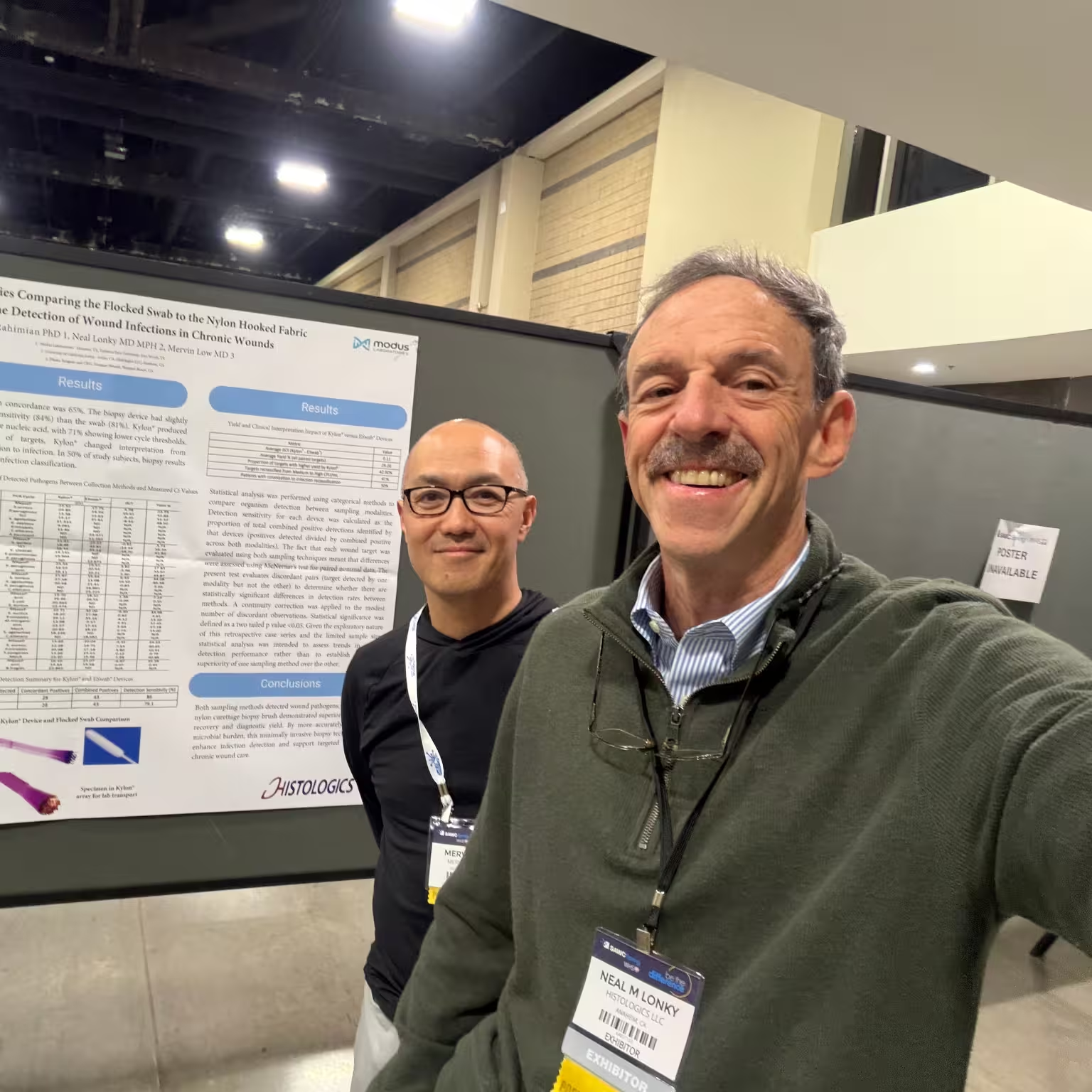
Among his most impactful contributions are innovations in cervical cancer screening and biopsy. Speculoscopy, a legacy visual adjunct popular in the 2000s, remains in use today as part of screening pathways. Building on this foundation, Dr. Lonky advanced tools such as SpiraBrush® and later the Kylon® brush biopsy. A more compassionate alternative now widely adopted. Devices like SoftBiopsy® and Soft-ECC® have redefined standards of care, offering highly diagnostic yet patient-friendly approaches to cervix, vaginal, and wound biopsies. Soft-ECC® in particular has become best-in-class, replacing painful metal curettes with a minimally invasive solution that preserves both diagnostic accuracy and patient comfort. The Soft K-Cot® that is finger controlled, “caring with a personal touch”, is a patient-friendly, versatile replacement for the sharp curette for chronic wound debridement. Again, patient-focused, value-based care intentions put into product deployment is the goal.
His conviction was straightforward yet powerful: maintaining or even improving the quality of care should never require patients to navigate greater complexity. This philosophy reflects a broader belief that healthcare innovation should not simply introduce new technologies; it should make exceptional care easier to deliver and easier to receive.
When Evidence Becomes the Ultimate Benchmark
Across healthcare, countless inventions demonstrate remarkable engineering. Far fewer redefine standards of care. The distinction, according to Dr. Lonky, lies not in technical sophistication but in clinical evidence. Every promising technology must ultimately answer one fundamental question: Does it genuinely improve lives?
The advantages of Kylon® are supported by strong clinical evidence and are now taught by professional societies training new physicians and nurses. These innovations have been deployed worldwide by Noah and other entities, particularly in low-resource, high cancer-burden countries, where they are transforming access to lifesaving care. This global adoption underscores how evidence-based innovation can bridge disparities and deliver compassionate healthcare at scale.
Evidence, not novelty, determines whether an innovation deserves widespread adoption. The objective is not simply creating devices capable of impressive performance; it is developing solutions that measurably enhance patient outcomes, prevent disease, improve quality of life, or save lives altogether.
Medical innovation rarely follows predictable timelines. Scientific validation, regulatory approvals, funding, physician acceptance, reimbursement pathways, and market adoption frequently demand years of sustained commitment before meaningful impact becomes visible.
He believes innovators must invest in scientific research with the same intensity they devote to business development, funding strategies, and commercial execution. Without rigorous evidence, even the most compelling technologies struggle to generate lasting clinical value. Conversely, research grounded in measurable outcomes creates the credibility necessary for long-term transformation.
Preparing Healthcare for the Age of Artificial Intelligence
Today, as healthcare enters one of the most technologically transformative periods in its history, Dr. Lonky remains optimistic but cautious. Artificial intelligence, advanced diagnostics, and increasingly sophisticated digital platforms possess extraordinary potential to reshape medicine. Yet technological capability alone does not guarantee better healthcare.
The quality of outputs will always depend upon the quality of underlying evidence. As he succinctly observes, flawed data inevitably produces flawed intelligence. Artificial intelligence may dramatically accelerate clinical decision-making, but only if the information guiding those decisions is reliable, comprehensive, and scientifically validated. Otherwise, healthcare risks automating inaccuracies rather than improving outcomes.
This perspective reflects the essence of his leadership philosophy. Progress should never be pursued for its own sake. Every innovation, every strategic decision, and every organisational initiative must ultimately be evaluated through one enduring measure: its capacity to improve the health, dignity, and lived experience of patients.
That commitment has transformed him from far more than a physician or entrepreneur. It has established him as a systems thinker whose work continues to bridge medicine, technology, governance, and human compassion, demonstrating that the future of healthcare belongs not to those who innovate the fastest, but to those who innovate with purpose.

Building Solutions That Redefine Standards of Care
Entrepreneurship in healthcare demands a mindset unlike any other industry. Success cannot be measured solely by market share, valuation, or commercial adoption. Every innovation carries a far greater responsibility: the potential to influence clinical decisions, improve quality of life, and, in many cases, determine whether patients live healthier lives.
This responsibility has shaped every venture he has pursued. His entrepreneurial journey has never been driven by the ambition to build companies alone, but by the desire to solve deeply rooted clinical challenges that conventional healthcare approaches have struggled to overcome.
This philosophy has guided his work across multiple medical technologies, where each innovation has been evaluated against a single benchmark: does it create demonstrable value for patients?
A truly transformative innovation must withstand the scrutiny of clinical evidence while proving its ability to improve outcomes in real-world settings. Only then can it begin to redefine standards of care rather than simply introducing another medical device into an already crowded landscape. Beyond women’s health, Kylon®’s versatility extends to wound debridement, filling a critical gap in chronic wound healing. Its ease of use and minimally invasive design make it a valuable tool for clinicians, offering a practical solution that accelerates healing while reducing patient discomfort. This adaptability demonstrates how a single innovation can create value across multiple domains of care.
This insistence on evidence has also shaped his understanding of business leadership. Research, he believes, should never become secondary to commercialisation. Investment in funding, marketing, and business development must be matched by equal investment in scientific validation. Sustainable healthcare companies are ultimately built not on compelling narratives, but on measurable improvements in patient care.
Innovation Beyond Intellectual Property
Few physician-entrepreneurs understand the delicate balance between protecting innovation and advancing global healthcare as intimately as he does. Intellectual property remains essential for encouraging investment, accelerating research, and rewarding innovation. Yet healthcare presents a unique ethical challenge. Medical breakthroughs possess an inherent social responsibility that extends beyond commercial ownership.
He approaches this dilemma with remarkable pragmatism. Innovators should protect the markets where they invest significant resources while recognising that truly valuable healthcare technologies will inevitably influence medical practice worldwide. Rather than fearing imitation, he sees it as evidence that meaningful progress has been achieved. His response is refreshingly simple: never stop innovating.
Continuous innovation, rather than permanent ownership, becomes the most sustainable competitive advantage in healthcare. In this philosophy lies a deeper understanding of leadership one that values lasting contribution over temporary exclusivity.
Leading Healthcare into the AI Era
Artificial intelligence is transforming nearly every aspect of medicine, from diagnostics and clinical documentation to predictive modelling and personalised treatment pathways. Yet amid the growing excitement surrounding AI, Dr. Lonky remains firmly grounded in one principle: technology can only be as reliable as the evidence that powers it.
He envisions AI becoming an indispensable clinical partner, particularly in situations where real-time decision-making determines patient outcomes. Whether assisting physicians during life-threatening emergencies or supporting the development of personalised care pathways for patients facing serious illnesses, intelligent systems possess the potential to dramatically enhance medical decision-making.
A real-world example is the research in AI-guided colposcopy still relies on biopsy, preferably minimally invasive comprehensive Kylon® biopsy devices to fill the gaps AI might miss. That is true integration and has been deployed and soon to be published in data generated around the world through the National Institutes of Health “PAVE” study and National Cancer Institute CASCADE study, and others.
https://pmc.ncbi.nlm.nih.gov/articles/PMC10945624/
https://prevention.cancer.gov/research-areas/networks-consortia-programs/cascade
Dr. Lonky cautions against treating AI as a substitute for scientific rigour. Algorithms trained on incomplete or inaccurate datasets risk amplifying clinical errors rather than preventing them. For healthcare leaders, therefore, the priority should not simply be adopting artificial intelligence; it should be strengthening the quality of evidence that informs it.
Looking ahead, he believes one of healthcare’s most significant advances will come from integrating evidence-based intelligence directly into electronic medical records, enabling clinicians to access real-time insights during patient encounters. Such capabilities could fundamentally reshape how physicians diagnose conditions, assess risks, and personalise treatment strategies, making healthcare not only faster but considerably more precise.
Leadership Rooted in Accountability
Throughout his career, Dr. Lonky has occupied positions that span both bedside care and executive leadership. This dual perspective as entrepreneur and practicing clinician board of director member of the Southern California Permanente Medical Group from 2002 to 2018 has profoundly influenced his understanding of what effective leadership truly demands. For him, transformational leadership extends far beyond operational efficiency or administrative excellence. It begins with culture.
Healthcare organisations perform at their highest level when every individual from physicians and nurses to administrators and executives feels personally invested in the complete patient journey. Accountability should never end when a patient leaves the consultation room. Instead, organisations should aspire to support patients throughout every stage of life, creating a continuum of care built upon trust, consistency, and shared responsibility.
This philosophy aligns naturally with the growing global shift toward accountable care models, where success is measured not by the volume of services delivered but by the long-term health outcomes achieved. Leadership therefore becomes less about directing organisations and more about cultivating environments where every decision ultimately serves the patient.
Preparing Tomorrow’s Healthcare Leaders
While technological innovation continues to accelerate, Dr. Lonky believes the future of medicine will depend equally upon the quality of its people. Having spent decades mentoring physicians, conducting research, and contributing to medical education, he remains deeply committed to preparing the next generation of healthcare leaders. (He remains a teacher and researcher at the University of California, Irvine, CA Department of Obstetrics and Gynecology.) Yet his greatest concern extends beyond scientific competence.
He believes future physicians must remain connected to the people they serve. Technology should strengthen, not replace, the human relationships that define exceptional healthcare. Whether consultations occur in person or through digital platforms, patients should always receive care in ways that make them feel understood, respected, and supported.
His experiences participating in medical missions earlier in his career reinforced another enduring lesson: access to healthcare remains one of medicine’s greatest challenges. Today, digital technologies and virtual care platforms are beginning to close those longstanding gaps, creating opportunities to extend quality healthcare to underserved communities that have historically remained beyond the reach of traditional systems.
A Legacy Measured in Lives Saved
Every distinguished career eventually raises a profound question. How should it ultimately be remembered? For many leaders, the answer lies in the companies they built, the titles they held, or the awards they received. Dr. Lonky offers a different perspective.
His career represents something increasingly valuable in modern healthcare: the ability to unite medicine, technology, entrepreneurship, governance, and human empathy within a single vision. As healthcare enters an era defined by artificial intelligence, digital transformation, and unprecedented scientific progress, his journey serves as a reminder that technology alone will never define the future of medicine. Delivering care with competent and effective compassion is what he seeks when he is a patient, and what he tries to deliver through his products, research, teaching, and services he provides.