
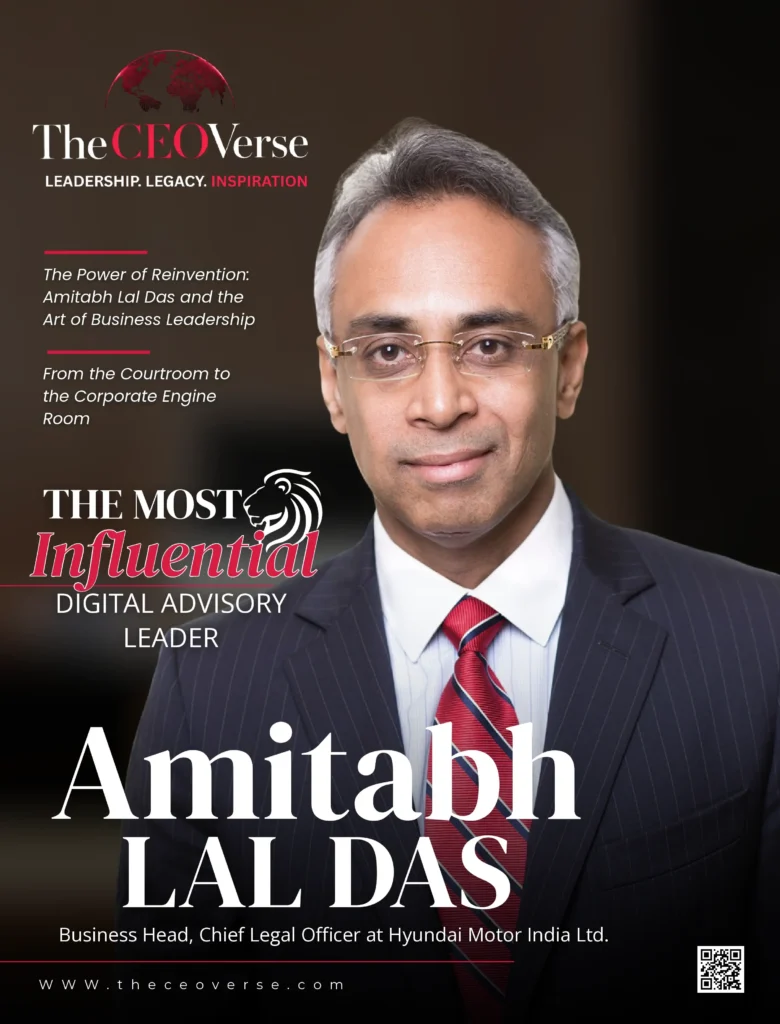
TheCEOVerse • Digital Edition
“The Most Influential Digital Advisory Leader”
Cover story
Amitabh Lal Das
Featured Profile - Amitabh Lal Das
The Power of Reinvention: Amitabh Lal Das and the Art of Business Leadership
From a small town beginning in erstwhile Bihar to the boardrooms of India’s leading corporations, the core of Amitabh Lal Das’s career rests on a simple premise: A great legal mind does more than safeguard a company, they propel it forward.
There are careers that follow a map, and then there are careers that are drawn while the journey is already underway. Amitabh Lal Das belongs to the second category. His professional story did not begin with an inherited corporate network, an established family name in law, or a carefully engineered route into the C suite. It began in a small town in erstwhile Bihar, present day Jharkhand, with a young man who eventually moved to Delhi after Class 10, entered the world of law, and gradually constructed a professional identity across courtrooms, law firms and some of the most consequential corporate environments in India.
Today, his career spans more than three decades and multiple industries. Technology services, internet and media, advertising, telecommunications, financial services, automotive manufacturing, and more. He has served as General Counsel and Chief Legal Officer in global and Indian corporations, developing expertise not only in law but also in compliance, corporate governance, public policy, regulatory affairs, risk management, finance, HR, internal assurance and, increasingly, artificial intelligence.
Yet the title of “Chief Legal Officer” only touches a mere fraction of the surface of Amitabh Lal Das’s story, the most significant parts lay deeper with a remarkable journey that Das took to become an outstanding architecture of business leadership. His evolution has been about understanding that law does not exist in isolation. It exists inside an organization. And an organization, in his view, is a living system. That distinction has shaped the philosophy with which he has approached nearly every major chapter of his career.
A Beginning Without a Safety Net
Before there was the boardroom, there was Delhi. Amitabh Lal Das was a first generation lawyer from a small town who came to the national capital after Class 10, without the social or family moorings that many young professionals might have taken for granted. His path into law was itself somewhat unconventional. He had initially aspired to become a civil servant, but when that route did not materialize, the legal profession became his chosen destination. What followed was not an overnight transformation. He first built his academic foundation at St. Stephen’s College, Delhi University, where he studied History, before moving to the University of Delhi’s Campus Law Centre. He completed his LL.B. in 1995.
The academic choice is revealing in retrospect. History, after all, is the study of systems, institutions, human behaviour and change. Those themes would later become central to the way Das understood organizations and leadership.
His early years were spent gaining exposure to the traditional foundations of legal practice. He worked in litigation, interacted with senior lawyers and developed an understanding of how law operated in practice rather than merely in textbooks. It was an education that would eventually become one of the most valuable assets in his career. The ability to see law both from the perspective of a practitioner and from the perspective of the business it serves.
When the Road Was Anything But Straight
Every successful career looks inevitable in hindsight. Almost none feel inevitable while they are being lived. Das’s early professional years were marked by precisely the kind of uncertainty that can test ambition. There was no established blueprint for becoming the kind of cross functional General Counsel he would eventually become. Even the city in which he was building his career presented challenges because he had arrived without the extensive social and infrastructural support systems that can make professional life easier. But instead of allowing those disadvantages to define his trajectory, he turned them into fuel.
In his own reflection on the journey, he describes those years as having “charged the fire in the belly”, a determination to learn and win despite the disadvantages. That period also gave him a lesson that would become increasingly important as his career matured. Control what you can control, do your best with the circumstances available to you, and do not spend your energy worrying about outcomes beyond your ability to shape. It is a philosophy that sounds simple. Living it is considerably harder.
The Scholarship That Changed the Lens
One of the defining moments of his early career arrived in 2000. Das was selected for the prestigious British Chevening Scholarship for Young Indian Lawyers, becoming one of twelve Indian lawyers chosen for the programme that year. The opportunity included a course in British and EC Commercial Laws and Practice at the College of Law in York and an associated stint with a London law firm.
The significance of the experience went beyond the credential. It exposed him to a different legal ecosystem and a different understanding of how lawyers could participate in the commercial world. That experience sharpened a growing ambition. He did not simply want to become a technically excellent lawyer. He wanted to become a business lawyer, someone who could understand the commercial realities behind the legal questions. That distinction would eventually drive one of the most consequential decisions of his career. Moving from external legal practice into an in-house leadership role.
From the Courtroom to the Corporate Engine Room
Das’s early professional experience traversed several forms of legal practice, including litigation and law firm work. He worked with senior lawyers in the Delhi High Court and Supreme Court environment and later joined Kochhar & Co. But the decisive transformation came when he moved in-house.
His professional journey subsequently took him through Sapient, where he became Director Legal and India Legal Head, followed by Yahoo India, where he spent around seven years as Senior Legal Director, General Counsel and Head of Government Relations. At Yahoo, he was operating at the intersection of law, technology, internet business, media, advertising and public policy, a combination that would prove formative.
Then came Max Life Insurance. In 2014, Das moved from Yahoo India to Max Life Insurance as Director & Head – Legal, Compliance & Regulatory Affairs. The transition represented more than a change of company. It demonstrated the portability of his approach. He was learning to take legal expertise into increasingly complex business environments, where the question was no longer simply, “What does the law say?” The more important question became “How do we use the law to help the organization achieve what it is trying to achieve in a responsible way?” That distinction lies at the heart of the modern General Counsel.
The In-House Awakening
Moving in-house presented Das with an entirely different challenge. An external lawyer can provide advice. An in-house leader has to live with the consequences of that advice. He has to understand the business, its people, processes, markets, customers, regulators, technology and commercial pressures. He has to understand why a business leader wants to move quickly, just as he must understand why a particular risk cannot be ignored.
Das describes this transformation through four broad challenges. Adapting to a new environment, understanding the deeper scope and sensitivity of the General Counsel role. Then creating frameworks and operating principles that the organization could actually use, and continuously improving the function through people, process and technology. The philosophy eventually became distilled into three words:
Enable. Guide. Protect.
They are not merely words on a leadership slide. For Amitabh Das, they describe the operating responsibility of the modern legal function.
The Three Words That Became a Leadership Philosophy
“Enable” means helping the organization move. “Guide” means bringing judgment, context and direction to complicated situations. “Protect” means ensuring that growth does not come at the cost of sustainability, governance or long term trust. The strength of the philosophy lies in the order. A legal function that only protects can become an obstacle. A legal function that only enables can become reckless. A legal function that guides without understanding the business can become disconnected. Amitabh Das’s model attempts to bring all three together.
And he places them on three organizational pillars. People, Process and Technology. It is an approach influenced by the interconnectedness of legal, compliance, corporate governance, public policy, risk management and internal assurance. Rather than treating these as isolated departments or responsibilities, he sees them as interconnected components of one larger corporate system. That thinking is rooted in systems theory. The analogy he uses is that of a wheel. The different functions are spokes, and while each has its own purpose, the collective strength comes from their interaction.
The implication is profound. A General Counsel who understands only law may be technically competent. A General Counsel who understands how law interacts with the rest of the organization can become a strategic business leader. That is the transition Amitabh has spent much of his career making.
The Most Important Lesson Came From a Mistake
The most revealing lessons in a career are rarely the ones written on award certificates. Sometimes they are buried in mistakes. Das remembers one in particular. Early in his General Counsel journey, he made the classic mistake of speaking to business stakeholders in legal language. He was being eloquent. He was being technically correct. But he was not being understood. The feedback he received was polite but devastatingly clear. Despite the sophistication of his communication, the stakeholders were no better equipped to deal with the problem.
That moment changed his understanding of communication. His conclusion was simple. Communication has not happened unless the other person has comprehended it. For an in-house lawyer, that is an extraordinarily important differentiation. Legal expertise can tell you what a contract means. Leadership requires you to explain what that meaning means for the business. It requires translation. Not translation between languages, but between disciplines. Between law and sales. Between regulation and strategy. Between risk and opportunity. Between what is legally possible and what is commercially sensible. Das calls this improving the “comprehensibility quotient” of communication. In many ways, it may be one of the most important skills behind his journey.
Building a Career Across Industries
After more than eight years at Max Life, Das took another significant step, joining Bajaj Auto as General Counsel in 2023. It was a yet another chapter in a nearly three decade career spanning General Counsel roles and expertise in compliance, governance, public policy, risk management, finance, HR, DEI and internal assurance. At Bajaj Auto, he entered the world of automotive manufacturing and mobility. The move demonstrated something significant about his career. He did not build his reputation by remaining within one narrow industry. Instead, he repeatedly moved across sectors, carrying a core philosophy with him while learning the language of each new business.
In September 2024, Das joined Hyundai Motor India as Chief Legal Officer, where he oversaw legal, compliance and secretarial functions. At Hyundai, the scale and complexity of his mandate expanded further. Automotive manufacturing brings together regulation, manufacturing, supply chains, technology, intellectual property, consumer interests, corporate governance, public policy, employment considerations and an increasingly sophisticated digital ecosystem.
In Hyundai Motor India’s 2024-25 Annual Report, Das’s message to stakeholders emphasized corporate governance as a source of confidence and competitive advantage, particularly as the company navigated its journey as a newly listed entity. The statement is consistent with the broader philosophy he has developed throughout his career. Governance, in this worldview, is not simply about avoiding mistakes. It is about building institutional trust. And trust is ultimately a business asset.
The Recognition That Followed the Journey
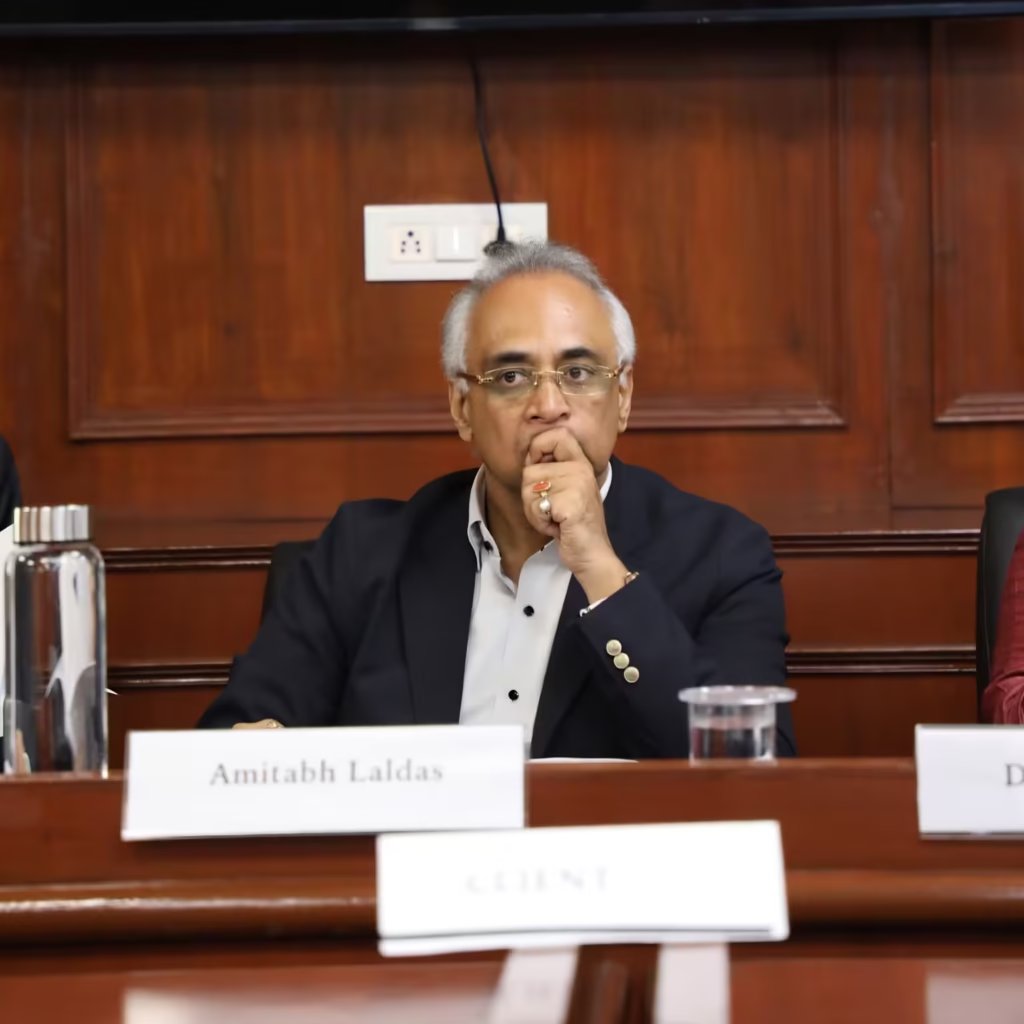
Over the years, Amitabh Das’s professional evolution has increasingly been recognized by the legal and corporate community. He has been featured in the Legal 500 GC Powerlist India, including the 2024 and 2025 editions, where he has been recognized as a General Counsel associated with Hyundai Motor India. Legal 500’s describes him as a C-suite corporate leader with more than three decades of domestic and international experience across litigation, law firms and senior in-house positions spanning U.S., Korean and Indian companies.
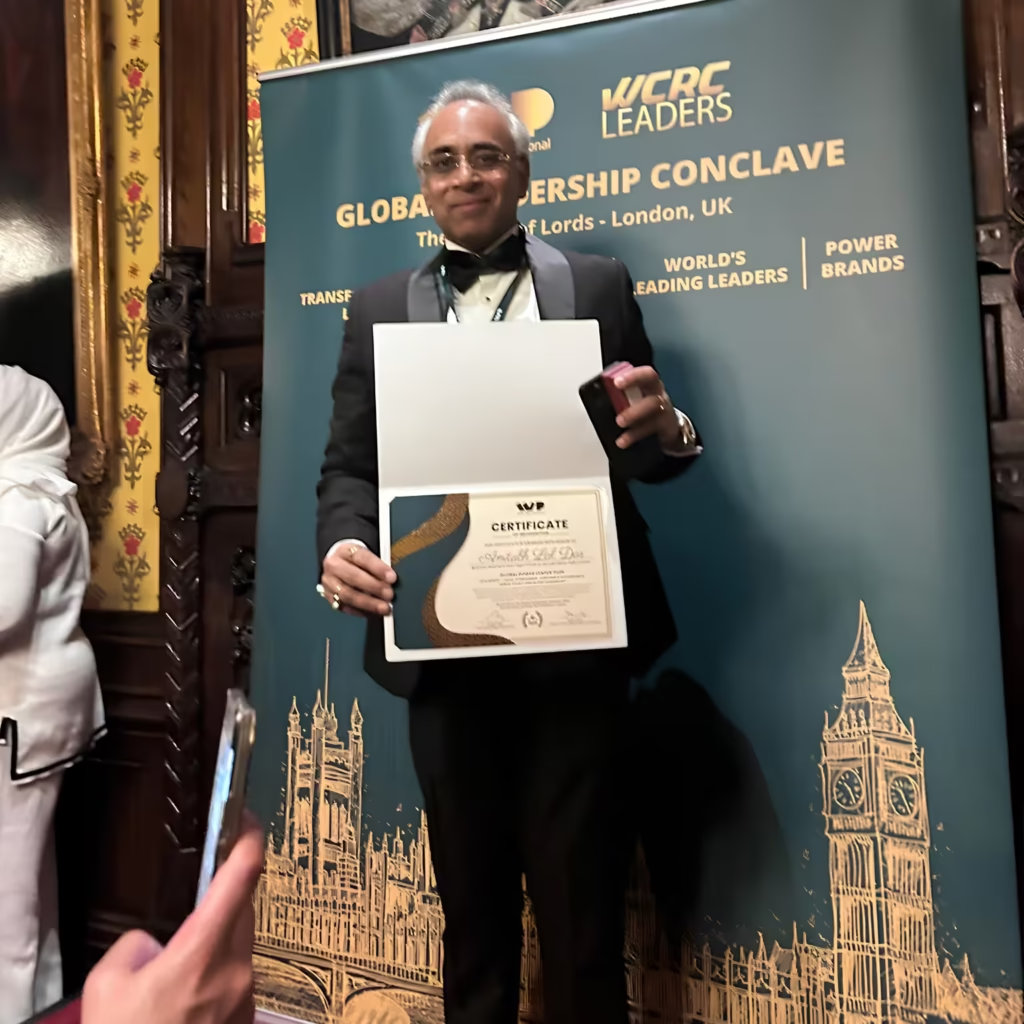
His recognition has also moved beyond the traditional legal community. In 2025, he was felicitated as a Global Power Leader at the Global Leadership Conclave held at the House of Lords in London. Das himself marked the occasion publicly, describing it as his second time at the House of Lords.
For someone who began his career without established social moorings in Delhi, the symbolism of that moment is hard to ignore. The journey had taken him from a small town in Jharkhand to one of the world’s most recognizable institutions of public life. But recognition, for Amitabh Das, appears to be less about the trophy than what it makes possible. He describes recognitions as “enablers”, as credentials that can create credibility for larger projects and conversations.
The Teacher Within the Lawyer
Another important dimension of Das’s career is his commitment to sharing knowledge. He serves as faculty with the Global General Counsel Academy under the aegis of King’s College London, bringing practical corporate leadership experience into professional education. That role fits naturally into his philosophy. He has repeatedly argued that professionals should read beyond their immediate domains, observe people and the world around them, ask questions, connect dots and cultivate a growth mindset. For younger lawyers, this matters particularly. The legal profession can easily encourage specialization at the expense of context. But the future belongs increasingly to professionals who can connect disciplines. Lawyers must understand technology. Business leaders must understand regulation. Governance professionals must understand organizational psychology. And General Counsels must understand the business itself. Amitabh Das has spent decades building precisely that interdisciplinary muscle.
A Lawyer Who Runs
Amitabh Lal Das describes himself as someone who always ran away from running. Then, at the age of 47, he decided to start running. Before turning 50, he had completed sixteen half marathons. The achievement may appear unrelated to his professional career. It isn’t. Endurance sports have a peculiar way of teaching the same lessons that difficult careers do. Consistency matters more than bursts of enthusiasm. Progress is often invisible until one looks back. And the body frequently reaches its limits before the mind has finished negotiating with them.
For Das, running became evidence of something larger. Limitations are not always fixed. Sometimes they are simply assumptions that have never been challenged. It is perhaps fitting that someone whose professional philosophy revolves around continuous improvement found a personal laboratory for that philosophy on the running track.
The Team Behind the Title
For all the emphasis placed on individual leadership, Amitabh Lal Das is careful not to present his career as a solo achievement. He credits mentors, managers, peers, friends and family who invested their time, energy and counsel in him. More importantly, he places substantial responsibility for his reputation on his teams. His view of leadership is collective. “We are what we are because of our teams,” is the essence of his reflection.
That belief connects directly to his systems philosophy. If an organization is a system, then no leader operates in isolation. A brilliant legal department cannot succeed if it is disconnected from finance. A sophisticated compliance framework cannot work if business teams do not understand it. A strategy cannot survive if the people responsible for executing it are moving in different directions. Team spirit, therefore, is not merely a cultural ideal. It is an operating requirement.

The Bridge He Wants to Build
Recognition has not made Das fully satisfied with the profession. If anything, it has strengthened his interest in solving a larger problem. The relationship between the legal function and the wider business.
One of the projects he has articulated is what he calls a “Bridge” project, an effort to connect the in-house legal function more effectively with both internal and external stakeholders, so that legal departments can provide better offerings and businesses can extract greater value from their own legal capabilities.
But his ambition extends beyond companies. He is also interested in connecting legal education with organizational and business education, encouraging stronger integration between Business Schools and Law Schools. It is a logical next step for someone who has spent his career navigating both worlds. Lawyers need to understand organizations. Managers need to understand law. The future General Counsel may need to understand both almost equally.
Making Business Easier Through Better Dispute Resolution
Another area of his interest is even wider and multifaceted. Improving the ease of doing business in India and strengthening the use and understanding of Alternative Dispute Resolution. This is not simply an academic interest. For businesses, disputes consume more than money. They consume time, executive attention, relationships and organizational energy. A sophisticated dispute resolution ecosystem can therefore become part of the infrastructure of economic growth.
Das’s interest in ADR reflects the broader philosophy that runs through his career. The purpose of legal expertise should ultimately be to help systems work better. Not merely to win individual battles but to reduce the number of battles that need to be fought in the first place.
The Advice He Leaves Behind
Ask Das what he would tell someone beginning their career and the answer does not sound like a conventional corporate success formula. Study hard. Work hard. Read beyond your domain. Prepare. Ask questions. Observe people. Observe the world. Learn to connect dots. Embrace failure. Build credibility and respect. Operate with discipline, honesty and integrity. Have the courage to stand up when necessary. Develop a growth mindset. Care about people. Develop hobbies outside work. And, importantly, have fun.
There is something striking about that list. It does not promise shortcuts. It does not promise certainty. It does not even promise success. Instead, it describes the habits required to make the journey worthwhile regardless of how predictable, or unpredictable, the destination may be.
The Journey Is Ours to Make
One of Amitabh Das’s reflections could almost serve as the epilogue to his entire career. “Our journey is uniquely ours and we are solely responsible for making it worthwhile and enjoyable.” It is an unusually personal conclusion for someone whose professional life has been spent dealing with contracts, governance frameworks, regulatory complexity, corporate risk and institutional responsibility. But perhaps that is precisely why it works.
Behind the titles, General Counsel, Chief Legal Officer, business leader, there is still the young professional who arrived in Delhi from a small town, without the conventional advantages, uncertain of where the road would lead. He could not know then that his career would eventually span continents and industries. He could not know that a scholarship application that initially seemed way out of the league would take him to Britain. He could not know that an unfulfilled civil service ambition would redirect him toward law. He could not know that an early mistake in communication would fundamentally change the way he led. And he certainly could not know that beginning to run at 47 would result in sixteen half marathons before 50. But perhaps careers of consequence are rarely built by knowing everything in advance. They are built by taking the next step intelligently.
For Amitabh Lal Das, that next step has repeatedly meant going beyond the obvious definition of his role. Beyond lawyer, beyond adviser, beyond guardian, to become an enabler of business, a student of organizations, a mentor to the next generation and an advocate for stronger institutions. His story is therefore not simply about law. It is about reinvention. It is about resilience without self pity. It is about ambition tempered by gratitude.
And, above all, it is about recognizing that professional success is not a destination at which one finally arrives. It is an evolving conversation between what one knows, what one has yet to learn, and what one chooses to do with the opportunities that come along. For a first generation lawyer from Hazaribag who once had no established path into Delhi’s professional world, that conversation has already produced a remarkable body of work. And the most interesting chapters may still be ahead.