
TheCEOVerse • Digital Edition
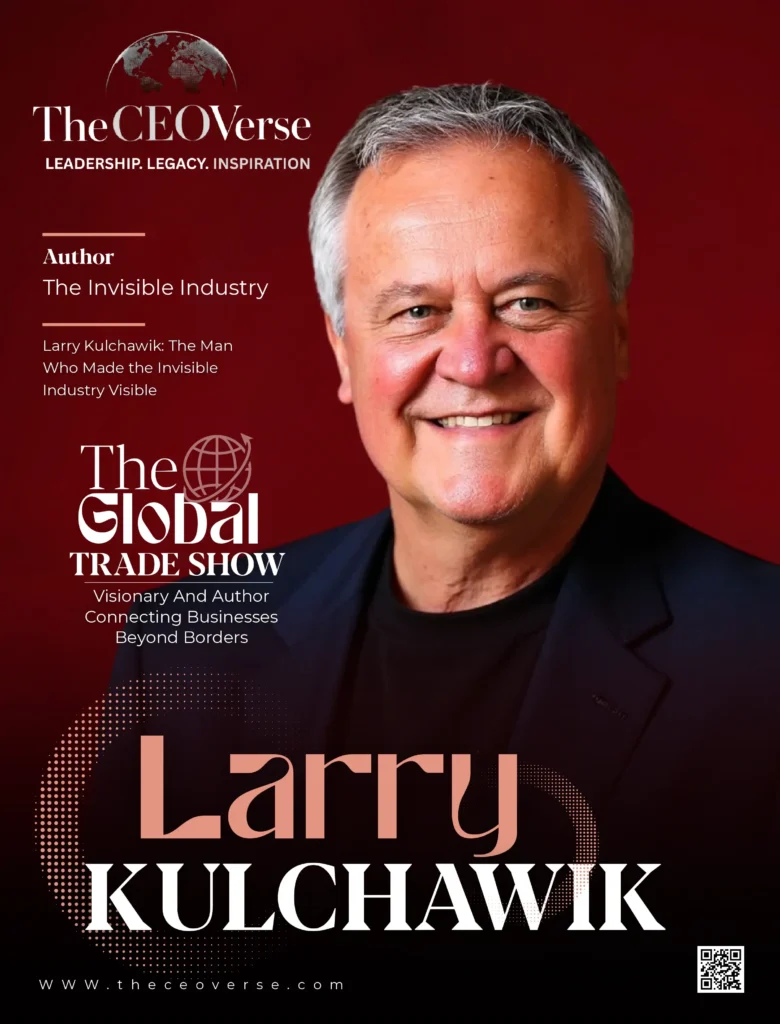
“Larry Kulchawik: The Global Trade Show Visionary And Author Connecting Businesses Beyond Borders”
Cover story
Larry Kulchawik
Featured Profile - Larry Kulchawik
Larry Kulchawik: The Man Who Made the Invisible Industry Visible
From a working class neighborhood on Chicago’s far South Side,to the floors of global expositions, Larry Kulchawik built a career around the power of face to face communication. When business crosses borders, success depends on understanding what is different, and respecting it.
A Career That Began Where Careers Usually Don’t
Some careers begin with a five year plan. Others begin with an inheritance, a family business, or a carefully chosen degree. Whereas, the first step of Larry Kulchawik’s journey was anything but ordinary. After graduating with a design degree, he wondered, “What exactly was I going to design?” It is an odd question for a man whose eventual career would be defined by designing not just physical spaces, but ways for businesses to enter unfamiliar markets, communicate across cultures, and build relationships face to face.
Today, Kulchawik is recognized as an international trade show specialist, author, consultant, industry leader and former president of both the Exhibit Designers and Producers Association (EDPA) and the International Federation of Exhibition and Event Services (IFES). He has spent more than five decades in an industry that, in his own words, few people even knew existed. His journey has taken him from exhibit design and sales to executive management, to international association leadership, and ultimately to authorship and consulting. His two books, The Invisible Industry and Trade Shows from One Country to the Next, reflect two sides of the same mission. To explain an industry that operates largely behind the scenes, and help businesses understand that taking a successful exhibition strategy from one country to another is rarely as simple as shipping the same booth overseas.
For Kulchawik, the world of exhibitions is not merely about walls, graphics, lighting and displays. It is about people. It is about culture. It is about trust. And, increasingly, it is about the ability to recognize that there is rarely a single “right” way to do business. As he puts it, “There is no right way, there is no wrong way, there is only a different way.” That philosophy has become the signature of a career spent helping companies cross borders without losing sight of the human beings, and their cultures, on the other side.
From Chicago’s Steel Mills to the World Stage
Before international exhibitions, before books and consulting, there was a small town called Hegewisch. Kulchawik grew up in a working class community on Chicago’s far South Side, a place shaped by steel mills, the Ford plant, shift work and tight knit neighborhood relationships. It was the kind of community where people knew one another, went to the same schools and churches, played on the same teams and depended on one another. That environment quietly planted one of the values that would later define his professional life, that community matters.
Money was tight, so rather than taking a conventional academic route through an expensive private school, Kulchawik attended a vocational high school and studied architecture. Half the day was spent on traditional academics, the other half was devoted to drawing and architectural skills. Those skills turned out to matter significantly. He later attended junior college to complete the necessary coursework required to get accepted to Southern Illinois University, where he earned a degree in Design. But the most consequential part of his education may not have been the degree itself. It was a professor by the name of Buckminster Fuller. Fuller was a famous visionary designer, architect, inventor, and systems thinker whose ideas about geodesic structures, and his book-“Spaceship Earth” left a lasting impression. Kulchawik recalls building geodesic domes as a student project.These structures would then become actual classroom spaces. Fuller’s influence would echo throughout Kulchawik’s career. The connection became more profound than it might initially appear.
Exhibit design requires people to think about space, structure, movement, materials, function and human behavior simultaneously. International exhibiting added another layer of thinking.
Suddenly the same structure has to operate within a different environment. Different regulations, labor systems, electrical standards, transportation methods and cultural expectations had to be considered. In other words, it requires systems thinking. Kulchawik had unknowingly found an ideal intellectual foundation from Fullers philosophy in his book Spaceship Earth.
The Unexpected Door Called McCormick Place
With a degree in Design, there was still that unanswered question. What exactly was he going to design? The answer arrived in Chicago. The original McCormick Place Convention Center had been destroyed by fire, and the city was now rebuilding it. Kulchawik found work as a trade show exhibit designer. He entered the profession knowing almost nothing about the industry.
What began as a job became a five decade career. That origin story is important because it mirrors something Kulchawik has repeatedly observed about the exhibition industry. People rarely grow up dreaming of becoming trade show professionals. Doctors know they want to become doctors. Engineers know engineering exists. Lawyers know the profession is waiting for them. Exhibit design and exhibition marketing, however, often remain invisible until someone accidentally walks through the door. Kulchawik became one of the people determined to open that door wider. His own questionnaire describes the industry as one that was hardly discussed in college marketing programs despite its enormous commercial importance. After more than 50 years in the field, he came to see part of his mission as making that “invisible” industry visible, especially to the next generation. That became the inspiration behind The Invisible Industry, his exploration of the history and evolution of trade shows in the United States. The title is deliberately provocative.
How can an industry be both highly influential and almost invisible? That is because much of the work happens behind the curtain. Before anyone walks onto a trade show exhibit floor at a convention center, someone has designed the exhibit space, calculated its structural requirements, organized transportation, coordinated labor, dealt with electrical and safety standards, planned the installation ,train their exhibit staff, organize catering, and preparing for the hundreds of details that visitors never see. The exhibit in the space stands for three days. The infrastructure behind it may take months of planning.
When Pencil Lines Became Business Strategy
The late 1970s found Kulchawik working with tools that today seem almost prehistoric- T-squares, angles, pencils, magic markers and whiteboards. Then came CAD. The industry methods now changed, and Kulchawik faced a decision familiar to professionals in every era of technological disruption, learn the new system or change direction. He chose the latter. Rather than spending his energy mastering CAD drafting, he moved into sales and began working directly with clients who needed an exhibit. It proved to be one of the most important decisions of his career. Sales brought him closer to the people for whom the exhibits actually mattered.Unlike today, where communication is mostly done digitally, exhibit design sales was done face to face, usually in the customers office, or in a restaurant. Developing an exhibit design required three dimensional thinking.
Larry had the ability to sit with a client and sketch an idea on a napkin. Instead of thinking exclusively about the exhibit design, he probed to uncover what the exhibitor actually needed to communicate. What final outcome did they need to achieve, and be measured.
The physical space to meet with a prospective client did not matter. What mattered wasthe outcome of a face to face meeting. This meeting created relationships in a way that remote communication could not fully reproduce.
Kulchawik describes this period of his career as a game changer. After roughly a decade of success in sales, he moved into management and eventually became president of the Chicago division of Greyhound Exhibit group, which, at the time, was the largest exhibit design and fabrication company in the United States. His professional experience subsequently included three of the largest exhibit companies in the USA-Exhibitgroup, Derse and 3D Exhibits. The progression of exhibit companies, and responsibilities, created an important characteristic of his leadership style: he did not abandon his design background when he moved into any new organization. He expanded it. Design taught him to see possibilities. Sales taught him to listen. Management taught him to build systems, and make a profit. International work taught him to respect Differences.

The Executive Who Realized an Industry Needed Standards
For many executives, professional associations are an extracurricular activity. For Kulchawik, they became part of his leadership laboratory. He joined EDPA, the Exhibit Designers and Producers Association, while working in senior roles within major leader within American exhibit companies. EDPA brought together leading exhibit design and service companies with a shared objective. Exchange business ideas and improve the experience for the exhibitors who invested in trade show marketing.
After eight years on the EDPA board, Kulchawik became president. His tenure was about more than ceremonial leadership. He helped lead an initiative to establish a master’s degree in exhibit design at FIT in New York, an important step toward recognizing exhibit design as a serious academic discipline rather than an obscure specialty. He also helped develop exhibit fabrication safety standards with Underwriters Laboratories. After two years of development, UL 2305 was completed. These achievements reveal another side of Kulchawik’s career. He was not content simply to operate successfully inside an industry. He wanted to improve the industry itself.
Education created a pipeline for future talent. Standards created greater consistency and safety Associations created networks through which competitors could exchange knowledge and collectively solve problems. It was a philosophy of leadership based on contribution rather than possession and added sales.
The Moment Global Business Became Personal
Perhaps the most revealing story in Kulchawik’s career happened in London. In 1992, one of his major customers, the Chicago Mercantile Exchange, was preparing to introduce Globex, its electronic futures trading platform, to an international audience. His company, Exhibitgroup Chicago, had built an impressive exhibit for the Mercantile Exchange to introduce Globex in the USA. The exhibit integrated the technology needed to demonstrate the value of Globex and its potential opportunities. The Mercantile Exchange then requested that we take the exhibit to London. Kulchawik said yes we can. The problem now was that he had limited experience exhibiting in Europe.
So he did what he would later advise companies around the world to do, he found a local exhibit company to help. But even with local assistance, the project became a crash course in international differences. The event was on the second floor of an old hotel. The exhibit crates were unloaded by hand rather than by forklift. To move the crates, a “dolly” was known locally as a “sack truck.” So what was a sack truck?
The crates were too large for the freight elevator. Parts had to be unloaded and cut down so they could physically fit to make it upstairs. The electrical transformer brought from the United States did not work as expected with the local system. A replacement had to be purchased locally. Connections were completed just an hour before the event. The client saw the finished exhibit. The client did not see the chaos behind the scenes to make it all happen. it. For many people, such an experience would simply become an embarrassing story from an early international project. For Kulchawik, it became a philosophy. The lesson was not that Europe was difficult. The lesson was that Europe was different. Meters are not feet. 110 volts are not 220 volts. Crated exhibits are not necessarily handled the same way as skid wrapped materials.
A “dolly” is not necessarily called a dolly. Labor rules differ. Freight systems differ. Installation practices differ. Labor breaks were different. And cultural expectations differ. The exhibit itself may be universal but the way you manage it onto the exhibit floor is not. That London experience eventually became one of the foundations for Trade Shows from One Country to the Next. “There Is No Right Way. There Is Only a Different Way.” Kulchawik’s most memorable business philosophy may also be his simplest.
It sounds almost obvious. In international business, however, it is remarkably difficult to fully understand the subtle differences when organizing a trade show event globally. Trade show events functionally each have the same objective. But the methods, and the people needed to put it all together each follow a different path to get there. Respect what is different.
Companies that succeed in one market often assume that their success formula can simply be exported. The exhibit design that works in Chicago should work in Frankfurt. The sales script that works in New York should work the same in Tokyo. The dress code that works in Europe should work the same in Australia.. The labor rules that work at home should work the same abroad. They don’t.
Kulchawik’s international consulting work was built around helping businesses understand these distinctions before they become expensive surprises. His book Trade Shows from One Country to the Next, first published in 2015 and now in a third edition, examines the venues, regulations, labor issues, exhibit styles and cultural differences across 45 countries. His stated purpose is practical, to help exhibit managers and suppliers understand what changes when an exhibition crosses borders. The book’s underlying message goes beyond exhibition marketing. It is really a guide to cultural intelligence and sales in business. A company entering a new market does not simply encounter a new customer. It encounters a new operating environment. Note that is is always good idea to have regional natives on your exhibit sales staff for any international trade show event.
The Power of the Local Partner
One of Kulchawik’s strongest recommendations is also one of the most practical, to find a trusted local exhibit supplier as a partner. He does not frame local expertise as a luxury. He frames it as protection and that the local ways are followed. His role as president of IFES helped to create with exhibit suppliers in the 45 countries covered in his book.This enabled him to and establish trusted regional partners to recommended to businesses looking to exhibit internationally. The philosophy is straightforward, combine the knowledge of the local supplier with the experience and expectations of the company’s home based exhibit provider. This principle was also reflected in Kulchawik’s work with IFES-the association of world exhibit suppliers.
IFES- The International Federation of Exhibition Services, initially started as eight European exhibit supplier Associations who created a bond to work as partners when servicing an exhibitors internationally.
During his term as president, he helped create a change at IFES to include the exhibit supplier companies within each country association to be recognized as full members of IFES as well as the associations themselves. This concept then further expanded to allow exhibit companies who did not have a formal association to be a member. This change to the IFES by laws helped to take IFES from eight countries to 45 countries in a ten year period. The IFES mission statement is “Sharing Knowledge with Partnerships”.
The result of this change created a network designed around country cooperation. No one company needs to know everything when exhibiting globally. The local partner knows their local environment. The international partner knows the client. Together, they reduce risk. That is not merely a trade show lesson. It is a global business lesson.
Communication Is More Than Translation
Kulchawik has taken the concept of cultural differences even further. He argues that international business communication is not simply about translating words. It is about
making sure that both sides use words that mean the same thing. He created an international RFP template that is designed to help companies requesting exhibit services abroad to communicate their requirements more precisely. This saves valuable time and helps to avoid misunderstandings. It is not what you say that matters, it is what you mean.
The template incorporates key industry terminology translated across thirteen languages, with The goal is to reduce ambiguity in a process where a small misunderstanding can become a major logistical problem.
The International Association of Exhibitions and Events (IAEE) now offers the RFP templates that Kulchawik gifted to the organization in 2021. He described his motivation as giving back to the industry and sharing his commitment to international exhibitions.
The thinking behind the template is quintessentially Kulchawik.
It is not what you say, but what you mean that matters. That distinction becomes critical when a single word can determine how a supplier interprets dimensions, materials, labor, electrical requirements or installation expectations. In a world where English is the official language of business we must be certain that what we say is really what we mean.
Translation is not the same as understanding. A machine can translate language. A trusted partner must interpret context.
The Invisible Infrastructure Behind Global Growth
Kulchawik’s. second book- The Invisible Industry examines the history of trade shows and the evolution of the exhibition industry in the United States.
It traces how an industry, that is often overlooked, became an enormous commercial ecosystem. The concept of exhibitions, of course, is much older than modern corporate marketing. World fairs and major expositions created physical environments where technology, commerce, culture and national ambition could meet. It was a place where inventors introduced their inventions and change the world we now live in.
Over time, the World Fairs evolved to create the concept of trade shows. Industry specific association created events where industry experts gathered, where companies introduced products, buyers compared suppliers, competitors watched one another, technologies were demonstrated and relationships were created.Kulchawik co authored this book with Bob McGlincy, a master historian on World Fairs. Their contribution is was to share how the concept of trade shows all started. Kulchawiks career is itself evidence of how large the ecosystem has became.
Specialty skills like designers.Fabricators. Project managers. Salespeople. Estimators. Freight Specialists. Convention Centers. General Service Contractors. Show Organizers.
Technology Providers. Lighting and Audiovisual teams. Labor crews. Marketing professionals. Caterers. Companies who train exhibitors how to engage within an exhibit space, companies who mange sales leads collected at an event.
This is why the phrase “invisible industry” is so appropriate. Since most trade shows are private events, advertising is limited to the people in the industry only, not to the public. The public may sees the booth. The industry sees the network
Leadership Means Building a Team You Can Trust
Kulchawik’s approach to leadership is not centered on being the smartest person in the room.
It is centered on creating a room where capable people can do their jobs. He credits his trusted teams that included estimators, production managers, account managers, field supervisors, with giving him the freedom to pursue broader responsibilities with industry associations and convention centere.
His philosophy is refreshingly operational, a leader should not have to be physically present every moment for the organization to function. Processes and procedures must be established, understood and followed. That mindset helped make a demanding international career possible. It also explains how he could simultaneously manage companies, participate in associations, travel internationally, advise clients and contribute to industry development.
Delegation, in this model, is not about doing less. It is about building an organization capable of doing more. Kulchawik also openly acknowledges the importance of personal support. He credits his wife of 50 years for supporting the extensive travel associated with his role as IFES president, including travel to IFES headquartered in Brussels. Behind many global careers is an invisible support system of its own. Kulchawik does not overlook it.
A Different Definition of Success
There is something striking about how Kulchawik describes his own success. He does not begin with money. He begins with luck. He says he feels fortunate to have “fumbled upon” an industry few people knew existed. But his definition of luck is more disciplined than it first sounds. Luck, in his telling, comes with a positive attitude. It comes with preparation. And it comes from being willing to explore the side roads. That idea explains much of his career. He did not initially plan to work in exhibitions. He did not remain a designer forever. He moved into sales.
He moved into management. He became involved with associations. He helped shape educational programs. He worked on safety standards. He entered international leadership. He became an author. He became a consultant. And eventually, he became an advocate for an industry that had once been invisible to him. At each stage, the next opportunity emerged from a willingness to move beyond the previous one. His advice to the next generation is therefore not a complicated formula. Discover your passion and you will never work another day in your life.
From Industry Executive to Industry Historian
Retirement, for Kulchawik, did not mean walking away. His professional experience lists his years as “Retired Expo Guy,” but the title is almost playful because his work after retirement remained deeply connected to exhibitions. He continued writing. He continued speaking about international exhibiting. He continued connecting companies with trusted exhibit partners. He continued contributing to associations. And he turned his accumulated experience into books. That transition, from operator to historian and educator, is one of the most valuable aspects of his later career. A person can spend decades doing something without ever documenting what they learned. Kulchawik chose to document it.
Trade Shows from One Country to the Next became a practical guide to international differences. Its third edition, released in 2025/2026 era publishing, continues that mission for companies looking beyond their domestic markets. Current descriptions emphasize the same central premise: international exhibitors must “recalculate” their thinking when moving between markets. The book is now positioned not simply as a trade show manual, but as a guide for global marketers, exhibition managers and business travelers. That evolution is telling. The world has changed since Kulchawik first entered the industry. But the problem has not disappeared. If anything, globalization has made it more important.
Face to Face Marketing in a Digital Age
It would be easy to assume that a veteran of physical exhibitions belongs to another era. Kulchawik makes the opposite case. The rise of digital communication has not eliminated the value of face to face interaction. In many ways, it has made genuine human contact more valuable. Trade shows create something digital channels struggle to reproduce completely, physical presence. A handshake. A conversation. A reaction to a product demonstration. The subtle shift in body language when a buyer becomes interested. The spontaneous conversation that was never on the agenda. The opportunity to discover that the person behind the corporate title is someone with whom a relationship can actually be built.
Kulchawik has written about the emotional power of face to face marketing, arguing that live interactions carry an emotional dimension that digital communication cannot fully replicate. His international marketing materials similarly emphasize that trade shows remain powerful vehicles for building brands and expanding global reach. This provides a businesses approach for each region on its own terms. This does not mean digital marketing is unimportant. It means the two can compliment each other. Digital platforms create awareness. Trade shows create encounters and experiences.. Follow up creates relationships. And relationships create trust and added business.

The Global Executive’s Real Advantage: HumilityPerhaps the most important lesson in Kulchawik’s career is not about trade shows at all.
It is about humility. International business punishes assumptions. The moment a company believes that its domestic marketing success makes them an expert everywhere, it becomes vulnerable. Kulchawik’s career offers a different approach. Ask. Observe. Partner. Listen. Learn. then Adapt and Respect.
His London experience taught him that expertise in one region does not automatically transfer to another. His work with IFES reinforced the value of international partnerships. His books turned those lessons into practical guidance. His RFP template transformed them into a tool. His consulting work continues to connect businesses with regional expertise. The philosophy is consistent. Do not pretend you know what you do not know. Find someone who does. For today’s executives, that may be one of the most valuable forms of international intelligence.
A Legacy Built on Connections
Awards and titles tell part of Larry Kulchawik’s story. He has received industry recognition-the EDPA Ambassador Award, the EDPA Hazel Hays Award, and the IFES Roger Taurant Award. He has served as president of EDPA and IFES, held leadership positions within industry associations and participated in industry organizations including UFI, the Chicago Chamber of Commerce, the International Trade Association, the Chicago World Trade Center, the Hong Kong Trade Association/Chicago. But the deeper legacy is found in what those positions allowed him to accomplish. He helped professionalize exhibit design education. He helped advance safety standards. He encouraged American exhibition companies to think globally. He helped develop international partnerships. He documented the industry’s history.
Kulchawik created practical tools for companies exhibiting abroad. And he has spent years encouraging businesses to approach international markets with greater awareness. His professional story is therefore not simply the story of a man who spent 50 years in trade shows. It is the story of someone who passionately realized that his industry had a problem, and decided to do something about it. The problem was invisibility. The solution was awareness and education.
What the Next Generation Can Learn From an “Expo Guy”
For young professionals, Kulchawik’s story offers an especially relevant lesson. Careers rarely unfold exactly as planned. A design degree may lead to sales. Sales may lead to management. Management may lead to association leadership. Association leadership may lead to international work. International work may lead to authorship. And retirement may lead to an entirely new chapter as a consultant and educator. The common thread is not a job title. It is curiosity. Kulchawik repeatedly allowed himself to follow the next interesting road. He also understood that changing direction is not necessarily failure. Sometimes it is growth. His own experience moving from design into sales demonstrates the point. When the technology of his original role changed, he did not interpret the change as the end of his usefulness. He found another place where his existing knowledge could create value. That ability, to carry knowledge forward while changing the role, is one of the defining characteristics of resilient professionals.The Man Behind the Message There is an appealing contradiction at the heart of Larry Kulchawik’s career. He spent decades working in an industry built around putting companies in the spotlight. Yet his own philosophy is remarkably modest.
He does not portray himself as the person who knows everything. Instead, he repeatedly emphasizes the value of finding the people who know the local market. They know their region better than you. He does not argue that there is one universal formula. He argues that there are different ways. He does not suggest that technology makes relationships less valuable. He argues that relationships remain essential. He does not describe success as simply winning contracts. He describes it as discovering passion, building trusted teams, serving in a face to face industry, and being willing to explore unfamiliar roads. That may be why his work has endured.
The physical exhibition industry has changed dramatically since the 1970s. Hand drawn plans have given way to digital design. Communication has moved from airplanes and hotel meetings to video calls. Exhibitions now incorporate immersive technology, digital experiences and increasingly sophisticated data strategies. But the human challenge remains. A business still has to understand another business. A buyer still has to trust a seller. A company still has to understand the market it enters. And when that market is thousands of miles away, surrounded by unfamiliar regulations, languages and customs, experience matters.
The Road Ahead Is Still Global
Kulchawik’s story began in a Chicago neighborhood where survival depended on people helping one another. Decades later, his professional philosophy still rests on essentially the same principle. People do better together. A local supplier knows the region. A global company knows its brand. An exhibit designer knows how to tell a story in physical space. A salesperson understands the needs of a customer. A consultant sees the potential problems before they become emergencies. An association connects people who might otherwise never meet. The strongest result emerges when those capabilities are combined. That may ultimately be Larry Kulchawik’s most enduring contribution to the exhibition industry. He did not merely spend his career building exhibits. He built bridges between disciplines, companies, associations, and countries.
He helped make an obscure industry more visible. He helped American exhibition professionals look beyond their borders. He helped international suppliers work together rather than operate in isolation. And through his books, articles, consulting work and educational efforts, he turned decades of experience into knowledge that others can use. His journey from his little town called Hegewisch, to the international exhibition community was not a straight line. It was a series of unexpected turns. A vocational school. A design degree.
Buckminster Fuller. A rebuilt McCormick Place. A job nobody quite understood. A move from drawing boards to sales. A leadership role. A safety standard. An educational program. An international federation. A difficult exhibition in London. Two books. A global network. And, finally, a philosophy.When in Rome, do as the Romans.
It is an old expression, but in Kulchawik’s hands it becomes something more sophisticated. Do not merely travel to another market. Understand it. Do not assume your way is the only way. Learn what is different. Do not try to become an expert everywhere. Find someone you trust who already is. And above all, remember that global business is ultimately not about borders, booths or buildings. It is about people meeting people face to face, where emotion is created. This is the magic formula about the invisible industry.
Larry Kulchawik has spent a lifetime making it more visible.