
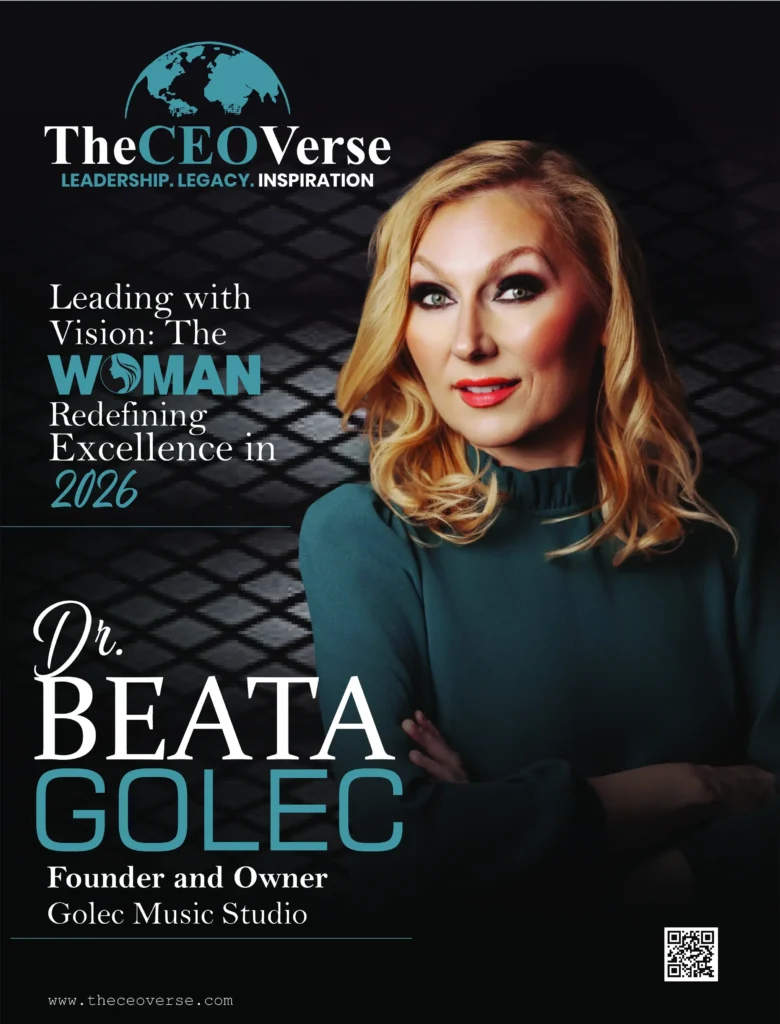
TheCEOVerse • Digital Edition
“Leading with Vision: The Woman Redefining Excellence in 2026”
Cover story
Dr. Beata Golec
Featured Profile - Dr. Beata Golec
Leading with Vision: The Woman Redefining Excellence in 2026
An anticipant hush descends over a room right before a pianist’s hands touch the keys, like a held breath, a suspended second where anything seems possible. Dr. Beata Golec has spent a lifetime living inside that second. From a converted classroom in Katowice, Poland, where a seven year old girl first sat before an upright piano, to concert halls in Vienna, Warsaw, and New York’s storied Carnegie Hall, to a music studio she built with her own hands in Victor, New York, Golec’s story is not simply about talent. It is about what a person chooses to do with talent once they have it, and Golec has chosen, again and again, to give hers away.
Today, she wears more titles than most executives collect in a lifetime. Pianist, composer, music theorist, doctoral scholar, piano instructor at the State University of New York at Geneseo, and Rochester Institute of Technology. The founder and owner of the award winning Golec Music Studio. Also, the Examiner for the Advanced Placement Program in Music Theory, examiner for the International Baccalaureate in Music, music director at two Rochester area churches, and member of the Board of Assessment Review for the Town of Victor. Additionally, in a twist that surprises even some of her longtime students, a licensed real estate agent with Howard Hanna Real Estate Services. On paper, it reads like a résumé assembled for three different people. In person, it reads like exactly a woman who has never believed in doing anything by half measures.
A Childhood Measured in Twelve Hour Days
To understand Golec’s story, you have to go back to Katowice, a city in the industrial heart of southern Poland, where she was accepted at age seven into the Mieczysław Karłowicz School of Music. Poland’s music education system does not coddle its students. It tests them, with juries, ear training exams, and theory assessments every semester, stacked on top of a full academic curriculum. By the time Golec reached high school, her class load included piano, accompanying, cello, orchestra, form analysis, music history, aural skills, part writing, counterpoint, conducting, and orchestration, layered over the ordinary demands of a “regular” secondary school. Her days ran roughly twelve hours, filled with lessons, rehearsals, and practice sessions that most adults would find exhausting to merely observe.
It was her mother, Alicja Golec, being an award winning educator herself, who first noticed that her daughter’s ear was unusual. The family later discovered that Beata had perfect pitch, a gift that would prove invaluable in aural skills training and, later, in transcription work. But talent alone did not make a seven year old want to practice. Golec is candid about this. As a young child, she resisted the discipline the same way any child might. Maturity came at ten, she says, the moment she understood exactly what she wanted her life to hold.
By thirteen, she had begun composing. At sixteen, her piece Fantazja Polska, built around the medieval Polish chant Bogurodzica and scored for cello and piano, earned an honorable mention at the national Patri Patriae All Polish Composers Competition, a rare distinction for someone still in secondary school. The piece premiered in 1997 at the Ars Cameralis Silesiae Superioris Festival in Katowice, performed alongside cellist Mirosław Makowski. Its score now rests in the Vatican, a fact Golec mentions with the particular calm of someone who has long since stopped being surprised by her own history.
Her formal training only intensified from there. She became a full time student simultaneously at the Fryderyk Chopin University of Music in Warsaw, studying piano performance and literature, and the Karol Szymanowski Academy of Music in Katowice, studying composition and theory, two campuses roughly two hundred miles apart. Three times a week, she rode intercity trains between the cities, earning government scholarships at both institutions along the way, awarded only to the most accomplished students in a system where higher education, however demanding, was entirely free.
Crossing an Ocean, and a Scholarship That Changed Everything
A single summer bent the trajectory of her life. During her freshman year in Warsaw, Golec was invited to attend the Chautauqua Institution Summer Music School in upstate New York on a full scholarship. What began as an exchange program became a turning point. It introduced her to the Eastman School of Music, sparked friendships that would anchor her new life abroad, and eventually pulled her across an ocean for good. She would go on to earn both her Master of Music and Doctor of Musical Arts degrees in Piano Performance and Literature at Eastman, again on full scholarship, while simultaneously spending a year as a doctoral student in composition at the University at Buffalo. Enrolled full time at two institutions while also working as a teaching assistant, Golec eventually recognized she was stretched too thin and made the difficult decision to step back from the Buffalo program. An early lesson, she says now, in the value of knowing one’s limits.
Moving continents, languages, and cultures, she says, taught her the two qualities she now considers foundational to everything she has built since. That are resilience and adaptability. “Our circumstances might evolve unexpectedly or within a short notice,” she reflects, and in a profession that depends on performing under pressure, teaching people of wildly different needs, and running a small business, that willingness to adjust on the spot has become something closer to a survival skill than a virtue.
Building an Empire of One Note at a Time
While still completing her studies at Eastman, Golec was already laying the groundwork for the career that would follow. Becoming an examiner for the College Board’s Advanced Placement Music Theory program, accepting a teaching post at SUNY Geneseo, and stepping into the role of Director of Music Programs for the Diocese of Rochester. Each of these positions might have anchored a career on its own. For Golec, they became the scaffolding for something larger.
In Victor, New York, she founded Golec Music Studio, an institution that has since earned Better Business Bureau accreditation with an A+ rating and, in 2026, the BBB’s prestigious Torch Award for Ethics. What distinguishes the studio, in Golec’s view, is not its list of offerings, as much extensive as that list is. It spans piano, voice, theory, analysis and composition instruction, masterclasses, hands on training for new music educators, exam preparation for Advanced Placement and International Baccalaureate students, graduate school and job interview coaching, and performance work for weddings, religious ceremonies, corporate events, and fundraisers. What distinguishes it, she insists, is who is welcome inside its doors.
Most studios draw a line at very young children. Golec accepts students as young as three. Most instructors are unequipped to teach adults returning to music after decades away, or neurodiverse learners, or aging students contending with reduced physical agility, memory loss, or illness. Golec has built her practice specifically around those populations. Retirees searching for new meaning, professionals with unpredictable schedules who need flexible lesson times, and people rediscovering an instrument they once gave up on entirely, only to find its healing power waiting for them on the other side. The studio also holds status as an approved vendor for the New York State Department of Education and Heritage Christian Services, extending music instruction to students with learning disabilities.
She has also made an unusual scheduling choice that she considers a genuine point of difference. Golec Music Studio never closes for school breaks. Winter recess and summer vacation, she argues, are precisely when consistency matters most. When skills either atrophy or advance, and when students can get a running start before the next academic year begins.
When Success Has No Villain, Only Discipline
Ask Golec about the obstacles that nearly shook her, and she offers an answer that runs against the conventional ways of a founder. She is grateful to say that building the studio itself was not marked by dramatic hardship. What it required instead was something less cinematic and considerably harder to sustain. Daily sacrifice, patient relationship building with students, collaborators, and community organizations, and an unglamorous commitment to consistency over years, not months.
That does not mean her journey has been without friction. Golec speaks candidly about a previous supervisor whose leadership style she describes as hostile. A manager who belittled employees, particularly women, until it produced genuine physical and emotional strain. She confronted him directly, refused to tolerate the environment, and was met with retaliation. A reduced salary, an expanded workload, and a thirty day ultimatum to accept a new contract. Within a week, she had interviewed elsewhere and left. She calls it one of the best professional decisions of her career. A reminder, she says, that no title or paycheck is worth trading away one’s dignity.
She has also encountered the subtler friction that many women in leadership recognize immediately. The colleague who mansplains instead of thanking her for flagging a phishing attempt made in his name, the gossip that trails anyone who succeeds visibly, the whispered suggestion that an accomplishment was luck rather than labour. Her response to all of it is consistent, almost clinical in its clarity. Invest only in relationships built on honesty and mutual respect, and release the rest without guilt. “Adversity and success act as filters,” she says, both reveal, with equal precision, who belongs in a person’s life and who does not.

The Philosophy Behind the Piano Bench
If there is a single idea that threads through every version of Golec’s professional life, including the studio, the classroom, the church choir loft, even her real estate practice, it is what she calls a “people first” philosophy. Business decisions at Golec Music Studio are not centered on the fastest return on investment. They are centered on the well being, growth, and satisfaction of the people she serves. She rejects the model of teacher as authority figure, describing herself instead as a guide. Someone whose lessons function as dialogue rather than lecture. Under that approach, she has found, students pay closer attention, ask more questions, and feel safe enough to share the creative ideas that a fear based classroom would have kept buried.
That empathetic instinct extends into how she thinks about competition in the arts. Music, she argues, has drifted from its original purpose, which was communication, storytelling, community bonding. Instead, it has strayed toward a hyper competitive culture that has driven talented students and professionals alike to consider quitting altogether. Often simply from anxiety over being fast enough, loud enough, or technically flawless enough. Restoring music’s original, human purpose has become something of a personal crusade, one she pursues most visibly through an initiative she founded in 2016, The Young Musicians’ Concerts.
A Stage With No Pressure and No Empty Seats
Twice each year, Golec organizes charity recitals that function as fundraisers for the food pantries at Holy Cross and Our Mother of Sorrows Churches in Rochester. The structure of these concerts is deliberately unlike a typical recital. There is no printed program, no fixed performance order, and no requirement that music be memorized. Golec opens each concert by performing one of her own compositions, leading by example, as she puts it, before inviting students of every age and skill level to come forward, introduce themselves, and share what they intend to perform. Entire families of pianists have taken the stage together, parents modeling the very confidence they hope to instill in their children.
The concerts carry three intertwined missions, in Golec’s own framing. To give performers a stress free environment stripped of the usual pressures of competition. To raise meaningful funds for community outreach programs feeding food insecure families. And, perhaps most quietly powerful, to teach children directly what it means to give. Families shop together beforehand for non perishable donations, with parents explaining to their children the difference between food that can wait and food that cannot. And what it means, in practical terms, to provide someone else’s next meal. It is community building at its best . Not an abstraction, but a lesson delivered hand to hand.
A Trophy Case That Keeps Growing
The recognitions have arrived in a near continuous wave in recent years, though Golec is careful to frame each one as validation of consistency rather than a single dramatic breakthrough. In 2020, she received the SUNY Chancellor’s Award for Excellence in Teaching, one of the system’s highest honours for faculty. In 2024, she was named a recipient of the Victor Business Award and an honouree of the Ontario County ATHENA Leadership Awards. Amid the recognitions that placed her among the region’s most respected businesswomen and civic leaders. That same year, she was featured in the United University Professionals’ SUNY Geneseo Chapter Spotlight.
2025 brought its own milestones. Golec sponsored the “Unmasking the Silence” Masquerade Ball supporting suicide and mental health awareness, alongside the 40th Ontario County ATHENA Leadership Awards ceremony, and she stepped into the SUNY Geneseo Honors Program to teach a course she designed herself, namely “Psyche, Mental Illness and Musical Creativity”. Where she brought her lifelong belief in music’s psychological power into a formal academic setting for the first time.
2026 has proven busier still. She was named a finalist for the ROC the City Choice Awards in the Best Professional Services category, and Golec Music Studio was awarded the Better Business Bureau’s 2026 Torch Award for Ethics. A recognition, she notes, that speaks directly to her leadership style and her commitment to her clients and community rather than to any single achievement in music. In July of that year, she received both the Trusted Business Award and the International Association for Business Excellence Award. In August, the Global Recognition Award followed. That November, she is on her way to sponsor the 41st Ontario County ATHENA Leadership Awards, continuing a pattern of giving back to the very institutions that once recognized her.
Her media presence has grown in tandem with the honours. She appeared as the cover story for Enterprise World Magazine in July 2026 and for Rochester Woman Magazine in December 2025, and sat for interviews with Bold Journey Magazine, Canvas Rebel Magazine, and Rochester Woman Magazine across 2024 and 2025.

A Growing Presence Across Leading Media Publications
Dr. Beata Golec’s remarkable journey and multifaceted contributions have garnered increasing attention from prominent media outlets and leadership publications across the globe. Her work and achievements have been highlighted through an impressive range of interviews, cover features, and news coverage. Most recently, in August 2026, Dr. Golec was featured on the covers of CEO World Leaders Magazine, CEO Time Magazine, and CIO Women Magazine, each accompanied by an in depth interview exploring her professional journey and impact.
In July 2026, she was also featured on the cover of The Enterprise World Magazine, further recognizing her accomplishments and influence. Her media journey includes interviews with Bold Journey Magazine in May 2026 and September 2025, as well as a cover feature and interview with Rochester Woman Magazine in December 2025.
Earlier features include interviews with Canvas Rebel Magazine and Rochester Woman Magazine in March 2025, a SUNY Geneseo interview in October 2024, and a feature in Rochester Woman Magazine in August 2024. Beyond print and digital publications, Dr. Golec’s commitment to nurturing young musical talent has also received television news recognition, with WHEC 10 News covering Young Musicians’ Concerts in both April 2025 and November 2023. Collectively, these features reflect the breadth of Dr. Golec’s influence across leadership, education, music, community engagement, and the arts, while underscoring the growing recognition of her work and the meaningful impact she continues to create.
The Second Career Few People See Coming
For all her accolades in music, Golec’s professional identity does not stop at the piano bench. She is also a licensed agent with Howard Hanna Real Estate Services, one of the largest family owned real estate firms in the United States, guiding buyers and sellers through transactions across the Victor and greater Rochester area. It is, on its surface, an improbable pairing. Concert pianist and real estate agent. But Golec approaches both with the identical instinct that shaped her music studio. Put people first, listen closely, and treat every transaction as a relationship rather than a sale.
Having relocated to the Rochester community in 2003, completed graduate studies at the University of Rochester, and built homes first in Farmington and later in Victor with her husband, Golec brings a homeowner’s lived understanding of the region into every client conversation, not merely a license and a listing sheet.
The Ones Behind the Becoming
Ask Golec who deserves credit for the life she has built, and she does not hesitate. Her parents, Alicja and Dariusz Golec, occupy that space without competition. She describes them as models of morality, fairness, and emotional intelligence. The source of a moral compass she now hopes to pass on to her own son. It was her parents who sacrificed time and resources so she could pursue advanced training, who supported an ocean crossing decision to study at Eastman. And who modelled, long before she had language for it, the empathetic leadership style she now tries to practice in her own classroom.
Family remains a throughline in her private life as much as her professional philosophy. Beyond teaching, composing, and closing real estate deals, Golec is known among friends as an enthusiastic home cook. A habit that began in childhood, she recalls sautéing sausages and onions in her family’s kitchen in Poland. It deepened during the pandemic into an ongoing pursuit of meat dishes, scratch made soups, breads, and Polish apple pancakes called racuchy, documenting every step of the way for her friends and family. Relatives in Austria and Poland draw her back across the Atlantic most years, trips she pairs, unsurprisingly, with concert going. Her recent visits have included the 150th anniversary season at the Vienna State Opera, a performance of Mahler’s Resurrection Symphony by the Polish National Philharmonic, and jazz concerts featuring Pat Metheny and Chris Botti.

A Life on Stage, In Every Sense
Golec’s performing career reads like a map of major concert halls. Carnegie Hall in New York, where she debuted in 2005 and returned in 2006. The Bösendorfer Saal in Vienna, and the Eastman Theatre and Kilbourn Hall in Rochester. Concert venues in Prague, San Sebastián, and across Poland, including the Polish National Philharmonic in Warsaw and the Silesian Philharmonic in Katowice. She has shared masterclass stages with musicians whose names anchor entire eras of American and international performance. Marvin Hamlisch, Alicia de Larrocha, Angela Hewitt, Malcolm Bilson, and composer Michael Torke among them. The experiences she describes less in terms of prestige and more in terms of humility. The discovery, repeated across every encounter, that there are as many ways to interpret a piece of music as there are musicians willing to sit with it.
One performance stands apart in her memory. An October 2024 faculty recital pairing her original compositions with image installations by local photographers who composed their visual responses without knowing the emotional intent behind each piece beforehand. The evening opened with a looping recording from “Balbutiendo Piano”. That was a collaborative, real time electronic acoustic improvisation she created with collaborator Ed Hallborg. And she closed it with a prepared piano improvisation, using the extended technique pioneered by John Cage, in which objects placed inside the instrument transform its sound entirely. It was, she says, a rare chance to make music that existed nowhere before that specific night and would never exist in quite that form again.
Advice, Offered Without Softening
When Golec speaks to the next generation of musicians and entrepreneurs, her counsel carries the same directness that runs through her teaching. Kindness, she insists, costs nothing and should never be rationed. Curiosity, the willingness to keep asking questions, she considers the true engine of learning, sharper and more durable than any single credential. She urges young women in particular to seek mentorship deliberately, from other women who have already built what they hope to build, describing those collaborations as potentially life changing. And she has little patience for one piece of familiar career wisdom. “Fake it until you make it”, which she calls exhausting, dishonest, and a direct pipeline to imposter syndrome. Transparency and consistent effort, she argues, will always outlast performance.
Talent, in her view, is only ever a head start. “Talent is not enough,” she says. “Hard work and discipline bring results.” Natural ability accelerates the learning curve, but it is daily practice, healthy habits, and sustained discipline that carry a person the rest of the distance. A philosophy she applies as readily to real estate closings and community fundraising as she does to a Chopin nocturne.
And The Symphony Continues
What emerges from Beata Golec’s story is not a tidy arc with a single turning point, but something closer to the domino effect she describes when asked about her own career’s most transformative moment. One decision triggering the next, momentum compounding quietly until, looking back, an entire life has assembled itself out of consistency. A girl who once resisted her mother’s piano lessons now runs a BBB Torch Award winning studio built specifically for the students other schools turn away. A doctoral scholar who once rode overnight trains between two Polish conservatories now examines the next generation’s Advanced Placement and International Baccalaureate exams. A performer once mentored by legends now mentors children as young as three, and adults returning to music after forty years away. Her closing message to readers is simple, and entirely consistent with everything that precedes it. It is never too late to learn. Growth, she believes, is the actual purpose of a human life. Not a means to an end, but the end itself. For Dr. Beata Golec, that belief has never remained theoretical. It has been lived, one composition, one lesson, one closing, and one community fundraiser at a time.