
TheCEOVerse • Digital Edition
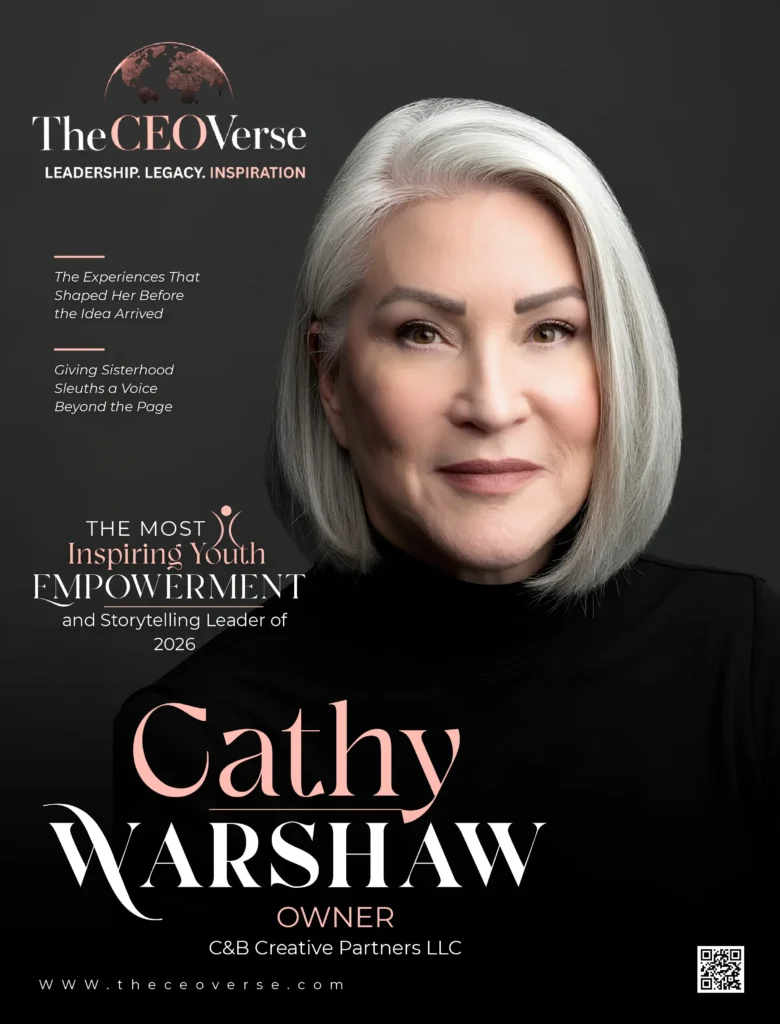
“The Most Inspiring Youth Empowerment & Storytelling Leader of 2026”
Cover story
Cathy Warshaw
Featured Profile - Cathy Warshaw
When Experience Became the Beginning
At 73, when many people begin looking back on what they have already accomplished, Cathy Warshaw found herself starting something entirely new. Her path into publishing did not begin with a degree, years of preparation, or a carefully researched market opportunity. Although Warshaw had already spent years as an entrepreneur, her entry into publishing began unexpectedly: with a vivid dream, a story that stayed with her, and the decision to put that story onto paper.
Within three days, Warshaw had completed almost half of what would become The Obsidian Eye, the first book in the Secret Societies and the Sisterhood Sleuths universe. What began as an instinctive creative response gradually became a much larger venture involving an eight-book global mystery series, the free Sisterhood Sleuths Outreach Program, educational activities, original music, audio experiences, a podcast, a digital magazine, and interactive projects still being developed, including the detective-style experience CipherNet.
The scale of what she eventually began building makes the starting point even more striking. Warshaw had not spent decades preparing for publishing. She did not attend college or follow a conventional academic path toward becoming an author, yet she brought decades of entrepreneurial and life experience to the challenge.
Today, Warshaw’s work brings together her roles as an author, songwriter, certified teen empowerment coach, and entrepreneur. More importantly, her journey has become an example of how a new chapter can emerge from experiences that once appeared unrelated.
The Experiences That Shaped Her Before the Idea Arrived
Long before Sisterhood Sleuths, Warshaw had already built an entrepreneurial life that included restaurant ownership and work across hospitality, nonprofit organizations, education, and teen empowerment coaching. Each experience taught her something about people, responsibility, communication, and personal growth.
Eight years of restaurant ownership taught her about people and responsibility in a practical environment. Hospitality sharpened her ability to read people. Nonprofit work exposed her to community needs, while education gave her insight into how young people learn, struggle, and grow. Coaching eventually required her to listen carefully and understand the perspectives of teenagers.
Those experiences became important later, even though there was no obvious connection between them at the time.
Warshaw had also spent much of her life observing people and asking questions. She wondered why people believed certain things, what influenced their choices, and how their behavior revealed what they were thinking. Watching, questioning, and wondering became natural parts of how she understood the world.
That curiosity eventually found a creative outlet. What might once have been dismissed as daydreaming became part of the thinking behind the world she created. For Warshaw, asking questions was never separate from learning. It was one of the ways she learned.
A Dream Turned Into a Larger Purpose
The beginning of Sisterhood Sleuths was not the result of a conventional entrepreneurial process. After the dream, Warshaw began writing because the story would not leave her. Within three days, she had completed nearly half of The Obsidian Eye. Only later did she begin to understand how much larger the idea could become.
As the story developed, Warshaw began seeing something beyond the mystery itself. The characters could represent young people who might recognize parts of themselves in them, including the quiet child, the daydreamer, or the young person who constantly asks questions without knowing whether those questions matter.
That realization gradually expanded the purpose of the project. Warshaw wanted young people to understand that curiosity has value. She wanted them to see that courage and curiosity can exist together, and that uncertainty about the future does not mean they have nothing valuable to contribute.
The book became the starting point rather than the destination. As the series took shape, Warshaw saw an opportunity to use mystery and adventure to encourage young people to become more curious, confident, resilient, and willing to think for themselves.
Cathy Warshaw’s Vision Outgrew the Book
Warshaw’s next question was not simply how the book could reach more readers. She began reconsidering what it meant to be a reader in the first place.
Reading about young characters solving mysteries was one experience. Giving young people the opportunity to solve mysteries themselves was another.
That distinction changed the direction of Sisterhood Sleuths. The book became the first doorway into a much broader world that Warshaw could continue developing across different forms of engagement. The universe now extends across an eight-book global mystery series, audio experiences, educational activities, original music, a digital magazine, a podcast, and interactive projects such as CipherNet, currently in development.
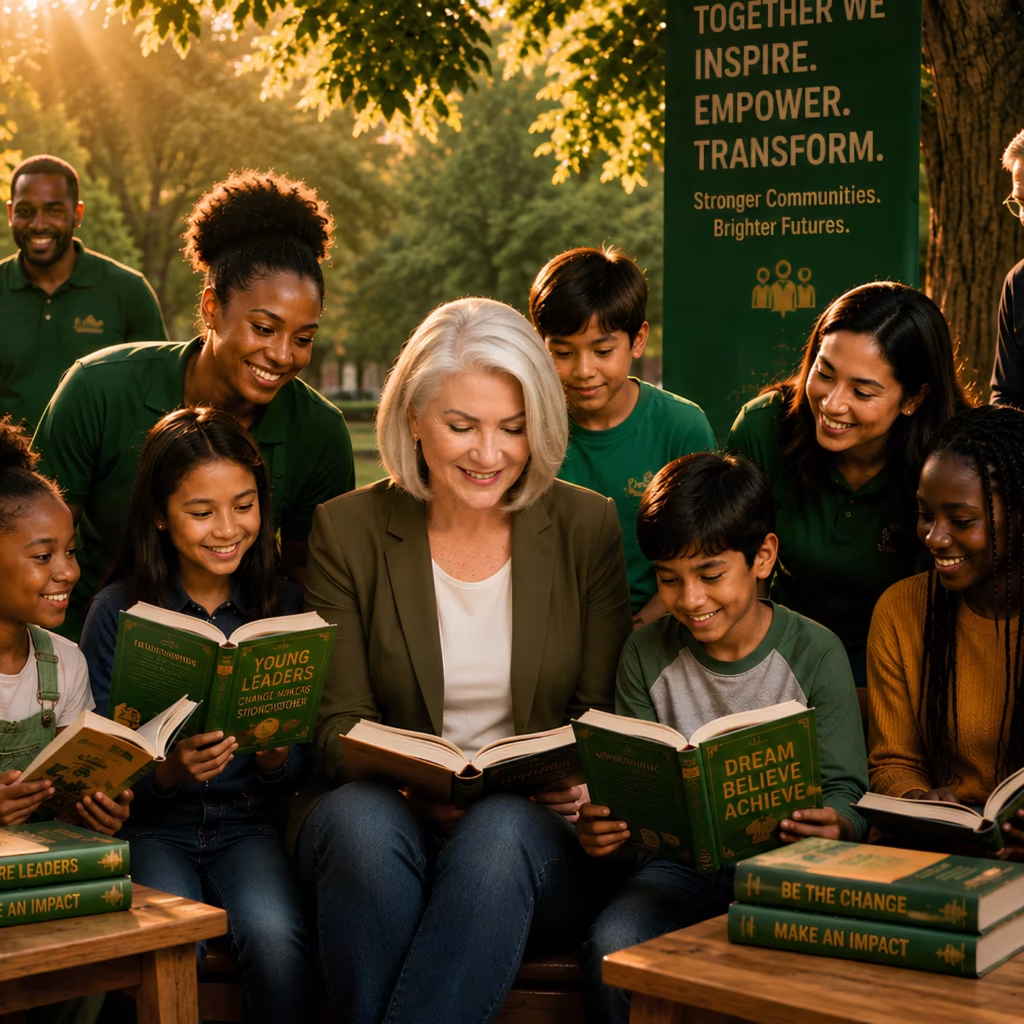
Central to that expansion is the free Sisterhood Sleuths Outreach Program for young people ages 10–18, designed to turn themes such as curiosity, critical thinking, teamwork, courage, resilience, and leadership into active learning experiences.
For Warshaw, the different formats are not separate ideas competing for attention. They are different ways of carrying the same world, characters, and purpose to audiences who may engage with stories differently.
A young person can read, listen, investigate, discuss, or participate. Through those experiences, Warshaw aims to encourage observation, critical thinking, communication, teamwork, confidence, leadership, creativity, and cultural understanding. The story itself becomes the vehicle for those experiences.
That evolution also reflects how Warshaw thinks about what she is building. The question is not simply whether the venture can sell more books. It is whether the world created through Sisterhood Sleuths can become increasingly useful to the young people, families, educators, and communities it is intended to reach.

Curiosity Became the Heart of Her Message
Curiosity sits at the center of Warshaw’s work because she sees it as something that can be developed rather than a quality reserved for naturally inquisitive people.
For Warshaw, curiosity is not simply about asking more questions. It is about learning to examine what young people see and hear: Is it true? How do I know? What might be missing? What evidence supports it?
The detective structure of Sisterhood Sleuths gives those questions a natural place. Investigation requires observation, comparison, evidence, and persistence. Rather than presenting critical thinking as a lesson delivered from the outside, Warshaw places it inside an adventure. Young people encounter clues, decode ciphers, investigate information, work with others, and explore different cultures as part of the experience.
For Warshaw, learning becomes more powerful when it is embedded in something young people genuinely want to explore.
Among the interactive concepts being developed is CipherNet, a detective-style experience intended to bring together puzzles, ciphers, languages, and cultural exploration inspired by the countries and worlds within Sisterhood Sleuths.
The underlying idea remains consistent throughout her work: curiosity is not something young people should eventually outgrow. It is a strength they can carry forward.
The Lessons Cathy Learned While Building
Creating the venture at 73 did not make the process simple. Warshaw encountered the realities that accompany any ambitious new undertaking, including changing technology, evolving publishing and marketing practices, rapidly multiplying social media platforms, difficult decisions, and moments when the scale of the work felt overwhelming.
Like many founders entering a new industry, Warshaw made investments and publishing decisions she would approach differently today. She also learned that collaborators can understand the same mission in very different ways, making communication, discernment, and clear expectations essential.
That experience changed the way Warshaw approaches the relationship between vision and collaboration. She learned that protecting an idea does not mean refusing to listen. Feedback can reveal when change is necessary, while certain elements of the original purpose still need to remain protected.
For Warshaw, that balance has become essential. Too much rigidity can prevent development, while too much flexibility can cause the original purpose to become unclear.
Experience also made Warshaw more discerning. She learned to ask more questions, investigate opportunities carefully, and pay closer attention to warning signs before making decisions — a real-life instinct that fittingly echoes the mysteries at the center of Sisterhood Sleuths. What appears obvious at first may not tell the whole story. The clues may already be present, but they have to be noticed.
Warshaw’s confidence has therefore not been about believing she is always right. It has become more closely connected to remaining bold while becoming more discerning.
Knowing Where Her Strengths End
Another important part of Warshaw’s development has been recognizing that leadership does not require knowing everything.
The personal connection an entrepreneur has with an original idea can create a desire to control every detail. Warshaw increasingly sees her role as protecting the central vision while surrounding herself with people whose expertise strengthens it. The goal is not to know everything herself, but to keep the work connected to the young people it was created to serve.
That philosophy is also reflected in the fictional world she has created. The Sisterhood Sleuths do not succeed because one character possesses every answer. Their strength comes from combining different abilities. One may understand puzzles, another languages, another may notice details others overlook, and another may contribute knowledge of science.
Warshaw sees the same principle in the venture itself. Her relationships with educators, youth organizations, homeschool families, bookstores, and community groups form part of the wider effort to carry the work forward. The founder can provide the initial spark, but a larger community can help that spark become something sustainable.
For Warshaw, collaboration does not dilute ownership of the vision. It gives the vision more ways to move.
Keeping Young People at the Center
Warshaw’s experience as a certified teen empowerment coach adds a particularly personal dimension to Sisterhood Sleuths. Her interest is not simply in creating something for young people. She wants their way of thinking and their experiences to remain part of what shapes the work.
Young people do not need adults to tell them what to think. They need opportunities to discover how to think for themselves. Warshaw’s approach is to build those lessons into mystery and adventure so that learning feels like discovery rather than instruction.
Warshaw wants young people to feel permitted to ask questions and to understand that being shy is not a weakness. She wants them to recognize that caring deeply about something others may not understand is not a flaw, and that entering adulthood without a perfectly mapped-out future does not mean they have failed.
Her own life gives that message particular weight. At 75, Warshaw says she is still learning. She continues to create, adapt, and expand rather than presenting herself as someone who has already figured everything out.
That perspective allows her to communicate a simple but meaningful idea to young people: it is acceptable to still be figuring things out. A direction can change. A new beginning can happen. Permission to begin does not always have to come from someone else.
The same message can resonate with adults who have postponed their own ideas because they believed the timing was not right.
Giving Sisterhood Sleuths a Voice Beyond the Page
The Sisterhood Sleuths Podcast for Curious Minds gives the universe another entry point. Rather than serving as an audio version of the books, it uses narration, soundscapes, original music, mystery, adventure, and thought-provoking themes to explore many of the same questions about curiosity, perception, trust, and critical thinking.
Episodes including What If You’ve Been Lied To? and Why Smart People Miss Red Flags! explore ideas around perception, trust, awareness, and the risks of accepting appearances without investigation.
The podcast also gives audiences another way to enter the universe. Someone may discover Sisterhood Sleuths through audio before encountering the books, while another person may enter through the magazine or eventually through an interactive experience.
For Warshaw, expanding the number of formats does not require changing the identity of the original idea. The story remains the foundation while the ways people experience it continue to evolve.
The Magazine Opens Another Door
Introduced in May 2026, the Sisterhood Sleuths Magazine adds another layer to the ecosystem Warshaw continues to develop. The digital publication is designed for teens, young readers, families, educators, and curious minds.
The magazine carries the same mission into shorter, participatory content, combining stories about young people with puzzles, cultural exploration, creative challenges, STEM-inspired thinking, and themes of courage, teamwork, and personal growth. Readers are invited into clues, puzzles, ciphers, challenges, and discussions rather than being positioned only as consumers of information.
For Warshaw, the magazine strengthens the connection between the different parts of the Sisterhood Sleuths world. The books establish the universe, the podcast deepens the experience, the magazine broadens the conversation, educational outreach connects the ideas with real-world learning, and interactive projects encourage participation.
Across each format, the mission remains the connecting thread.
Her Decision Not to Wait
Perhaps the clearest reflection of Warshaw’s character can be found in what she refused to wait for.
She did not wait until she had mastered publishing, until technology stopped changing, or until someone decided that 73 was an appropriate age to begin. She began anyway.
The decision did not remove uncertainty. There were costly mistakes, technological challenges, disagreements, moments of doubt, and times when the undertaking felt overwhelming. What changed was her willingness to continue learning instead of requiring certainty before taking the next step.
Warshaw’s background also became part of what made the venture distinctive. By the time the idea arrived, she had already lived through multiple careers, setbacks, mistakes, and reinventions. Those experiences did not become irrelevant when she entered entrepreneurship. They became part of her perspective.
A Different Timeline for Opportunity
Warshaw’s story offers a useful counterpoint to the culture of early achievement: innovation does not always come before experience. Sometimes experience is precisely what makes a new kind of innovation possible.
Business culture often celebrates people who achieve early, and stories about young entrepreneurs can unintentionally create the impression that important opportunities have an expiration date. Warshaw’s experience suggests something else. Decades of experience can precede the idea that finally brings those experiences together.
The original concept had grown into a broader creative and educational ecosystem, with new formats emerging and further reach into new languages and communities among the directions being explored.
For Warshaw, age is not necessarily a barrier to innovation. The experience accumulated over time can itself become valuable. It can sharpen pattern recognition, make red flags easier to notice, clarify which relationships matter, reveal which opportunities deserve attention, and provide the confidence to say no when necessary.
Where the Sisterhood Sleuths Journey Goes Next
The direction ahead for Sisterhood Sleuths is one of continued expansion. The series already reaches readers in multiple languages, with further language expansion and interactive experiences among the directions being explored, while its outreach continues to focus on educators, families, organizations, and young people across different communities.
Warshaw’s vision increasingly moves beyond traditional publishing. She sees possibilities in stories that can be read, heard, solved, and explored. A mystery can become an opportunity to think critically. A puzzle can introduce collaboration. A fictional adventure can open a window into another culture. A reader can become an active participant.
For Warshaw, expanding Sisterhood Sleuths across different formats is not simply about building a larger brand. The deeper opportunity is finding more ways for the stories and activities to reach and positively influence young people.
Her ambition is to connect young people regardless of where they live and provide every child with an entry point into the experience.
The direction is ambitious, but it remains connected to the same idea that started everything: a dream, a story, and the willingness to see where it could lead.
The Chapter That Proved It Was Never Too Late
There is a fitting irony in Cathy Warshaw’s journey. She created a world built around mysteries, yet one of the greatest mysteries in her own life was discovering what she was capable of creating.
She did not grow up planning to become an author. She did not enter adulthood with a carefully designed professional roadmap. At the time, there was no reason to assume that restaurant ownership, hospitality, nonprofit work, education, and coaching would eventually contribute to a youth-focused creative venture. Those experiences simply had to happen first. Only later could their value become visible.
Her story is about more than publishing. It is about what can happen when experience, curiosity, and opportunity finally meet. Warshaw did not begin again at 73 with an empty slate; she brought a lifetime of experience with her. That experience became part of what she created.
At 75, Warshaw was still learning, creating, and expanding the story she had begun. Her journey suggests that the next opportunity may arrive after years of experiences that once appeared unrelated, and that its meaning may only become clear after the journey has progressed.
For Cathy Warshaw, the important question was not whether she had started early enough. It was whether she was willing to begin when the idea arrived.
The answer began with a dream, three days of writing, and The Obsidian Eye. Everything that followed grew from that decision.
And the story is still being written.