TheCEOVerse • Digital Edition
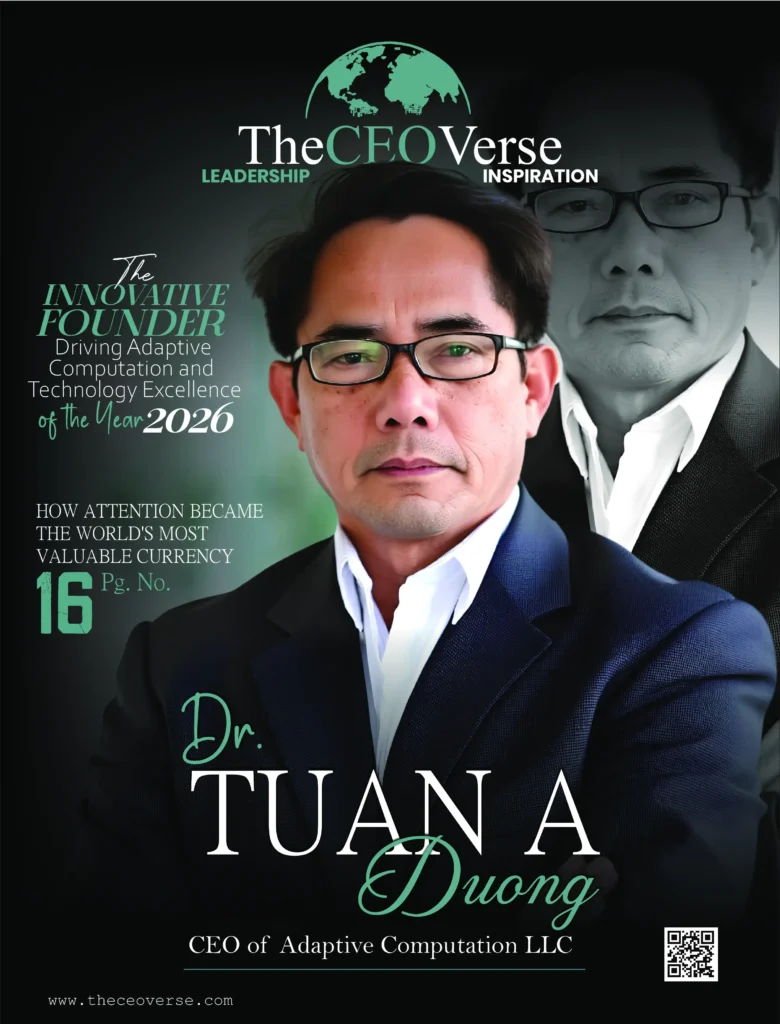
“The Innovative Founder Driving Adaptive Computation and Technology Excellence of the Year 2026”
Cover story
Dr. Tuan A Duong
Featured Profile - Dr. Tuan A Duong
Dr. Tuan A. Duong: The Innovative Founder Driving Adaptive Computation and Technology Excellence of the Year 2026
While some engineers build for the latest trend, true innovators build to answer the hardest questions. Dr. Tuan A. Duong belongs firmly to the second category. For more than forty years, one question has followed him from a research bench at NASA’s Jet Propulsion Laboratory to the boardroom of the company he now leads. Why can a human being glance at an object once and simply know it, while a machine needs thousands of labelled examples to learn the same lesson? It is not a question with an easy answer, and Duong has never pretended otherwise. Instead, he has spent a career assembling the pieces, one algorithm, one chip design, one patent at a time, until the pieces started to look like an answer.
Today, Dr. Duong is the CEO of Adaptive Computation LLC, a technology company built on the conviction that the next real leap in artificial intelligence will not come from bigger data centers or larger language models, but from machines that borrow their architecture directly from the human eye and brain. It’s a contrarian gamble in a landscape fixated on scale, which is precisely why his journey demands our attention.
A Summer Internship That Became a Life’s Work
Every origin story has a first door, and for Duong, that door opened at the Jet Propulsion Laboratory in the summer of 1985. He arrived as an intern with an assignment that, at the time, sounded almost theoretical. To help build a neural computing system to simulate neuronal activity, using the associative memory model pioneered by physicist John Hopfield and a technique known as diluted coding. Few interns get to say their first project put them in direct intellectual conversation with one of the founding fathers of modern neural networks, but then again, few internships turn into a beginning of the remarkable path that a scientist sought out to shape.
What kept Duong at JPL wasn’t inertia. It was atmosphere. JPL, he has said, gave him an unusually open research environment, one that allowed him to reach past conventional thinking rather than simply execute someone else’s roadmap. That freedom to imagine first and justify later became the defining spirit of his career, and it is the same spirit he says he carries into Adaptive Computation today. Over the decades that followed, his research fanned out across a striking range of disciplines. Neural networks, neuromorphic hardware, sensor fusion, machine vision, electronic “noses” capable of detecting chemical signatures, autonomous systems, and ultra low power VLSI chip design. He did not simply work within bio inspired technology at JPL, but in many ways, he helped initiate it as a distinct field of inquiry within the laboratory.
The scientific output from those years reads like the résumé of several careers compressed into one. Thirty NASA New Technology Reports. Patented inventions spanning hardware neural networks, adaptive learning algorithms, cognitive computing, and AI enabled sensing. Peer reviewed publications numbering well over eighty. In 2002, NASA recognized him with the Exceptional Space Act Award, one of the agency’s highest honors for technical achievement, and he followed it with Major Space Act Awards in 2003, 2006, and 2009. A run of recognition that few engineers, inside or outside NASA, ever assemble in a single career.
Building Intelligence for Places Humans Cannot Go
Ask Duong what he built at JPL, and the answers sound less like engineering and more like science fiction that happened to work. He served as technical leader on the 3D Analog Neural Network processor. An ambitious hybrid in memory architecture designed to deliver high speed and low power by moving computation closer to memory itself. The first version ran into the messy realities of semiconductor fabrication, processing variations that limited its precision, but rather than treating that as a dead end, Duong treated it as a foundation. Decades later, a modified version of that same architecture would be proposed to DARPA’s Microsystems Technology Office, a full circle moment that says as much about his persistence as it does about his engineering.
Along the way, he invented Cascade Error Projection, a hardware learning algorithm that could solve the notoriously difficult 2 to 8 parity benchmark problem using only four bits of resolution, at a time when conventional techniques needed sixteen bits or more. In an industry where every extra bit costs power, weight, and money, that kind of efficiency was not a curiosity. It was survival, particularly for the Ballistic Missile Defence Organization programs he supported, where computing hardware had to fit inside the punishing size, weight, and power constraints of an interceptor system.
He also built an adaptive feedback learning system capable of recognizing changes in the shape and colour of objects and environments. A technology that fed directly into research on real time adaptive colour segmentation for identifying safe Mars landing sites. Somewhere in the middle of designing systems for missile defence and Martian terrain, Duong began sketching out what would become the most defining idea of his career. The Extended Visual Pathway, an integration of a saccadic eye movement emulator with a model of the human visual pathway. It started as a JPL research thread. It would later become the technological backbone of an entire company.
Perhaps most remarkably, his on line learning neural network software became part of aerospace history in 1994, when it demonstrated fault tolerant, gracefully degrading performance aboard hybrid neural network VLSI chips flown into space for the STRV-1b mission, testing how the hardware coped with the harsh radiation of the space environment. It was the first neural network chip, and the first on line learning software, ever flown into orbit.

When Innovation Outpaces the Market
Every founder eventually meets the moment when brilliant technology collides with an unbuilt market, and for Duong, that moment arrived around 2010, as he pushed deeper into bio inspired visual systems. There was, quite literally, no obvious competitor working the same problem the same way. That sounds like an advantage until you realize it also means no established customer base, no comparable pricing model, and no playbook to borrow from. The technology worked. The demonstrations were compelling. But proving something works in a lab and keeping the lights on while the rest of the world catches up are two very different challenges.
Funding became the daily battle. Keeping cutting edge, unproven technology alive required Duong to diversify aggressively. Pursuing Department of Defence proposals, courting venture capital, and enforcing a disciplined budget that let the company move forward without drifting from Adaptive Computation’s founding vision. He made a deliberate strategic choice that shaped everything that followed. As a technology company first, Adaptive Computation would prioritize building the science and locking down the patents before chasing the market. The bootstrapped approach meant self funding the core research, developing the underlying technology to maturity, and only then building applications on top of it. It is a slower path than the venture backed sprint many startups take, but it is one that leaves Duong, not outside investors, holding the steering wheel.
That patience is paying forward now. Adaptive Computation is currently bringing a handful of software and commercial off the shelf products to market, while simultaneously working to raise capital for its most ambitious hardware effort yet. A Hybrid Processing Unit built on in memory processing architecture, engineered for massive parallel learning on a single chip, paired with its own compiler. Conceptually similar in spirit to what CUDA did for Nvidia’s GPUs, but purpose built for Duong’s bio inspired computing approach.
Teaching Machines to See the Way We Do
If there is a single idea that captures what makes Duong’s approach genuinely different, it is that he did not simply try to make existing AI models faster or bigger. He tried to reverse engineer intelligence itself, using the architecture of the human eye and brain as his blueprint.
The software side of his work rests on two complementary systems that mirror the way human memory actually functions. The first, the Extended Visual Pathway, operates as an unsupervised learning system, what Duong describes as the short term memory of the architecture. The idea came to him almost by observation, studying the building blocks of the visual pathway’s configuration and applying his own earlier inventions, including Cascade Error Projection and a technique called Spatial Independent Component Analysis, to decode how the system might work computationally. In an unexpected twist, his independently derived model turned out to closely mirror the Nobel Prize winning neuroscience of David Hubel at Harvard, whose decades of research on the visual cortex had already mapped much of the same terrain from a biological angle. Rather than treat the overlap as coincidence, Duong used Hubel’s findings to sharpen his own model further. An incredibly rare case of an engineer’s intuition and a neuroscientist’s evidence arriving at the same truth from opposite directions.
The results were striking enough to matter well beyond the lab. In testing, the Extended Visual Pathway’s underlying search engine reportedly outperformed average human face recognition accuracy against ten thousand visual distractors. Combined with a feedback mechanism for detecting and tracking moving objects, even when those objects were noisy, low resolution, unfamiliar in pose, or only partially visible. The system evolved into what Duong calls the On line and Adaptive Image based Search Engine in the Loop, or OAISEE. That technology earned Adaptive Computation a DARPA ERIS Awardable in 2025, and a related innovation, a real time adaptive tracking system for irregular target trajectories built around size, weight, power, and cost constraints, earned a second DARPA ERIS Awardable in 2026.
The second pillar, Dynamic Supervised Learning, functions as the system’s long term memory. Duong built it as a direct answer to one of traditional supervised learning’s biggest weaknesses. Static systems like standard backpropagation require frozen labels and a fixed architecture, which makes them brittle the moment real world data starts shifting, updating, or introducing entirely new categories. His alternative uses a far less competitive learning approach, allowing new information to settle on top of existing knowledge rather than overwriting it. An intelligent, evolving feature learning system rather than a static, one time trained model. The feedback loop between these two systems, perception feeding memory, memory refining perception, is the essential building block of genuine self intelligence.
On the hardware side, Duong continues to push a modified hybrid in memory processing architecture designed to tolerate manufacturing variations while preserving resolution accuracy, alongside a massive parallel learning mechanism aimed at cutting training time by at least two orders of magnitude compared to conventional approaches. Tie all of it together with the compiler currently in development, and Duong believes the combination, including bio inspired software architecture fused with asynchronous, low power hardware, represents a genuinely distinct path toward self intelligent systems. Rather than an incremental improvement on the deep learning playbook everyone else is refining.
The Strategic Pitfalls of Tech Centric Thinking
Ask Duong to reflect on his own missteps, and he doesn’t reach for false modesty or manufactured drama. His answer is plain and specific. He became so absorbed in the excitement of building genuinely innovative technology and application products that he underinvested in marketing strategy and commercial partnerships. In the short term, that focus cost the company visibility and speed to market. But Duong has come to see it differently in hindsight. As a decision that, in the long run, protected the integrity of an entire innovation direction, one he believes will ultimately contribute something meaningful to people’s lives rather than simply chasing a faster exit.
It is a rare kind of honesty for a CEO to offer publicly, and it says something about how Duong measures success. For him, the metric was never simply “did we raise the next round quickly.” It was “did we build something real, on our own terms, without compromising the science to satisfy a market that wasn’t ready yet.”
The People Who Held the Vision Alongside
Duong is eager to name the people who shaped his thinking during the JPL years. He speaks warmly of the researchers who surrounded him early on. Dr. Alex Moopenn, Dr. Silvio Eberhard, Dr. Raoul Tawel, and Mua Tran among them. The colleagues whose collaboration sharpened his own ideas in the laboratory’s freewheeling research culture. Outside JPL, Dr. Allen Stubberud of UC Irvine became an important source of guidance in systematic engineering thinking, a mentorship that has since come full circle. Stubberud now serves as VP of Advisory at Adaptive Computation, helping steer the company’s long term technical vision.
Then there is the moment Duong still returns to when asked about validation from unexpected corners. John Hopfield himself, the same physicist whose associative memory model had anchored Duong’s very first JPL project back in 1985, later visited JPL to see a demonstration of Duong’s new approach to the Traveling Salesman Problem, and offered genuinely encouraging feedback. For an engineer who started his career studying Hopfield’s work as a student of the field, having Hopfield return decades later to appreciate his independent contribution is the kind of full circle moment that seldom gets scripted this well in real life.
Walking Alone, and Choosing To
Here is where Duong’s story takes an unusual turn. Early in his JPL career, his supervisor affectionately labelled him a loner. Someone pursuing his own imagination rather than falling neatly into a team’s existing direction. Duong didn’t resist the label, he embraced it. He has said, without regret, that working for NASA was perhaps the luckiest break of his career, precisely because the organization’s culture made room for that kind of independent imagination to flourish rather than snuffing it out.
That independence came with real trade offs. When Duong eventually left JPL, several major investors were ready to help him take the next step, and one of them proposed teaming up with a highly capable neural networks group out of Los Alamos National Laboratory. Duong, deep in his own technology first focus, let those opportunities pass. Looking back now, he describes the decision without either regret or self congratulation. Simply as the path that got him to where the company’s technology achievements now stand, ready, in his words, to turn to the next page.
That same instinct toward independence has evolved rather than disappeared. Today, because Adaptive Computation’s technology vision represents such an ambitious departure from the AI industry’s mainstream direction, Duong is actively working across multiple channels to build the kind of partnerships and collaborative momentum the company will need to accelerate its path to market. A deliberate, more outward facing approach to teamwork than the one he practiced for most of his career.
A Vision Bigger Than a Balance Sheet
What ultimately distinguishes Duong from many of his AI industry peers isn’t just the bio inspired architecture, it’s what he wants that architecture to accomplish. He is openly skeptical of the brute force direction much of the industry has taken. Gigantic models, sprawling data centers, and statistical learning approaches that demand enormous resources relative to the practical gains they deliver for ordinary people. His SWaP-C philosophy, the size, weight, power, and cost combined with his self intelligence architecture, is his answer to that imbalance. And he sees both as among the final, decisive frontiers in artificial intelligence, whether applied broadly or within specialized domains.
Notably, Duong isn’t chasing general artificial intelligence for its own sake. He has said plainly that broad, general self intelligence may not even be necessary, and that pursuing it recklessly could introduce real danger for humanity. His preferred path starts narrower and more affordable. Specialized domains first, where low cost, self intelligent systems can be deployed practically in agriculture, manufacturing, and distribution. The sectors he believes are ripe for meaningful productivity gains without the runaway risks of general AI.
The scale of his ambition, though, is anything but modest. If self intelligent, SWaP-C-based AI systems can be successfully developed, validated, and deployed across these productive industries, Duong envisions a future where the resulting efficiency could shrink the standard workweek dramatically. He has floated a figure as low as sixteen hours a week. Freeing people to spend more time with family, with nature, and with their own wellbeing. It’s a striking vision to hear from an engineer more commonly found discussing bit depth and hybrid memory architectures, but it underscores how deliberately Duong has tied his technical roadmap to a broader human outcome. One where artificial intelligence eases the burden of daily labour rather than simply maximizing output for its own sake.
Pearls of Wisdom
When asked what he would tell someone just beginning their own journey, Duong doesn’t offer a polished soundbite. He offers three plain, hard won truths. Passion gives you endless energy when everything else runs out. Well planned projects earn you longer lasting resources. And ambition is what pushes you to a higher level when the easier path would be to settle. It is not advice designed for a motivational poster. It is advice that reads like it was extracted directly from four decades of practice, failure, patience, and eventual vindication.
He is equally candid about the nature of the path he chose. Running a technology first company demands enormous passion and a genuinely solid technical foundation, paired with an innovative vision strong enough to sustain the company’s spirit through the inevitable lean years. The approach has clear costs. It is slower, and it will likely never scale as fast as an applications first company chasing quick market share. But it also comes with a distinct advantage. The technology built step by step, secured with real patents before the market push begins, is more resilient to bad market timing and remains fully under the founder’s control rather than dictated by outside pressure.
The Road Ahead
More than four decades after that first summer internship at JPL, Dr. Tuan A. Duong is still chasing the same question that pulled him into the field in the first place. Not because he hasn’t found pieces of the answer, but because each piece he finds reveals how much further the puzzle extends. From a hybrid neural network chip flown into space in 1994, to a bio inspired vision system that now outperforms average human recognition against ten thousand distractors, to a DARPA recognized tracking system built for the harshest constraints of size, weight, power, and cost, his career reads less like a single résumé and more like a long argument. Which is made patiently, algorithm by algorithm, that the deepest lessons about intelligence were written long ago, in the architecture of the human brain itself.
Adaptive Computation LLC is, in many ways, the final proving ground for that argument. A company built not to out scale the giants of the AI industry, but to out think them, using a fraction of the power, a fraction of the data, and a philosophy borrowed directly from the way human beings have always seen and understood the world around them. Duong is now actively seeking partners who share that outlook. The collaborators motivated less by short term commercial upside and more by a genuine commitment to building AI that benefits people broadly, not just the corporations large enough to build it at scale.
For a man once quietly nicknamed “the loner” by his own boss, it is a fittingly independent way to close out, or perhaps more accurately, to continue one of the more quietly remarkable careers in American aerospace and artificial intelligence research. The story of Dr. Tuan A. Duong is not yet a finished one. If his last four decades are any indication, the next chapter is likely to be built the same way all the others were. One patient and deliberate insight at a time.