
TheCEOVerse • Digital Edition
“Top 10 Most Influential Business Titans”
Cover story
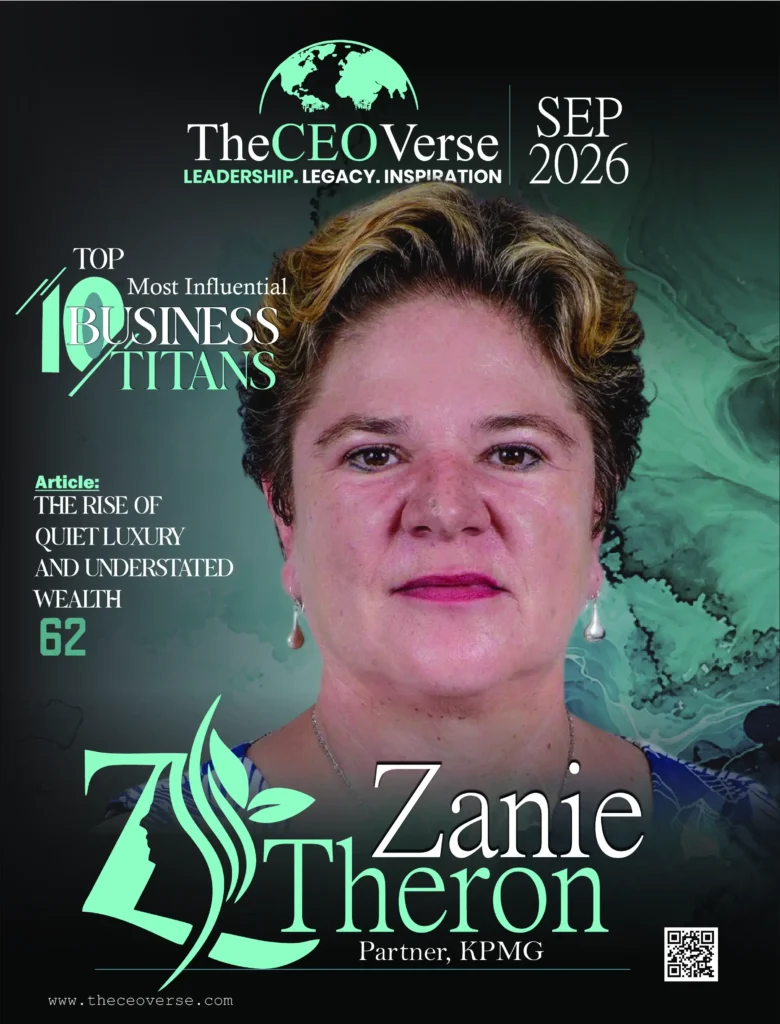
Zanie Theron
Featured Profile - Zanie Theron
Zanie Theron: Where Financial Discipline Meets Strategic Leadership
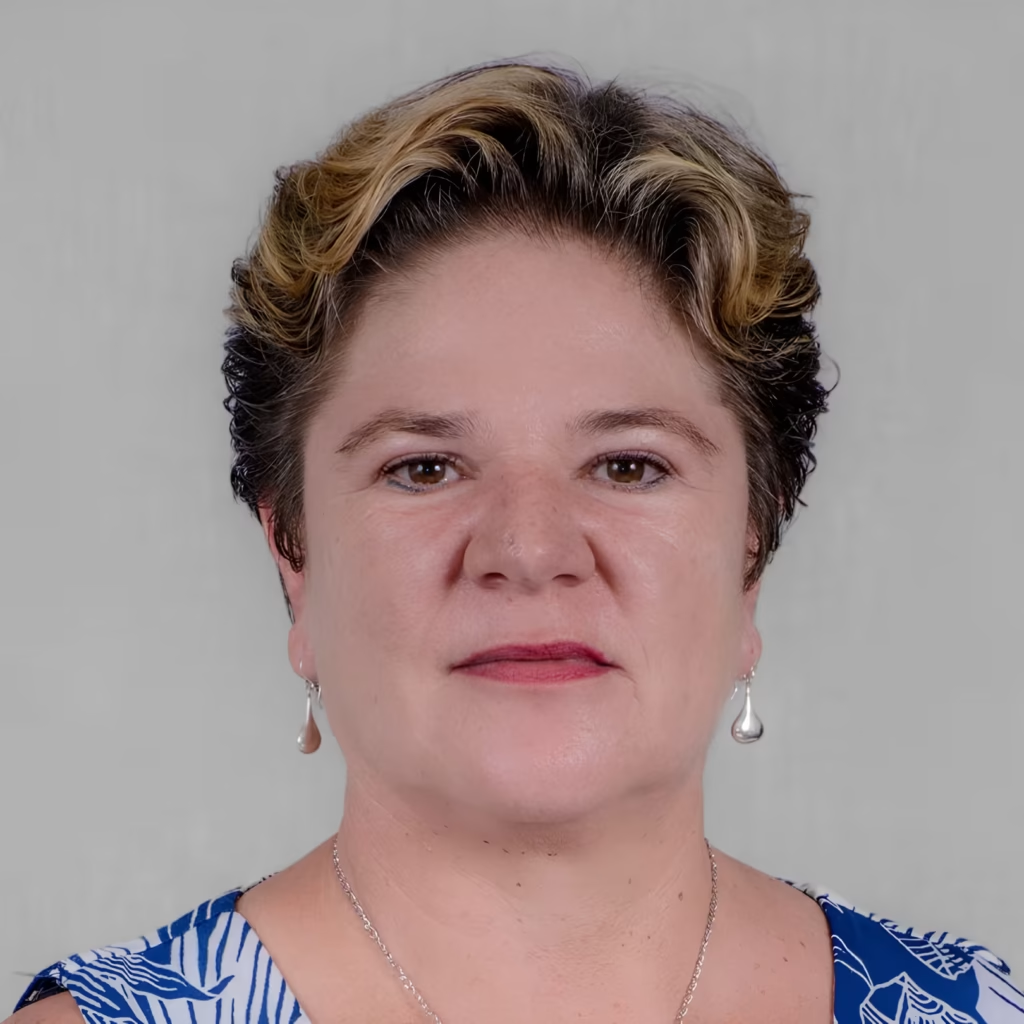
In boardrooms, numbers rarely tell the whole story. Behind every balance sheet is a strategy. Behind every audit finding is a question of governance. Behind every investment decision is an assessment of risk, opportunity and confidence. And behind every organisation navigating a complex operating environment is the need for leaders who can connect financial discipline with commercial judgement. Few careers illustrate that intersection as distinctly as that of Zanie Theron, South Pacific Practice Partner-in-Charge at KPMG in Papua New Guinea.
A Chartered Accountant in South Africa and Australia, CPA in Papua New Guinea, and a licentiate member of the Institute of Solomon Islands Accountants, she brings an unusually broad professional foundation to her leadership role. Her qualifications extend beyond accountancy: she was admitted as an Advocate/Barrister to the South African Supreme Court, adding a legal dimension to an already multidisciplinary career.
Today, she leads KPMG’s South Pacific Practice, which services eight South Pacific nations, including the established PNG and Fiji practices as well as other Pacific locations. She also leads the Advisory Practice in Papua New Guinea and maintains a substantial portfolio of external audit clients.
But the significance of her journey is not simply the number of professional designations attached to her name or the seniority of the positions she has held. It is the evolution of a professional who has repeatedly moved across disciplines, jurisdictions and increasingly complex leadership mandates and has turned that breadth into a distinctive approach to solving business problems.
Law to Numbers and Beyond
Zanie’s professional story did not begin in the traditional accounting pathway. Before entering the world of professional services, she spent close to eight years as a Legal Officer with the Department of Defence/South African National Defence Force, from 1989 to 1997. That experience established an early foundation in law, governance, institutional responsibility and the importance of operating within clearly defined frameworks. She subsequently pursued accounting, eventually joining Deloitte Pretoria as a Trainee Accountant in 1999. The transition from law into accountancy may appear unconventional. In reality, it became one of the defining strengths of her career.
Accounting teaches precision. Law teaches interpretation, evidence and accountability. Professional advisory work demands both as well as the ability to understand the commercial realities behind technical questions.
Her academic and professional background reflects that combination. KPMG records her qualifications as including an Honours degree in Accounting Science, a B Proc LLB, a Bachelor of Arts and Honours degree in English, alongside advanced investigative accounting training through Macquarie University/CAANZ. This combination matters in leadership because today’s business challenges rarely sit neatly within one discipline.
A governance problem may have financial consequences. A regulatory issue may affect strategy. A transaction may require financial, legal and operational judgement simultaneously. A risk identified through audit may ultimately reveal a deeper organisational or cultural issue. The ability to see those connections is increasingly valuable at the executive level.
Building a Cross-Jurisdictional Perspective
After beginning her professional-services career with Deloitte in South Africa, Zanie moved through Canberra and Perth before relocating to Papua New Guinea in 2006. That geographic progression became more than a sequence of career moves. It gave her exposure to different institutional environments and business cultures before she established deep professional roots in the Pacific.
KPMG notes that she has now spent two decades in Papua New Guinea following earlier professional experience in Pretoria, Canberra and Perth. The firm also highlights her experience across financial services, manufacturing and retail, mining and resources, aviation, development, NGOs, state-owned enterprises and government agencies. That breadth provides an important perspective.
A professional who has worked across multiple industries learns that the same management principle can produce very different outcomes depending on the environment in which it is applied. A risk framework that works in one sector may require adaptation in another. A governance model designed for a large corporation may not translate directly into a state-owned enterprise or development organisation.
The role of an adviser, therefore, is not simply to bring a technical answer into the room. It is to understand the context well enough to determine which answer will actually work. That philosophy appears strongly aligned with her stated approach to problem-solving. KPMG describes her methodology as pragmatic, collaborative, and approachable, with an emphasis on contributing to client success. For senior executives, that distinction is critical. The best advice is rarely the advice that looks most impressive on paper. It is the advice that can withstand the realities of implementation.
The Audit Perspective
Zanie’s career has been deeply rooted in audit, but her professional trajectory demonstrates that she has never treated audit as merely a compliance exercise. Her Deloitte career progressed from Auditor to Director and ultimately Partner, with her role in Papua New Guinea identified as an Audit Partner. She later joined KPMG as a Partner in 2016 and moved into increasingly senior leadership responsibilities.
Audit provides a unique vantage point within an organisation. It requires leaders to understand how decisions translate into financial outcomes, whether controls are functioning, where risks accumulate and whether reported performance reflects operational reality. Yet the value of that perspective extends beyond financial statements. In a volatile operating environment, assurance can become a strategic capability.
Boards need confidence that the information reaching them is reliable. Investors need confidence that risks are understood. Executives need visibility into weaknesses before those weaknesses become crises. That is why modern audit and assurance increasingly intersects with governance, risk management and strategic decision-making. Her current areas of expertise reflect this broader perspective: financial statement and special-purpose audits, strategy, human capital consulting, executive recruitment, compliance audits, risk management framework reviews, internal audit design and implementation, forensic investigations, procurement review and design, and due diligence.
Taken together, those capabilities reveal something important about her leadership philosophy. Financial information is not an endpoint. It is an input into better decisions.
From Technical Expertise to Enterprise Leadership
In 2017, Zanie was appointed Managing Partner of KPMG in Papua New Guinea. At the time, The National reported that she described quality, superior service delivery and culture as foundational to the firm’s offering and expressed confidence in the team’s ability to drive the organisation forward. Several years later, her leadership mandate expanded again. In April 2023, she became Partner-in-Charge of KPMG’s South Pacific Practice, succeeding the previous regional leader.
The practice encompasses PNG and Fiji as major established offices, along with services delivered in locations including Solomon Islands, Samoa, Tonga and Nauru. This transition represents more than a change in title. Leading a country practice and leading a regional practice require different leadership architectures. A country leader can focus heavily on the performance, people and client relationships of one market. A regional leader must think simultaneously about consistency and local relevance, talent mobility, market development, regulatory differences, cross-border opportunities and the strategic allocation of expertise.
The challenge is to create connectivity without imposing uniformity. The South Pacific is not a single market. Its economies, institutions, industries and development priorities differ considerably. A successful regional professional-services strategy therefore needs a strong understanding of local conditions while retaining access to global capabilities. Her long tenure in Papua New Guinea gives her a particularly valuable perspective in that environment. KPMG states that she understands the country’s business environment and its unique challenges and has built extensive networks during her time there. That local knowledge becomes a strategic asset when combined with international professional experience.
Leadership in a Complex Pacific Economy
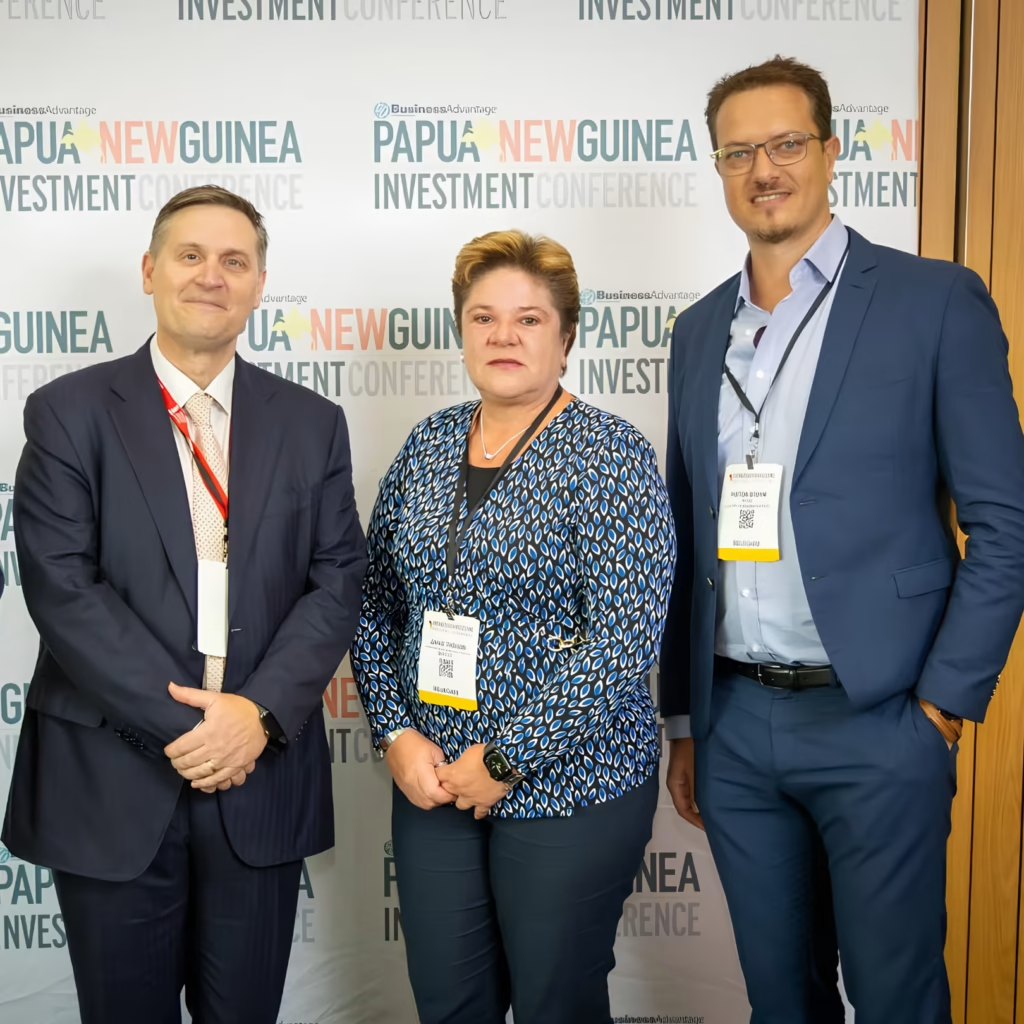
Papua New Guinea presents a distinctive environment for business leadership. Its economy brings together major resource opportunities, government and state-owned enterprises, infrastructure needs, emerging businesses, international investors and a developing institutional landscape. For organisations operating in such an environment, conventional approaches to risk and growth can be insufficient. Leaders must understand not only what the numbers say, but why they look the way they do. They must consider regulatory conditions, foreign exchange, infrastructure, access to talent, governance capability, investment requirements and the practical realities of operating across dispersed markets.
Zanie’s current professional remit places her directly within that intersection. KPMG’s advisory practice in PNG spans corporate strategy, company transformation, business performance, digital transformation, governance and policies, change management, enterprise risk management, financial risk management, forensic services and internal audit, risk and compliance services. This is the environment in which her multidisciplinary background becomes particularly relevant.
Her legal training provides an understanding of regulatory and institutional frameworks. Her accounting career provides financial discipline. Her audit background provides a rigorous approach to evidence and controls. Her advisory experience brings strategic and operational considerations into the discussion. And her years in Papua New Guinea provide local context. The combination allows her to approach complex problems from multiple angles rather than through a single professional lens.
The Shift from Risk Avoidance to Risk Intelligence
One of the most important changes taking place in boardrooms today is the evolution of how organisations think about risk. Risk can no longer be treated simply as something to eliminate. Strategic growth inherently involves uncertainty. The question is therefore not whether an organisation can avoid risk. It is whether leadership understands the nature of the risk it is taking, whether the organisation has the capabilities to manage it, and whether the potential return justifies the exposure. That requires risk intelligence.
Zanie’s work across audit, advisory, forensic investigations, internal audit, compliance, procurement and due diligence places her close to precisely these questions. Her involvement in KPMG’s thought leadership around the region also reflects this broader mandate. For example, KPMG’s South Pacific publications address investment regulation, monetary policy, foreign exchange and business sentiment alongside tax, regulatory and investment developments. Such work demonstrates the role professional advisers increasingly play in helping organisations interpret external change. The modern adviser cannot simply report what happened. The greater value lies in helping leadership understand what it means.
Making Advice Actionable
Perhaps the most distinctive element of her professional profile is the emphasis on pragmatism. In executive environments, intellectual sophistication has limited value if it cannot translate into action. A board does not need another presentation that describes a problem elegantly. It needs clarity about the choices available, the implications of each choice and the actions required to move forward. That is where pragmatic advisory leadership becomes powerful.
KPMG describes her as collaborative and approachable in addition to being pragmatic. These qualities can be especially important when dealing with complex or sensitive issues. Transformation creates resistance. Audit findings can expose uncomfortable weaknesses. Risk reviews can challenge established assumptions. Governance improvements can require changes in behaviour as much as changes in policy. Leadership in these circumstances is not about winning an argument. It is about creating enough trust for the organisation to confront reality and then act on it.
Developing People
The sustainability of any professional-services organisation ultimately depends on its people. This becomes even more important in markets where developing local capability is central to long-term economic progress. When she moved into the South Pacific leadership role in 2023, KPMG highlighted the importance of developing local talent in Papua New Guinea, with the transition of country leadership to Ces Iewago described as part of a broader focus on progressing citizen staff into senior leadership roles.
This points toward a wider leadership principle: institutions become stronger when leadership is built into the organisation rather than concentrated around individual leaders. Regional leadership therefore extends beyond client delivery. It involves creating platforms through which professionals can develop expertise, assume responsibility and ultimately become leaders themselves. That is particularly relevant in the Pacific, where building sustainable local capability can be as consequential as attracting external expertise.

A Career Defined by Adaptability
There is a temptation to describe long professional careers through titles. Auditor. Director. Partner. Managing Partner. Regional Partner-in-Charge. But titles only describe the structure around a career. They do not explain its substance. Zanie’s trajectory is better understood through the transitions between disciplines.
That adaptability may ultimately be one of the most important leadership capabilities for the next generation of executives. Industries are changing faster. Regulation is becoming more complex. Technology is reshaping operating models. Investors are demanding greater transparency. Boards are confronting interconnected risks rather than isolated ones. In such an environment, leaders who understand only one dimension of business may increasingly find themselves constrained. Leaders who can connect those dimensions will have greater influence.
Looking Beyond the Numbers
Her professional journey offers a broader lesson about what leadership in professional services can become. The accountant of yesterday was expected to understand the numbers. The adviser of today must understand the organisation behind them. That means understanding strategy, people, governance, regulation, technology, risk and the external environment and, importantly, understanding how these elements interact.
Zanie’s career has evolved in that direction. Her current leadership role places her at the intersection of assurance and advisory, country expertise and regional perspective, financial discipline and strategic judgement. It is a position that demands more than technical excellence. And perhaps most importantly, it demands an understanding that sustainable business performance is rarely created by one intervention.
It is built through stronger institutions, better decisions, capable people and disciplined execution. That philosophy is particularly relevant across the South Pacific, where organisations are navigating the dual imperative of capturing new opportunities while strengthening the foundations required for sustainable growth. For Zanie, the next chapter of leadership is therefore not simply about expanding a professional-services practice.
It is about helping organisations make better decisions in an increasingly complex region and helping develop the people capable of making those decisions long after today’s leaders have moved on. From the courtroom to the audit room, from South Africa and Australia to Papua New Guinea and the wider Pacific, her career has been shaped by one consistent capability: the ability to move beyond a single perspective. In a world where business problems are becoming less linear, that may be one of the most valuable forms of leadership there is. Because when the numbers matter, context matters. And when context matters, leadership makes the difference.