
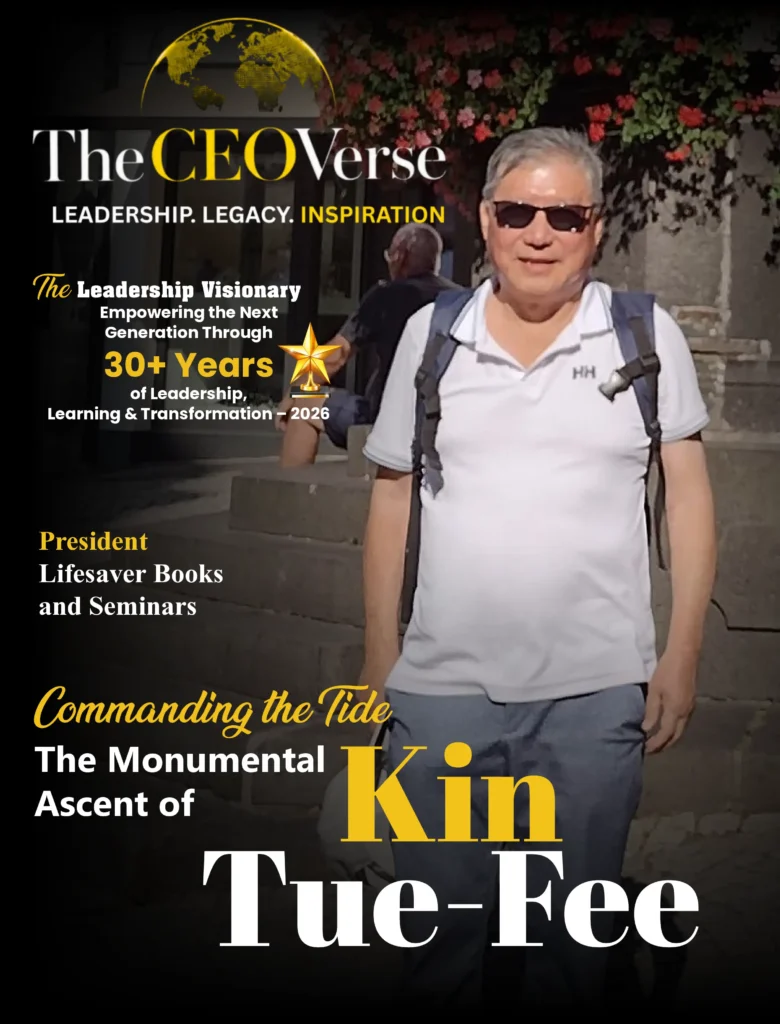
TheCEOVerse • Digital Edition
“The Leadership Visionary: Empowering the Next Generation Through 30+ Years of Leadership, Learning & Transformation – 2026”
Cover story
Kin Tue-Fee
Featured Profile - Kin Tue-Fee
Commanding the Tide: The Monumental Ascent of Kin Tue-Fee
How a boy from the small tropical island of Mauritius Turned a Fascination with Ships into a Lifelong Mission of Leadership, Learning, and Purpose
Some journeys begin with a carefully drawn five year plan. Others begin with curiosity. For Kin Tue-Fee, the first chapter of his remarkable journey was written beside the harbour of Port Louis, Mauritius, where, as a young boy, he would cycle with his best friend to watch yachts, fishing boats and cargo ships arriving from distant parts of the world. From the quays of the island’s capital, he looked outward toward the Indian Ocean and wondered how these yachts and fishing boats managed to cross such immense distances from Asia, Australia, New Zealand and South Africa to reach Mauritius.
That fascination with ships would eventually become a profession. But the deeper story of Tue-Fee’s career is not really about ships. It is about movement. Moving from one discipline to another, from technical expertise to leadership, from fear of public speaking to becoming an international speaker, from engineering to public administration, and eventually from conventional professional development to a broader exploration of purpose, values, vision and legacy.
Today, as President of Lifesaver Books and Seminars, Tue-Fee brings more than three decades of experience in leadership development, management, communication and strategic planning. His work encompasses books, seminars, workshops, coaching, consultancy, retreats and events designed to help people develop professionally while also asking more fundamental questions about the lives they want to build.
“I tend to depend more on my strengths than my weaknesses.” This sentence could almost serve as a summary of his career. His story is one of reinvention, but also of accumulation. Each chapter, including Mauritius, Glasgow, naval architecture, Arctic icebreaker research, Canadian public service, Toastmasters, executive leadership, writing and entrepreneurship became preparation for the next.
And perhaps most importantly, many of the qualities that define his work today were forged during the moments when things did not go according to plan.
A Childhood Spent Looking Beyond the Horizon
Born in Port Louis, Mauritius in 1952, Tue-Fee grew up on an island where the sea was not merely part of the landscape but a natural gateway to the wider world.
His weekend bicycle trips to the harbour became an early education in possibility. He watched international vessels arrive and occasionally spoke with sailors docked along the quays, proudly practising his English with them. The young boy could not yet know where this curiosity would lead, but his imagination was already travelling beyond Mauritius.
When the time came to decide what he would study, his parents encouraged him toward accountancy and engineering. Kin Tue-Fee, however, had another ambition. He wanted to study seafaring and navigation and dreamed of becoming the captain of a passenger ferry or cruise ship. If that path did not materialize, he was interested in naval architecture, civil engineering or architecture.
In 1971, he applied for a French government scholarship connected to a new programme intended to train officers for the Mauritian merchant navy. His application was accepted based on the results of his high school examination results.
Then, almost immediately, the plan collapsed.
Only three months into the programme, Tue-Fee learned that the French naval officers’ training initiative had been cancelled because there were not enough qualified applicants from Mauritius. An opportunity that had seemed to open the door to his preferred future suddenly disappeared.
But the setback did not end the journey. Kin Tue-Fee redirected it.
He persuaded his parents that naval architecture was, in essence, an engineering discipline. A decision that opened another route forward. He applied to four universities in the United Kingdom. Newcastle, Southampton, Glasgow and Cardiff. The first positive response came from the University of Glasgow, and he accepted.
There was, however, another obstacle, that was financing. His parents were not wealthy, so Tue-Fee was encouraged to seek every scholarship and financial award available to fund his studies. He did exactly that. In July 1972, he travelled to Britain, beginning a new chapter far from the tropical environment in which he had grown up.
Glasgow, Laundry Machines and the First Lessons in Adaptation
Moving from Mauritius to Glasgow was not simply an academic transition. It was a cultural and personal adjustment.
There is a humorous story from his early days in Scotland that reveals something important about Tue-Fee’s character. His first experience with a university laundry machine.
Having never used a laundry facility before, he gathered his dirty clothes, added washing powder and inserted the required coins. The machine began operating. A few minutes later, another student entered the room, and Tue-Fee suddenly realized his mistake.
He had put his clothes into the dryer instead of the washing machine. The student helped him rectify the situation, but the incident became a memorable reminder that independence sometimes begins with very ordinary mistakes.
The more serious challenge, however, was communication. During his first two or three months at the University of Glasgow, Tue-Fee struggled to understand his fellow students and lecturers because of their strong Scottish, and particularly Glaswegian accents. He sometimes had to copy notes from students sitting beside him.
Yet he adapted.
Rather than retreat from the difficulty, he learned quickly enough that, after some time, he was speaking much like those around him. It was an early demonstration of a quality that would repeatedly appear throughout his career. The willingness to enter an unfamiliar environment, learn its language, and adapt without abandoning his own identity.
About five months into his university studies, he received a letter from the British Council that he was being awarded an Overseas Students Fees Award Scheme (OSFAS). He was so delighted that his university fees would be taken care of for the next four years. He immediately informed his parents, brother and sister, who were all supporting him financially and emotionally. It was a big relief for everybody.
In 1976, after four years of studies, he graduated with a BSc Honours Second Class in Naval Architecture.
His university experience had given him technical knowledge, but it had also exposed a weakness that would stay with him for years, which was public speaking.
The Presentation That Became a Turning Point
Tue-Fee’s final university project was ambitious. He designed a multi-purpose ferry intended for Mauritius and neighbouring islands, preparing detailed plans and performing calculations involving stability, subdivision and structural strength. The technical work was not the problem. Presenting it was.
When he stood before his professor, lecturers and fellow students, anxiety took over. His voice shook. His legs trembled. His attention became divided between explaining his project and trying to control his physical reaction to being in front of an audience. He later described it as a poor presentation, to say the least, although he managed to perform better during the questions and answers.
That experience had a lasting effect. It became his first full oral presentation and, because he had had very little public speaking experience at school, it created what he describes as his biggest fear – speaking before an audience.
For years, he avoided public speaking whenever possible. Yet one of the defining themes of Tue-Fee’s life is that the weaknesses we avoid can sometimes become the abilities we eventually build our identity around. And his public speaking journey would prove exactly that.
Arctic Icebreakers and the Moment Fear Lost Its Power
In 1984, while working for Canadian Marine Drilling Ltd., a subsidiary of Dome Petroleum, Tue-Fee was instructed by his boss to prepare a presentation for a major Japanese delegation interested in the company’s research on icebreakers in the Arctic. His instinct was to avoid the assignment. His boss refused to let him pass it to someone else.
The stakes were considerable. Canadian Marine Drilling had built two innovative icebreakers, Kigoriak and Robert Lemeur, smaller scale models of potential future icebreaking oil tankers. The vessels were used to study how ships behaved when confronting multi-year Arctic ice, including stress, turning performance and interactions between ice and propellers. Tue-Fee had been involved in the full scale testing over a period of three years.
He had approximately one month to prepare. This time, he did not rely on other people. He slowly built his confidence through preparation.
He had his colour slides professionally prepared. He rehearsed repeatedly at home while babysitting his one year old son, using a slide projector. A week before the event, he rehearsed at work with colleagues acting as members of the Japanese delegation. They challenged him with difficult questions and provided feedback on his voice, eye contact, mannerisms and use of filler words.
Two days before the presentation, his boss attended one of the rehearsals and gave him a simple message to relax. He was ready.
Then came the revelation that the audience was larger, and more expert, than he had expected. There were 38 Japanese shipbuilders, ship designers, ice scientists and other specialists in the room. His boss introduced him as the person who had conducted most of the full scale testing on the innovative icebreakers over three years. The old fear appeared immediately. His voice was slightly shaky. His legs trembled. But then something changed.
A few minutes into the presentation, Kin Tue-Fee realized that he knew the test results better than anyone else in the room. He stopped thinking about himself and began thinking about the information he had to share. He later described the feeling as though he were explaining a story to curious children who were interested in everything he had to say.
The questions and answers became something he actually looked forward to. The man who had once dreaded public speaking discovered that expertise, preparation and a shift in perspective could transform fear into confidence. His boss congratulated him afterward and told him that he had worried unnecessarily. The experience changed his self-confidence enormously.
Soon, he was invited to present at the Society of Naval Architects and Marine Engineers in North America and the Royal Institute of Naval Architects in London, UK, and his research papers were published by both institutions.
The irony was powerful. The fear that had once limited him was becoming one of his professional strengths.
From Technical Expert to Public Sector Leader
Eight months after leaving Canadian Marine Drilling, Tue-Fee joined Transport Canada in Ottawa as a marine surveyor.
This was the beginning of a new professional chapter, but also the beginning of a transformation from technical specialist to leader.
He joined Toastmasters International in Ottawa and remained involved with the organization for more than 25 years. He credits much of his development in communication and leadership to that experience. He attended district conferences and international competitions and was eventually invited to facilitate educational workshops at Toastmasters district conferences.
The transformation was becoming visible. As a marine surveyor, Tue-Fee also participated in working committees of the International Maritime Organization in London, sometimes serving as head of the Canadian delegation. His responsibilities included communicating Canada’s research on ship safety and marine pollution.
The once reluctant speaker had now become someone trusted to represent Canada in international technical forums. Toastmasters had helped him develop communication skills, but Tue-Fee also credits another group of teachers. The leaders he encountered in Canada’s federal public service. Some were excellent examples of leadership. Others showed him precisely what leadership should not become.
Learning Leadership from Both Good and Bad Bosses
Among the leaders who influenced Tue-Fee most was Cameron Wallace, whom he describes as the best boss he ever had at Transport Canada.
Cameron Wallace taught him to think logically, take appropriate risks and develop competence without fear of career consequences. He demonstrated how effective meetings should work. Invite the people who genuinely need to participate, keep meetings focused and avoid wasting time. He also provided regular constructive feedback and encouraged relevant training.
But Tue-Fee also observed leaders who behaved very differently under pressure. He saw managers become excitable during stressful situations, place immediate pressure on subordinates and become excessively focused on outcomes and personal performance. He noticed defensiveness and resistance to criticism.
These contrasting experiences became an informal leadership education. He did not simply learn what successful leaders did. He learned what behaviours could damage trust, morale and effectiveness. His conclusion was straightforward. Excellence in leadership requires kindness, understanding, courage and integrity. And rather than obsessing over weaknesses, he increasingly learned to depend on his strengths. That principle would later become central to his leadership development work.
The Setback That Changed Everything
Every career contains moments that cannot be controlled. For Tue-Fee, one of the most consequential came in 1986. Canadian Marine Drilling Ltd. laid off hundreds of engineers, naval architects and other professionals after the Canadian Petroleum Incentive Program grants ended. Tue-Fee was among those affected.
The professional setback was compounded by a financial crisis. His pension money had been invested in Dome Petroleum shares, which fell rapidly. He sold them at a substantial loss. His Calgary home had also lost value as many properties were placed on the market at the same time.
His financial capital had effectively disappeared. At the time, he and his wife had a three year old son, and she was pregnant with their daughter. It was a profoundly uncertain period. Yet once again, uncertainty became an invitation to adapt.
The Calgary job market was difficult for naval architects and engineers because many others had been displaced at the same time. Tue-Fee expanded his search across Canada and internationally.
After eight months, two opportunities emerged in Ottawa. One was a Vice President position leading the Icebreaker Section at Canada’s largest naval architecture consultancy. The other was a Marine Surveyor role with Transport Canada. He chose the safer and more secure federal public service position. That decision redirected his career yet again.
Financial difficulties as a motivator for entrepreneurship
After five years of innovative work in icebreaking technology in the Canadian Beaufort Sea, in the Arctic, also including two weeks working at an Osaka’s shipyard in Japan, Kin Tue-Fee lost his job, together with hundreds of his co-workers. The government had decided to end the Petroleum Incentive Program, which was financing most of the Arctic research that many companies in Calgary depended on.
Kin Tue-Fee work pension almost disappeared as it was funded in Dome Petroleum shares, which fell drastically after that news. The value of his house plummeted as there were hundreds of houses on sale at the same time in Calgary. His wife and him were in a financial crisis at a time when they had a three years old son and, in addition, his wife was pregnant.
He had to find another job as quickly as possible. It took eight months of sustained efforts to finally start to work for Transport Canada as a Marine Surveyor. His pay was about two thirds of the previous job in Calgary. There were virtually zero dollars in his bank account.
After some deep discussion, the decision was made that his wife would stay at home with their two children in Ottawa and live off with only Tue-Fee’s salary. They started to think of ways of having other sources of income besides only his. The couple tried numerous small ventures. The first one was selling fresh flowers imported from Mauritius. It was time consuming and eventually unprofitable. It lasted for only six months.
He attended numerous free seminars about how to become more financially independent. One seminar that had a strong impact was one about real estate investment. The difficulty was that they hardly had any money saved to invest. However, the bank was prepared to lend an individual most of the real estate investment if he or she had a solid job in the government.
So Kin Tue-Fee started his venture in real estate investment in Ottawa. Over thirty years, his real estate investment in more than twelve residential rental houses and apartments was very profitable. He made a lot of mistakes along the way, but overall learned a lot more. Today he conducts real estate investments seminars annually, exclusively in Mauritius, with his business partner, Eric Wong Cheong who is a real estate developer in the island. They tend to be sold out as Mauritians are eager to learn from the distinguished pair.
The Engineer Who Learned to Think Like a Leader
At Transport Canada, Tue-Fee found strong mentors and access to training that helped him advance rapidly in the technical field. But after roughly twelve years, he knew he wanted something more.
He wanted to move from the technical side into management. That transition did not happen immediately or smoothly. He entered numerous competitions, both within Transport Canada and across other federal departments. More than a dozen competitions later, he finally secured an executive director position at the Public Service Commission of Canada in 1999. There again, Kin Tue-Fee found an amazing role model in his boss, Mrs Denise Boudrias. Upon his request, she got him involved in every aspect of her job, as Vice President of the Public Service Commission. Needless to say, Tue-Fee learned a lot about strategic planning, budgeting, negotiation, management and leadership.
The move from engineer to manager is a recurring theme in Tue-Fee’s professional education. His personal website now offers a course specifically focused on helping technical professionals make that transition effectively and confidently, alongside programmes covering management skills, people first leadership and high performance teams. It is a natural extension of his own story. He does not teach the transition merely as an abstract management concept. He lived it.
A Career Built Around Public Service and Strategic Leadership
Tue-Fee’s public service career subsequently expanded into increasingly senior strategic roles. He served as Director of Strategic Planning, Policy and Program Coordination at the Public Service Commission of Canada from 2002 to 2005. He then became Director of the Office of the Senior Vice President at the Canada School of Public Service.
At Veterans Affairs Canada, he served as Director of Special Projects, where his responsibilities included the Departmental Management Accountability Framework, integrated business and human resources planning, and strategic advice related to employment equity.
Later, at Human Resources and Skills Development Canada (HRSDC), he served as Director of Planning and Priorities, with responsibility for corporate planning, departmental performance reporting, and corporate risk analysis.
These positions demonstrate the evolution of his career from technical engineering into organizational strategy, planning, leadership and public administration.
His education evolved alongside it. He earned a Master of Public Administration in Management from Dalhousie University in 2009. His dedication to community building is further demonstrated by his long standing involvement with Toastmasters International and the Canada Mauritius Cultural Association in Ottawa, including being the President of both local clubs for two years.
The technical engineer who once studied ship structures had become a senior public sector strategist.
Unfortunately at HRSDC, his boss’ management and leadership skills and style were not compatible with Kin Tue-Fee’s core values. This inevitably caused conflicts between them, leading to Tue-Fee’s anxiety and depression over time. He eventually became sick and had to retire from the federal public service.
But another chapter was waiting.
Lifesaver Books and Seminars: Turning Experience into a Platform for Others
Since the mid 1990s, Tue-Fee has led Lifesaver Books and Seminars, an enterprise that brings together many of the disciplines accumulated throughout his public speaking. Leadership. Management. Communication. Personal development. Strategic planning. Coaching. Consultancy. Writing.
The company is both a publishing and a professional development organization, with services that include publishing and marketing books, customized coaching, leadership and management training, consultancy, seminars and relationship development.
In the years 1997 to 2018, Tue-Fee’s work extended internationally. He conducted courses, seminars and workshops on management, communication, team building and leadership, including programmes in Canada, Singapore, Kuala Lumpur, Malaysia, Mauritius and Brunei. Presently, he conducts real estate investment seminars exclusively in Mauritius and organizes summits and retreats in both Canada and Mauritius focused on meditation, manifestation, core values, purpose, future vision, financial freedom and legacy.
This evolution is significant. His early career was largely about understanding systems, such as ships, structures, safety, engineering and organizations. His later career became increasingly concerned with understanding people, values, relationships, leadership and legacy.
The Author Behind the Speaker
Writing has become another vehicle through which Tue-Fee shares what he has learned. His published work includes a trilogy of books; Become Your Best – Principles of Personal Management and Development, Putting People First, and In Pursuit of Relationship, among other works. He took on average 6 to 7 years to research, write and edit each of his books.
His book Become Your Best focuses on principles of personal management, development and leadership and presents practical strategies intended to help readers pursue goals, fulfil ambitions and navigate life’s challenges. This book is his best seller, so Tue-Fee translated it in French: Realisez votre Plein Potentiel. Become Your Best is also available as a kindle ebook on Amazon.
The subjects of these books mirror the trajectory of his own life. Personal development was not something he discovered after becoming successful. It was something he had to practise while navigating uncertainty, professional setbacks, communication fears, career changes and financial hardship.
His writing therefore sits naturally alongside his seminars. One provides the ideas in written form, while the other allows him to engage directly with people seeking to apply them.
Tue-Fee’s signature quotation is: “Become your best by putting people first in pursuit of your relationships.” It is essentially the titles of his three books, written in the same order.
His next book project is tentatively entitled: The Power of Word Therapy. Basically, it is about how kind and life-enriching words can heal and influence people positively, while harsh and destructive words can cause damage to and traumatise people, especially young children. Kin Tue-Fee intends to print and publish his next book in 2027 at T-Printers in Mauritius, like all his previous books.
All his books are exclusively available from Bookcourt in Mauritius. www.bookcourt.mu. You can also order them directly from the author, Kin Tue-Fee, who will be delighted to autograph them personally for you. There will be an additional mailing cost. kintue-fee@rogers.com
From Leadership Development to a Deeper Conversation About Purpose
In recent years, Tue-Fee’s work has expanded beyond traditional professional development.
His seminars and retreats increasingly explore questions such as:
What are your core values?
What is your purpose in life?
What kind of future do you want to create?
What legacy do you want to leave?
His current work includes masterclasses, summits and retreats built around meditation, manifestation, purpose, future vision, financial freedom and legacy. These experiences are a natural extension of his leadership and personal development work.
This evolution reflects a broader understanding of human relationships and leadership. For Tue-Fee, leadership is not simply the ability to manage people, deliver results or occupy an executive position. It is also about understanding what drives a person and whether professional achievement is aligned with personal core values.
That philosophy gives his later work a distinctly reflective dimension. The engineer who once calculated the structural strength of ships is now asking people to examine the structure of their own lives.
Service Beyond the Boardroom
Tue-Fee’s interests also extend beyond commercial leadership development. His stated causes include arts and culture, civil rights and social action, economic empowerment, education, environmental issues, disaster and humanitarian relief, poverty alleviation, and science and technology. These interests reflect a career that has repeatedly crossed professional boundaries.
His public service experience placed him inside large institutions concerned with national programmes, accountability, planning and public outcomes. His international work connected him with professionals across different cultures. His connection with Mauritius remains important, while his professional life in Canada has given him another perspective on community and service.
His long involvement with Toastmasters also illustrates this orientation toward shared learning and mentoring. He did not simply use the organization to improve himself, he eventually facilitated workshops at district conferences, helping others develop the very communication and leadership abilities he had once struggled to build.
The Recognition That Matters Most: Becoming the Person He Once Needed
There are many ways to measure a career. Titles. Degrees. Publications. International speaking engagements. Executive positions. Business ventures. But Tue-Fee’s story suggests another measure. Whether the lessons of one’s own journey become useful to someone else. He has had an incredibly wonderful journey of being a knowledgeable coach and trainer, and one long term colleague describes him as a thinker and visionary whose interests have extended into books, relationships, investments and personal development. His career provides evidence of that breadth.
He has been a naval architect. A marine surveyor. An international technical representative. A public sector strategist. And a director. An author, coach, consultant, speaker, seminar leader, and entrepreneur. Above all, a lifelong student of human relationship and leadership. Each title tells only part of the story.
What the Next Generation Can Learn from a Career of Reinvention
If there is one consistent lesson in Tue-Fee’s story, it is that careers rarely unfold in straight lines. His first professional dream to become a merchant navy officer was interrupted by the cancellation of a training programme. His early university experience challenged him culturally and academically. His first major presentation reinforced his fear of public speaking. His engineering career was interrupted by a major industry wide layoff. His financial security was severely damaged. His transition into management required more than a dozen competitions before he finally obtained an executive position. None of these events looked like success while they were happening.
Yet each became part of the foundation for what came next. The cancelled marine officers programme pushed him toward naval architecture. The Glasgow experience taught him adaptation. The disastrous presentation exposed his fear. The Japanese delegation forced him to confront it. Toastmasters gave him the structure to develop communication and leadership. The 1986 layoff pushed him toward public service. His mentors shaped his understanding of effective leadership. The difficult leaders he encountered taught him what he did not want to become.
His executive career gave him experience in strategic planning and organizational leadership. And those experiences eventually became the raw material for his books, seminars and coaching work. This is perhaps the most valuable lesson of all. A setback does not necessarily disappear from a successful life. Sometimes it becomes one of the reasons the later chapters are possible.
From the Harbour of Port Louis to a Life of Purpose
There is a beautiful symmetry in Kin Tue-Fee’s journey.
As a boy in Mauritius, he stood beside the harbour and watched ships arrive from distant countries.
Decades later, his own career would become international.
He studied in Scotland, UK.
Worked in Canada’s marine and petroleum sectors.
Participated in international maritime work.
Presented icebreaking research to Japanese experts.
Spoke through professional institutions in North America and the United Kingdom.
Developed seminars for audiences in countries including Singapore, Malaysia, Brunei, Mauritius and Canada.
And built a professional identity around helping people communicate, lead, collaborate, grow and develop.
The ships he watched as a child represented possibility.
His career became an expression of that same idea.
Today, Lifesaver Books and Seminars provides the platform through which he continues to share the lessons gathered along the way. His work has expanded from technical expertise to human development, from management skills to questions of meaning, and from career advancement to the larger issue of legacy.
For a man whose childhood imagination was shaped by vessels crossing the Indian Ocean, perhaps the metaphor is fitting. A ship is designed to move. It must respond to changing conditions. It needs a strong structure. It requires a capable crew. And it needs a destination.
Leadership, in many ways, is no different.
From Success to Significance: The Next Chapter
As Kin Tue-Fee’s work continues to evolve, his focus is increasingly moving beyond conventional measures of achievement toward a deeper question: What comes after success?
In his latest LinkedIn article, From Success to Significance: The Quiet Shift of the High-Achiever, Tue-Fee reflects on the point at which titles, milestones and financial achievements become less of a destination and more of a foundation for something greater. For him, significance is about shifting the focus from what one has accumulated to what one can contribute, and ultimately what one will leave behind.
This philosophy will take shape at his upcoming Significance Retreat, being held at Fairmont Le Château Montebello in Quebec, Canada, from October 23–25, 2026. Designed as an intimate retreat rather than a conventional seminar, the experience will explore themes that have increasingly become central to Tue-Fee’s work. Clarity of vision, core values, purpose, mindful presence and the deliberate creation of a meaningful legacy. “Significance is not about what you have gathered, but what you have planted.”
For Tue-Fee, this represents a natural progression of his decades long work in leadership and personal development. After helping professionals build careers, develop leadership capabilities and achieve their goals, he is now inviting accomplished individuals to pause and consider the larger question. What should those achievements ultimately make possible?
Kin Tue-Fee is already planning for his next Significance Retreat in mid March. This time it will be in the beautiful tropical island of Mauritius.
A Legacy Still Being Written
Kin Tue-Fee’s story is not a story of someone who knew exactly where he was going from the beginning. It is the story of someone who kept moving when the route changed. The young Mauritian who wanted to become a ship captain became a naval architect. The engineer who feared public speaking became a professional speaker. The technical specialist became a senior public servant. The executive became an author, coach and seminar leader. And the leadership trainer has increasingly become a guide for people asking deeper questions about purpose, values and legacy. His current work suggests that the next stage of his journey is less about collecting titles and more about helping others create lives that are meaningful to them. That distinction matters. Professional success can be measured externally. Purpose is more personal. For Tue-Fee, the two do not have to be separated.
The principles he has carried throughout his life and career, of continuous learning, preparation, adaptability, courage, communication, kindness, integrity and the willingness to learn from both exemplary and difficult leaders remain at the centre of his work.
His journey began with a boy looking out across the harbour of Port Louis, wondering how ships crossed the ocean.
More than five decades later, the horizon has changed.
But his curiosity remains.
And perhaps that is the defining characteristic of Kin Tue-Fee’s story. Not that he found one destination and stopped, but that every new horizon gave him another reason to learn, adapt, serve and move forward. The journey from ships to leadership was never simply a change of profession.
It was a gradual discovery of purpose. And as he says, “The journey is still underway”.
And so it is.