TheCEOVerse • Digital Edition
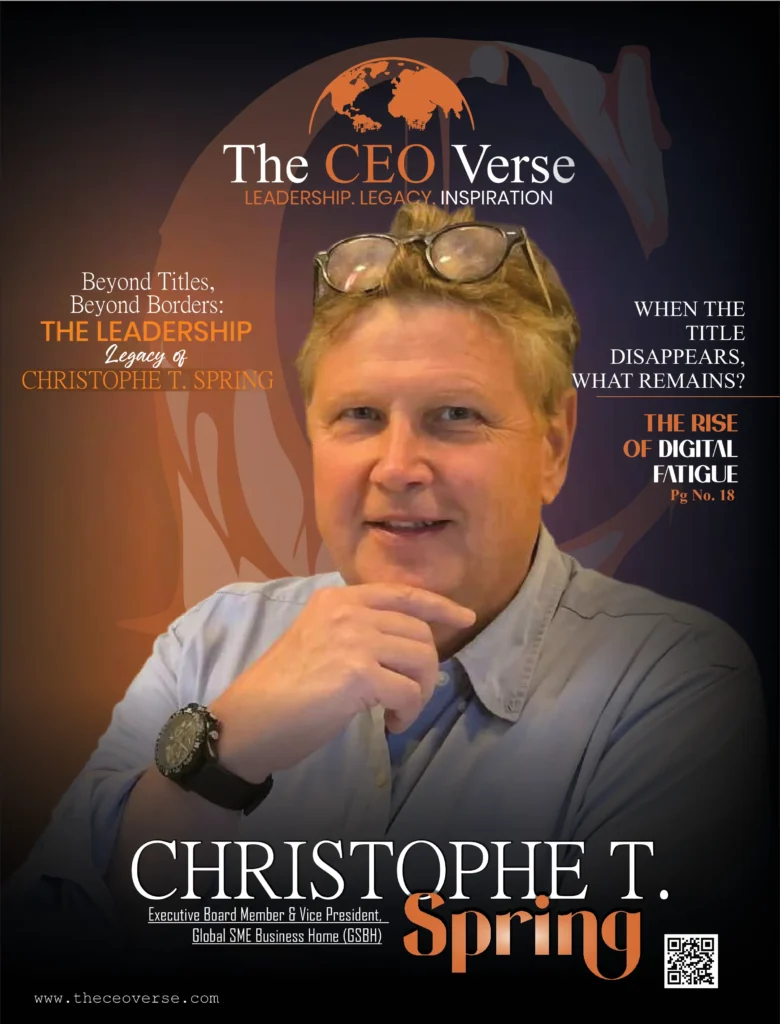
“Beyond Titles, Beyond Borders: The Leadership Legacy of Christophe T. Spring”
Cover story
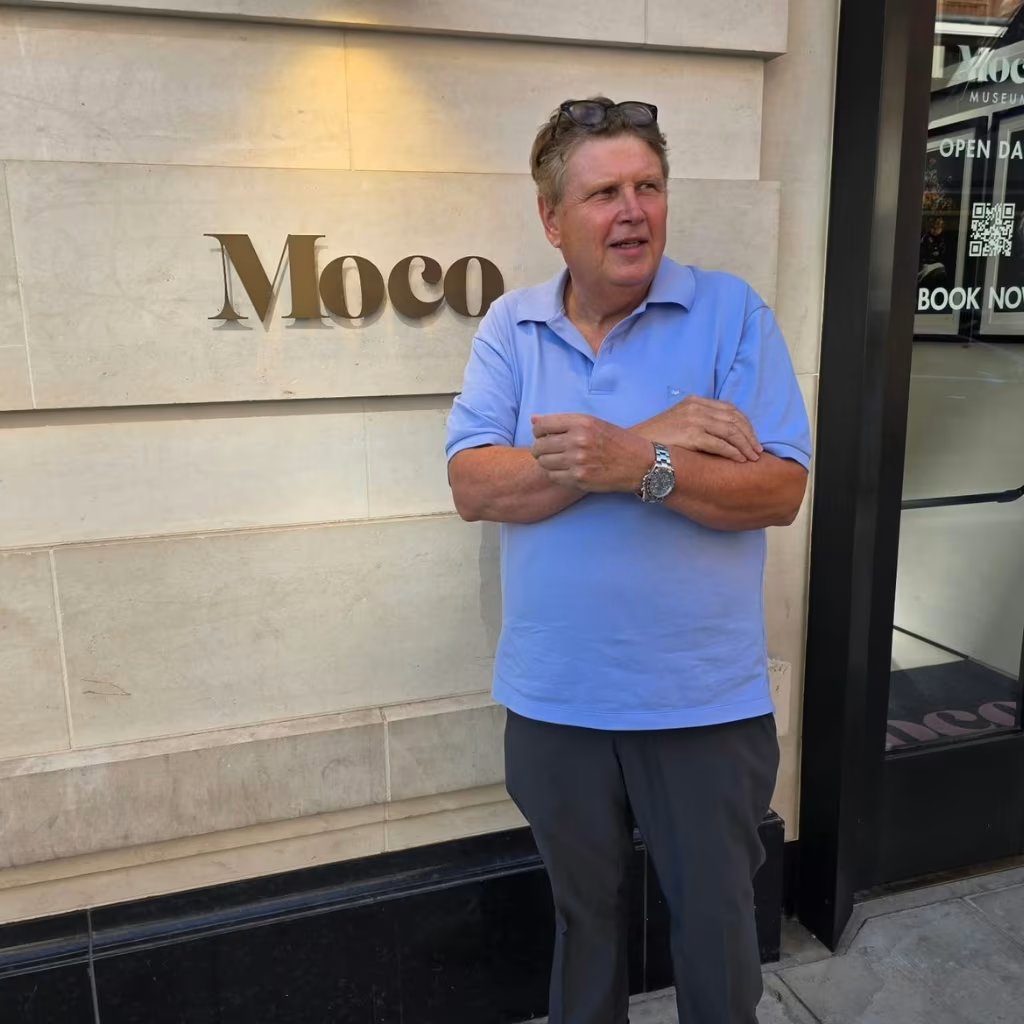
Christophe T. Spring
Featured Profile - Christophe T. Spring
WHEN THE TITLE DISAPPEARS, WHAT REMAINS?
For Christophe T. Spring, four decades of international business have produced one surprisingly simple answer: character.
Across Europe, North America, the GCC and Asia, Christophe T. Spring has spent more than four decades building businesses, developing markets in over 36 countries and creating relationships across corporate, entrepreneurial and diplomatic circles.
Along the way, he learned something no business school can teach particularly well:
Success tells you who wants to meet you. Adversity tells you who remembers you.
Spring has experienced both.
There were successes, international opportunities and fascinating encounters. But there were also uncomfortable conversations, setbacks and moments when speaking openly carried a professional price.
Would he choose differently today?
Probably not.
Perhaps conviction and a healthy dose of Swiss stubbornness have something in common.
His principle remains simple:
Truth can be expensive. Integrity should never be for sale.
A CV Records Titles. Reputation Records Behaviour.
A résumé tells us where somebody worked, which positions they held and, occasionally, how creatively they can fit four decades onto two pages.
Reputation records something much harder to manufacture:
How did that person behave when things became difficult?
For Spring, the distinction became very real when one difficult professional chapter unexpectedly led to another opportunity only weeks later.
It was not simply his experience that opened the door.
People remembered how he had treated them.
That changed his understanding of professional capital.
Titles matter while you hold them. Reputation continues working after you hand back the business card.
Leadership Starts When the Conversation Gets Uncomfortable.
Working across cultures, four languages and dozens of markets taught Spring that leadership is not primarily about being liked.
It is about accepting responsibility.
Sometimes that means having the conversation everyone else has been carefully avoiding.
Confrontation itself achieves little. But avoiding a necessary conversation usually does not solve the problem either.
It simply allows it to become bigger — and frequently more expensive.
Spring believes directness and respect can coexist.
In fact, they must.
Respect is not what you add after making a difficult decision. It should be part of how you make it.
Pressure Removes the Makeup.
Spring believes courage becomes meaningful only when there is something to lose.
Leaders should protect their people, question accepted thinking when necessary and remain prepared to defend principles when doing so becomes inconvenient.
Life eventually tested that philosophy far beyond business.
A serious hip injury forced him to rebuild physically later in life. Suddenly resilience was no longer a leadership word. It involved pain, patience, rehabilitation and the humbling discovery that determination cannot negotiate with anatomy.
The experience reinforced an old belief:
Strength is not about never falling. It is about getting up again.
Pressure has an interesting quality. It strips away many of the easy options.
That is when values stop being words on a presentation and become choices.
When Conviction Has a Price Tag.
Spring has stood behind employees when doing so was inconvenient, questioned decisions others preferred not to challenge and chosen principle at moments when silence would have been considerably easier.
Sometimes there was a price.
But careers are long, and immediate consequences are poor accountants of character.
Jobs change. Companies change. Titles disappear.
Character is rather harder to replace.
His measure is therefore different:
Will I still be comfortable with this decision when I look back at it ten years from now?
If the answer is yes, the short-term price may have been worth paying.
Long After the Business Card Is Gone.
One theme runs consistently through Spring’s international career: relationships.
Professional contacts became friends. Friends became partners. Business relationships sometimes developed into bridges between companies, cultures and countries.
And that leads him to make an important distinction.
A network tells you who you know. A relationship tells you who still answers the telephone ten years later.
Spring has built relationships across business and diplomatic circles, including with ambassadors from around the world, ministers, entrepreneurs and international executives. Among the personal encounters he particularly values are meetings with His Holiness Pope Leo XIV and the Apostolic Nuncio.
What stayed with him was not proximity to impressive titles.
It was something much simpler:
Humility opens doors that status alone never can.
Business Builds Prosperity. Diplomacy Builds Understanding.
Today, as Executive Board Member and Vice President of Global SME Business Home, Spring increasingly sees his role through the lens of bridge-building.
Between SMEs and international markets.
Between business and diplomacy.
Between countries, cultures and people who might otherwise never meet.
His conclusion after decades of international business is that collaboration is becoming more valuable, not less.
Different cultures see problems differently. Different markets possess different knowledge. Different industries often hold separate pieces of the same puzzle.
Connecting them can create opportunities that remain invisible when everyone stays safely inside their own silo.
Sometimes the person with the answer simply speaks a different language.
The first requirement is being willing to listen.
His Best Leadership Teachers Never Wore a Suit.
Not every lesson came from a CEO, ambassador or boardroom.
Some came with four legs.
Dogs taught Spring about loyalty. Elephants fascinated him through their intelligence, memory and powerful family bonds.
And horses taught him something particularly useful about leadership.
A horse does not care about your title.
It has never checked your LinkedIn profile.
It is spectacularly unimpressed by PowerPoint.
But it understands trust, consistency, confidence and respect remarkably quickly.
And it notices equally quickly when any of them are missing.
Ego may impress a boardroom. It rarely impresses a horse.
Innovation Starts Before Technology.
Travel, art, architecture and different cultures have also shaped Spring’s way of thinking.
They keep curiosity alive.
And curiosity, he argues, comes before innovation.
Technology can accelerate almost anything. But without curiosity, it can also help organisations repeat yesterday’s thinking much faster.
Real innovation begins earlier.
With a question.
Why?
And, perhaps more importantly:
Why not?
So, What Remains?
Spring does not measure legacy primarily through titles, awards or positions.
He looks elsewhere.
At the people he helped.
The teams that achieved something together.
The bridges that survived after the deal was completed.
And the people who still call years later when there is absolutely nothing left to sell one another.
Those relationships tell him more about a career than another line on a résumé ever could.
Because eventually, careers end.
Business cards become outdated.
Awards gather dust.
LinkedIn will probably invent another title for all of us.
But people remember how you treated them.
And nobody has ever asked a horse for your résumé.
Leadership, in the end, is not about being the most powerful person in the room.
It is about being the person others can trust when the room becomes difficult.
For Christophe T. Spring, that is where reputation begins — and where the title ends.