
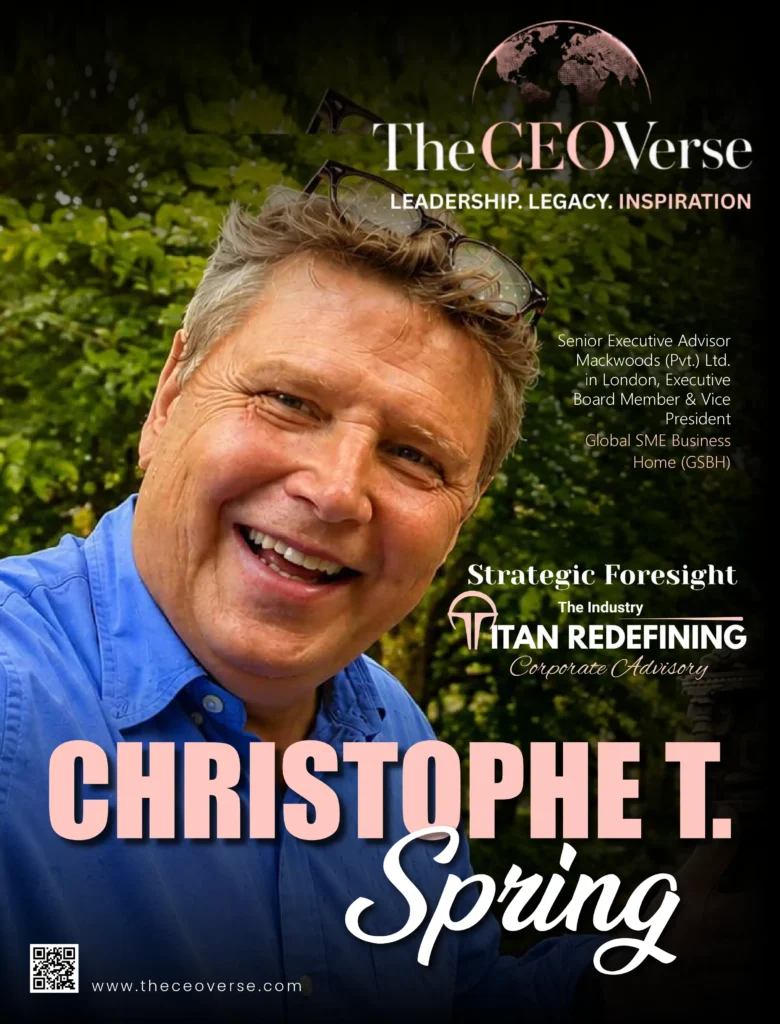
TheCEOVerse • Digital Edition
“Strategic Foresight: The Industry Titan Redefining Corporate Advisory”
Cover story
Christophe T. Spring
Featured Profile - Christophe T. Spring
Christophe T. Spring: Where Strategic Foresight Meets Global Leadership
Across more than four decades, Christophe T. Spring has developed a professional perspective shaped by international markets, complex relationships and decisions that often demanded more than conventional business judgment. His experience spans Europe, North America, the GCC and Asia, with professional exposure across more than 36 countries and communication across four languages. Yet the breadth of his career is matched by a consistent principle: long-term value is built through integrity, trust and the ability to make difficult decisions with clarity.
That perspective has shaped the way Spring approaches leadership and professional relationships. His career has included moments when speaking openly affected opportunities and positions, but those experiences reinforced rather than weakened his commitment to principle. When a new opportunity emerged only weeks after one difficult professional chapter ended, its significance came from something beyond a résumé. People remembered how he had conducted himself when circumstances were challenging.
Strategy Begins With the Decisions Others Avoid
For Spring, leadership is not defined by keeping every conversation comfortable. International teams, diverse business cultures and changing markets have taught him that meaningful leadership often begins where difficult conversations do. Feedback, accountability, disagreement and unpopular decisions are not interruptions to leadership. They are part of the responsibility itself.
His approach, however, does not equate courage with confrontation. Difficult decisions can be made without compromising dignity. A leader can challenge an employee, question an established decision or reject an existing way of working while continuing to treat the people involved with respect. The objective is not to win an argument, but to reach the right decision without diminishing those affected by it.
This balance between accountability and humanity forms an important part of Spring’s strategic outlook. Sound judgment is not only about identifying what needs to change. It is also about understanding how that change affects people and maintaining trust throughout the process.
Pressure Reveals the Principles Behind the Strategy
The value of any leadership philosophy becomes clearer when circumstances become difficult. Spring places courage at the centre of that test, particularly when leaders are required to protect their people, question the status quo or remain committed to their principles despite personal and professional consequences.
His own experience with a serious hip injury reinforced another dimension of that thinking. Rebuilding aspects of life after a major setback demonstrated that disruption can change a path without necessarily determining its destination. The same principle has appeared throughout his professional journey, where difficult periods have tested confidence, reputation and direction while also revealing what remains when superficial measures of success fall away.
For Spring, that remaining foundation is character. It is what allows strategic decisions to retain consistency even when circumstances change.

Long-Term Thinking Puts Principles Before Convenience
There have been points in Spring’s career when the easier option could have been to remain silent, accept established decisions or compromise values. Instead, he describes instances of standing by loyal employees, challenging decisions and defending principles even when doing so carried consequences.
That approach reflects a longer view of professional success. Organisations change, industries evolve, positions disappear and titles move from one person to another. The way people are treated, however, can remain part of a professional relationship long after a particular role has ended.
The significance of that perspective became especially visible when a new opportunity followed a difficult career period within weeks. For Spring, the episode demonstrated that integrity may not always produce an immediate return, but the trust created through consistent conduct can continue to generate relationships and opportunities over time.
Global Experience Turns Relationships Into Strategic Capital
Spring’s international career has placed relationships at the centre of his understanding of business. After more than four decades across different markets and cultures, he has seen professional environments change while one element remains constant: people remember how they were treated.
His network extends across corporate and international circles, including ambassadors from all five continents, ministers, entrepreneurs, global executives and members of the diplomatic community. He also values meetings with His Holiness Pope Leo XIV and the Apostolic Nuncio, experiences that reinforce for him the importance of humility, trust and mutual respect in building meaningful connections across borders.
This perspective is particularly relevant to corporate advisory. Working across cultures requires more than commercial knowledge. It requires listening, recognising different perspectives and understanding cultural nuances before drawing conclusions. For Spring, relationships are therefore not simply an outcome of business activity. They are part of the foundation from which meaningful business activity can develop.

From Business Connections to International Bridges
Spring’s involvement in international diplomatic circles has strengthened his belief that business and diplomacy can complement one another. Business can contribute to prosperity, while diplomacy can contribute to understanding. Together, they can help create bridges between nations, cultures and communities.
That philosophy connects directly with his role as Executive Board Member and Vice President at Global SME Business Home. His focus extends beyond conventional definitions of business growth toward connection: connecting cultures, industries and people.
Having worked across diverse markets, Spring sees collaboration as increasingly important in an interconnected business environment. Different perspectives can strengthen ideas when they are brought into the same conversation, making bridge-building more than a diplomatic concept. It becomes a practical way of approaching business, leadership and international growth.
Curiosity Creates the Space for Better Decisions
Strategic foresight also requires the ability to look beyond established assumptions. Spring’s appreciation for art, architecture and culture has encouraged him to approach familiar problems from different angles, reinforcing a belief that innovation does not necessarily begin with technology.
It begins with curiosity.
Asking why something is done a certain way, considering whether another approach could work better and learning from disciplines outside one’s own industry can open new possibilities. Technology may provide tools, systems may provide structure and strategy may provide direction, but curiosity initiates the process of questioning what already exists.
For an advisor or leader operating in a changing environment, that willingness to challenge assumptions becomes an important part of seeing beyond the immediate decision and considering what may come next.
Lessons in Leadership Beyond the Corporate World
Some of Spring’s perspectives on leadership have developed far outside conventional business environments. His experiences with animals have offered lessons that translate into his understanding of trust and influence.
Dogs have demonstrated unconditional loyalty to him, while elephants have fascinated him through their intelligence, memory and strong sense of family. Horses have provided another particularly direct lesson: they respond to trust, humility and consistency rather than ego.
For Spring, the lesson extends well beyond working with horses. Authority alone cannot create cooperation. Influence must be earned, and meaningful relationships depend on consistency. That same principle informs his broader understanding of leadership, where credibility develops through repeated actions rather than a title or position.

Advisory Thinking That Looks Beyond Immediate Gain
When Spring considers achievement, he does not place positions, awards or corporate milestones at the centre of the discussion. His attention turns instead toward the people he has helped, the relationships he has developed, the bridges he has contributed to building and the teams that achieved more collectively than any individual could have achieved alone.
That perspective offers a different way of understanding professional value. Success is not limited to what an individual can accumulate. It can also be measured through what that person enables in others.
Some of Spring’s friendships have developed into partnerships. Professional relationships have continued long after formal roles ended. Other connections have extended across companies and even countries. The fact that people continue to call him years after professional relationships have concluded represents, for him, one of the clearest indicators of lasting impact.
Strategic Foresight Is Ultimately About What Endures
The defining thread through Christophe T. Spring’s career is not a particular position, market or title. It is an approach to leadership built around trust, integrity, courage, curiosity and long-term relationships.
For Spring, leadership is not about being the most powerful person in the room. It is about being someone others can trust when the room becomes difficult. That trust cannot be created through designation alone. It develops through countless decisions, particularly the ones that carry a personal or professional cost.
Markets change. Organisations evolve. Positions eventually end and titles pass to others. What remains is the character behind those decisions and the relationships those decisions have shaped.
In that sense, Spring’s approach to strategic foresight reaches beyond predicting what comes next. It is about building the judgment, trust and connections that remain valuable when circumstances inevitably change.