
TheCEOVerse • Digital Edition
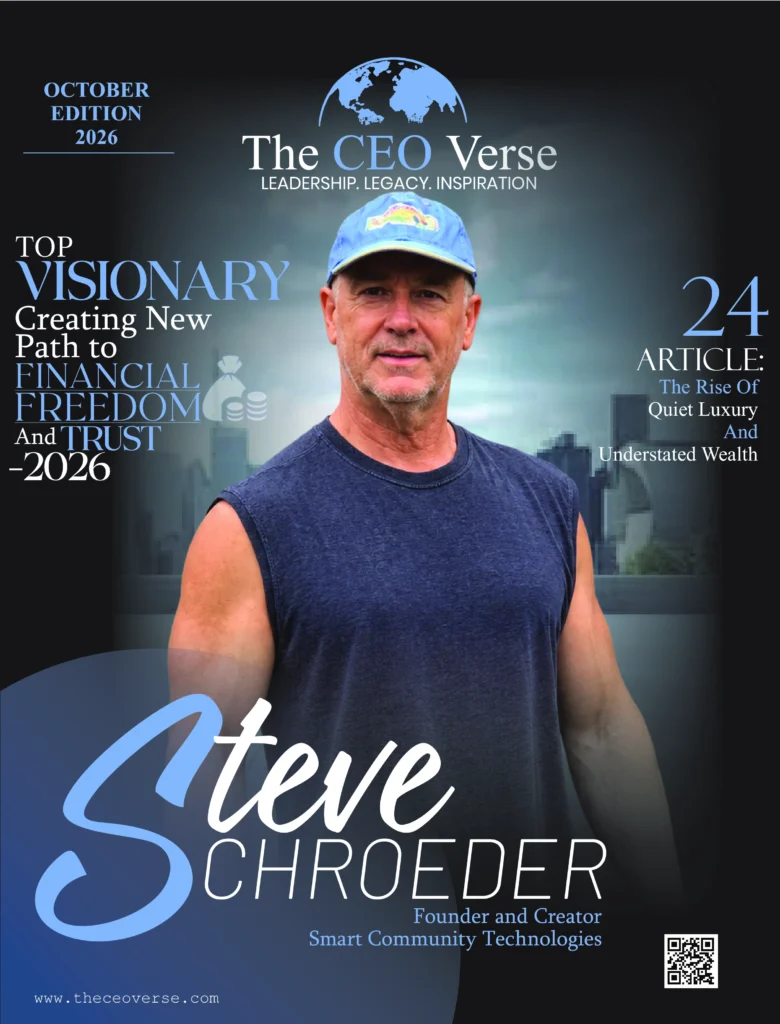
“Top Visionary Creating New Path to Financial Freedom and Trust -2026”
Cover story
Steve Schroeder
Featured Profile - Steve Schroeder
Steve Schroeder: Building the Systems Behind What Comes Next
Across loyalty, decentralized technology, capital, real estate, and artificial intelligence, Steve Schroeder has spent decades looking for the signals that appear before major systems begin to change.
The Pattern Connecting an Unconventional Portfolio
There is no single industry that neatly explains Steve Schroeder’s entrepreneurial career. His work has moved through customer loyalty, mobile technology, fundraising, Bitcoin, decentralized systems, community development, artificial intelligence, real estate, and capital strategy. Viewed separately, the businesses can appear unrelated. Viewed together, they reveal a more consistent interest in how systems can give people greater control over money, technology, information, and community.
That philosophy now sits across an ecosystem that includes Smart Community Technologies, FAAST, DeCoy, NOSTR Fundraising, Grey Swan Capital, and Grey Swan Real Estate. The latest developments bring several of those ideas together. In August 2026, Grey Swan Capital announced what it calls “Hedge Fund as a Service,” a membership-based model designed to provide individuals with research, education, real estate intelligence, tax tools, and AI-powered decision support without requiring their assets to be placed into a traditional percentage-of-assets management structure.
At the same time, Schroeder is developing Grey Swan Real Estate as something broader than another property marketplace. The vision is an AI-native operating system connecting property intelligence, listings, capital, financing, contractors, tax and legal services, and eventually Bitcoin and emerging eCash infrastructure. For Schroeder, these are not isolated projects. They represent different pieces of the same larger thesis: technology should be capable of giving ordinary people more agency over the systems around them.
Reading the Signal Before It Becomes Obvious
The idea behind the name “Grey Swan” offers one of the clearest ways to understand Schroeder’s approach. A Black Swan traditionally describes an event that is extremely difficult to anticipate. A Grey Swan is different. The possibility can already be seen, the signals may already exist, but the timing and eventual scale of the consequences remain uncertain.
That distinction reflects much of Schroeder’s entrepreneurial history. His work in customer loyalty and alternative approaches to customer engagement began long before decentralized finance became a familiar phrase. Before Bitcoin became an institutional talking point, he was studying digital scarcity, payment networks, and the ways property rights could change the relationship between individuals and money.
He has spent more than two decades in the customer loyalty space, with earlier ventures including Bowling Rewards and Loyal Patron, before launching Smart Community Technologies in 2017 and DeCoy in 2021. Across those chapters, technology has rarely appeared to be the destination itself. Schroeder treats technologies more like ingredients, asking how different existing tools can be combined to address a larger problem. The description “Master Chef of Technologies” captures that method particularly well. The objective is not necessarily to invent every ingredient, but to understand how the right ingredients can be assembled into something useful.
Reinvention Became Part of the Strategy
Schroeder’s career has developed through reinvention rather than a straight progression from one predetermined destination to another. His early work in customer loyalty and marketing technology exposed him to the importance of networks, relationships, incentives, information, and participation.
Those experiences raised questions that continued to follow him into later ventures. How can businesses encourage people to participate? How can transactions become more valuable? How can companies retain customers? How can communities benefit from the economic activity taking place around them?
Those questions gradually moved him toward mobile technologies and later toward Bitcoin and decentralized infrastructure. A major personal turning point came in 2014, when Schroeder collapsed from cardiac arrest during a development meeting shortly after beginning a new professional chapter. He was initially pronounced dead before being transported to hospital and ultimately surviving the event.
The significance of that experience, in the context of his career, lies in what followed. Schroeder increasingly connected entrepreneurship with purpose, service, faith, and the goal of helping people build greater independence. His published work has repeatedly returned to the idea that technology should do more than produce financial returns. It should also help people retain ownership and create meaningful economic opportunities. For him, innovation is therefore not simply about moving faster, but about moving toward a different direction.
From Loyalty Programs to Community Infrastructure
Smart Community Technologies represents an important connection between Schroeder’s earlier work and the ecosystem he is building today. The company has explored mobile technology, loyalty, fundraising, Bitcoin, Lightning, and community-oriented applications. DeCoy, or Decentralized Community Trust and Loyalty, extends that thinking into decentralized customer relationships, while FAAST, or Fundraising as a Service Technologies, applies technology to fundraising.
NOSTR Fundraising pushes the concept further by combining fundraising with decentralized communication and emerging Bitcoin and eCash technologies. Across these projects, participation remains a central theme.
Traditional systems often place an intermediary between an individual and the economic activity they are trying to access. That intermediary may provide an important service, but it can also control the rules, information, infrastructure, or transaction. Schroeder’s preferred model seeks greater openness and composability, allowing different technologies to work together while preserving more control for the participants.
That philosophy is also reflected in the Grey Swan Real Estate business plan, where the stated objective is not simply to generate profits but to create structures in which buyers, sellers, capital partners, service providers, communities, and the platform can all benefit. The idea is architectural: if the incentives are designed correctly, the economics of the business can reinforce the mission rather than work against it.
Real Estate Becomes the Next System to Rethink
Real estate is the industry where Schroeder sees particularly significant opportunities to challenge existing structures. It is a massive and valuable market, yet many of its systems remain fragmented and difficult to navigate.
The Grey Swan Real Estate business plan argues that MLS infrastructure remains largely gatekept, while consumers and professionals often have to move between listing platforms, commissions, contractors, lenders, legal providers, tax specialists, and other disconnected services. Schroeder’s response is not simply to create another property listing website.
Grey Swan Real Estate is envisioned as a complete operating system in which properties can be discovered, analysed, listed, matched, financed, renovated, sold, rented, or converted into notes. AI would continuously assess opportunities, buyer and seller propensity, distress signals, and potential exit strategies.
In that model, the property listing is only the starting point. The larger product is the infrastructure surrounding the transaction and the ability to connect the many pieces that currently operate separately.

Turning Property Records Into an Intelligence Layer
At the centre of the Grey Swan Real Estate vision is an AI-powered property intelligence dashboard. Rather than functioning simply as a catalogue of properties for sale, the proposed system would bring together property information, public records, tax data, comparable sales, contact intelligence, economic catalysts, and signals associated with distressed or off-market properties.
The distinction Schroeder makes is between data and intelligence. A database can tell an investor what exists. An intelligent system is intended to help identify what matters.
The proposed dashboard would look for signals involving liens, pre-foreclosures, off-market opportunities, buyer propensity, seller motivation, and economic catalysts. It would also examine the potential effects of major infrastructure investments, including data center development. The objective is therefore not merely to make property searches easier, but to create an information advantage by identifying meaningful signals before their significance becomes obvious to everyone else.
Arkansas as the First Real-World Test
Despite the scale of the wider vision, the initial strategy is deliberately concentrated. Grey Swan Real Estate’s launch plan focuses on Arkansas, particularly the Conway and Clarksville corridors.
The reasoning centres on the rapid development of data centers driven by artificial intelligence. Such facilities require land, electricity, water or alternative cooling systems, infrastructure, construction workers, engineers, suppliers, and eventually a broader ecosystem of businesses and residents.
When major infrastructure investment enters a market that has previously been underpriced, the consequences can extend well beyond the project itself. Housing demand can change. Commercial demand, transportation, employment, tax bases, and property values can also be affected.
The Grey Swan business plan identifies Conway and Clarksville as examples of this dynamic, citing a major data center campus associated with Conway and a Serverfarm project in Clarksville described in the plan as a $6.6 billion to $8 billion development. The argument is that these investments can create employment, infrastructure expansion, housing demand, and commercial activity before the wider market fully reflects those effects in property pricing.
That becomes the Grey Swan strategy in concentrated form: identify where the signal is already visible, build the tools around it, prove the model locally, and then expand.
Where Intelligence Meets Capital
Grey Swan Real Estate becomes considerably more ambitious once the capital layer is added. Schroeder’s vision extends beyond giving investors a place to discover opportunities. The platform is intended to become an engine capable of sourcing, underwriting, acquiring, improving, and exiting properties at scale through third-party capital.
That creates a potential feedback loop. Better intelligence can generate better deal flow. Better deal flow can create more opportunities for capital. More capital can finance more transactions, while more transactions generate additional information that can strengthen the intelligence layer.
If successfully executed, the result would resemble a financial operating system more than a conventional real estate website. The ambition is not simply to reduce the cost or effort involved in finding a property. It is to connect information, execution, and capital within one broader architecture.
Rethinking the Economics of Real Estate Access
Another significant part of the Grey Swan Real Estate model is its proposed cost structure. The business plan outlines a target one-time $25 listing fee for licensed agents and a similarly low-cost FSBO listing model. It also envisions membership at approximately $100 per month for users seeking access to more advanced AI search, buyer databases, and related tools.
The underlying question is straightforward. If technology has reduced the marginal cost of publishing, searching, matching, and coordinating information, why should the economics of real estate continue to resemble an era when those processes were far more expensive?
Schroeder’s argument is not that professionals should disappear. Agents, contractors, lenders, title companies, tax professionals, attorneys, investors, landlords, and other participants can remain part of the ecosystem. The intended change is in the friction between them.
That is why Grey Swan positions itself as an operating system rather than simply another marketplace. The goal is to alter how value moves through the ecosystem while keeping the professional participants within it.
Bringing the Same Thesis Into Finance
The real estate strategy connects naturally with Schroeder’s newest financial proposition. In August 2026, Grey Swan Capital announced “Hedge Fund as a Service,” a membership model designed to give individuals and families access to research, education, real estate intelligence, tax tools, community benefits, and AI-powered decision support for a flat monthly fee instead of a traditional percentage of assets under management.
The announcement points toward illustrative pricing of approximately $99 per month. By comparison, a conventional 2% annual management fee on a $1 million portfolio would amount to $20,000 per year.
The proposed distinction is not simply paying less. It is the idea of learning more while retaining control. Members would receive tools and education intended to help them evaluate opportunities and make their own capital allocation decisions.
That represents a philosophical shift in how expertise is distributed. Instead of assuming that the professional permanently retains the expertise while the client retains the capital, Schroeder’s model attempts to push more of that expertise outward. The client keeps the capital, while the platform provides intelligence and AI acts as a force multiplier.

AI as an Access Tool
This may be one of the most consequential parts of Schroeder’s broader vision. Sophisticated financial analysis has traditionally been expensive because expertise, research teams, analysts, data, and specialised knowledge all carry costs.
Artificial intelligence changes that equation. It does not remove the need for judgment, but it can reduce the cost of research, pattern recognition, information retrieval, and decision support.
Grey Swan Capital’s announcement explicitly presents AI as one reason the traditional justification for permanent high percentage fees may be weakening. That argument fits into Schroeder’s wider philosophy around technology.
The objective is not simply to make institutions more powerful. It is to make individuals more capable.
That distinction is central to the way he approaches both technology and financial participation.
Ownership as the Foundation
Beneath both Grey Swan Capital and Grey Swan Real Estate sits a deeper concern with ownership and control.
The Grey Swan Real Estate plan states the principle directly: if individuals do not hold the keys, they do not truly own the thing. From there, the document emphasises cryptographic identity, private relays, multi-party custody, and privacy-preserving infrastructure for information and capital where greater control is required.
This is where Schroeder’s interest in Bitcoin and NOSTR extends beyond technology preference and becomes a question of governance. Who controls identity? Who controls data? Who controls money? Who controls the communication channel? Who can change the rules? And what happens when a platform becomes so powerful that users can no longer leave?
His preferred answer is to favour open protocols and composable infrastructure where possible. The same thinking informs the project’s interest in Nostr-native collaboration tools and local knowledge-graph infrastructure. The Grey Swan plan references open-source tools such as Buzz and Graphify as examples of infrastructure that can support human and AI collaboration while keeping identity, history, and knowledge closer to users and their own systems.
The broader principle is sovereignty by design.
One Ecosystem, Many Applications
The different initiatives Schroeder is building fit together as parts of a wider ecosystem. Smart Community Technologies provides a broader technology foundation. FAAST applies technology to fundraising. DeCoy explores decentralized community loyalty. NOSTR Fundraising brings communication, incentives, and community support together. Grey Swan Capital focuses on capital intelligence and individual empowerment, while Grey Swan Real Estate applies the same philosophy to one of the world’s largest asset classes.
The connective tissue is not the technology itself. It is the belief that economic systems can be designed so participants retain greater control and receive more of the value they help create.
FAAST is particularly revealing in that progression. Grey Swan Capital’s press release describes FAAST as one of the earlier fundraising-as-a-service platforms created specifically for children, special needs communities, and local causes, presenting that experience as part of the intellectual lineage behind the newer capital model.
The progression follows a clear sequence: helping communities raise money, helping businesses build stronger relationships, helping individuals understand emerging financial technologies, and now helping people participate more directly in capital allocation and real estate.
The product categories change. The mission does not.
A Business Model That Still Depends on Profit
Schroeder’s philosophy does not reject profit. It treats profit as necessary.
The Grey Swan Real Estate plan repeatedly argues that sustainable economics are essential because independence depends on the ability of a business to support itself. The objective is not to create a nonprofit version of a technology platform, but a profitable company whose profits come from creating more value than it extracts.
That distinction matters to the model. A business that cannot make money cannot remain independent indefinitely. At the same time, a business that can only make money by increasing extraction can eventually create incentives that work against its users.
Schroeder’s stated objective is to operate between those extremes. The goal is a sustainable enterprise where lower friction for customers can coexist with attractive economics for the platform and better outcomes for capital partners.
The business plan describes this as a “win-win” structure. Within the wider Grey Swan thesis, it is a concise expression of the desired relationship between profitability and participation.
Turning the Blueprint Into Execution
The scale of the vision also brings its own challenge. Ambition and execution are not the same thing.
The systems being proposed bring together real estate, finance, tax, legal services, AI, Bitcoin, NOSTR, eCash, capital management, privacy, and marketplace economics. Each carries its own technical, regulatory, and operational challenges.
The Grey Swan roadmap addresses that complexity through a concentrated initial deployment. Phase One, covering the current period through the fourth quarter of 2026, calls for completion of the AI dashboard, concentrated property and participant databases in Conway and Clarksville, initial listing tools, controlled capital deployment, and secure coordination infrastructure.
Later phases envision broader marketplace expansion, lending and tax integrations, deeper NOSTR Fundraising functionality, Bitcoin-related financial products, national expansion, and institutional capital partnerships.
The approach is therefore not to build everything simultaneously. It is to find a high-conviction market, create the minimum architecture required to generate real value, prove that people will use it, and then expand the system. That execution model may ultimately matter as much as any individual feature within the platform.

Thinking Like a Systems Architect
Schroeder’s role increasingly resembles that of a systems architect rather than a conventional entrepreneur focused on a single company or product.
The question is not simply which company should be built. It is what pieces need to exist for a different kind of economic system to function. That requires thinking simultaneously about technology and incentives, capital and communities, data and privacy, business models and human behaviour.
It also requires patience because many of the technologies involved are still developing. AI is changing the economics of knowledge work. Bitcoin continues to develop as both a monetary network and financial infrastructure. NOSTR is experimenting with decentralized communication. eCash and federated systems are exploring different approaches to digital value. Meanwhile, data center investment is reshaping local economies.
None of those developments guarantees a particular outcome. Together, however, they create an environment where the boundaries between technology companies, financial companies, real estate platforms, and community infrastructure are becoming less rigid.
That is the environment Schroeder is positioning himself within.
Scale Without Rebuilding the Same Gatekeepers
For many CEOs, scale means reaching more customers. Schroeder’s approach suggests a broader definition: making better tools available to more participants without recreating the centralized structures those tools were intended to replace.
That is why composability is so important to the Grey Swan architecture. The company does not need to own every layer if strong components can be connected. AI can provide intelligence. NOSTR can provide communication. Bitcoin can provide monetary infrastructure. eCash can potentially provide privacy-preserving transfers. Local knowledge graphs can provide organisational memory. Real estate databases can provide market intelligence. Professional networks can provide human execution. Capital can provide the fuel.
The platform becomes the connective tissue between those components.
That is fundamentally different from the traditional “walled garden” approach to technology, where one organization seeks to control the majority of the environment around the user.
The Signals Are Already Appearing
There is an irony at the centre of the Grey Swan philosophy. Schroeder’s work is built around identifying developments whose significance can be seen before their ultimate impact is fully understood. His own portfolio can be viewed through the same lens.
AI is changing the economics of research. Data centers are transforming local real estate markets. Bitcoin is pushing institutions to reconsider digital property and monetary infrastructure. Decentralized protocols are challenging established assumptions about identity and platform ownership.
At the same time, individuals are increasingly asking whether they should outsource every financial decision to an institution, while communities are looking for ways to capture more of the economic value generated around them.
None of these developments is hidden. The question is what happens when they are combined.
That combination is where Schroeder is placing his entrepreneurial focus.
The Next Chapter Has to Be Proven
There is no guarantee that Grey Swan Real Estate will become the operating system for real estate described in its business plan. Nor does the launch of Hedge Fund as a Service guarantee that consumers will adopt a membership-based alternative to traditional asset management.
The proposals remain ambitious, and the Grey Swan Real Estate plan itself makes clear that its arrangements, fees, digital asset products, capital structures, and cross-border activities will require legal, tax, and regulatory review. It also explicitly states that real estate investing carries substantial risk and that the document is a strategic discussion draft rather than an offer of securities or investment advice.
That context matters because the scale of the vision is matched by the complexity of execution. Schroeder is building across multiple systems that each carry their own requirements and uncertainties.
Yet uncertainty is also central to the way he approaches opportunity. His interest has consistently been in recognising change early enough to build around it.
He sees a future in which AI makes sophisticated intelligence cheaper, open protocols make platforms less indispensable, digital assets reshape ideas of ownership, infrastructure investment creates new real estate opportunities, and individuals increasingly want to understand and control their own capital.
His response is not one product. It is an ecosystem.
From Transactions to Agency
Taken as a whole, Steve Schroeder’s entrepreneurial journey can be understood as a progression from transactions to systems, from systems to networks, and from networks to empowerment.
He began by exploring how businesses could build stronger relationships with customers. He moved into technologies designed to help communities and organizations raise money. He embraced Bitcoin and decentralized infrastructure as tools for reconsidering ownership and financial participation. Now those ideas are being brought into capital and real estate.
The common denominator is not Bitcoin. It is not AI. It is not real estate. It is not even technology.
It is agency.
Who gets to participate? Who gets to own? Who gets access to information? Who gets to make the decision? Who captures the value? And can a profitable company be structured so that its success does not require everyone else to lose?
Those questions sit at the centre of the Grey Swan philosophy. For Schroeder, the future of business is not necessarily about building the largest gatekeeper. It may instead be about building infrastructure that makes gatekeepers less necessary.
That is a considerably harder business to build, but it is also the central test of the philosophy he has spent years developing. As Grey Swan Capital moves toward its membership model and Grey Swan Real Estate moves from strategic blueprint toward local implementation, the next chapter will provide a real-world test of whether the architecture can work beyond the idea.
The experiment begins in Conway and Clarksville. The ambition is national. The underlying proposition is that the next significant business advantage may not belong exclusively to those controlling the largest pools of capital or data.
It may belong to those who can see the signal early, connect the right technologies, align the incentives, and give more people the tools to act on what they see.
That is the Grey Swan at the centre of Steve Schroeder’s work. Not a prediction of the future, but a business architecture designed around preparing for it.