TheCEOVerse • Digital Edition
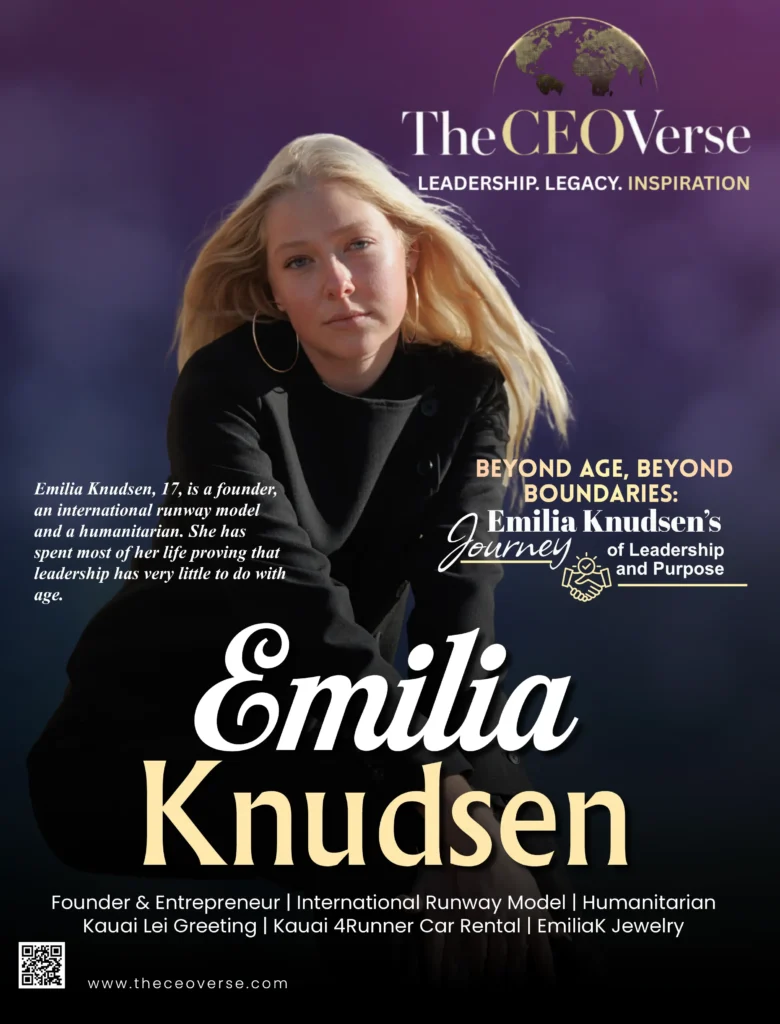
“Beyond Age, Beyond Boundaries: Emilia Knudsen’s Journey of Leadership and Purpose”
Cover story
Emilia Knudsen
Featured Profile - Emilia Knudsen
A Welcome That Starts At The Arrivals Gate
Step out of the terminal at Lihue Airport on a bright Kauai morning and the first thing you notice is the air. It is warm, soft and faintly sweet. The second thing, if you are lucky, is a stranger holding a sign with your name on it and a fresh flower lei draped over her arm.
That moment, the one in which a tired traveller is suddenly treated as a guest instead of a customer, is the product that Emilia Knudsen sells. She would say it is not a product at all. In her own words, “We aren’t simply selling flowers. We are creating an emotional connection.”
Emilia is seventeen. She is also a full time high school student, the founder of two tourism businesses, a jewellery designer, a fire poi dancer, a runway model who has walked in cities from Paris to Tokyo, and a fundraiser who is currently trying to put a deep water well into the ground in Uganda. On its own, any single one of these achievements would define an impressive career. Woven together, they reveal something truly extraordinary. A young leader whose diverse passions, no matter how distinct they appear on the surface, are all nourished by the very same purpose
To understand that purpose, you have to go back to a small island in the middle of the Pacific, and to a child who kept noticing what other people needed.
An Island Classroom
Emilia was born and raised on Kauai, the northernmost and greenest of the main Hawaiian islands. It is a place where everybody seems to know a cousin of somebody you know, where the mountains are always in view, and where the idea of caring for the land, mālama ʻāina, is taught long before it is explained. A small island, she says, teaches you something quickly. What you do, even in a modest way, lands on real people you will meet again at the grocery store.
Her family added a second map to that one. Her mother, Kamala, comes from Denmark, and Emilia grew up with a foot in each culture. From Hawaii she took community responsibility and hospitality. From Denmark she took a fondness for equality, education and environmental thinking. Long before she could afford the ticket, she knew she wanted to see Denmark with her own eyes. In a local newspaper interview at eleven, she said she had wanted to go since she was four.
The dream had a price tag, and Emilia set out to pay it herself. At five she began fire dancing, trained by a local instructor and performing under the stage name Emilia Ahi Naga. The flames never left her life. Today she is a fire poi dancer as well as a founder, model and designer. She danced at art walks and night markets on Kauai, sometimes earning up to a hundred dollars a night, and put the money toward the trip. She sold avocados from the tree in her backyard. A child that young rarely thinks about business models, but she had stumbled onto the first principle of one. If you want something, work out what people value and go offer it.
Later, she would spend an academic year at an international school in Denmark. The trip she had saved for as a little girl became something larger, a year of living independently among classmates from many countries. She came home with a sharper sense of how different places answer the same human questions.
Dough, Sea Glass And The First Customers
The first real business arrived while she was still in elementary school. For a class project in entrepreneurship, Emilia co-created Keiki Dough, a homemade, non-toxic play dough for children. (Keiki is the Hawaiian word for kids.) It was an ordinary school assignment with an unusual result. The dough sold at local Kauai stores, and half of what she earned went to charity, a habit of generosity built into the business from day one.
Around the same time, she was walking beaches with a different kind of eye. Kauai’s shores deliver sea glass, old bottles worn into soft, frosted jewels by years of tumbling in the surf. Emilia had been a treasure hunter for as long as she could remember, and in 2019 she turned the hobby into EmiliaK Jewelry. Bracelets, earrings and ornaments made from beach glass, shells and seeds. She sold at craft fairs and the Kilauea farmers market, in a local shop, and online through Etsy. Before the pandemic arrived, she had a dozen wholesale customers. She also started a Facebook community, Hawaii Sea Glass and Art, so other island artists could share and sell their own work.
These early ventures taught her two things that she still draws on. First, that a good idea combined with creativity and persistence can become something real. Second, and more quietly, that there was a way to make a business and a gift out of the same object. Even then, the jewellery was never only jewellery. It was a way of turning the ocean’s leftovers into something that could be sold, and the money into something that could be shared.
The Cupboard On Bricks
In March 2020 the world shut down, and Kauai, an island that lives on tourism, felt it almost immediately. Jobs vanished. Shelves in shops emptied. Families who had never needed help began to need it.
Emilia was eleven. On her street in Kapaa there was a little free library, a wooden box where neighbours swapped paperbacks. She took out the books and put in food. That was the whole idea. A cupboard on bricks by the roadside, open at all hours, stocked with canned fish, rice, pasta, flour, hygiene items and pet food. Take what you need. Leave what you can.
Nobody, least of all Emilia, expected it to grow. But the island noticed. The owner of The Kauai Store in Kapaa set aside space for a community pantry and Emilia became one of its managers, a title that must have sounded unusual for a sixth grader. On busy days the pantry served around a hundred people. She financed the effort by selling her Keiki Dough and sea glass jewellery, by performing fire dances for private events, by applying for grants, and by asking local businesses and neighbours to join in. Her father, a writer who works for himself, taught her how paperwork and business registration worked, which is possibly the most useful education a young humanitarian can get.
It would be easy to make the story about the food alone, but Emilia’s instinct was to look at what else people were missing. If parents were short on money for groceries, she reasoned, they were probably short on money for presents. So she raised funds for a Christmas event that gave gifts, photographs with Santa and shave ice to eighty children and their families, with about forty volunteers in costume handing out the presents. Everything was bought from local shops. Later, when she learned that the elderly residents of a Lihue assisted living home were isolated by pandemic rules, she and a friend made eighty Valentine’s Day cards in a single weekend and organized a party for them. The effort grew into a larger event for around two hundred kupuna, or elders, with cards, painted rocks and ti-leaf lei, and cards delivered to patients at several care facilities across the island.
By her own count, the whole movement eventually raised more than $35,000. Local reporters, who followed it closely, captured her own explanation, “If we can help each other, we will all be OK.” She has never claimed more than that.
The money matters less than what she took from it. Emilia says that the experience rewrote her definition of success. Leadership, she realized, was not about doing everything yourself. It was about spotting a need, finding a solution and inviting other people into it.

Earning the Spotlight, and Harnessing It
Recognition followed, though Emilia treated it as a side effect. In early 2021 she received a Certificate of Excellence from the Prudential Spirit of Community Awards, presented at her school by her principal. The same work qualified her for the President’s Volunteer Service Award. She has since earned its Gold level, with a letter acknowledging more than five hundred hours of service. She remembers the honor but says that the best part of volunteering was always the knowledge that someone else had been helped.
At fourteen, she entered the Miss Hawaii Teen Volunteer pageant on Oahu, her first ever. It was a modest start, by her telling. “I just got my braces out,” she told a reporter afterward. “I still don’t know how to smile with my teeth.” The judges’ marks were serious. Private interviews, evening gown, wellness, an on-stage question and a talent portion, for which she performed her fire knife dance. She finished as first runner-up and won the People’s Choice award, decided by public vote. The award also made her an advocate for the American Lung Association, where she worked on youth vaping awareness in Hawaii. It is characteristic of Emilia that a trophy came with a cause attached.
The Runway Years
While the pantry was growing, a second story was unfolding in parallel. Emilia had been modelling since she was small, and what she loved about it was not the glamour so much as the creativity. How a garment could carry a culture, how confidence could be learned.
The turning point arrived in 2022, when she was offered a place to walk at Paris Fashion Week in 2023. A teenager on a small island had a very large plane ticket to pay for. True to form, she set up a table at a local family festival in Lihue and sold Keiki Dough to raise funds. Friends and family began talking about a “Team EmiliaK” to get her to France.
She made it, and then kept going. Her international schedule now reads like an airline route map. New York, Paris, London, Milan, Dubai, Bangkok and Tokyo, along with other fashion capitals, bringing her total to approximately forty five countries. The reality is much less glossy than the photographs suggest. Between shows come long flights, late homework and the quiet knowledge that she is missing the usual teenage weekends. But she says the shows themselves have been instructive. Every image, she points out, is the product of a crowd. Designers, creative directors, stylists, hair and makeup artists, photographers and production crews, along with the models. A runway is a lesson in teamwork.
Two recent chapters carry particular meaning. In mid 2026 she took part in Sustainable Fashion of the World, an international congress in Panama that gathered participants from fifteen countries around runway shows, workshops and talks on circular fashion and environmental education. For Emilia, who grew up near an ocean that returns its litter as sea glass, the theme could hardly have been closer to home. She also won the title of Top Young Model 2026 in Malaysia, and she won Authentic Beauty 2026, an award that came with a prize of $1,000. She did not keep either amount. Both went toward a project on another continent, which we will come to shortly.
Hospitality As The Product
If the pantry was Emilia’s response to the pandemic, Kauai Lei Greeting is her answer to the tourism economy that the pandemic exposed.
The business is straightforward to describe and unusually hard to copy. Visitors arriving at Lihue Airport are met by an Emilia led team with a fresh flower lei, big smiles, a personalized sign carrying their names, a photograph and a handful of recommendations for exploring the island with care. Hawaii has a long tradition of welcoming people with lei, and Emilia’s insight was that a modern traveller, shuffling off a six hour flight, craves exactly this, to be seen. The business has collected 330 Google reviews, every one of them five stars, which suggests she is right.
She carried the same thinking into Kauai 4Runner Car Rental, which runs through the Turo platform. Rental cars are usually the most transactional part of a trip, a key, a contract and a fuel gauge. Emilia thought about the first fifteen minutes instead. Guests who book a 4Runner can have a complimentary lei greeting at the airport, along with local tips, a reminder to respect the island’s fragile places and encouragement to spend money at small local businesses. The car becomes the first chapter of a visit rather than a line on a credit card statement.
Her jewellery completes the triangle. The pieces, shaped from sea glass and natural materials, mostly become thank you gifts for people who support her humanitarian projects. Between the lei, the SUVs and the sea glass, there is no single product line. There is a habit of mind, and she describes it as a question she asks herself repeatedly. How can I make this experience better for someone else?
Her business partners, such as the flower suppliers and island hosts who help make each greeting happen, are part of that story. And Emilia has a next step in mind. Her own flower farm on Kauai. More than a hundred trees are already planted. The farm will let her grow the flowers for her lei locally, cutting dependence on imports, supporting local agriculture and keeping a Hawaiian tradition rooted in Hawaiian soil.

The Storm
In September 2026, nature handed Emilia the most severe test of her business life.
Hurricane Lowell struck Kauai and left the island reeling. Power failed in places. Infrastructure was damaged. Port facilities that bring in the island’s food and fuel were knocked out of service, and officials urged tourists to stay away while recovery was underway. The North Shore was closed to visitors as a disaster zone. Local news reports in the following days counted the toll on small businesses. Restaurants, food trucks, coffee shops and fish suppliers cut hours or laid off employees as visitors disappeared.
Emilia’s two tourism companies were in the middle of that. Reservations were cancelled, customers needed refunds, and revenue that would normally have kept the businesses humming through the season dried up. The damage did not end with the refunds. Tourism kept declining in the weeks that followed, so the season she had planned for simply never arrived.
She describes the weeks that followed with a candor that is incredibly rare. The financial hit was only part of it. What she remembers, she says, is how heartbreaking it was to watch hardworking people on the island struggle to keep their doors open. But she also describes the island’s response, neighbours checking on neighbours and businesses helping one another, as a reminder of why she wanted to build something in Kauai in the first place.
The storm sharpened her definition of resilience. She no longer thinks of it as simply surviving. It is, in her words, adapting, supporting others, and continuing to move forward when the future feels uncertain. The tourism industry is moving again, and Emilia is moving with it, now with a more detailed contingency plan than she would have written a year ago.
Lessons Learned The Hard Way
Emilia will tell you that the hurricane was not her first lesson in what a business can throw at you, only her loudest.
When she started, she believed that hard work, kindness and a great service would carry everything. They are still necessary. They are not sufficient. Running a tourism company means that flights run late, visitors change plans and weather rearranges your calendar. It also means that a guest may expect something the company never promised. She learned to write clear policies, describe services precisely and talk to customers early, before a small misunderstanding grows into a bad review.
She learned not to take every disappointment personally. A setback, in her view, does not prove that something has failed. It often shows what needs to be improved. And she learned something that grown up executives take decades to accept. She cannot do everything perfectly at once. Juggling school, international bookings and two companies forced her to prioritize, to ask for help and to say no to some things.
There is also the quieter challenge of being taken seriously. A seventeen year old CEO attracts doubt, and some people assume her accomplishments must have been easy. Emilia has decided not to argue the point. She answers with reliability and professionalism, and lets the results speak.
Beneath all of it sits a lesson about humility. No matter how many trophies she wins or passports she fills, she says, there is always more to learn. The day a person stops learning, she adds, is the day they stop growing.
The Well
In partnership with Aid Africa, a nonprofit organization, Emilia is working to raise $5,000 to help build a deep water well in Uganda. For many readers, clean water is something that arrives without thought. For communities without a reliable source, it can change daily life. It reduces waterborne illness, improves school attendance and frees women and children from spending hours collecting water.
The fundraising draws on every tool she has built over the years. Supporters receive handmade sea glass jewellery as a thank you. The $1,000 from Authentic Beauty 2026 went to the well. So did the prize money from Top Young Model 2026. In effect, her runway career and her jewellery business have become a single fundraising engine, with a destination she has already marked on the calendar. She hopes to travel to Uganda in August 2027 to see the well in use.
It is the clearest expression of a belief she repeats with remarkable consistency. Personal opportunities, she says, are most valuable when they can be passed on to someone else. A trophy on a shelf is pleasant. A trophy that becomes a water source is something else.
The People Behind The Person
Ask Emilia who shaped her and the list is long and gratefully specific. Her family comes first, for the independence and curiosity they encouraged and for the unspoken rule that you follow through on what you promise. She credits the Kauai community that believed in her when she was still a child with big ideas, the local businesses and volunteers who turned a roadside cupboard into an island wide operation, and the thousands of online followers who have supported her for years, many of whom, she says, have become real friends.
She also speaks warmly of the designers, photographers, organizers, stylists and fellow models she has met around the world. She says that working beside people from different backgrounds taught her discipline, adaptability and a respect for other people’s art. And she holds on to one idea above the rest, that the most valuable encouragement comes from the person who sees possibilities in you before you see them yourself. She believes everyone owes someone that kind of faith.
The Road Ahead
The calendar for the coming months is already crowded. In November she returns to Tokyo for another fashion show. December will bring modelling and editorial work in Okinawa, Taiwan, Hong Kong and Beijing. In 2027 she plans to graduate from high school with her class, a milestone she names with as much pride as any runway. Then comes Uganda.
Beyond the immediate schedule, she hopes to grow her businesses without losing the personal touch that sets them apart, to keep building her modelling career, and to expand her humanitarian work into clean water, education, environmental protection and opportunities for children. She wants to be a better leader in ten years than she is today, and she is not shy about saying that she expects to make more mistakes along the way.
What she does not want is for recognition to become the point. Awards and magazine features, she says, should be doors, not destinations.
A Note To The Next Generation
Asked what she would tell someone just starting out, she offers advice that sounds simple until you remember who is giving it. Do not wait until you feel ready. She started her first business as a child and her food pantry at eleven, with no university degree, no budget and no experience. What she had was an idea and a willingness to begin.
Start with something you care about, she says. Learn as much as you can. Be ready to make mistakes and improve. Stay curious about the world, because travel has shown her that there is no single definition of success. And do not underestimate kindness. Ambition and compassion, she insists, belong together.
She is also clear eyed that the world’s problems can feel too large for any one person. Climate change, poverty and inequality can seem unmovable. Her answer is the story of her own life. A food pantry began with one child wanting to help her neighbours. A well began with a wish to help families thousands of miles away. A business began with the courage to try.
“Your age doesn’t determine your potential,” she says. “Your actions do.”
At seventeen, her story is by her own admission unfinished. The chapters so far suggest a theme that will carry into the next ones. She hopes to be remembered less for what she achieved than for what she contributed. “My goal isn’t simply to become successful,” she says. “My goal is to make success meaningful.”
On a bright Kauai morning, somewhere between the baggage claim and the car park at Lihue, a traveller is about to be handed a flower. It is a small gesture. It is also, in its way, a whole philosophy.