
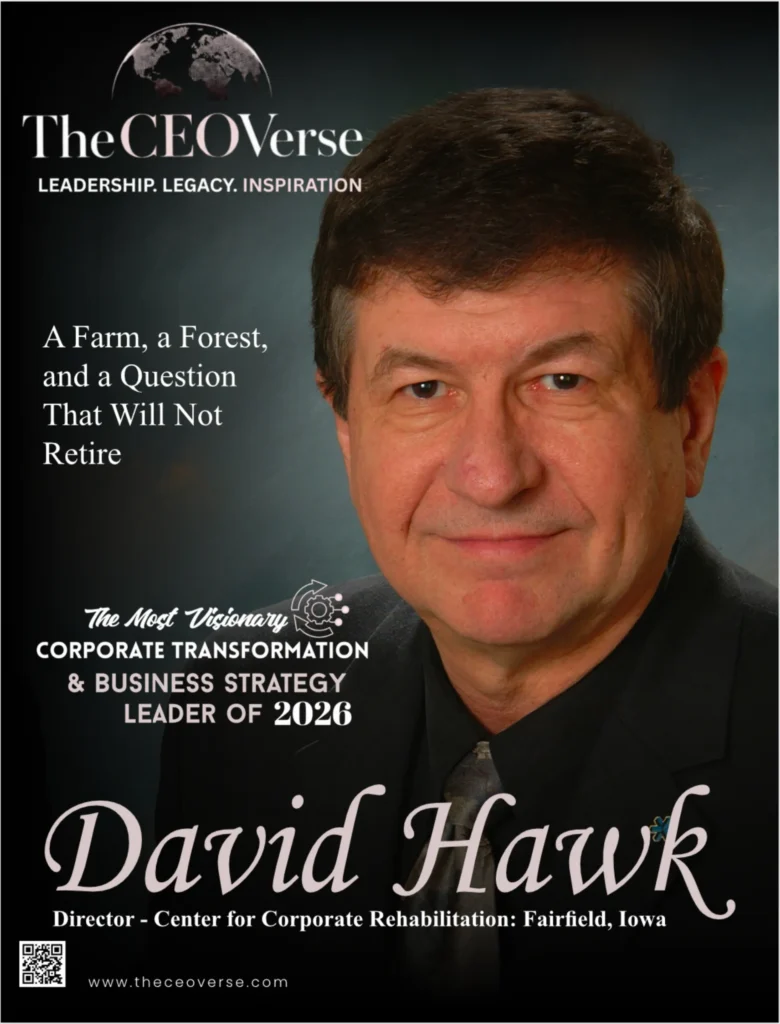
TheCEOVerse • Digital Edition
“The Most Visionary Corporate Transformation & Business Strategy Leader of 2026”
Cover story
David Hawk
Featured Profile - David Hawk
A Farm, a Forest, and a Question That Will Not Retire
On the edge of Fairfield, Iowa, there is a backyard that ends where a forest begins. It is a quiet place, big enough to hold a meeting of fifty people or fewer, and it is where David Hawk now spends much of his time. He keeps animals. He watches trees. He also keeps asking a question that has followed him across six decades and four continents. Why does a species so clever keep waging war on the living system that sustains it?
Most executives of his stature would have settled into a comfortable emeritus life by now. Hawk has no interest in comfort. He is the Director of the Center for Corporate Rehabilitation, an organization he has led since the early 2000s from two bases, Fairfield, Iowa, and Mt. Olive, New Jersey. The name is deliberate. Hawk believes that corporations, like people, can fall into destructive habits and need to be helped out of them. His work has been to show leaders how to leave what he calls nineteenth century business as usual, built on Newtonian machines and metaphors, for a twenty first century business as unusual shaped by the ideas of Einstein, Feynman, Bohm and Hawking.
It is a bold proposition, and Hawk delivers it with a mix of scholarly rigor and mischievous humor. He describes himself as a good teacher, a troublesome dean and a useful advisor to many chief executives. To understand how one person came to hold all three reputations, you have to begin at the beginning, with a young man who wanted to build cities that floated on the sea.
A Young Architect in a Restless Decade
Hawk’s formal education began in 1963 at Iowa State University, where he studied architecture and building sciences. The years that followed were not gentle ones. The Vietnam War hung over his generation, and Hawk later joked that his grades from that period were a matter of no care and no idea, because the war was in the middle of everything. Yet the same years show a student who refused to wait for permission to learn.
In 1969, while still an undergraduate, he founded the foreign studies architecture programs at Iowa State. The first was a study tour for his design class in Merida, in the Yucatan. For three months the students worked alongside Dr. Sagovia, the Mexican government’s Minister of Archeology, helping at digs among Mayan ruins and the remains of former cities. The aim was to understand the human past by touching it. A year later he organized a second group to live and study in Europe for a full term. The itinerary was a pilgrimage through modern design thinking, beginning in Finland with the master Alvar Aalto and ending in Germany with Hans Bennish.
His 1971 design thesis showed where his mind was heading. Instead of another building, he proposed a floating city at sea. The idea was disarmingly simple. If humans lived on the water, they would stop crowding natural landscapes, the forests could stand, and the trees could go on stabilizing the climate. It was architecture as an apology to nature, offered half a century before climate anxiety became a dinner table subject.
London, Westminster, and an Unexpected Mentor
After graduating, Hawk crossed the Atlantic to work as an architect and planning officer for the City of Westminster. For about sixteen months, from 1971 into 1972, he worked on design and construction projects in the heart of Central London, covering education, housing and commercial buildings. It was a practical apprenticeship in how cities are actually made, with all the committees, constraints and compromises that textbooks leave out.
One assignment changed his direction. Hawk found himself managing a project connected to Piccadilly Circus, one of the most scrutinized public spaces on earth. As a consultant on that project he met Edmund Bacon, the celebrated Philadelphia city planner who had spent a career arguing that design should restore human vitality to urban life. Bacon saw something in the young Iowan and drew him toward the University of Pennsylvania. Hawk would later point readers to Bacon’s book, Design of Cities, as one of the formative texts in his life.
Philadelphia: Where Cities and Systems Collide
At Penn, Hawk pursued two master’s degrees at once, in Architecture and in City Planning, between 1972 and 1974. He also served as Bacon’s teaching assistant in city planning and urban design. His thesis, titled “The Communications Alternative: From Moving Mass to Moving Ideas,” was strikingly ahead of its time. It argued for a global communications network that would reconnect human beings and reduce the need to move people and materials around, thereby cutting the energy and resources that a conventional idea of progress demanded. A city, he proposed, was really a missing institution, and technology should serve conversation between people rather than the control of people by hierarchies. Real time negotiation at the edges of a system would replace the plan and the planner.
The thesis was not universally admired at first. Hawk recalls that it received a failing mark, which two Wharton faculty members argued should be raised to an A. It was. He now looks back at it with mixed feelings. The network he imagined did arrive, but in his view it was bent by ordinary business habits and human weakness until it became something quite different from the reconnecting force he had pictured. That tension, between a good idea and what people do to it, would run through all of his later work.
Dover, Delaware: A Factory Without Bosses
In 1974 Hawk entered the Wharton School’s doctoral program in Systems Sciences and International Business, working as a teaching and research assistant to two giants of systems thinking, Eric Trist and Russell Ackoff. Trist, the father of socio technical systems, became a particular influence, and Hawk helped teach and research autonomous work groups, socio technical design and industrial democracy.
The great field experiment of those years was a Scott Paper plant in Dover, Delaware, an unusual factory built without a managerial hierarchy and without union control. It brought new products to market quickly while limiting the pollution created by both production and product use. By Hawk’s account it worked. His final report, however, upset the company’s board. Scott later brought in a famously ruthless executive, nicknamed Chainsaw Al, who cut jobs sharply and returned the firm to the old tradition of raising productivity by firing people rather than motivating them. Hawk draws a wry lesson from the episode. The better system does not always win, and sometimes the bad one wins precisely because it is familiar. It was an early and costly education in how institutions defend themselves against ideas that threaten their habits.
Stockholm and the Warning Nobody Wanted to Hear
If there is a single chapter that justifies the word visionary, it is Stockholm. In 1975 Hawk joined the Stockholm School of Economics, where with two close friends, Dr. Gunnar Hedlund and Dr. Lars Otterbeck, he helped create the Institute of International Business. The Institute was designed as a research group for doctoral students working alongside major multinational firms. He would remain connected to Stockholm until 1996, and he counts his Swedish years among the happiest of his life. Summers in Lapland, above the Arctic Circle, and long walks in the wilderness with Gunnar were, in his words, a search for the source of innovation in meaning.
The first research project of the Institute was Hawk’s own, and it was extraordinary in scope. Between 1975 and 1977 he led a study of how business creates environmental deterioration across the globe and what the public and private sectors might do together to manage it. Twenty companies and six governments took part. The project carried a title that has since become something of a signature: “Environmental Deterioration: Analytic Solutions in Search of Synthetic Problems.” The Prime Minister of Sweden presented the results to the OECD in Paris. The three volume final report included contributions from a chief scientist at Exxon, who described how climate change would emerge from human activity, including the products of his own company.
The study’s conclusion was sobering. Government regulation, built on a legal order that treats each problem separately, would not be capable of managing a crisis that was systemic by nature. What did work, Hawk found, was negotiated order, in which firms owning similar plants in different countries could actually measure and manage their impacts together. This was in the late 1970s. The science of climate change was still decades from its public breakthrough, and the people who might have acted on the warning went on to other business.
A Dissertation Too Controversial to Publish
That research became Hawk’s doctoral dissertation, which he completed at Wharton in 1979. He was told it was too controversial. Wharton’s dean sealed it, and for years the work sat out of public view.
Hawk is not a man to leave a good argument in a drawer. Decades later the dissertation was republished under the title “Too Early, Too Late, Now What?” The title is a compact autobiography. He had been too early for his colleagues to listen, and the world is now too late to avoid all the consequences. What remains is the third question, the practical one. A 2022 edition appeared under a far blunter title, and Amazon declined to carry it, which Hawk treats as one more proof of his thesis about how comfortable truths travel better than uncomfortable ones. His companion book, “Short-term Gain, Long-term Pain,” takes up the “now what” in detail, examining how modern commerce markets its own mistakes as progress, and why entropy, the tendency of every system toward disorder, remains the one law no strategy can repeal.

Iowa State: The Report That Cost a Job
In 1979 Hawk returned to Iowa State University as an assistant professor, this time on the faculty. He helped separate the College of Design from the College of Engineering and set about establishing a new School of Business. He built graduate programs, attracted outside and research funding, started an external lecture series and recruited international students. A National Endowment for the Arts grant funded his study of why design schools should gain more autonomy without leaving engineering behind. The finding was that students needed what both schools had to offer. His recommendation went largely unheeded. Most American architecture departments eventually did leave engineering, and Hawk believes both disciplines were poorer for it, with architecture drifting from technology and engineering drifting from design.
The business school episode was more personal. Hawk chaired the committee to create the school and proposed one built around business as unusual, an institution that could lead the next century. The university’s president had something more modest in mind, in Hawk’s telling an average Iowa type school. Hawk responded with a report titled “How to Have the Most Mediocre Business School in America.” He lost his position. He still speaks warmly of the students, whom he liked very much, and with a dry blessing for the president, who may rest in peaceful mediocrity.
The Road to Newark
In 1981 Hawk made a decision that surprised his peers. He turned down an offer from the Boston Consulting Group and Harvard to teach at the New Jersey Institute of Technology in Newark. The students there were not the polished products of elite pipelines. Many came from limited financial means with few connections, and they became his passion.
He would stay for more than thirty years, serving as Professor and eventually as Dean of both the School of Architecture and the School of Management. His classroom was never confined to the classroom. His students met New Jersey’s congressional representatives in Washington, D.C. They visited the president and headquarters of the Concha y Toro wine company and its great vineyard in Chile. Executive MBA students toured the headquarters of one of Europe’s leading pharmaceutical companies. Hawk wanted them to see how global business actually worked, from the inside, and to feel at ease there.
His research gave him a conviction he repeats often. NJIT graduates, he found, were among the most desirable employees in the world precisely because of what they had endured. They had come through a university that sometimes treated them poorly, with high costs, absent leadership and professors who did not profess, and they carried on with humor and passion. Nothing in corporate life, he reasoned, could frighten people who had already been there. He describes himself as humbled by their enthusiasm for life.
The Dean Who Turned a School Around
Hawk’s time as dean was brief but remarkable. A newly appointed provost, impressed by his resume, website and fundraising record, asked him to serve as acting dean for a year. To accept, Hawk gave up a leadership research position in Beijing. What he did next is the part of his career that most conventional measures can verify. He attracted considerable new funding and recruited a prestigious advisory board. He expanded the Executive MBA by three hundred percent, with plans to double enrollment again the following year. He rebuilt the facilities. The school’s accreditation was on probation with the AACSB, the global standard for business education. Under his leadership the probation was lifted and the school was recognized as the most improved AACSB school of the year.
The story, as Hawk tells it, ended abruptly. Within an hour of receiving the accreditation letter, he was dismissed by the university president, who by Hawk’s account wanted a school oriented to undergraduate athletics and to institutional loyalty rather than progress. He faced a difficult exit and chose to contest it, a fight that lasted five years and was paid for in part by companies he had advised. He says he emerged knowing a great deal more about New Jersey law.
The costs of the episode went beyond one man’s career. A high profile venture between Tsinghua University and NJIT was cancelled, one that would have brought twenty five Chinese business leaders to Newark to take four NJIT Wharton courses. Tsinghua, which Hawk describes as the world’s leading institution in artificial intelligence and information systems education, took its agreement elsewhere. NJIT students lost opportunities as a result, and that, for Hawk, is the real injury.
Beijing: A Bridge Across the Pacific
Even as American institutions tested his patience, China embraced his ideas. From 2004 to 2012 Hawk served as a visiting lecturer at Tsinghua University in Beijing, teaching and advising students in the Ph.D. program of the School of Public Policy and Management. He admired the program’s quality, its timely research questions and its remarkable students and faculty. Several of those students visited his homes in New Jersey and Iowa and took courses at NJIT. He has said that America needs a program of similar calibre, and he hopes that the Kennedy School at Harvard may one day become one.
In parallel, from 2004 until 2019 he served as Senior Advisor to China Construction America. In his own words, he helped the company deal with the external limits of local prejudice and incompetence so that it could concentrate on what mattered, and he assisted with due diligence on its selective expansion. He speaks of the company as a good one, led by very bright people, and he keeps a photograph of two colleagues who became friends.

A Billion Dollar Bet on Young Women
Between 2016 and 2019, Hawk served as CEO of the Foundation of the Eternal Feminine, an international foundation headquartered between Beijing and Mt. Olive, New Jersey. According to his account, the foundation held assets of roughly one billion dollars, drawn from contributions and gifts. Seven percent each year was devoted to supporting vibrant, intelligent young women from every continent, half of them with little access to connections or funding, so that they could attend leading universities.
The curriculum went beyond a degree. Scholars studied the consequences of nineteenth and twentieth century masculinity in business and learned how the second law of thermodynamics bears on the Faustian bargains that drive climate change. Hawk’s concern was that the crude forms of industrialization might be carried unchanged into the age of information technology and artificial intelligence, and that the women he was educating might be the best chance of stopping it. He says plainly that it may be too little, too late, and also that it looks like a last best chance to reverse what he calls the manly war on nature. The Foundation’s motto comes in the form of an image. A small girl, trapped by a world she did not define, and the question of where she should begin.
The Philosophy: Five Dimensions of Hope
Hawk’s thinking is easier to appreciate when set out as a path. He starts with reverence for natural beauty. He asks leaders to put aside the vocabulary of leadership, strategy and hierarchy, except for its comic value, and to seek truth through transparency in place of strategic posturing, which he describes as faking it until you are making it. He is wary of the limits he sees built into the foundations of the great business schools.
He also offers a playful geometry of how people think. Zero dimensions, he says, are pointless. One dimension is political. Two dimensions are visually limiting. In three dimensions, humans make a mess of things while chasing one dimensional dreams of immortality born of anger about the fourth, which is time. The fifth dimension is where hope lives, where living systems communicate without lying, cheating or stealing. It is a quirky framework, but it carries a serious claim about what organizations could become if they communicated the way forests do.
His list of concerns is equally unusual. Recovering from the limits of nationalism, artificial intelligence dreams that obscure natural intelligence, the development of fluid infrastructure, the entropy that governs even black holes, and the discipline of being kind even when it confuses others. He shares his thinking at davidhawk.com, eternalfeminine.org and njitbs.org, where the letters BS, he is careful to note, stand for business schools and not for the content of the courses.
Honest About the Cost of Honesty
One does not read Hawk’s story without noticing how often telling the truth cost him something. A sealed dissertation, a terminated post in Iowa, a dismissal in Newark, a cancelled partnership, a banned book, five years in court. A less stubborn person might have drawn the lesson that candor is expensive. Hawk draws a different one that the institutions of his era were shaped for loyalty and continuity rather than for learning, and that the only sensible response is to keep building new ones.
He does so with a humor that is rarely gentle and never bitter for long. He describes himself as an idiot among idiots, most upset with himself for his own contributions to the mess. The self mockery disarms. It also reflects a real humility, the kind that lets a man admit his own part in a shared failure while still insisting that a better approach is possible.
What the Trees Know
These days Hawk farms. He watches droughts widen year after year and says plainly that, in his judgment, humans mostly cannot manage climate change. His animals, he says, are unhappy with us. He treats trees as teachers, and he wonders aloud whether people have always been inclined to cut down the very things that could instruct them, or whether the habit grew from the tradition of unaided rationality that runs from Aristotle through Newton and Darwin to the present.
Yet he does not surrender to despair. The hope he describes is conditional, sometimes hidden, and carried by the young women his foundation sought to educate, by the NJIT graduates who outwork the odds, and by the quiet intelligence of natural systems that have never needed a strategy to survive. At seventy something, with more than half a century of work behind him, David Hawk is still asking the questions that most of the business world prefers to postpone.
His is not the story of a leader who followed the map. It is the story of one who kept redrawing it, who dropped a Harvard offer for a school in Newark, who put a warning about climate in front of the OECD in the 1970s, and who is still, in the forest behind his Iowa home, searching for a better path for the human project.