
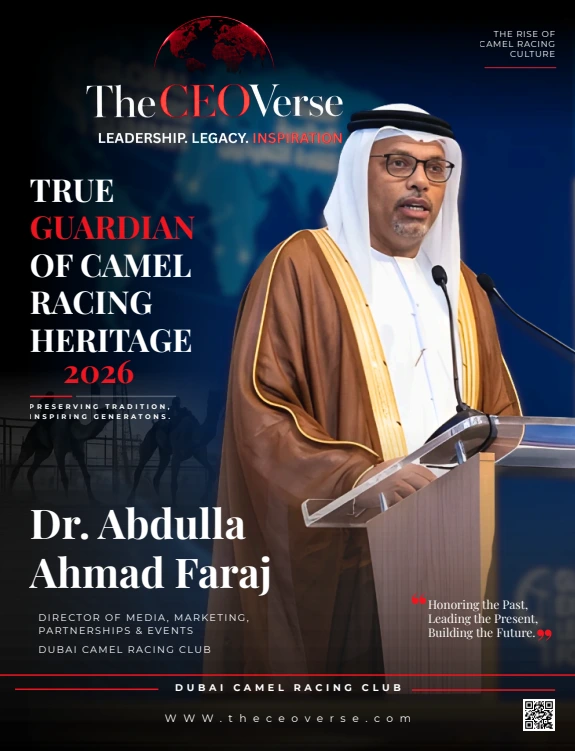
TheCEOVerse • Digital Edition
“True Guardian of Camel Racing Heritage-2026”
Cover story
Dr. Abdulla Ahmad Faraj
Featured Profile - Dr. Abdulla Ahmad Faraj
Dr. Abdulla Faraj: Preserving a Nation’s Heritage While Designing Its Global Future
In an age where leadership is increasingly measured by disruption, speed, and technological transformation, a different kind of leadership continues to prove its enduring value: leadership that understands progress is most meaningful when it safeguards the identity of a nation while preparing it for the future.
For more than two decades, Dr. Abdulla Ahmad Faraj has built his career around this philosophy. Rather than viewing heritage and innovation as competing priorities, he has consistently demonstrated that the strongest institutions are those capable of embracing modern thinking while protecting the cultural foundations upon which they were built. His professional journey reflects an unwavering commitment to preserving one of the United Arab Emirates’ most treasured traditions, camel racing, while elevating its international profile through strategic communication, institutional partnerships, world-class events, and visionary marketing.
As Director of Media, Marketing, Partnerships & Events at Dubai Camel Racing Club, Dr. Faraj has played a central role in strengthening the Club’s institutional reputation both locally and internationally. His leadership extends far beyond media relations or promotional campaigns. It encompasses strategic planning, corporate communications, international partnerships, destination marketing, sponsorship development, event management, stakeholder engagement, and the continuous evolution of one of the UAE’s most prestigious heritage institutions.
Throughout his career, he has led initiatives that have enhanced the global visibility of the Dubai Camel Racing Club while preserving the authenticity of Emirati heritage. Under his strategic direction, media operations have evolved into an integrated communication ecosystem spanning digital platforms, international media relations, multilingual publications, live broadcasting, strategic storytelling, and innovative audience engagement. These initiatives have generated millions of digital interactions, expanded international awareness of camel racing, and reinforced Dubai’s position as a global destination for heritage sports.
His contribution extends equally to the development of the visitor experience surrounding the UAE’s flagship camel racing festivals. Dr. Faraj has played a leading role in enhancing the accompanying events of both the Dubai Crown Prince Camel Racing Festival and the Al Marmoom Heritage Camel Racing Festival, transforming them into integrated cultural experiences that celebrate Emirati identity while welcoming international visitors, media organizations, strategic partners, government entities, and global stakeholders. Through carefully designed activations, cultural programming, hospitality initiatives, and institutional collaborations, these festivals have become powerful platforms for cultural diplomacy, tourism promotion, and international engagement.
His vision has also been reflected in the establishment of long-term international partnerships that extend beyond commercial objectives. Among the most notable is the enduring collaboration with a leading German sports club, a relationship that has continued for more than a decade and has contributed to promoting camel racing and Emirati heritage across Europe through sustained cultural and institutional cooperation.
Dr. Faraj’s leadership has earned recognition from respected regional and international organizations, reflecting both his personal contribution and the institutional excellence achieved under his direction. These recognitions celebrate not only leadership in media and strategic marketing but also his commitment to preserving cultural heritage through innovation, international collaboration, and responsible institutional development.
What distinguishes Dr. Faraj is not simply the number of initiatives he has delivered or the recognition he has received. It is his belief that leadership is ultimately measured by the institutions it strengthens, the people it inspires, and the legacy it leaves for future generations. His work continues to demonstrate that heritage is not an obstacle to progress; it is one of its greatest strategic assets when guided by vision, integrity, and purpose.
Leading Beyond Recognition
Leadership is often associated with visibility, titles, or personal achievement. For Dr. Abdulla Ahmad Faraj, however, leadership has always been defined by something far more enduring: responsibility. Throughout a career spanning more than two decades, he has consistently believed that the true measure of leadership lies not in the recognition one receives, but in the lasting value one creates for institutions, communities, and future generations.
This philosophy has shaped every stage of his professional journey. Whether leading strategic communications, developing international partnerships, directing large-scale marketing initiatives, or enhancing some of the UAE’s most prestigious heritage events, Dr. Faraj has remained focused on strengthening institutions rather than promoting individuals. Recognition, in his view, is never the objective; it is the natural outcome of consistent performance, ethical leadership, and meaningful impact.
Serving as Director of Media, Marketing, Partnerships & Events at Dubai Camel Racing Club, he has contributed to transforming the Club into a modern institution that combines cultural authenticity with international standards of excellence. Under his leadership, media operations have evolved beyond traditional communication into an integrated strategic platform that supports institutional reputation, stakeholder engagement, sponsorship development, tourism promotion, and global visibility.
His leadership philosophy is built upon four enduring principles: integrity, trust, collaboration, and sustainability. Every strategic decision is evaluated not only by its immediate outcome but also by its long-term contribution to institutional credibility. He believes that lasting success is achieved when organizations earn public trust, build meaningful partnerships, and create opportunities for others to succeed alongside them.
Throughout his career, Dr. Faraj has championed a collaborative leadership model that brings together government entities, private-sector partners, media organizations, international institutions, and local communities under a shared vision. This approach has enabled the successful delivery of major initiatives while reinforcing the role of camel racing as a living symbol of the UAE’s cultural identity.
His leadership has also been recognized through numerous regional and international honors celebrating excellence in media, strategic marketing, heritage preservation, and institutional leadership. Yet, despite these achievements, he continues to regard every award as a reflection of collective effort rather than personal accomplishment. Behind every successful initiative, he believes, stands a dedicated team united by a common purpose.
One of the defining characteristics of Dr. Faraj’s leadership is his ability to balance ambition with humility. He encourages innovation while respecting tradition, embraces technological transformation without compromising cultural values, and pursues international growth while remaining firmly rooted in Emirati identity. This balanced perspective has enabled him to guide institutional development with confidence during a period of rapid global change.
For Dr. Faraj, leadership is not about standing at the center of success; it is about creating an environment where others can excel. Empowering colleagues, mentoring future leaders, and building high-performing teams have remained central to his management philosophy. He believes that organizations achieve sustainable excellence when knowledge is shared, responsibility is embraced collectively, and every individual understands how their contribution supports a larger institutional vision.
Perhaps most importantly, he believes that leadership is a continuous journey of learning. Inspired by the visionary leadership of the United Arab Emirates, he has consistently sought to develop his knowledge, embrace innovation, and adapt to changing global realities while remaining faithful to the values that have guided his career from the beginning.
As the demands placed upon modern leaders continue to evolve, Dr. Faraj’s journey demonstrates that authentic leadership is not measured by authority alone. It is measured by the confidence people place in your vision, the institutions you strengthen, the partnerships you build, and the legacy you leave behind. That philosophy continues to define his work today and remains the foundation upon which he is shaping the next chapter of institutional excellence.
Protecting Heritage Through Modern Vision
Camel racing is far more than a competitive sport within the United Arab Emirates. It represents a living expression of the nation’s history, identity, resilience, and social fabric. Preserving this legacy requires more than operational excellence; it demands visionary leadership capable of ensuring that heritage continues to thrive in an increasingly digital and globally connected world.
Throughout his professional career, Dr. Abdulla Ahmad Faraj has embraced this responsibility with a clear conviction: heritage should never remain static. Instead, it must evolve responsibly, allowing future generations to experience its authenticity while benefiting from contemporary standards of excellence in communication, event management, institutional governance, and international engagement.
This philosophy has become a defining characteristic of his leadership at the Dubai Camel Racing Club, where he has consistently worked to position camel racing not only as one of the UAE’s most treasured cultural traditions but also as an internationally respected heritage sport. Rather than allowing modernization to dilute authenticity, Dr. Faraj has demonstrated that innovation can become one of heritage’s strongest allies when guided by purpose and cultural responsibility.
One of his most significant contributions has been the continuous development of the accompanying events surrounding the Dubai Crown Prince Camel Racing Festival and the Al Marmoom Heritage Camel Racing Festival. Under his strategic direction, these accompanying programs have evolved beyond traditional entertainment into comprehensive cultural experiences that celebrate Emirati identity while attracting international visitors, media organizations, government entities, diplomatic delegations, strategic partners, and tourists from around the world.
Every initiative has been designed to ensure that visitors experience not only the excitement of camel racing but also the values that define the UAE: hospitality, generosity, authenticity, and respect for heritage. Cultural exhibitions, heritage villages, VIP hospitality, media centers, educational activations, sponsor engagement, and visitor experiences have all been carefully integrated to create an immersive environment that reflects the nation’s vision while strengthening its cultural diplomacy.
Dr. Faraj has also played a leading role in strengthening the Club’s international presence through strategic communication and destination marketing. His efforts have contributed to expanding media coverage across traditional and digital platforms, enabling millions of viewers and followers to engage with camel racing through multilingual storytelling, live broadcasting, social media campaigns, and innovative digital content. These initiatives have significantly enhanced the global visibility of the Dubai Camel Racing Club while reinforcing Dubai’s reputation as a leading destination for heritage tourism and international sporting events.
Equally important has been his commitment to institutional collaboration. Throughout his leadership journey, he has cultivated productive relationships with government authorities, tourism organizations, corporate partners, educational institutions, international media, and global sporting organizations. These partnerships have strengthened the ecosystem surrounding camel racing, creating sustainable opportunities that extend beyond the racecourse itself and contribute to cultural preservation, economic development, and international cooperation.
Innovation has remained central to this transformation. Dr. Faraj has consistently encouraged the adoption of digital communication strategies, data-driven marketing, immersive visitor experiences, and emerging technologies that improve operational efficiency while protecting the authenticity of Emirati traditions. His vision for the coming years includes expanding the role of artificial intelligence and advanced digital platforms to enhance audience engagement, strengthen institutional performance, and preserve cultural knowledge for future generations without compromising the essence of the sport.
His leadership demonstrates an important principle that increasingly defines successful cultural institutions worldwide: heritage should not compete with innovation; it should inspire it. By integrating modern communication, strategic partnerships, world-class event experiences, and responsible technological advancement, Dr. Faraj has created a model in which cultural preservation and institutional excellence reinforce one another.
For Dr. Faraj, protecting heritage is ultimately about protecting identity. Every communication strategy, every international partnership, every visitor experience, and every institutional initiative serves a larger purpose to ensure that the story of camel racing continues to inspire future generations while representing the United Arab Emirates with authenticity, excellence, and pride on the global stage.
Building Institutions That Endure
For Dr. Abdulla Ahmad Faraj, leadership has never been about creating isolated successes or short-lived achievements. It has always been about building institutions capable of growing stronger with time, organizations that continue to deliver value long after individual projects have concluded. This long-term perspective has become one of the defining characteristics of his professional philosophy.
Throughout his career, Dr. Faraj has viewed every initiative as part of a broader institutional vision. Whether developing strategic partnerships, enhancing media operations, expanding international engagement, or elevating the visitor experience surrounding major heritage festivals, his objective has remained consistent: to strengthen the institutional capacity, credibility, and sustainability of the Dubai Camel Racing Club.
This philosophy has guided his approach to strategic planning. Rather than measuring success solely by attendance figures, media impressions, or sponsorship revenue, he evaluates every initiative by its ability to enhance institutional reputation, improve stakeholder confidence, and create lasting value for the organization and the wider community. Sustainable institutions, in his view, are built through consistency, governance, innovation, and public trust.
One of the clearest examples of this approach has been the continuous modernization of the Club’s communication ecosystem. Under Dr. Faraj’s leadership, media has evolved into a strategic function that supports decision-making, strengthens stakeholder engagement, enhances international visibility, and preserves the cultural narrative of camel racing. Through integrated digital platforms, multilingual publications, professional content production, and strategic storytelling, the Club has significantly expanded its reach while maintaining the authenticity of its heritage mission.
Institutional excellence has also been reinforced through the development of strategic partnerships that extend beyond traditional sponsorship models. Dr. Faraj has consistently sought collaborations based on shared values, long-term commitment, and mutual growth. His work with government entities, tourism authorities, corporate partners, educational institutions, international media organizations, and private-sector stakeholders has created an ecosystem that supports not only major events but also the broader objectives of cultural preservation and institutional development.
A notable example is the long-standing partnership with a German sports organization, which has continued successfully for more than a decade. What began as a sporting collaboration evolved into a meaningful cultural bridge between the United Arab Emirates and Europe, contributing to the international promotion of Emirati heritage while strengthening relationships built on mutual respect and shared purpose. This partnership reflects Dr. Faraj’s belief that institutions become stronger when they invest in relationships that transcend geographical boundaries and commercial objectives.
Dr. Faraj has also championed a culture of continuous improvement. He believes that institutional resilience depends upon the willingness to embrace innovation while remaining faithful to core values. This mindset has encouraged the adoption of advanced communication strategies, digital transformation initiatives, and emerging technologies including artificial intelligence to improve operational efficiency, enhance stakeholder engagement, and support long-term strategic planning. Yet throughout this transformation, he has maintained that technology should always serve people and purpose, never replace them.
Equally important has been his commitment to developing human capital. Dr. Faraj believes that institutions achieve sustainable excellence only when their people are empowered to grow. Throughout his leadership journey, he has encouraged collaboration, professional development, knowledge sharing, and cross-functional teamwork, fostering an organizational culture in which every individual understands their role in achieving a shared mission.
The success of this institutional approach is reflected not only in operational performance but also in the recognition the Club has received through various regional and international platforms. These achievements are viewed by Dr. Faraj not as final destinations, but as indicators that the institution is moving in the right direction earning credibility, strengthening partnerships, and reinforcing its position as one of the world’s leading heritage sports organizations.
Looking ahead, Dr. Faraj remains focused on preparing the Dubai Camel Racing Club for the future. His vision is to continue building an institution that combines cultural authenticity with innovation, operational excellence with human values, and national heritage with global engagement. For him, the greatest legacy any leader can leave is not a collection of successful projects, but an institution that continues to inspire confidence, preserve identity, and create opportunities for generations to come.
Building Influence Beyond Borders
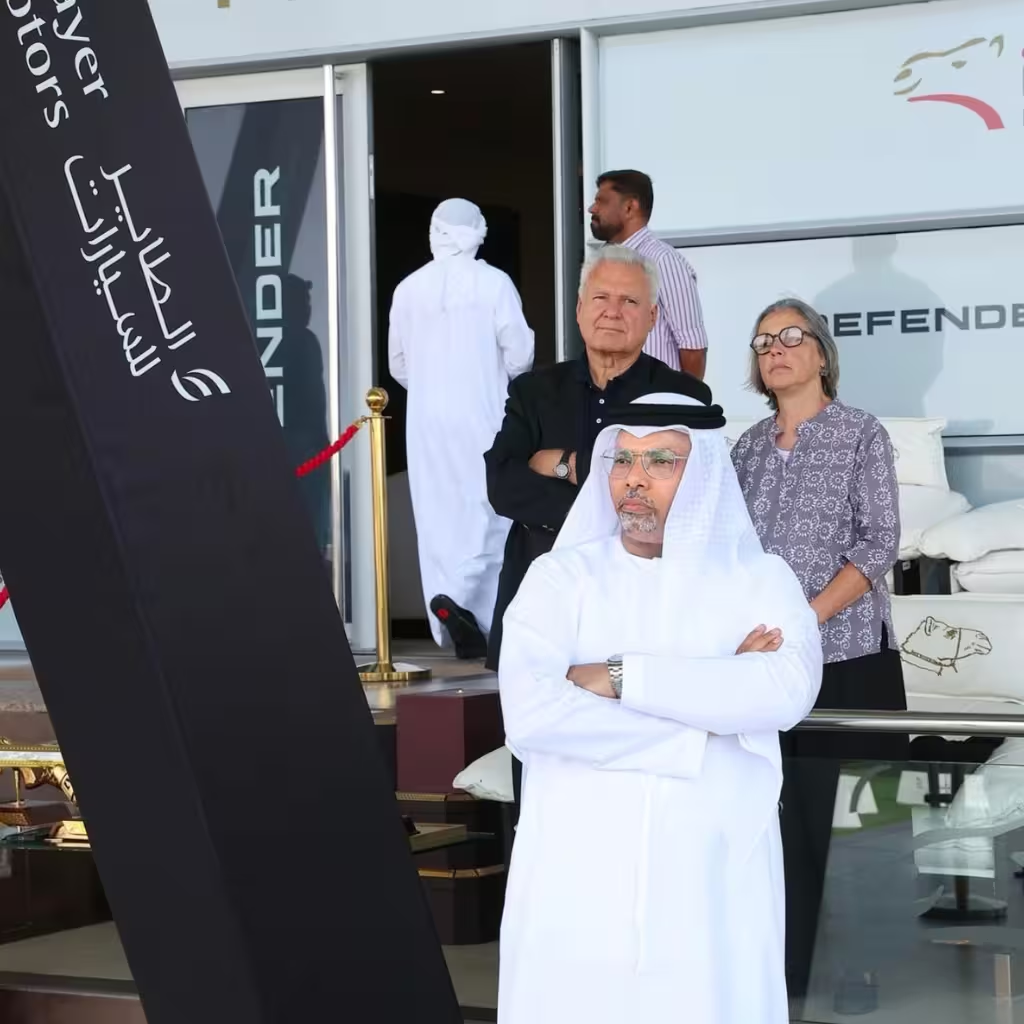
True institutional influence is not measured by how widely an organization is known, but by how deeply it is respected. While many institutions pursue international recognition through visibility alone, Dr. Abdulla Ahmad Faraj has consistently believed that lasting global influence is earned through credibility, authenticity, and a clear sense of purpose. Throughout his leadership journey, his objective has never been to internationalize camel racing by changing its identity, but by presenting its authentic heritage to the world with confidence and excellence.
This philosophy has guided every major communication, marketing, and partnership initiative he has led at the Dubai Camel Racing Club. Rather than treating heritage as a local story with limited international relevance, Dr. Faraj has positioned camel racing as a universal cultural experience that reflects values admired worldwide: discipline, perseverance, respect for tradition, community, and national pride.
One of the cornerstones of this international vision has been the development of strategic partnerships that extend beyond conventional sponsorship agreements. Under his leadership, collaborations have been established with government entities, tourism authorities, multinational corporations, media organizations, educational institutions, and international sporting bodies. These partnerships have strengthened the global profile of the Dubai Camel Racing Club while contributing to Dubai’s reputation as a destination where heritage and innovation coexist.
Among the most distinguished examples is the Club’s long-standing relationship with a German sports club, a partnership that has flourished for more than a decade. Far more than a sporting alliance, it has evolved into a platform for cultural exchange between the United Arab Emirates and Europe. Through this collaboration, Emirati heritage has been showcased before new audiences, reinforcing international awareness of camel racing while building enduring relationships based on mutual respect, shared values, and institutional trust.
Dr. Faraj has also played a leading role in expanding the Club’s international media presence. Through carefully designed communication strategies, multilingual content, digital storytelling, and coordinated media relations, camel racing has reached audiences well beyond the Gulf region. International journalists, broadcasters, documentary producers, influencers, and cultural organizations have increasingly recognized the Dubai Camel Racing Club as an authoritative reference in the preservation and promotion of heritage sports.
Equally significant has been his contribution to positioning the Dubai Crown Prince Camel Racing Festival and the Al Marmoom Heritage Camel Racing Festival as internationally recognized cultural destinations. By enhancing the accompanying events, strengthening media engagement, improving visitor experiences, and fostering collaboration with tourism stakeholders, these festivals have evolved into global showcases of Emirati heritage, attracting visitors, dignitaries, and media representatives from around the world.
Under Dr. Faraj’s strategic direction, international communication has never been about promoting an event alone; it has been about communicating a national narrative. Every campaign, every partnership, every publication, and every visitor experience has served a broader objective: to introduce the values, traditions, and cultural richness of the United Arab Emirates to global audiences through meaningful engagement rather than conventional promotion.
His approach demonstrates that authentic storytelling possesses far greater influence than commercial messaging. Rather than adapting Emirati heritage to satisfy international expectations, he has consistently presented it with confidence, integrity, and respect for its origins. This philosophy has strengthened institutional credibility while allowing global audiences to appreciate camel racing as a living cultural tradition rather than simply a sporting event.
Looking toward the future, Dr. Faraj believes that international influence will increasingly depend on institutions that successfully combine cultural authenticity with digital innovation. Emerging technologies, artificial intelligence, immersive media, and strategic communications will continue to reshape how organizations engage with global audiences. However, he remains convinced that technology alone cannot build reputation. Lasting international influence will always be rooted in trust, consistency, and the courage to remain authentic.
For Dr. Faraj, building influence beyond borders is ultimately about representing the United Arab Emirates with distinction. Every international collaboration, every strategic partnership, and every global media initiative contributes to a larger mission: ensuring that Emirati heritage is not only preserved for future generations but also respected, understood, and celebrated across the world as an enduring symbol of cultural excellence.
Partnerships That Create Shared Legacies
For Dr. Abdulla Ahmad Faraj, partnerships have never been defined by contracts, sponsorship values, or commercial transactions alone. Throughout his career, he has consistently believed that the most enduring partnerships are those founded upon shared purpose, mutual trust, and a long-term commitment to creating value that extends beyond organizational boundaries.
This philosophy has become one of the defining pillars of his leadership at the Dubai Camel Racing Club. Rather than viewing strategic partners simply as sponsors or service providers, Dr. Faraj has cultivated relationships built on collaboration, transparency, and shared ambition. Every partnership is designed to contribute not only to the success of an event or initiative but also to the preservation of Emirati heritage, the promotion of cultural tourism, and the long-term development of the institution.
Under his leadership, the Club has strengthened relationships with a broad network of stakeholders, including government entities, tourism authorities, corporate organizations, media institutions, educational partners, and international sporting organizations. These collaborations have enabled the successful delivery of world-class heritage festivals while reinforcing Dubai’s position as a global destination where culture, innovation, and sporting excellence intersect.
Among the most distinguished examples of this philosophy is the long-standing partnership with a German sports club, a collaboration that has continued successfully for more than a decade. What began as a professional sporting relationship gradually evolved into a meaningful bridge between the United Arab Emirates and Europe. Through reciprocal visits, institutional cooperation, and sustained cultural engagement, the partnership has promoted Emirati heritage beyond national borders while strengthening international understanding and mutual respect.
Dr. Faraj has always believed that successful partnerships should leave a legacy. They should create opportunities for knowledge exchange, encourage innovation, strengthen institutional capabilities, and contribute to society beyond immediate commercial objectives. This long-term perspective has enabled the Dubai Camel Racing Club to establish relationships that continue to grow stronger with time, generating benefits for partners, stakeholders, and the wider community alike.
His approach has also transformed sponsorship into a strategic platform for mutual growth. Rather than focusing solely on brand exposure, Dr. Faraj works closely with partners to develop integrated initiatives that enhance visitor experiences, strengthen community engagement, and create meaningful value for all parties involved. Whether through media integration, hospitality programs, promotional activations, or collaborative marketing campaigns, each partnership is designed to achieve measurable outcomes while reflecting the shared values of excellence, authenticity, and innovation.
This collaborative mindset has played a significant role in enhancing the accompanying experiences surrounding the Dubai Crown Prince Camel Racing Festival and the Al Marmoom Heritage Camel Racing Festival. By bringing together public institutions, private-sector organizations, sponsors, cultural entities, and media partners, these festivals have evolved into comprehensive cultural platforms that extend far beyond sporting competition. Visitors experience an integrated celebration of Emirati heritage supported by strong institutional cooperation and world-class event management.
Equally important has been Dr. Faraj’s commitment to maintaining relationships long after agreements have been signed. He believes that trust is built through consistency, open communication, and delivering on commitments. For this reason, many of the partnerships established under his leadership have developed into long-term strategic alliances that continue to generate value year after year.
Looking ahead, Dr. Faraj sees partnerships becoming even more critical in an increasingly interconnected world. Emerging technologies, digital transformation, sustainability initiatives, and global cultural exchange will require organizations to work together more closely than ever before. Institutions that embrace collaboration while remaining true to their values will be best positioned to create meaningful and lasting impact.
For Dr. Faraj, every successful partnership represents more than organizational cooperation; it represents a shared legacy. It is a commitment to preserving heritage, strengthening institutions, inspiring innovation, and building bridges between cultures. Through this philosophy, he continues to demonstrate that the strongest institutions are not those that achieve success alone, but those that create success together.
Media as the Architect of Trust
In today’s interconnected world, media is no longer simply a channel for delivering information; it has become one of the most influential forces shaping institutional reputation, public confidence, and international perception. For Dr. Abdulla Ahmad Faraj, media has never been viewed as an end in itself, but as a strategic instrument for preserving heritage, building trust, and strengthening meaningful relationships between institutions and society.
Throughout more than two decades of executive leadership, Dr. Faraj has consistently advocated for a communications philosophy founded on credibility rather than publicity. While media visibility may generate attention, he believes that sustainable institutional influence can only be achieved when communication is authentic, transparent, and aligned with an organization’s values and long-term vision.
This philosophy has guided the transformation of media operations at the Dubai Camel Racing Club into an integrated strategic communications platform. Under his leadership, traditional media, digital platforms, corporate communications, multilingual publications, visual storytelling, and social media have been unified within a comprehensive communication ecosystem designed to strengthen institutional identity while introducing Emirati heritage to audiences around the world.
The results have extended far beyond conventional media coverage. Through innovative digital strategies and continuous content development, the Club has achieved millions of interactions across its social media platforms, significantly expanding public engagement with camel racing while reinforcing its position as one of the world’s leading heritage sports institutions. These achievements have been driven not by volume alone, but by carefully crafted storytelling that reflects the values, traditions, and aspirations of the United Arab Emirates.
Dr. Faraj has also overseen the development of multilingual editorial publications, official race guides, event documentation, media centers, and integrated press operations that serve local, regional, and international media organizations. During major festivals, these communication platforms become essential bridges between organizers, journalists, broadcasters, strategic partners, and global audiences, ensuring that every aspect of the event is communicated with professionalism, accuracy, and cultural authenticity.
His approach extends beyond media relations to reputation management. Every communication initiative is viewed as an opportunity to strengthen institutional trust. Whether responding to public inquiries, coordinating international press coverage, managing stakeholder communications, or promoting strategic partnerships, Dr. Faraj believes that credibility is built through consistency, professionalism, and openness. Reputation, in his view, is not created by campaigns; it is earned through sustained institutional performance.
Recognizing the rapid evolution of the communications landscape, Dr. Faraj has embraced digital transformation as a catalyst for institutional excellence. He has championed the adoption of advanced content strategies, audience analytics, artificial intelligence, and emerging communication technologies to improve engagement, support decision-making, and deliver more personalized and meaningful experiences. Yet throughout this transformation, he has remained committed to one fundamental principle: technology should enhance human connection, never replace it.
This balanced perspective has become increasingly relevant as artificial intelligence reshapes global communications. While AI can improve efficiency, analyze audience behavior, and automate routine processes, Dr. Faraj believes that the qualities that define trusted leadership: judgment, empathy, cultural awareness, and ethical responsibility, remain uniquely human. These qualities continue to shape every communication strategy developed under his leadership.
His vision for the future of institutional communication is equally ambitious. He sees media evolving into a fully integrated platform that combines strategic storytelling, immersive digital experiences, data intelligence, and global collaboration while continuing to preserve the authenticity of Emirati heritage. By embracing innovation without compromising identity, he believes institutions can remain relevant in an increasingly competitive international environment while staying true to the values that define them.
For Dr. Faraj, media is ultimately about far more than communication. It is the architect of trust, the guardian of institutional reputation, and one of the most powerful tools for preserving culture in a rapidly changing world. When guided by integrity, purpose, and vision, it becomes a bridge between generations, between nations, and between heritage and the future, ensuring that the story of the United Arab Emirates continues to inspire audiences across the globe.
Leadership Without Silos
In today’s rapidly evolving business environment, organizations no longer succeed through isolated departments operating independently. Sustainable excellence is achieved when every function works in harmony toward a shared institutional vision. Throughout more than two decades of executive leadership, Dr. Abdulla Ahmad Faraj has consistently championed this integrated approach, believing that the strongest institutions are those where collaboration replaces hierarchy and shared purpose replaces organizational silos.
His professional journey has provided him with multidisciplinary experience spanning media, strategic marketing, corporate communications, business development, international partnerships, event management, stakeholder relations, institutional branding, and organizational development. Rather than viewing these disciplines as separate functions, Dr. Faraj has learned to connect them into a unified strategic framework where every decision contributes to long-term institutional growth.
Serving as Director of Media, Marketing, Partnerships & Events at the Dubai Camel Racing Club, he has transformed cross-functional collaboration into a defining element of the Club’s institutional culture. Major heritage festivals, international media operations, sponsorship programs, government coordination, tourism initiatives, and visitor experiences are no longer managed as individual projects but as interconnected components of a single strategic vision.
This integrated philosophy has been particularly evident in the planning and execution of the Dubai Crown Prince Camel Racing Festival and the Al Marmoom Heritage Camel Racing Festival. The success of these prestigious events depends upon seamless collaboration between government authorities, security services, tourism organizations, sponsors, media partners, protocol teams, hospitality specialists, technical committees, and operational departments. Under Dr. Faraj’s leadership, these diverse stakeholders are united through clear communication, shared objectives, and disciplined execution, ensuring that every participant contributes to one consistent institutional experience.
His experience has reinforced an important leadership principle: people build institutions not departments. For this reason, Dr. Faraj has consistently invested in creating an organizational culture based on mutual respect, accountability, and knowledge sharing. He believes that innovation flourishes when professionals from different disciplines exchange perspectives, challenge assumptions, and collaborate toward common goals rather than protecting individual responsibilities.
This philosophy also shapes his strategic decision-making. Every initiative is evaluated through multiple dimensions: its impact on institutional reputation, stakeholder confidence, operational sustainability, cultural preservation, financial value, visitor experience, media visibility, and long-term organizational development. Such a holistic perspective enables balanced decisions that strengthen the institution as a whole rather than optimizing one function at the expense of another.
Dr. Faraj has equally emphasized the importance of empowering future leaders. Throughout his career, he has encouraged delegation, professional development, and cross-functional learning, believing that resilient institutions are built when knowledge is distributed rather than concentrated. Leadership, in his view, is measured not by personal control but by an organization’s ability to continue thriving through capable teams, effective governance, and shared ownership of success.
His commitment to integrated leadership extends beyond internal operations. By aligning communication strategies with marketing initiatives, sponsorship development with cultural objectives, digital transformation with visitor engagement, and international partnerships with institutional priorities, he has demonstrated how cross-functional leadership can generate measurable value while preserving the authenticity of Emirati heritage.
Looking toward the future, Dr. Faraj believes that the complexity of modern institutions will require even greater collaboration across disciplines. Artificial intelligence, digital transformation, sustainability, global partnerships, and evolving stakeholder expectations demand leaders who can connect expertise rather than compartmentalize it. Organizations capable of integrating diverse capabilities into one coherent vision will be those best positioned to succeed in an increasingly interconnected world.
For Dr. Faraj, leadership without silos is ultimately about unity of purpose. When every department understands not only its own responsibilities but also how its work contributes to a larger institutional mission, organizations become more agile, more innovative, and more resilient. It is this philosophy that continues to shape his leadership and has become one of the defining characteristics of his contribution to the continued evolution of the Dubai Camel Racing Club as a world-class institution preserving heritage while embracing the future.
Designing Experiences That Leave a Lasting Impression
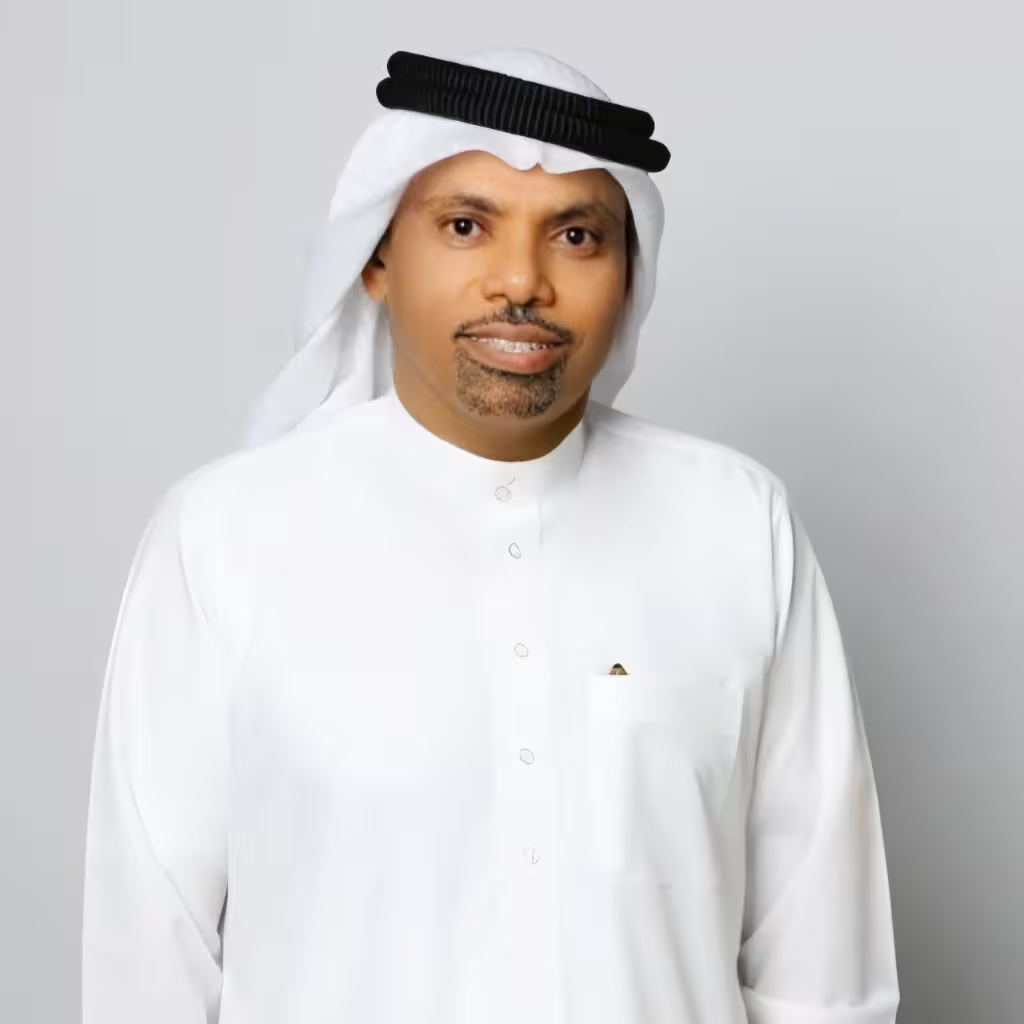
The success of a world-class event is rarely measured solely by its programme, attendance, or media coverage. Its true value lies in the experience it creates, the emotions it inspires, and the memories it leaves behind long after the final ceremony concludes. For Dr. Abdulla Ahmad Faraj, every major event represents an opportunity to tell a story, one that reflects the heritage, values, and ambitions of the United Arab Emirates while delivering an experience worthy of an international audience.
Throughout his leadership at the Dubai Camel Racing Club, Dr. Faraj has played a pivotal role in transforming the accompanying events surrounding the Club’s flagship festivals into comprehensive cultural experiences that extend far beyond sporting competition. His contribution has focused on developing integrated programmes that combine heritage, hospitality, institutional excellence, strategic partnerships, media engagement, tourism, and community participation into one unified visitor journey.
Among the most distinguished examples are the Dubai Crown Prince Camel Racing Festival and the Al Marmoom Heritage Camel Racing Festival, two of the UAE’s most prestigious heritage events. While the races themselves celebrate centuries-old traditions, Dr. Faraj has worked to ensure that every accompanying activity reinforces the cultural significance of these occasions. Through carefully curated heritage exhibitions, cultural performances, VIP hospitality programmes, sponsor activations, educational initiatives, media experiences, and visitor engagement activities, the festivals have evolved into internationally recognized celebrations of Emirati identity.
His approach begins with a simple principle: every visitor should leave with a deeper understanding of the UAE than when they arrived. Whether welcoming senior government officials, members of the diplomatic community, international media, strategic partners, tourists, or families attending for the first time, every detail is designed to reflect the values of generosity, authenticity, professionalism, and excellence that define Emirati culture.
Delivering experiences of this scale requires extraordinary coordination across numerous stakeholders. Government authorities, security services, protocol teams, hospitality providers, tourism organizations, sponsors, broadcasters, media professionals, volunteers, and operational teams must work together seamlessly. Dr. Faraj has consistently demonstrated the ability to unite these diverse contributors under a shared vision, ensuring that every element supports one coherent institutional experience while maintaining the highest standards of organization.
Media has become an essential part of this experience. Under his direction, media operations have evolved beyond event coverage into immersive storytelling platforms that bring audiences closer to the heritage, traditions, and people behind camel racing. Live broadcasting, multilingual content, digital storytelling, documentary production, social media engagement, and real-time communication strategies have significantly expanded the festivals’ international reach while preserving their cultural authenticity.
Visitor experience has also become a strategic priority. Dr. Faraj believes that modern audiences seek participation rather than observation. Consequently, the accompanying events have increasingly emphasized interactive cultural experiences that encourage visitors to engage directly with Emirati traditions. These initiatives strengthen cultural understanding while creating lasting emotional connections between international audiences and the heritage of the United Arab Emirates.
Another defining element of his work has been the successful integration of strategic partners into the overall visitor experience. Rather than limiting sponsorship to brand visibility, Dr. Faraj has developed collaborative activations that create value for partners while enhancing the quality of the event itself. This balanced approach has strengthened long-term relationships with stakeholders while ensuring that commercial participation complements rather than competes with the cultural identity of the festivals.
Looking ahead, Dr. Faraj envisions an even more immersive future for heritage events. Emerging technologies, artificial intelligence, interactive digital platforms, and smart visitor experiences will provide new opportunities to engage audiences from around the world. However, he remains firmly committed to ensuring that technology enhances, not replaces, the authentic human and cultural experiences that define these festivals.
For Dr. Faraj, every event represents far more than successful execution. It is an opportunity to strengthen national identity, preserve living heritage, promote cultural diplomacy, support tourism, inspire future generations, and showcase the United Arab Emirates as a nation where tradition and innovation exist in perfect harmony. Through this philosophy, he has helped transform the accompanying events of the Dubai Camel Racing Club into internationally admired experiences that continue to leave a lasting impression on everyone who attends.
Innovation Guided by Human Values
Innovation has become one of the defining forces shaping modern institutions. Artificial intelligence, digital transformation, automation, predictive analytics, and emerging technologies are fundamentally changing the way organizations communicate, operate, and engage with society. Yet for Dr. Abdulla Ahmad Faraj, innovation has never been an objective in itself. Its true purpose is to strengthen people, preserve culture, and create lasting institutional value.
Throughout his leadership journey, Dr. Faraj has consistently embraced innovation while remaining firmly anchored in the timeless values that define the United Arab Emirates. He believes that technological advancement should never replace identity; rather, it should empower institutions to preserve their heritage more effectively, communicate more intelligently, and serve their communities more efficiently.
This philosophy has guided his approach at the Dubai Camel Racing Club, where digital transformation has been introduced as a strategic enabler rather than a technological trend. Under his direction, modern communication platforms, integrated digital marketing strategies, advanced media production, audience analytics, and innovative storytelling have strengthened the Club’s ability to engage local and international audiences while preserving the authenticity of camel racing as one of the nation’s most treasured cultural traditions.
Dr. Faraj also recognizes that the future of institutional excellence will increasingly depend upon the responsible adoption of Artificial Intelligence (AI). He believes AI possesses enormous potential to transform communications, visitor engagement, operational planning, data analysis, media production, and decision-making. However, he is equally convinced that artificial intelligence must always remain guided by human judgment, ethical responsibility, and cultural awareness.
This balanced perspective has shaped his long-term vision for the future of institutional development. Rather than viewing technology as a replacement for human expertise, he sees it as a strategic partner capable of enhancing creativity, improving efficiency, and supporting better decision-making. In his view, innovation succeeds only when it reinforces trust, strengthens relationships, and protects the values upon which institutions are built.
His leadership philosophy has also encouraged a culture of continuous learning. Dr. Faraj believes that organizations cannot embrace innovation unless their people are empowered to evolve alongside it. Investing in professional development, encouraging new ideas, fostering collaboration across disciplines, and creating an environment where innovation is welcomed have become essential components of his management approach. Sustainable transformation, he believes, begins with people, not technology.
Within the context of heritage sports, this philosophy carries particular significance. Camel racing represents centuries of Emirati history and cultural identity. As digital platforms continue to reshape how audiences consume information and experience events, Dr. Faraj has consistently advocated for solutions that amplify authentic stories rather than replacing them. Virtual experiences, immersive digital content, multilingual communication, intelligent audience engagement, and AI-assisted media production all offer valuable opportunities, but only when they serve the larger purpose of protecting cultural authenticity.
Looking ahead, Dr. Faraj envisions an even more immersive future for heritage events. Emerging technologies, artificial intelligence, interactive digital platforms, and smart visitor experiences will provide new opportunities to engage audiences from around the world. However, he remains firmly committed to ensuring that technology enhances, not replaces, the authentic human and cultural experiences that define these festivals.
His own leadership reflects this principle. Every innovation introduced under his direction is evaluated not only by its technical capability but also by its contribution to institutional purpose, stakeholder value, and long-term sustainability. Technology, in his philosophy, is successful only when it improves people’s lives while preserving the identity that gives institutions their meaning.
For Dr. Faraj, the future belongs neither to tradition alone nor to technology alone. It belongs to organizations capable of bringing both together in harmony. When innovation is guided by human values, heritage becomes stronger, institutions become more resilient, and progress becomes both sustainable and meaningful. This belief continues to define his leadership and remains central to his vision for the future of the Dubai Camel Racing Club and the preservation of Emirati heritage on the global stage.
Values That Never Compromise
Leadership philosophies evolve with changing markets, emerging technologies, and shifting global priorities. Values, however, should remain constant. For Dr. Abdulla Ahmad Faraj, integrity, trust, respect, accountability, and service have never been negotiable. Throughout more than two decades of executive leadership, these principles have provided the foundation upon which every strategic decision, institutional initiative, and professional relationship has been built.
Dr. Faraj believes that sustainable leadership is not defined by authority or position, but by character. Institutions earn credibility only when their leaders consistently demonstrate honesty, fairness, transparency, and responsibility. Reputation, in his view, is accumulated over years of principled conduct and can never be replaced by short-term success or public recognition.
This conviction has guided his leadership at the Dubai Camel Racing Club, where preserving public trust has always taken precedence over pursuing immediate results. Whether managing strategic partnerships, leading media operations, coordinating high-profile heritage festivals, or representing the institution before national and international audiences, he has remained committed to maintaining the highest standards of professionalism and ethical leadership.
Integrity has also shaped his approach to communication. Dr. Faraj believes that institutional credibility depends upon honest dialogue, accurate information, and responsible storytelling. Every communication strategy, public statement, and media initiative should strengthen confidence rather than simply attract attention. In an era where information travels instantly across digital platforms, he considers credibility to be one of an institution’s most valuable strategic assets.
Respect forms another pillar of his leadership philosophy. Throughout his career, Dr. Faraj has demonstrated deep respect for the cultural heritage of the United Arab Emirates, for the people he works alongside, and for the diverse stakeholders who contribute to institutional success. This respect extends equally to government entities, strategic partners, international organizations, media professionals, visitors, and the wider community. He believes that meaningful collaboration can only flourish when relationships are built upon mutual appreciation and shared values.
Accountability has remained equally important. Dr. Faraj accepts that leadership carries a responsibility not only for success but also for continuous improvement. Every challenge presents an opportunity to learn, refine processes, and strengthen institutional performance. Rather than assigning blame, he encourages a culture where transparency, evaluation, and constructive feedback become essential drivers of organizational growth.
His commitment to service is reflected in his belief that leadership exists to create opportunities for others. Whether supporting colleagues, mentoring young professionals, strengthening partnerships, or contributing to national initiatives, Dr. Faraj has consistently sought to build environments where people are empowered to grow, collaborate, and succeed. He views institutional leadership as a responsibility to serve the organization, its stakeholders, and the broader community before serving personal ambition.
These values have become increasingly significant as organizations navigate rapid technological transformation. While artificial intelligence, digital innovation, and automation continue to reshape modern institutions, Dr. Faraj remains convinced that no technology can replace the qualities that define ethical leadership: integrity, empathy, sound judgment, humility, and respect for people. Innovation, he believes, must always be guided by principles that protect human dignity and preserve institutional trust.
Inspired by the visionary leadership of the United Arab Emirates, Dr. Faraj has consistently embraced a culture of excellence, continuous learning, and national responsibility. He believes that preserving heritage while embracing innovation is not simply an organizational objective but a national duty, one that requires leaders to remain faithful to the values that have shaped the country’s remarkable development.
Ultimately, Dr. Faraj measures success not by awards, titles, or international recognition, but by the confidence others place in his leadership. Trust, once earned, becomes a lifelong responsibility. For him, this responsibility continues to guide every decision, every partnership, and every initiative, ensuring that institutional excellence is always accompanied by integrity, purpose, and respect for the values that define both the organization and the nation it represents.
Lessons Earned Through Experience
Leadership is often taught through theories, models, and management frameworks. Experience, however, teaches lessons that no classroom can fully replicate. After more than two decades of executive leadership, Dr. Abdulla Ahmad Faraj believes that the most valuable lessons are not learned from success alone, but from the responsibility of leading people, preserving institutions, and making decisions whose impact extends far beyond the present moment.
Among the most profound lessons he has learned is that trust is the true currency of leadership. Financial resources can be rebuilt, strategies can be redesigned, and technologies can be replaced. Trust, once lost, is far more difficult to recover. Every decision throughout his career has therefore been guided by a commitment to transparency, accountability, and consistency principles that continue to shape every professional relationship he builds.
Another defining lesson has been the importance of patience. In an age where organizations often seek immediate results, Dr. Faraj has learned that sustainable institutional success is built gradually through discipline, perseverance, and long-term thinking. The strongest institutions are not created overnight; they evolve through continuous improvement, shared commitment, and a willingness to invest in the future rather than pursuing short-term recognition.
His experience has also reinforced the importance of listening before leading. Throughout his career, he has worked alongside government officials, strategic partners, media professionals, international organizations, operational teams, and community stakeholders. Each perspective has enriched his understanding of leadership and strengthened his belief that the best decisions emerge through collaboration rather than individual authority. Listening, he believes, is not a sign of uncertainty but a demonstration of respect and confidence.
Working in the field of heritage preservation has taught him another invaluable lesson: progress should never come at the expense of identity. Modernization is essential, but its purpose should be to strengthen cultural heritage rather than replace it. This philosophy has guided his leadership in transforming communication, marketing, partnerships, and visitor experiences while ensuring that camel racing remains an authentic reflection of Emirati culture and national values.
Dr. Faraj has likewise come to appreciate that leadership is ultimately about developing people. Throughout his professional journey, he has consistently invested in empowering colleagues, encouraging innovation, sharing knowledge, and creating opportunities for others to grow. He believes that a leader’s greatest achievement is not the number of projects completed, but the number of capable leaders developed along the way.
One of the most significant influences on his leadership philosophy has been the visionary leadership of the United Arab Emirates. Inspired by the nation’s commitment to excellence, innovation, and sustainable development, Dr. Faraj has sought to reflect these principles in his own professional journey. He believes that the UAE has demonstrated to the world that preserving national identity and embracing global progress are not opposing objectives but complementary forces capable of driving remarkable institutional success.
This inspiration has also reinforced his personal commitment to continuous learning. Despite years of executive experience and international recognition, Dr. Faraj remains convinced that leadership is a lifelong journey of growth. Every new partnership, every major event, every institutional challenge, and every emerging technology presents another opportunity to expand knowledge, refine judgment, and strengthen organizational capability.
Perhaps the greatest lesson experience has taught him is that leadership is measured by the confidence others continue to place in you over time. Titles may change, responsibilities may evolve, and recognition may come and go, but enduring influence is built through integrity, consistency, humility, and the ability to inspire others to believe in a shared vision.
Looking back on more than twenty years of leadership, Dr. Faraj does not measure his career solely by awards, milestones, or professional achievements. Instead, he reflects upon the institutions strengthened, the partnerships built, the people empowered, and the cultural heritage preserved. These are the achievements that endure beyond any individual accomplishment and continue to shape the legacy of responsible leadership.
For Dr. Faraj, experience has confirmed one timeless truth: the finest leaders are remembered not because they sought recognition, but because they left their institutions, their communities, and their nations stronger than they found them. It is this principle that continues to guide every decision he makes and every vision he pursues for the future.
A Legacy Written in Impact
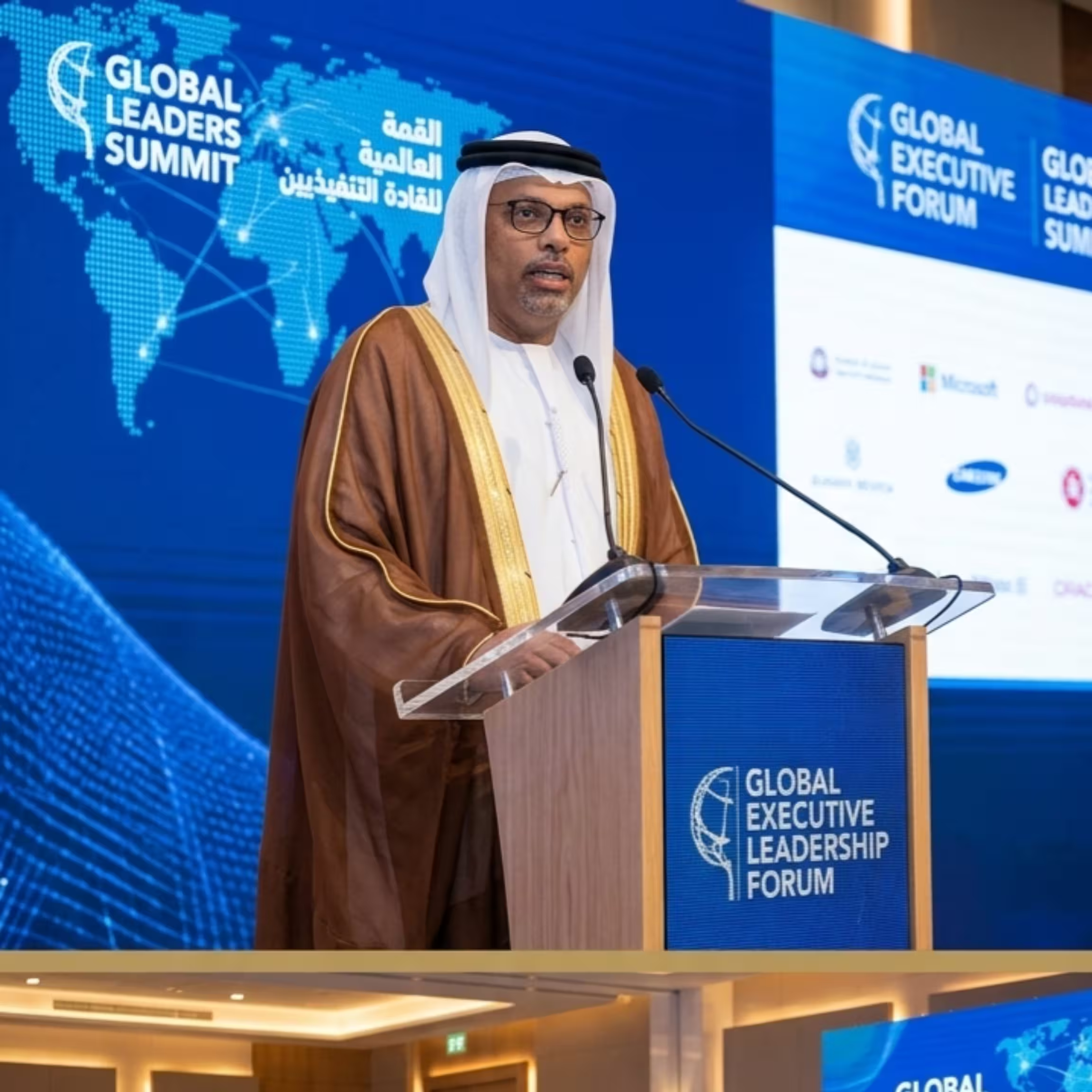
When asked how he hopes future generations will remember his professional journey, Dr. Abdulla Ahmad Faraj offers a response that reflects the philosophy that has guided his entire career. He does not aspire to be remembered solely for the positions he has held, the awards he has received, or the recognition that has accompanied his work. Instead, he hopes his legacy will be measured by the institutions he strengthened, the people he inspired, and the cultural heritage he helped preserve for generations to come.
Throughout more than two decades of executive leadership, Dr. Faraj has remained committed to a purpose that extends beyond organizational success. His vision has consistently focused on ensuring that the Dubai Camel Racing Club continues to serve not only as a leading sporting institution, but also as a global ambassador for Emirati culture, national identity, and heritage preservation. Every strategic initiative, every partnership, every communication campaign, and every international collaboration has contributed to that broader mission.
One of the defining aspects of his legacy has been his ability to demonstrate that heritage and innovation are not competing forces. Under his leadership, traditional values have been strengthened through modern communication, strategic partnerships, digital transformation, and world-class visitor experiences. His work has shown that cultural preservation becomes even more powerful when supported by responsible innovation and visionary institutional leadership.
His contribution has extended beyond media and marketing. By enhancing the accompanying experiences of the Dubai Crown Prince Camel Racing Festival and the Al Marmoom Heritage Camel Racing Festival, he has helped transform these events into internationally respected cultural platforms that celebrate the identity of the United Arab Emirates while welcoming audiences from across the world. These experiences have strengthened cultural diplomacy, promoted heritage tourism, and reinforced Dubai’s position as a global destination for authentic cultural experiences.
Equally significant has been his commitment to building relationships that endure. The long-standing international partnership with a German sports institution, together with numerous collaborations involving government entities, corporate organizations, media partners, and international stakeholders, reflects a leadership philosophy founded on trust, mutual respect, and shared purpose. For Dr. Faraj, every successful partnership contributes not only to institutional growth but also to the creation of lasting bridges between cultures and nations.
Looking toward the future, Dr. Faraj believes that the next chapter of institutional leadership will be defined by organizations capable of combining artificial intelligence, digital transformation, sustainability, and human-centered leadership without compromising their cultural identity. His vision is to continue advancing the role of technology as an enabler of institutional excellence while ensuring that heritage, ethics, and human values remain at the heart of every innovation.
Inspired by the visionary leadership of the United Arab Emirates, he continues to pursue excellence with the conviction that continuous improvement is both a professional responsibility and a national obligation. The UAE’s commitment to innovation, ambition, and global competitiveness has profoundly influenced his own leadership philosophy, reinforcing his belief that the preservation of heritage and the pursuit of progress are complementary objectives that together shape a stronger future.
For Dr. Faraj, leadership is ultimately an act of stewardship. Institutions do not belong to one generation alone; they are entrusted to today’s leaders so they may be strengthened for those who follow. This perspective continues to influence every strategic decision he makes, ensuring that immediate achievements contribute to long-term institutional resilience and sustainable national development.
As global institutions continue to navigate an era of unprecedented transformation, Dr. Faraj’s journey offers a compelling example of leadership rooted in purpose rather than position, influence earned through integrity rather than visibility, and progress guided by values rather than convenience. His story demonstrates that enduring leadership is not defined by the speed with which change is achieved, but by the wisdom with which it is guided.
Ultimately, Dr. Abdulla Ahmad Faraj’s legacy is not simply one of professional accomplishment. It is a legacy of preserving a nation’s heritage while preparing it confidently for the future; of building institutions that inspire trust; of creating partnerships that transcend borders; and of demonstrating that authentic leadership leaves its greatest mark not on history books, but on the lives of people, the strength of institutions, and the identity of a nation.
His journey continues not as the pursuit of recognition, but as an enduring commitment to ensuring that the rich heritage of the United Arab Emirates remains vibrant, relevant, and admired by generations across the world.
About Dr. Abdulla Ahmad Faraj
Dr. Abdulla Ahmad Faraj is an accomplished executive leader with more than two decades of experience in media, strategic marketing, corporate communications, strategic partnerships, business development, and major event management. He currently serves as Director of Media, Marketing, Partnerships & Events at the Dubai Camel Racing Club, where he has played a pivotal role in strengthening one of the United Arab Emirates’ most respected heritage institutions while advancing its international reputation through innovation, strategic communication, and institutional excellence.
Throughout his distinguished career, Dr. Faraj has championed a leadership philosophy that harmonizes heritage preservation with modern innovation. Under his strategic direction, the Dubai Camel Racing Club has expanded its global visibility through integrated media strategies, digital transformation, international partnerships, destination marketing, and world-class communication initiatives that celebrate the rich cultural heritage of camel racing while engaging audiences across the world.
Among his most notable contributions has been the development of the accompanying events surrounding the Dubai Crown Prince Camel Racing Festival and the Al Marmoom Heritage Camel Racing Festival. By integrating heritage, tourism, hospitality, media, government collaboration, strategic partnerships, and visitor engagement, he has helped transform these prestigious festivals into internationally recognized cultural experiences that showcase the values and identity of the United Arab Emirates.
Dr. Faraj has also been instrumental in building sustainable partnerships with government entities, multinational organizations, corporate sponsors, tourism authorities, educational institutions, and international sporting organizations. His long-standing collaboration with a leading German sports club, continuing successfully for more than a decade, stands as a distinguished example of cultural diplomacy, strengthening international understanding while promoting Emirati heritage throughout Europe.
Recognized for his strategic vision and institutional leadership, Dr. Faraj has received numerous regional and international recognitions celebrating excellence in media, strategic marketing, leadership, and heritage preservation. These recognitions reflect not only his personal achievements but also the continued success and international standing of the institutions and initiatives he has helped develop.
An advocate of responsible digital transformation, Dr. Faraj believes that artificial intelligence and emerging technologies should enhance human capability rather than replace it. His vision for the future focuses on building intelligent, resilient institutions that combine technological innovation with ethical leadership, cultural authenticity, and sustainable development.
At the heart of Dr. Faraj’s leadership philosophy lies a simple yet enduring belief: institutions achieve their greatest success when innovation is guided by values, partnerships are built on trust, and leadership is measured by the positive impact it leaves on people, culture, and society.
Today, Dr. Abdulla Ahmad Faraj continues to work toward strengthening the global profile of Emirati heritage, expanding international collaboration, developing future-ready institutions, and ensuring that the legacy of camel racing remains a living symbol of the United Arab Emirates’ history, identity, and vision for generations to come.
A Legacy Written in Impact
Throughout his distinguished career, Dr. Abdulla Ahmad Faraj’s contribution has been recognized by respected regional and international institutions that celebrate excellence in leadership, strategic communication, institutional development, and the preservation of cultural heritage.
Among these are awards, recognitions, selections, and features from the Dubai Sports Council, MEA Business Awards, The BIZZ Awards, Global Excellence & Leadership Awards, White Page International, Business Fame, CIO Today, and several other internationally respected platforms.
Adding a distinguished dimension to these recognitions, Dr. Faraj was bestowed the honorary title of “Ambassador Extraordinary” by the Arab Academy of Media Arts in the Arab Republic of Egypt, in recognition of his contributions and professional journey in media, strategic communication, and the advancement of institutional and cultural initiatives.
His journey was further honored with the conferral of an Honorary Doctorate from Kennedy Baptist University, representing another significant recognition of his leadership, professional accomplishments, and sustained contribution across the fields of media, strategic marketing, institutional development, and cultural heritage.
While these honors—including the title of Ambassador Extraordinary, the Honorary Doctorate, and the numerous regional and international awards and recognitions—reflect the impact of his professional journey, Dr. Faraj has always regarded them not merely as personal achievements, but as a testament to the collective success of dedicated teams, visionary leadership, and institutions committed to excellence.
Yet, if there is one legacy he hopes will endure beyond every award, title, or recognition, it is the legacy of preserving a nation’s heritage while preparing it confidently for the future.
His journey demonstrates that authentic leadership is measured not by the prominence of one’s profile, but by the strength of the institutions one helps build, the opportunities created for future generations, and the positive impact left on society.
As the United Arab Emirates continues its remarkable journey toward global leadership, Dr. Abdulla Ahmad Faraj remains committed to contributing to that vision, ensuring that Emirati heritage continues to inspire the world through innovation, integrity, strategic partnerships, and purposeful leadership.