TheCEOVerse • Digital Edition
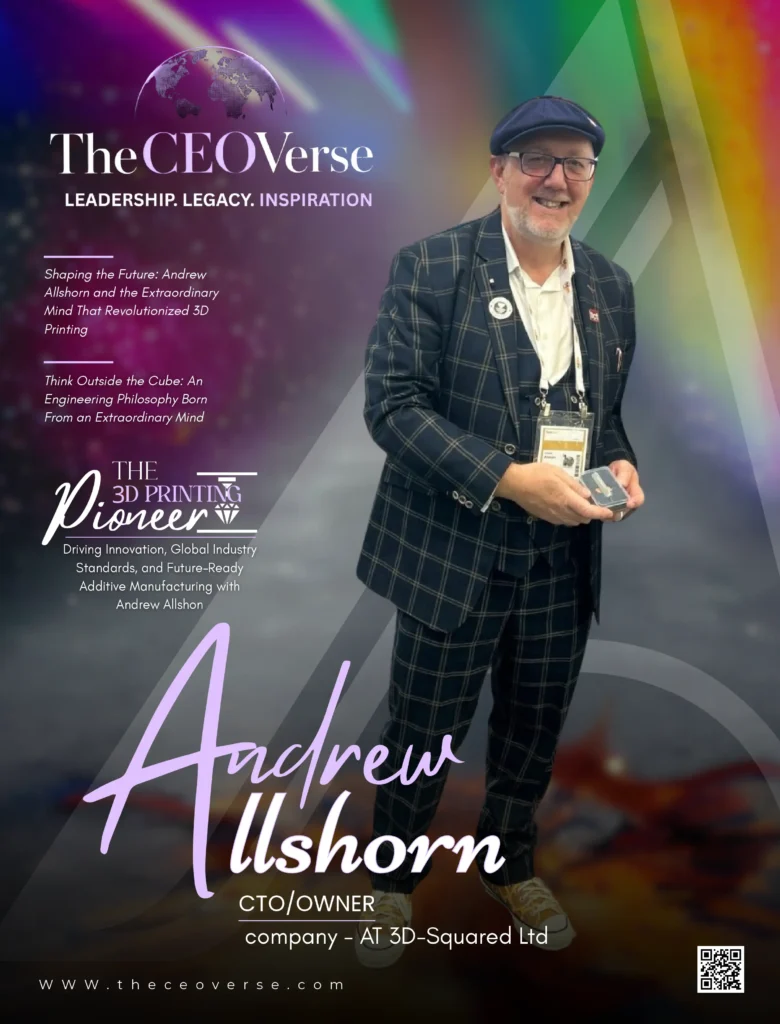
“The 3D Printing Pioneer: Driving Innovation, Global Industry Standards, and Future-Ready Additive Manufacturing with Andrew Allshorn”
Cover story
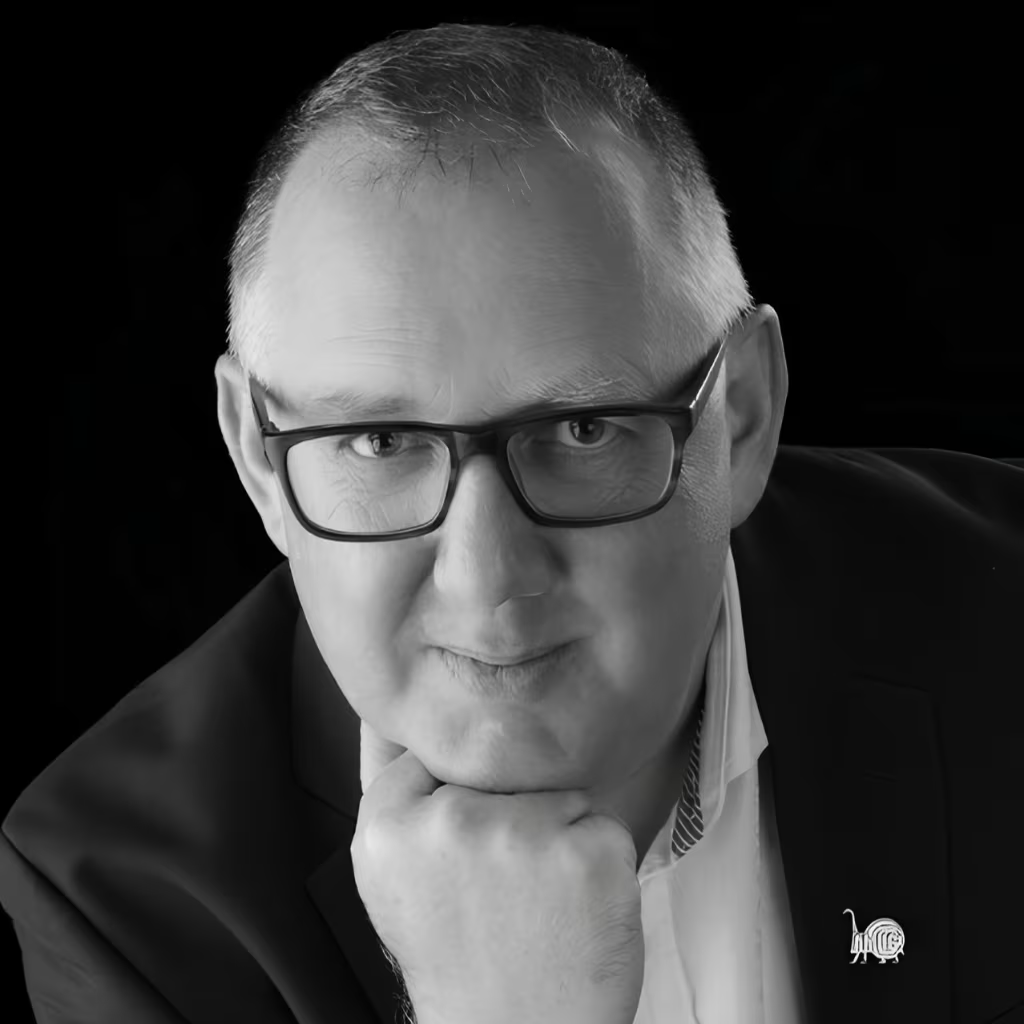
Andrew Allshorn
Featured Profile - Andrew Allshorn
Shaping the Future: Andrew Allshorn and the Extraordinary Mind That Revolutionized 3D Printing
Entire industries are forged on the back of the restless, who look at a broken world and refuse to let it rest. They are the quiet architects of commerce, trading their own finite days to build empires out of dust and desire. Those people may not have the loudest voice in the room, but they are the ones everyone eventually finds themselves calling when a problem refuses to be solved by conventional means. Andrew Allshorn has spent more than three decades being that person for additive manufacturing. Today he carries titles that read like a roll call of the industry’s own history. Former Vice President of the Additive Manufacturing Users Group (AMUG), DINO Award recipient, advisor to AMUK, 3DPIndustry, and Women in 3D Printing (Wi3DP), and yet his story doesn’t begin in a boardroom or a lab. It begins in a small town in North Wales, with a boy who preferred the company of a sketchbook to the company of other children, and who had no idea that his mind worked differently until he was 57 years old. This is the story of how that boy became a pioneer.
A Childhood Built With Hands and Pencils
Andrew was raised in a family where making things wasn’t a hobby, it was simply how life worked. His grandfather, his father, and later his younger brother all worked in the building trade, and from an early age, Andrew was pulled into that world of measuring, planning, and constructing. By fifteen or sixteen, he wasn’t just helping his father renovate the family home, he was drawing up the plans for the extension himself, then picking up tools alongside his brother to help build it.
At the same time, something else was quietly forming. Long before he understood engineering or design as disciplines, Andrew could draw. Animals, birds, anything that caught his eye. It came to him with an ease he never had to work for. His mother remembers a boy who was content in his own company, quiet, methodical, simply getting on with things by himself. It’s a description that, decades later, would take on a much deeper meaning.
School told a different story about him than the one that would eventually play out. He excelled at everything hands on. Including woodwork, engineering drawing, art, and held his own in mathematics. But English defeated him again and again, no matter how many times he sat the exam. A headmistress once told him bluntly that without passing English, university simply wasn’t going to happen for him. It would be decades before Andrew understood why words on a page had always fought him so hard, but even without that explanation, he refused to let the prediction define him.
The Art School Rebellion That Built an Engineer
At seventeen, drawn by his natural pull toward art, Andrew enrolled in a foundation course. A full year of creative chaos that ranged from graphic design and fine art to sculpture, ceramics, and the simple joy of throwing paint at a canvas. It was here that he found the discipline that would shape everything after. Product Design, a field that let him fuse his artistic instinct with the technical precision of engineering drawing he’d already mastered at home.
When he told his father he was heading to art school, the response was exactly what you’d expect from a family of builders. “How are you going to make a living painting? You’ll be cutting your ear off next.” Andrew didn’t cut off an ear, but he did get it pierced, much to his father’s horror. It was a small act of defiance that said everything about the young man he was becoming. Respectful of where he came from, but unwilling to be boxed in by it.
Despite never passing that English exam, Andrew secured a place at his second choice university and went on to complete a degree in 3D Design. Working across wood, metal, and plastics, at Wolverhampton School of Art & Design. He wasn’t interested in being an artist detached from reality. Everything he designed had to actually work, had to be something that could be manufactured and used. One of his tutors, sensing this practical streak beneath the creative talent, told him as he left, “If you don’t get a job as a designer, you will as a model maker. Your eye for detail and perfection is amazing.” That single observation turned out to be prophetic.
The Machine That Changed Everything
Andrew’s first job out of university was as a designer at a traditional model making company. The kind of trade built on painstaking, hand built precision. It was here, almost by accident, that he stumbled into the technology that would define the rest of his life.
In 1993, Andrew became the first person at a university in the UK to operate a Rapid Prototyping machine, what the world now calls 3D printing. The machine was a 3D Systems SLA 250/40, installed at the University of Liverpool. Remarkably, Andrew still owns that very machine today, and after years of his own modifications, it still runs. It’s a detail that says something important about who he is. Not someone who simply uses technology and moves on, but someone who forms a lasting relationship with the tools of his craft.
Two years later, in 1995, that early expertise earned him the role of Senior Applications Engineer at 3D Systems. The company that had, quite literally, invented the technology he’d fallen into by chance. Within a year, Andrew had risen to become the company’s senior Applications Engineer for Europe, tasked with introducing stereolithography machines into some of the most demanding industries in the world. Automotive, aerospace, prototyping bureaus, and Formula 1. He worked directly with OEMs and race teams to develop advanced applications for a process that was still, in the eyes of most of the world, closer to science fiction than industrial reality.
And then there was the detail that still seems to astonish him when he tells it. He ended up working for Chuck Hull, the very inventor of 3D printing. For a young designer from North Wales who had wandered into this field through a model making workshop, it was a full circle moment he couldn’t believe.
When the Job Became the Wound
Success in a role, however, doesn’t guarantee a healthy environment. And Andrew’s departure from what he once thought would be a job for life came from somewhere painful. While at 3D Systems, he found himself the target of a manager who made a habit of singling people out. Andrew’s turn came in a particularly cruel form. He was ordered to drive four and a half hours to a customer site on a Sunday, the day before his wife was due to give birth. When Andrew explained the situation to the customer upon arriving, the customer’s response cut straight to the point, “Why the hell are you here in the first place then?”
That moment became the line in the sand. Andrew left the company, moving into his first venture as a business owner. But the pattern repeated in a worse form. His new business partner turned out to be even more difficult than the manager he’d escaped, and after three years, Andrew experienced a major breakdown.
It was a turning point that reshaped how he would operate for the rest of his career. He made a decision then that he has held to ever since. He would never allow himself to be placed in that position again. And he would never stand by silently while he watched it happen to someone else.
A Diagnosis That Rewrote His Own History
For most of his adult life, Andrew understood himself as simply a little different, a quiet loner who loved music and fashion. Who once stood out in a small Welsh town by wearing bright, colourful clothes and red patent leather shoes without a second thought about what anyone made of it. His close friendships tended to form with fellow artists. People who, like him, were seen by others as weird but who never let that perception touch how they lived.
Then, at the age of 57, Andrew was diagnosed as neurodivergent, specifically with AuDHD, the combined presentation of Autism and ADHD. He describes the years since as an emotional rollercoaster. A period of looking back across an entire lifetime and finally understanding why certain things had always been the way they were. It explained his preference for solitude. It explained, at long last, why English, and spelling in particular, had tormented him throughout his school years, despite excelling in nearly every other subject.
Rather than treat the diagnosis as something to quietly absorb, Andrew turned it outward. He became a vocal advocate for neurodivergent understanding, attending support groups, speaking openly about his experience, and using his platform in the additive manufacturing world to push for a more compassionate, less judgmental industry culture. When asked recently what the biggest challenge is for people with autism, his answer was immediate. “We trust everyone too much.” It’s a trait, he explains, not a flaw, one that has too often been exploited by people who recognised an openness they could take advantage of.
Think Outside the Cube: An Engineering Philosophy Born From an Extraordinary Mind
Ask Andrew what makes his professional approach distinct, and he doesn’t reach for a technical answer first. He reaches for his mind. For years, he has solved problems that stump the very customers he works with, across aerospace, motorsport, and medical applications. And he attributes this ability directly to an artistic mind. A willingness to move in any direction necessary to reach a solution, without attachment to a single correct method.
It’s this philosophy that gave birth to the company strapline that now defines his professional identity. Think Outside The Cube! Its a playful but pointed twist on the familiar cliché, tailored for an industry literally built around cubic build volumes and layer by layer geometry. Since his diagnosis, Andrew has come to see this problem solving instinct not as a personality quirk but as a direct consequence of being AuDHD. A neurological wiring that, far from holding him back, has become the very engine of his professional value.
Building AT 3D Squared From the Ground Up
In 2007, Andrew struck out to build something entirely his own. AT 3D Squared Ltd, based in North Wales, where he serves as CTO and Owner. The company was built on a simple but powerful premise that businesses adopting additive manufacturing needed more than just a machine. They needed a partner who understood the interplay between software, hardware, and materials, and who could translate that technical depth into practical, best practice results.
At 3D Squared’s client base grew to span some of the most demanding sectors imaginable, drawing on Andrew’s own decades of hands on relationships across automotive and aerospace to attract invitations to international events worldwide. The company’s approach was never just transactional. It offered a comprehensive service from machine acquisition and lease management to training and ongoing maintenance. Treating clients as long term partners in their additive manufacturing journey rather than one off customers.
That approach paid off publicly in 2011, when At 3D Squared received the Clogau Gold “Growth through Innovation” award at the Daily Post Achievement Wales Awards, following an earlier win at the Flintshire Business Awards. For a company built in North Wales rather than a major industrial hub, these wins were a statement. World class additive manufacturing expertise didn’t need to come from Silicon Valley or a multinational conglomerate. It could come from a business built on one man’s relentless curiosity and craftsmanship.

The DINO, the Ambassador, and the First European Vice President
If there is a single credential that additive manufacturing insiders recognise instantly, it’s the DINO Award. The Distinguished INnovator Operator honour bestowed by AMUG, the industry’s most respected user community. It is reserved for those with the deepest levels of AM expertise, combined with a demonstrated willingness to give that knowledge back to the community. In AMUG’s more than three decade history, fewer than 210 people have ever received it.
Andrew received his DINO Award in 2016, recognition for what the industry itself described as “tireless work in raising global awareness of AM” across three decades of seminars, training sessions, and knowledge sharing at every level of the field. A year later, in 2017, he was appointed AMUG’s European Ambassador, formally representing the organisation across the continent.
Then came a milestone with historical weight. In 2019, Andrew was elected Vice President of AMUG’s Board of Directors, becoming the first European ever to hold the position. He was re elected for a second term in 2021, serving through 2022 alongside a board that included some of the most recognised names in the additive manufacturing world. It was a role he approached not as a ceremonial honour, but as a working relationship with an entire global community he genuinely considered friends.
The Cost of Integrity
Not every chapter of Andrew’s leadership story is a straightforward tale of accolades. Being the first European Vice President came with a quieter, harder truth attached. Andrew never became AMUG’s president, a role many expected him to eventually step into. The reason wasn’t a lack of capability or support from the wider membership. It was because he refused to look away from wrongdoing.
Andrew has spoken about witnessing board members break their own organisation’s rules, watching people who had let positions of power distort their sense of purpose. In one particularly difficult episode, he reported an instance of sexual harassment to fellow board members, people he considered close friends and trusted as having the same integrity he held himself to. Only to watch them do nothing, sweeping the matter aside. For speaking up, Andrew was labelled toxic and rude by some of the very people whose conduct he had challenged.
He describes this strong, almost unshakeable sense of justice as a defining trait of being AuDHD. An inability to simply stay silent when something is wrong, regardless of the personal or professional cost. Looking back, Andrew is candid that being deliberately kept from the presidency, after giving so much of his life to the industry, was heartbreaking. But there is a quieter victory in the story too. The individuals responsible for the misconduct he challenged have since been removed from their positions. For Andrew, that outcome, however delayed, however costly to himself, mattered more than the title he never received.
A Life That Extends Far Beyond One Boardroom
Andrew’s influence in additive manufacturing was never confined to AMUG alone. Over the years, he has taken on advisory roles across a wide constellation of industry bodies. AMUK, 3DPIndustry, Women in 3D Printing (Wi3DP), and TCT. Lending his expertise to organisations working from different angles to strengthen and diversify the additive manufacturing community. He has also served on the expert judging committee for the 3D Printing Industry Awards, evaluating the achievements of others in a field he has spent thirty years helping to build.
Alongside his industry service, Andrew has become a familiar face in education. As a lecturer at colleges and universities, and as a CREATE Education Ambassador, he has made it a personal mission to open doors for the next generation of designers and engineers. He set up a 3D Printing Club at his local high school, giving young people direct, hands on access to a technology that once required a university laboratory and a great deal of luck to encounter, as Andrew himself once experienced firsthand.
His passion for STEAM education even found an unexpected intersection with his early career in Formula 1. Decades after helping introduce 3D printing into the F1 industry through his work at 3D Systems, Andrew was approached by Ysgol Llywelyn, a local school, to sponsor its BAS Racing team for the F1 in Schools initiative. He didn’t hesitate. For Andrew, it was a chance to connect two threads of his life that had never technically touched before. His professional origin story and his enduring belief that young people deserve early exposure to the tools that will define their futures.
The People Who Shaped the Path
For all his independence, Andrew is quick to name the people who shaped him along the way. It started with Colin Edwards, his art teacher at high school, who believed in his talent before anyone else did. Ironically, even the headmistress who told him he’d never make it to university played a role. Her doubt became a quiet motivation to prove otherwise.
Within the additive manufacturing industry, Andrew credits a circle of mentors who guided his professional development. Professor William O’Neill, the late Graham Tromans, Professor Phil Dickens, Steve Deak, Dean Sheku Kamara, and Andy Christensen. Each, in different ways, helped sharpen his understanding of both the technology and the industry built around it.
And when it comes to partnerships, Andrew points to one relationship above all others. His long running collaboration with Pat Warner of Benetton, Renault, and later Alpine Racing’s Formula 1 teams. It’s a partnership built on shared instinct. Both push limits, and both treat failure not as an ending but as simply another step in the process of finding a solution. In an industry where so many people, in Andrew’s own words, want to be your partner because they want to use you for their own benefit, a genuine, like minded collaboration like this one stands out as rare and valuable.
Shaping the Next Generation
For someone who has spent thirty years at the frontier of a transformative technology, Andrew’s advice to the next generation is disarmingly simple. Follow your passion first, and let the career follow from there. It’s advice he doesn’t just hand out, he lives it every time he steps in front of students at the 3D Printing Club he founded, or lectures at a college or university. Getting paid to do something you love, he argues, is the closest thing to a guarantee of a fulfilling working life.
He hopes his own story, including the flaws, setbacks, and all, encourages people to be a little more understanding of others, and to remember that the bigger picture always matters more than any one individual’s ego or position. He speaks often about the importance of sharing knowledge freely with the next generation, of never judging people by their surface presentation, and of holding firmly to one’s morals and integrity, no matter how much pressure is applied to abandon them.
The Man Behind the Machine
Strip away the titles. The DINO Award, the AMUG Vice Presidency, the advisory board seats, the decades of aerospace and Formula 1 work. And what remains is a strikingly consistent thread running through Andrew Allshorn’s entire life. A refusal to be anything other than exactly who he is. The boy who wore red patent leather shoes in a small Welsh town where nobody else did. The design student who pierced his ear against his father’s wishes. The board member who reported wrongdoing even when it cost him the presidency he’d earned the right to hold. The 57 year old who received a diagnosis that finally explained a lifetime of quiet difference, and chose to speak about it publicly rather than keep it hidden.
Andrew Allshorn didn’t build a career in additive manufacturing by following a conventional path. He built it, quite literally, by thinking outside the cube. By trusting an unconventional mind to find solutions no one else could see, by treating every setback as data rather than defeat. And by insisting, again and again, that kindness and integrity matter more than any title he might have won or lost along the way.
His final piece of advice sums up the philosophy that has carried him from a model making workshop in the early 1990s to the highest honours his industry can bestow. Be kind, because you never know what someone else is carrying. Keep your feet on the ground. And never, under any circumstances, let anyone talk you out of who you really are.