
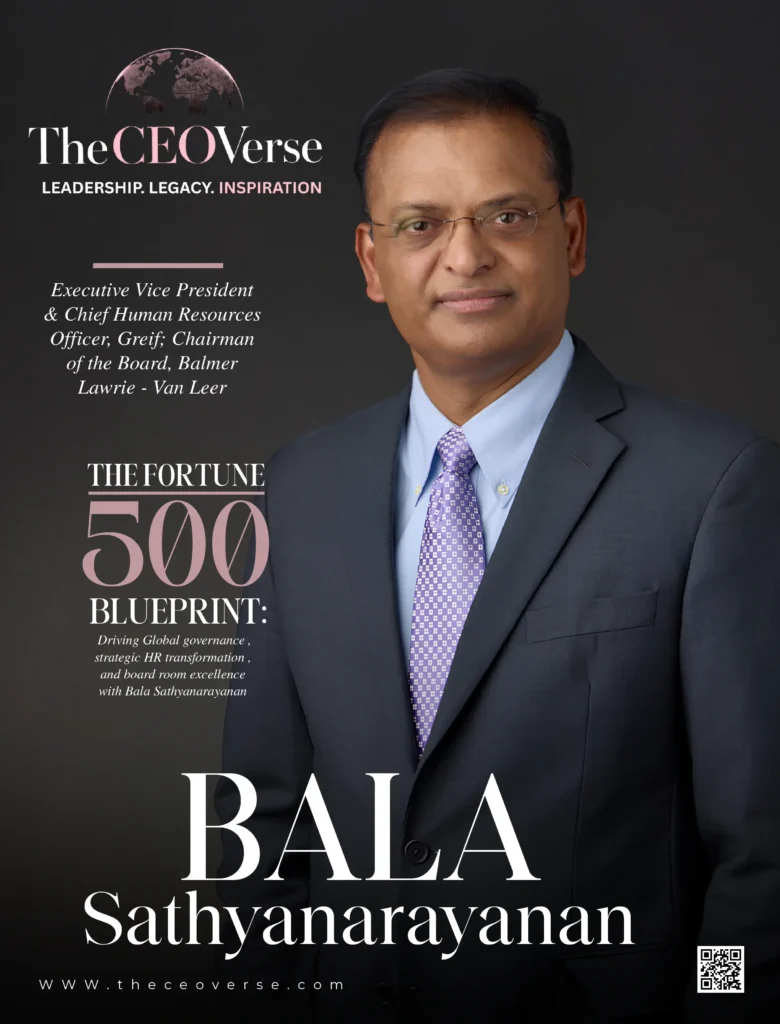
TheCEOVerse • Digital Edition
“The Fortune 500 Blueprint: Driving Global governance , strategic HR transformation , and board room excellence with Bala Sathyanarayanan”
Cover story
Bala Sathyanarayanan
Featured Profile - Bala Sathyanarayanan
Engineering the Future: How Bala V. Sathyanarayanan’s Early Roots Shaped an Enterprise Leader
Growing up in Chennai, the fourth largest city of India, Bala V. Sathyanarayanan’s path was shaped by a persistent curiosity, rather than following a conventional career plan, that greatly influenced his worldview. Why do some organizations outlive others? Why do some companies come crumbling down even after boasting the smartest manpower and elitest of resources? Having pursued his education in Electronics and Communications Engineering, followed by an MBA at the University of Madras, his fascination towards such issues only deepened.
After joining United Technologies’ Otis Elevator Company as a graduate trainee, he experienced how a large multinational corporation actually functions, how decisions made in one place ripple out into dozens of others. Also including a stretch working out of Malaysia, this significant early exposure emboldened him with the knowledge and expertise to accelerate the growth of subsequent organizations in his professional journey.
Eventually becoming a distinguished part of industry titans like Coca Cola, Hewlett Packard, Xerox, and Greif, Bala V. Sathyanarayanan holds the position of the esteemed Chairman of Balmer Lawrie – Van Leer, and continues to inspire millions at a global stage. Even with the roles and the industries changing, the questions that he originally pondered never really escaped his mind.
Somewhere along the way, they hardened into a conviction: you cannot separate how a business performs from how its people perform, the two rise and fall together. And over the course of time, that simple belief kept expanding, until it became something much bigger than an HR philosophy. It became his whole perception of what leadership actually is, not a title or a function, but the discipline of pulling strategy, culture, people, and accountability together around one shared goal.
Building a Global Career
One of the most interesting things about Bala V. Sathyanarayanan’s career is that he didn’t stay confined to one place or put himself under a fixed label, he diversified his areas of expertise and redirected his professional trajectory whenever the hour called for it. From Otis, he moved to Coca Cola.
Then to Polaris Software, where he ran HR and management services. Then to Avaya. Then a long stretch at Hewlett Packard, leading HR for its Americas Enterprise Business. Followed by Xerox, where he eventually rose to Executive Vice President for Human Resources and Business Transformation, overseeing a technology business that stretched across roughly 145 countries. Each move may have seemed like a fresh start on paper, but in practice, it was the same puzzle seen from a different angle. Being in close proximity to CEOs, senior leadership, and boards consistently with every single one of his roles, Sathyanarayanan kept running into the same hard truth again and again, the decisions that actually matter almost never live inside one neat function.
They’re trade offs, growth against risk, speed against control, performance against sustainability, what shareholders want against what stakeholders trust. Somewhere across those years, his job evolved into an entirely new sculpture. He stopped looking at himself as someone operating HR functions in the room, and started to see his real value as a person who was helping other leaders see the whole system, asking the question nobody else was asking, and finding clarity before complexity took over.
He doesn’t consider it as a job title, he calls it a discipline. And he’ll tell you he didn’t build it alone but rather it was sharpened by mentors along the way who taught him something quite simple but easy to forget: authority and leadership are not the same thing.
The Weight of the Hard Calls
The toughest stretches of his career aren’t a part of some dramatic story about a crisis he single handedly fixed, but something much quieter and more familiar to anyone who has ever had to deal with people. Those moments when everyone around the table demands something reasonable, and yet you can’t provide each individual with what they want. The business needs to move fast, the people need time to understand why.
Someone has to be held accountable, but that someone also deserves empathy. The easier answers are very often the wrong ones, because the harder solutions are those which rightfully protect the institution ten years down the line. There’s no obvious “right call” at those instances, and that’s exactly the point. It was the absence of a plainly unmistakable answer, over and over, that slowly reshaped how Bala V. Sathyanarayanan thinks about leadership. He came to a simple conclusion that courage isn’t just making the difficult decision, it’s sitting with the full weight of what that decision costs, saying so honestly, and still being there to own it when the consequences show up.
The same high stakes moments also taught him to see governance in a new way, not as red tape, but as the anchor that actually guides people in taking the tough but right steps. Including who gets to make the decision, what information actually matters, what risk you’re choosing to accept, whose voice needs to be prioritized at the front, and how one figures out the pros and cons of such even in later stages. When things are uncertain, people don’t stop watching their leaders. They notice everything. Whether you brought clarity or just added to the anxiety. Whether you actually listened before deciding, and whether you practiced what you preached!
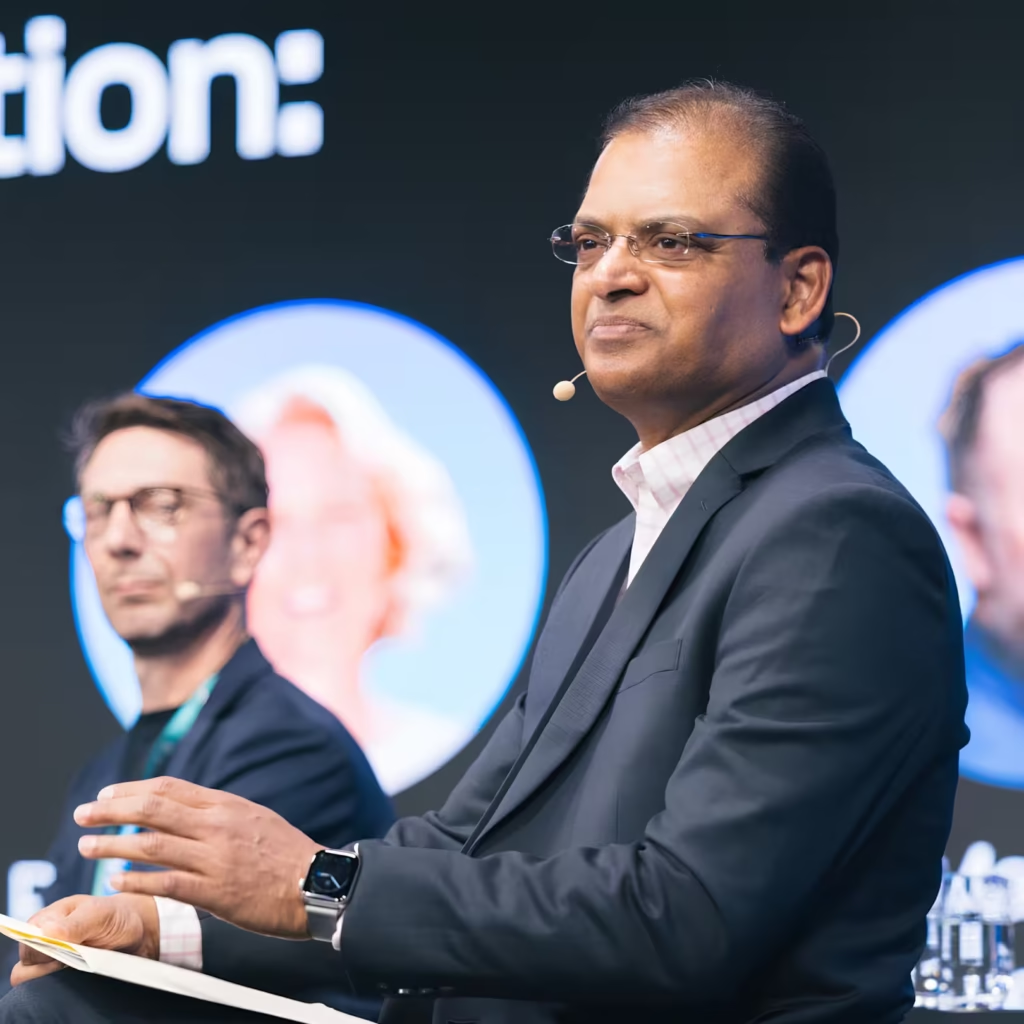
The Sathyanarayanan Method — Clarity Over Complexity
Sathyanarayanan’s signature method is that he begins with the enterprise problem rather than fixating upon a functional solution beforehand. A business issue may present itself as a talent problem, an operating model problem, a technology problem, or a cultural problem, but the root cause, more often than not, lives somewhere else entirely. His instinct is to step back and avoiding falling into a tunnel vision.
Understand the system as a whole, simplifying the problem, and aligning the right leaders around a practical path forward is the way to go. This is also where his philosophy takes an unusual turn for an HR leader as he treats clarity itself as a source of competitive advantage.
Complexity, in his view, taxes growth, every unnecessary layer, every unclear decision right, every duplicated process or misaligned incentive slows an organization down. One of the most valuable things a senior leader can do, he argues, is reduce that friction, by making accountabilities, priorities, and decision principles unmistakably clear. Said governance lens now sits at the focal point of how he approaches every mandate, whether at Greif’s executive table or the Balmer Lawrie – Van Leer boardroom: What are we trying to achieve? What assumptions underpin the plan? What could derail it? What capabilities must exist? Who owns the decision? How will we know if we are wrong? For Sathyanarayanan, innovation is not a mere novelty but the disciplined conversion of industry insights into better outcomes for the world.
The greater good of society depends heavily on the innovation and integrity being practiced by the business leaders around the globe.
The Mistake That Changed Him
Being candid about the mistake that reshaped him most, Sathyanarayanan considers that to believe, earlier in his career, that being solely right was sufficient in getting the job done. If the logic was sound and the evidence compelling, he assumed the organization would naturally move.
Experience taught him otherwise, and the lesson has stayed with him ever since. Execution is a social process, people need to understand the reasons behind a change. Leaders need to be aligned on what they will collectively reinforce. Incentives need to support the desired behavior. And stakeholders need a genuine opportunity to challenge assumptions before they are asked to commit to them. According to Sathyanarayanan, influence and persuasion must not be used synonymously.
Influence consists of a wide tapestry of timing, context, listening, trust, and the ability to incorporate dissent without losing direction. That reframing changed him as both an executive and, later, as a board leader. He has come to believe that a strong board is one where the quality of the debate naturally improves the quality of the decision.
The same holds true inside companies as well, constructive challenge is not a threat to alignment but one of the conditions that makes alignment durable. Today, when he feels confident about an idea, he asks himself what would have to be true for others to own it with the same conviction he feels? That shift, from winning an argument to building shared ownership, is one he describes as among the most consequential changes in how he leads.
Mentors, the Boardroom, and a Second Discipline
Bala V. Sathyanarayanan credits the people who shaped him as the leaders he encountered throughout his journey. People who understood the business, respected people, held high standards, and stayed grounded when circumstances turned difficult. Watching them taught him that leadership is not a mere title one wears but a responsibility one carries. It was governance, though, that added an entirely new dimension to his development.
Since 2019, Sathyanarayanan has served on the Board of Balmer Lawrie – Van Leer Limited, a publicl industrial manufacturer in India, a role that runs in parallel to his executive responsibilities at Greif and that has deepened his conviction that board work demands a fundamentally different kind of leadership from operating management. He has come to understand that a board must support management without becoming management.
It must challenge without undermining, remain future focused without losing sight of present performance, and protect the institution while still enabling intelligent risk taking. That balance, a discipline he has formalized through his credential as an NACD Certified Corporate Director, one of the highest recognitions available to corporate directors in the United States, has sharpened his appreciation for the CEO’s role as the ultimate integrator of an enterprise.
It also made him a better listener inside his own organization. The higher a leader climbs, the more easily information becomes filtered on its way to them. Leaders who deliberately create space for candid voices are the ones who stay closest to reality.
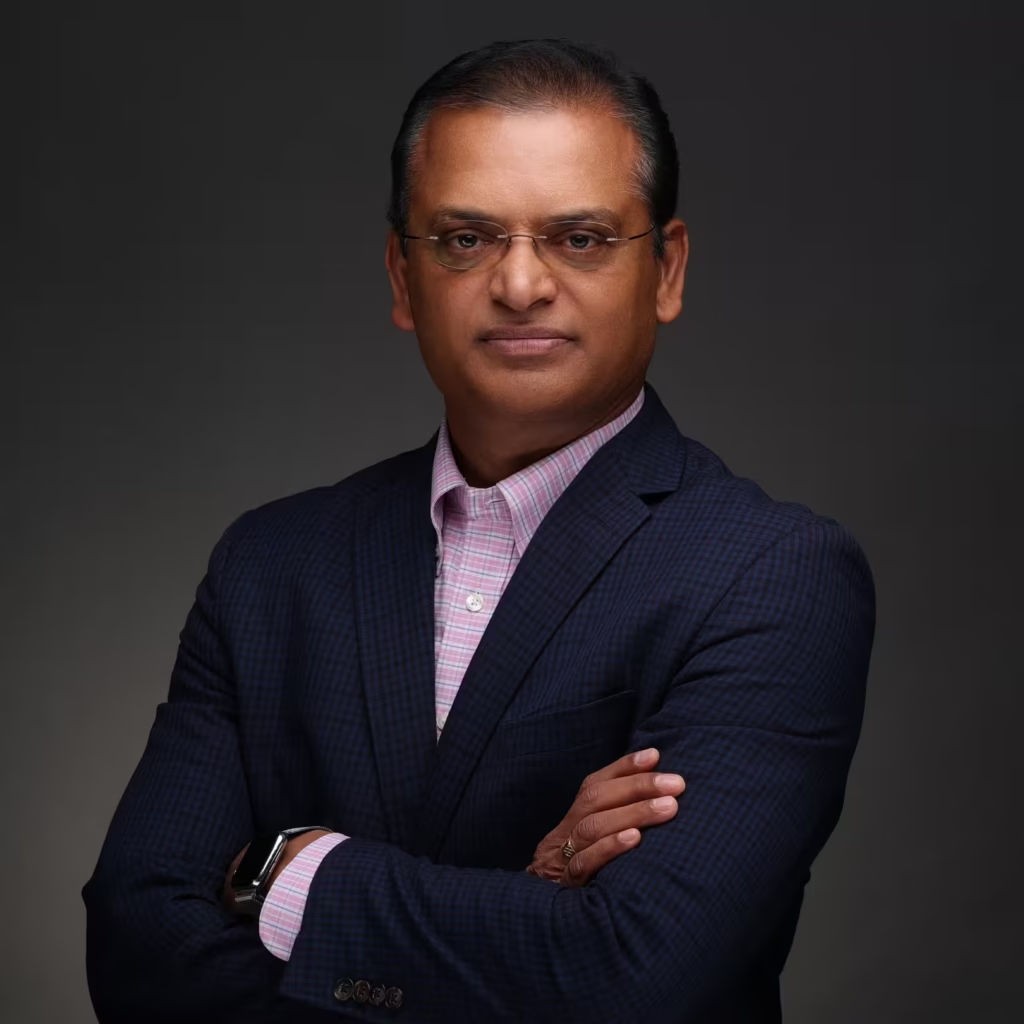
Enterprise-First: Building the System Behind the People
At Greif, the 149 year old, Fortune 1000 global leader in industrial packaging, operating hundreds of locations across dozens of countries, his central organizing idea is what he calls enterprise-first leadership. Finance sees one set of signals, operations another, commercial teams understand the customer, technology sees architecture and scalability, people leaders understand capability and organizational health, and boards bring stewardship and long term accountability.
Bala V. Sathyanarayanan believes that value appears only when those perspectives are integrated rather than defended in isolation. In Sathyanarayanan’s view, the operative question for any function leader should never be “What is best for my function?” It should be, “What is best for the enterprise, and what must my function do to enable it?” That single reframe, when applied consistently, changes the quality of senior team dialogue. And it applies just as much in the boardroom as it does inside a company’s four walls.
Sathyanarayanan argues that high performing boards and executive teams are not defined by the absence of disagreement but by trust, disciplined challenge, clarity of role, and the ability to converge after debate has run its course. A board should help management see around corners, management, should give the board the transparency and context needed to do so responsibly. According to Bala V. Sathyanarayanan, vision becomes reality as an ongoing operating capability, where people understand the destination, see their own role in reaching it, and trust that the leadership system around them will support disciplined execution.
A Word for the Next Generation
For someone just starting out, Sathyanarayanan advices that one must not build a career solely around titles. Contrary to reaching for platitudes about ambition, he emphasises the importance of trust, judgment, learning, and contribution because titles are temporary, while reputation and goodwill compounds.
He urges younger professionals to learn the business along with their profession, to understand how their company makes money, how customers create value, where capital is deployed, what risks matter, and what makes their enterprise unique from its competitors. He claims that technical skills may gain you a seat at the table, but your wider perspective determines what you actually do once you’re sitting in it.
He also pushes back against comfort, and to cherish the challenging opportunities as growth rarely happens when every problem is familiar. Take on work where the answer is not obvious, where you cannot simply command the people around you, and where the consequences are real. Ask for feedback before you feel ready to hear it. Learn to change your mind without losing your conviction. And above all, pay close attention to how you exercise power as your responsibility grows, because people will increasingly learn from what you model rather than what you say.
How a leader responds to bad news, how they allocate opportunity, how they treat people who cannot help them, and whether they give credit generously. In Sathyanarayanan’s view , these are the behaviors that gradually become a leader’s legacy.
Recognition as Responsibility
Sathyanarayanan’s influence has consistently had robust presence across all borders. He has been named to the list of Outstanding 50 Asian Americans in Business by the Asian American Business Development Center, recognized as Executive of the Year by Columbus CEO Magazine, and featured among the world’s most influential business leaders to follow by international business publications. He is a member of the Forbes Human Resources Council, sits on Gartner’s CHRO Global Leadership Board, and serves on the Center for Executive Compensation’s advisory board in Washington, D.C., alongside board service with the Columbus Council for World Affairs. Yet, when asked about the meaning of recognition, his answers often resists the easy triumphalism such honors usually invite.
He sees recognition as a responsibility rather than a final destination. In Bala V. Sathyanarayanan’s words, every milestone raises a useful question; what will you do with the credibility, access, and experience you have accumulated? His answer remains to keep broadening the impact of his leadership, may it be across enterprise strategy, governance, organizational performance, or the development of the next generation of leaders.
Professionally, Sathyanarayanan remains preoccupied with how CEOs and boards can build institutions that perform today while remaining relevant tomorrow. He insists that it requires governance that is rigorous without becoming bureaucratic, succession systems that build leadership depth before it becomes urgently needed, cultures that reward truth telling, and operating models that turn complexity into clarity.
Personally, his ambition is to remain a learner. One danger of seniority he notes is that experience can harden into certainty. He would rather let experience sharpen his judgment while preserving his curiosity, and continue writing, mentoring, and serving in settings where thoughtful leadership can make institutions stronger.
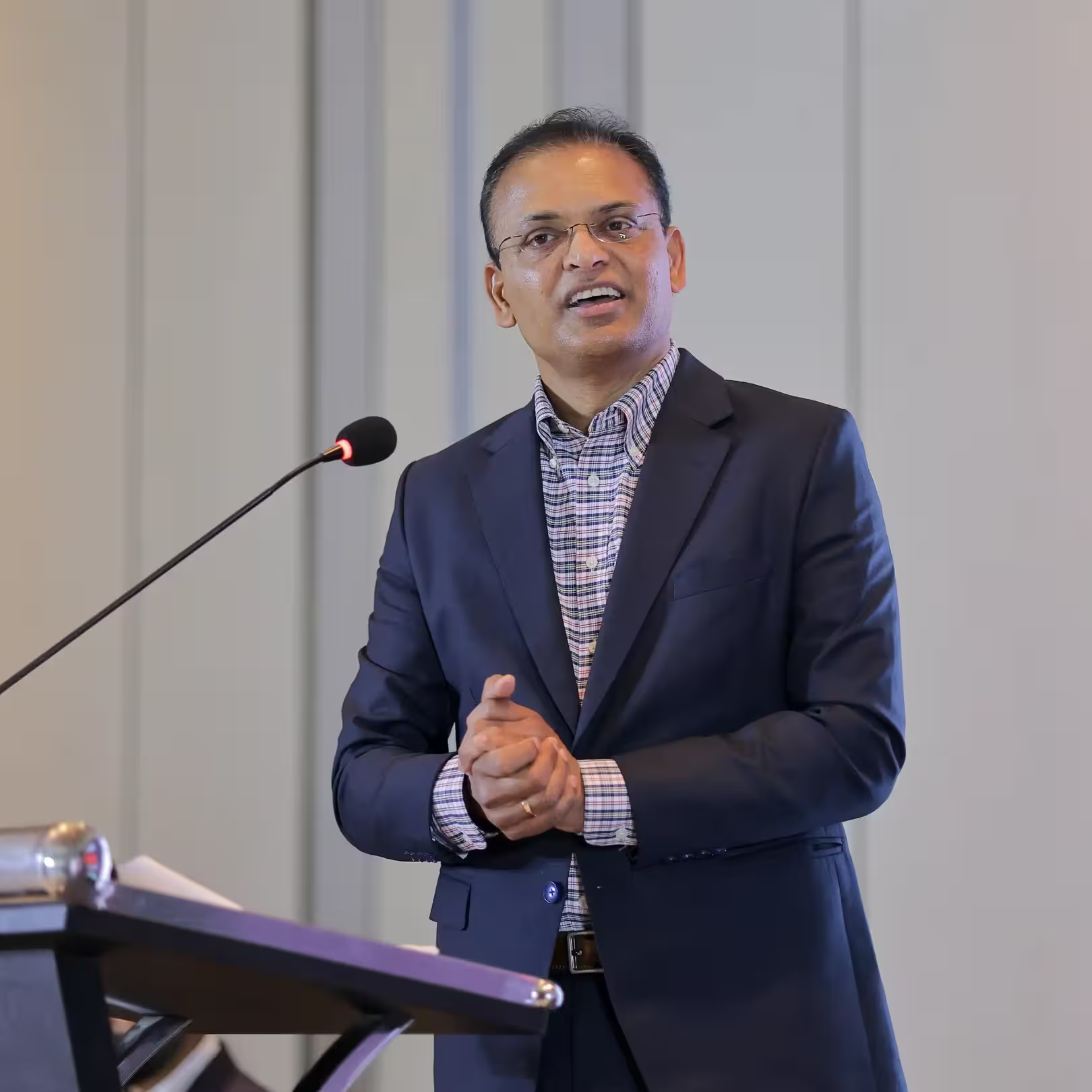
Leadership as Stewardship
A single idea that threads through everything Sathyanarayanan has built across four decades, half a dozen global companies, and two continents of boardrooms is that leadership is stewardship. According to Bala V. Sathyanarayanan, executives and directors are entrusted for a period of time with people, capital, institutions, brands, relationships, and reputations that existed before them and should be stronger after they leave.
That is true whether the leader in question is a CEO, a board member, a functional executive, or a first time manager. The scale of the responsibility changes, but its nature does not. Results matter. Strategy matters. Execution matters. Governance matters. But the quality of leadership, in his view, is ultimately visible only in what endures after the leader has left the room. Did the organization build stronger capabilities? Did it create better decision systems? Did it strengthen trust? Did it leave behind leaders capable of carrying the institution forward? Did people come to believe more was possible because of how they were led? It is why Sathyanarayanan refuses to separate performance from humanity, insisting that high standards and deep care are not opposites, that the best leaders can demand accountability while preserving dignity, and that the best boards can challenge management while simultaneously strengthening it.
He says that leadership, at its best, is the disciplined use of authority in service of something larger than oneself.
The Integrator’s Instinct
Sathyanarayanan states that the most valuable leaders become integrators. Organizations naturally divide their work into functions, business units, geographies, committees, and reporting lines. Those structures are necessary, but customers and shareholders experience the enterprise as a single whole, not as an org chart. Bala V. Sathyanarayanan has said that The CEO’s responsibility is fundamentally integrative. Connecting strategy to execution, risk to opportunity, culture to performance, people to purpose, and today’s decisions to tomorrow’s consequences.
Effective governance exists to strengthen that integration, not to sit apart from it. Having viewed the enterprise through the lenses of executive leadership, people and organization, transformation, and board stewardship, Sathyanarayanan has arrived at a conclusion that leadership problems are rarely “HR problems,” “finance problems,” or “technology problems.” They are business problems that require cross functional judgment and shared accountability.
He believes that the organizations that understand this are the ones that build leaders who last. He is quick to add that no story is ever built alone. Behind every milestone are teams, mentors, colleagues, and moments of real difficulty. His own aspiration, stated as simply as anything in his career, is to keep learning, to keep contributing, and to leave every institution he has the privilege to serve stronger, clearer, and better prepared for whatever comes next.