
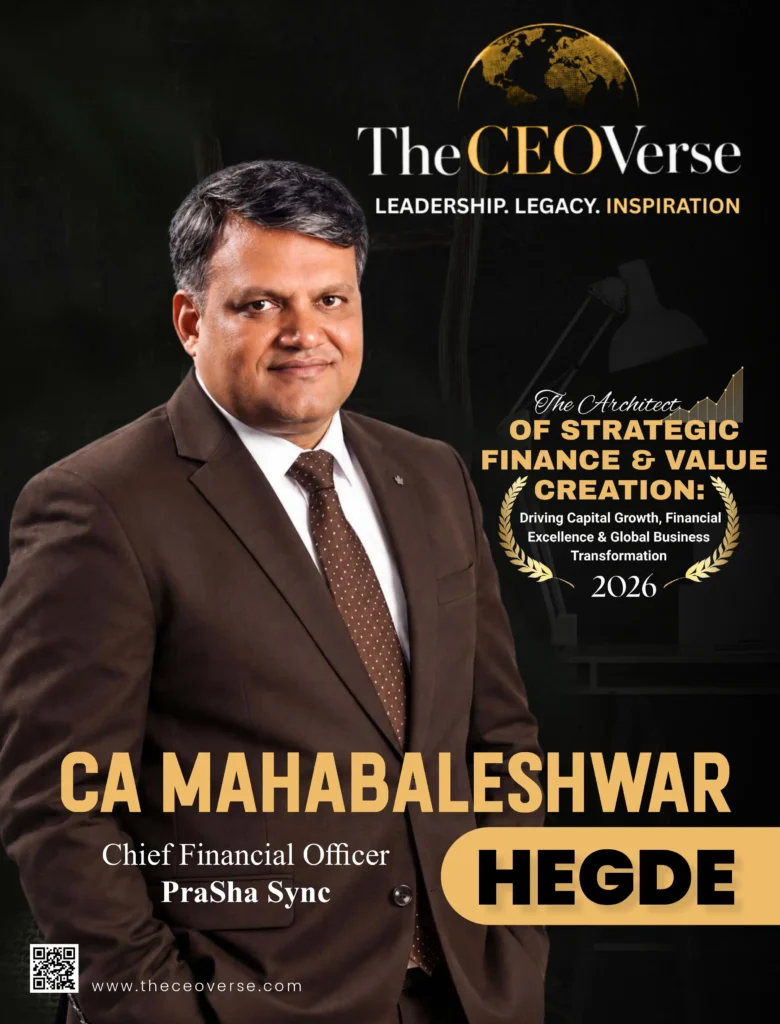
TheCEOVerse • Digital Edition
“The Architect of Strategic Finance & Value Creation: Driving Capital Growth, Financial Excellence & Global Business Transformation – 2026”
Cover story
CA Mahabaleshwar Hegde
Featured Profile - CA Mahabaleshwar Hegde
The Architect of Numbers: CA Mahabaleshwar Hegde and the Power of Purpose Driven Finance
Most people look at a balance sheet and see a record of the past. CA Mahabaleshwar Hegde sees a story in it. For him, the columns and totals are only the visible surface of hundreds of human decisions about which customer to chase, which vendor to trust, whom to hire and how much risk to carry.
“It started with a fascination for numbers,” he says. He is quick to add that it was never the numbers themselves. It was what they could reveal about an organisation if you looked closely enough.
That habit of looking closely has carried him through more than two decades in finance. He has worked in real estate, infrastructure, FMCG, retail, hospitality, e-commerce, executive search, SaaS and health tech. He has worked in India, the UAE and the United States, and in a few other markets. His professional identity is simple. He is a strategic finance leader who believes finance should help decide what happens next, not just report what already happened. Today that belief is being tested at PraSha Sync, where he serves as Chief Financial Officer.
The Discipline of Distinction
Every long career has a first proof of seriousness. For Hegde it was the Chartered Accountancy examination, one of the most demanding professional gauntlets in India. He cleared it with an All India Rank of 43.
A rank that high could easily be told as a story of brilliance. Hegde tells it differently. The process, he says, taught him that preparation and consistency beat talent when talent isn’t backed by discipline. The lesson is almost unfashionably plain, but it has stayed with him ever since.
It surfaces in how he approaches work today. He distrusts heroics and prefers routine. He also distrusts the rescue mission style of leadership, in which a brilliant individual saves the day. He would rather build the habit, the process or the platform that makes the rescue unnecessary.
Learning to Ask the Uncomfortable Question
His early years in audit gave him something no classroom could. An auditor spends his days sitting across the table from business after business. Hegde remembers how quickly that experience taught him that a financial statement is the residue of decisions made by people.
Audit, he says, trained him to ask uncomfortable questions and to hold his ground when holding it was inconvenient. It also taught him a principle he treats as nearly sacred. Trust is the only currency a finance professional really has. An auditor who is liked but not trusted is useless. A finance leader who is trusted can ask for anything, from a hiring freeze to a difficult conversation with a board.
When he moved from audit into corporate finance, his ambition shifted with him. Getting the numbers right was no longer enough. He wanted to shape what the numbers would say next year.
A Passport Full of Lessons
Careers in finance often run in a straight line through a single industry. Hegde’s has been a deliberate sprawl, and he treats each sector as a school.
Real estate taught him capital discipline, the habit of treating every rupee of funding as a long term commitment. FMCG taught him respect for thin margins and for the supply chains that sit behind them. E-commerce taught him speed, and the humility of watching a plan become obsolete in a week. Startups taught him the hardest lesson of all, which is how to build when nothing is certain yet.
His own account lists manufacturing, retail, hospitality and SaaS in the mix as well. Each exposure left a mark. Together they gave him a rare ability to walk into an unfamiliar business and quickly work out which numbers actually matter.
That portability has served him well in a profession that increasingly rewards translation, meaning the capacity to speak the language of an operations head in the morning and a venture investor in the afternoon.
When Growth Outruns the Systems
If you ask Hegde about the hardest stretches of his career, he does not point to the quiet years. His toughest chapters came when a business was growing faster than its systems or capital structure could handle. In those moments, he says, you are trying to protect the company and push it forward simultaneously, usually without complete information. His view is that waiting for certainty is itself a risk.
The COVID-19 pandemic was the sharpest test. Working capital visibility suddenly became the only thing that mattered. At the organisation where he was leading finance, Hegde raised INR 40 crore through ECGLS and letters of credit. He also restructured debt in a way that cut interest costs by INR 20 crore.
The numbers are impressive, but he draws a quieter lesson from them. A funding problem caught six months out is manageable. The same problem spotted a week before it hits is a crisis. The skill, therefore, is less about heroic fundraising and more about seeing the cliff while it is still far away.
The Quality of Spending
Another tension has followed him through every growth story. Cost discipline versus ambition. Hegde has seen what blunt cost cutting does. Cut every department by ten percent and you quietly damage the parts of the business that generate revenue.
At a fast scaling consulting and technology firm, he took a different route. He focused on the quality of spending, not the quantity. That meant renegotiating contracts, optimising manpower and tightening overheads. The programme found INR 12 crore in savings while the company was expanding internationally, and the firm still reached a 40 percent EBITDA margin.
That experience cemented a belief he now repeats often. Finance has to understand operations before it tries to change them.
The Leap Away from Safety
At some point in many careers, a door opens that looks like a step backwards. Hegde’s came when he left a large, publicly listed organisation to become Head of Finance at an early stage company. On paper it was a poor trade. He was giving up established processes, a familiar structure and the comfort of a famous name. In exchange he would walk into a place where most of the finance function did not yet exist, and he would have to build it.
What drew him was the prospect of owning something end to end. He recounts, “growth usually begins when a role is slightly too big for you, not when it fits comfortably”. He knew the learning curve would be steep.
It became, in his words, the most transformational stretch of his career. He built processes from scratch. He worked shoulder to shoulder with founders. He made calls with half the information he would have liked, and he learned to balance speed against control every single day.
The experience also changed how he sees uncertainty. Ambiguity, he realised, is not the absence of structure. It is an invitation to build the right one. Confidence, he says, was never about knowing the outcome. It was about being willing to take responsibility for the choice once it was made.
One System, Four Moving Parts
If there is a signature to Hegde’s work, it is the refusal to treat finance activities as separate jobs. Budgeting, reporting, systems, cost management and fundraising, in his view, form a single decision making system. When they are designed together, finance becomes faster and genuinely useful to every other function.
His clearest demonstration came at that fast growing consulting and technology firm. The company needed profitable growth, better reporting, international expansion and investor readiness, all at once. Hegde organised the work around four mutually reinforcing efforts. The first was resetting the cost base. The second was implementing SAP and Zoho ERP. The third was building real management visibility. The fourth was shaping a credible story for investors.
The results were substantial. Revenue reached INR 60 crore, which was 240 percent growth over the previous year. EBITDA stood at 40 percent. Operations across the US, UK, Singapore and the UAE contributed 15 percent of that year’s revenue, and the company secured INR 10 crore in Series A funding.
Hegde insists there was no single dramatic idea behind it. It was sequencing. Cost discipline improved profitability, better systems improved transparency, stronger performance built investor confidence, and the capital that followed funded the next stage of expansion. Each piece fed the next.
He also places great weight on financial storytelling, because data alone moves no one. It has to be translated into a clear choice. He uses ERP platforms, Power BI and Anaplan to create visibility, but the goal is always faster execution with the right guardrails. His formula is enough structure to protect the business, but not so much that it kills momentum.
The Mistake That Moved Finance Upstream
Hegde is unusually candid about the lesson that took him longer to learn than it should have. Early in his career he believed that a well built financial model was the argument. Get the numbers right, he thought, and the decision would follow.
It did not work that way. A technically correct answer can still fail if the people who must live with it do not trust it or do not see their role in it. When finance appears only at the end of a process, it looks like a gatekeeper. Even a good recommendation can meet resistance simply because no one asked the people executing it what they thought.
So he moved finance upstream. He began asking operational questions before proposing financial ones. He learned to listen before recommending and to explain the “why” as carefully as the “what.”
That shift changed how he approached ERP rollouts, cost programmes and international expansion alike. To him, an ERP system is not finished when it goes live. It is finished when people use it to make better decisions. A cost programme is not a success because a line item shrank. It succeeds when waste is removed without weakening the capability that earns revenue.
His summary is memorable. “Leadership is not presenting the best answer in the room. It is building shared clarity and getting people to own the action that follows.”
The Global Playbook: Three Continents, Three Decisions
Working across India, the UAE and the United States gave Hegde a practical education in how cultures decide. American teams, he observes, tend to move fast with imperfect information and decentralised ownership. Indian teams often bring stronger documentation and consensus building. His own style has settled somewhere in between, with clear guardrails and quick review cycles, but with disciplined validation underneath.
He is firm that none of his results were solo achievements. Cost savings needed procurement and business leaders at the table. ERP adoption needed people willing to change comfortable habits. Fundraising needed founders, investors, lawyers and auditors pulling in the same direction. International expansion needed local trust that cannot be built from a spreadsheet.
The INR 12 crore in savings and the 240 percent growth, he says, were not finance wins. They were organisational ones.

The Scale of the Ledger
Step back from the individual stories and the sheer breadth of his work comes into focus. Across his career, Hegde has helped raise more than INR 2,500 crore through banks, venture capital and private equity. He worked on a roughly INR 2,000 crore structured transaction for an IT park. He has supported capacity expansion, tightened forecasting, cut interest and operating costs, rolled out ERP systems and helped companies enter new markets.
Different as these sound, he says they all reduce to the same four things. Clarity, Discipline, Collaboration and Trust.
He adds a philosophy that explains the shape of his career. Sustainable performance, he believes, comes from systems, not heroics. Anyone can solve a problem once. An organisation grows stronger when the solution is built into a process or platform that others can rely on without his personal intervention. That is why he cares so intensely about management reporting, cash flow visibility, automation and documented controls.
Building PraSha Sync from the Ground Up
Today, all of those threads converge at PraSha Sync, where Hegde is Chief Financial Officer. It is a US based mental wellness startup with the goal of integrating fintech into a HealthTech platform to address healthcare’s liquidity challenges. Their core idea is to use technology and sound financial design to make care more sustainable.
At PraSha Sync he is building the organization from close to scratch. He is standing up the finance, HR and compliance functions. He is putting platforms and policies in place and setting up management reporting and working capital systems. He is also contributing to the company’s digital and AI roadmap. Within six months of his work, the company closed USD 1 million in pre seed funding to support product development.
It is hard to imagine a role better suited to him. It demands the early stage instincts he sharpened when he left the listed company, the investor storytelling he honed on the Series A, the cross functional diplomacy of his ERP years and the working capital vigilance of the pandemic. It also adds something new. The chance to align capital with a purpose he can see in human terms.
The Mentor in the Classroom
If the boardroom is where Hegde builds companies, the mentoring room is where he builds people. He has mentored more than 18 finance professionals over the years. What he tries to create, he says, is an environment where people understand why their work matters and feel safe enough to push back on an assumption.
His approach to trust is practical. Leaders earn it by being honest about constraints, consistent in their decisions and generous with credit. Collaboration, to him, was never about agreeing on everything. It is the ability to argue honestly, decide clearly and then own the outcome together.
His mentoring extends beyond the corporate world. He has taken part in a corporate mentorship programme at Alliance University, and he has shared about significance of the experience. He described the motivation and talent of the MBA students as something that never ceases to inspire him. It is a small detail, but it shows a leader who treats the next generation as a source of energy and not only a duty.
Grace in the Spotlight
Hegde’s work commands the attention of the greater business community. He has been recognised by TradeFlock among the 10 Best Leaders from Finance in India for 2025. He has also been present at the Great Indian CFO Community’s Leaders Summit and Awards 2025 in Bengaluru, an event he recalls as a proud moment indeed. He has also been actively engaged with the CXO leadership conversation, including a gathering in Dubai.
He wears these markers of recognition lightly. When asked about milestones such as these, he calls them an honour, but more of a responsibility than a finish line. Such recognition, he says, honours the kind of work that mostly happens out of sight. Building controls, protecting liquidity, improving how decisions get made and developing people. It should not become a destination, he adds. If anything, it raises the bar for what he does next.
Finding the Pause, and the Road Not Taken
The pressures of a CFO’s life are relentless, and Hegde’s method of managing them is refreshingly modest. When the pressure rises, he steps away for a few minutes. He uses some breathing or mindfulness to reset. Then he returns with a short list of the three things that actually matter that day. He protects focused work time and tries not to let meetings eat the day alive.
His imagination, meanwhile, has a second career waiting. If he had taken a completely different path, he believes he would have become a travel writer. The draw was never the destinations. It was the chance to understand how different cultures and local businesses really work.
The confession explains something about his finance career. The same curiosity that sends a travel writer into an unfamiliar market sends Hegde into an unfamiliar organisation. Every company is a new landscape, and he still enjoys working out how it runs and where he can help it run better. He also says he wants to keep travelling, keep mentoring and keep learning how different people and cultures build value.
Advice to the Next Generation
Asked what he would tell someone beginning their career, Hegde gives a sequence of instructions that reads like a compressed version of his own path. Build your credibility before you chase your visibility, because titles and recognition follow the work, not the other way around.
If you are in finance, he adds, technical competence gets you in the door but is only the starting point. Go and spend time with sales, operations and supply chain. Understand how a number is created before it lands in your report. Become comfortable with technology and data early, because spotting a pattern, testing an assumption and modelling a scenario will define the finance leaders of the future.
His most pointed advice concerns ambition. Do not shy away from a role that feels beyond you, because the day you feel completely ready never arrives. Ask for help, prepare seriously and stay humble. His one line version is the one he hopes people remember. “Become the person people bring their hardest problems to. Competence gets you noticed, but integrity and judgement decide how far you go.”
The Footprint Left Behind
Near the end of any conversation with Hegde, the talk turns from what he has built to what he hopes will outlast it. His answer is a definition of leadership he returns to again and again. Leadership, he says, is measured by what remains after the leader has left the room. The trust, the systems and the people who are better equipped because you were there.
Hegde is proud of the capital raised, the costs reduced and the systems built. But he says none of that means much unless it made an organisation stronger and more capable of serving its people. He believes in finance centred on value rather than optics. That means long term health over short term appearances, data used to clarify choices rather than obscure them, and integrity treated as a daily practice instead of an abstract virtue.
Above all, he reminds himself that finance is a human function. Behind every budget line sits a person, a trade off and a priority. Discipline, he insists, should never come at the cost of empathy.
Looking ahead, he wants finance pushed further into data driven decision making. He expects the next generation of CFOs to combine financial discipline with technology, scenario planning and genuine storytelling, along with an understanding of the human outcomes behind the numbers.
The legacy he hopes for is not a number at all. It is a group of finance leaders who see themselves as architects of sustainable growth, not custodians of a ledger. They would be people who do not just follow the numbers, but make the numbers worth following.