
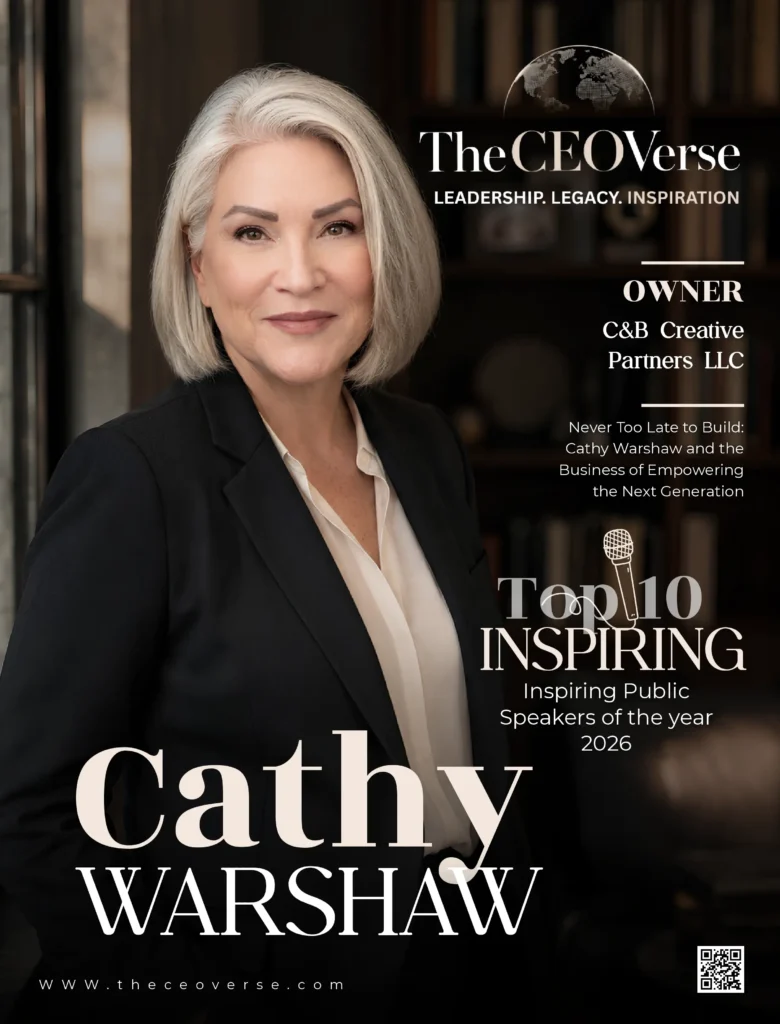
TheCEOVerse • Digital Edition
“Top 10 Inspiring Public Speakers of the year 2026”
Cover story
Cathy Warshaw
Featured Profile - Cathy Warshaw
Never Too Late to Build: Cathy Warshaw and the Business of Empowering the Next Generation
Making one’s way toward entrepreneurship begins with a business plan. Usually, there are spreadsheets, market studies, pitch decks, financial projections, and competitor analyses. Founders identify a gap in the market and set out to fill it. And then there is the kind of entrepreneurship that begins with a dream.
For Cathy Warshaw, that dream arrived when she was 73 years old. At an age when society often begins speaking about retirement, slowing down and reflecting on what has already been accomplished, Warshaw found herself standing at the beginning of something entirely new. She had not spent decades preparing to become a bestselling literary entrepreneur. She had not graduated from college with a degree in publishing or business. She had not built a startup around a carefully researched market opportunity. Instead, she woke up from a vivid dream with a story in her mind, and hence, began writing.
Within three days, she had written almost half of what would become The Obsidian Eye, the first book in the Secret Societies and the Sisterhood Sleuths universe. That single creative impulse would eventually grow into something much larger than a mystery series. A multi platform ecosystem involving books, youth empowerment, educational outreach, music, podcasts, a digital magazine, interactive activities and the forthcoming detective adventure experience, CipherNet. Today, Warshaw is a celebrated author, songwriter, certified teen empowerment coach and entrepreneur. But perhaps the most compelling part of her story is not simply what she has built. It is when she decided to build it.
Her journey challenges one of business culture’s most persistent assumptions that innovation belongs primarily to the young. Warshaw’s answer to that assumption is simple. Sometimes, the most important chapter of a person’s life has not happened yet. Her own, she says, began at 73.
Before the Author: A Life of Detours, Curiosity and Experience
Cathy Warshaw did not grow up believing she would one day become an author. By her own account, she did not excel in English class. She barely finished high school and did not attend college. Her professional life took her through a series of different industries and identities. Restaurant owner, hospitality professional, nonprofit worker, educator and eventually certified teen empowerment coach.
For eight years, she owned a restaurant. Each chapter added another layer of experience, even if, at the time, none of them appeared to be leading toward a career in publishing. That is one of the central threads running through Warshaw’s story, the realization that a career does not always move in a straight line.
What looks like a detour in one decade may become an advantage in the next. Long before she became an author, Warshaw was observing people. She was curious about why people behaved the way they did, why they believed certain things and why they chose particular paths. She asked questions, watched, and wondered. Years later, those instincts would become the intellectual foundation of the world she created. The curiosity that may once have seemed like simple daydreaming evolved into a business philosophy. In Warshaw’s universe, asking questions is not a distraction from learning.
It is learning. Her earlier career experiences also gave her something that cannot easily be acquired through a classroom, which is the development of a real perspective. Hospitality teaches people how to read others. Nonprofit work introduces the realities of community needs. Education brings adults face to face with the ways young people learn, struggle and grow. Coaching requires listening. When Warshaw eventually turned her attention toward teenagers, she was bringing an accumulation of experiences with her.
A Dream at 73—and the Beginning of a Business
The origin story sounds almost cinematic. Warshaw had a dream. It was vivid, detailed and difficult to ignore. Rather than dismissing it, she got up and began to write. For three days, she wrote intensely. By the end of that period, she had nearly half of her first Sisterhood Sleuths book on the page. There was no elaborate business plan, no formal market survey, no moment spent asking whether 73 was too late to become an author.
There was simply a story that needed to be told. That instinctive beginning is striking because it runs counter to much of the conventional startup narrative. Entrepreneurs are often encouraged to validate every idea before beginning. Research the market, identify the customer, build the minimum viable product. Test, measure and iterate. Warshaw’s journey began somewhere much more personal, that is to create with conviction. But as the story evolved, so did the scale of her ambition. She realized she was not simply creating mysteries for young readers.
She was building stories for young people who might recognize something of themselves in the characters. The quiet child, the daydreamer, the person who questions everything but does not yet know whether those questions matter. The mission became bigger than entertainment. Warshaw wanted young people to understand that curiosity has value. That courage and curiosity can work together. That not having everything figured out does not mean a person has nothing to offer.
That purpose became the engine behind the business that followed. And perhaps that is one of the most important entrepreneurial lessons in Warshaw’s journey. Businesses can begin with products, but enduring ventures often grow because the founder discovers a mission larger than the original product.
From Pages to a Platform
The real transformation occurred when Warshaw began to reconsider the role of the reader. She did not want young people merely to read about characters solving mysteries. She wanted them to solve mysteries themselves. That shift changed everything. Suddenly, the book was no longer the final product. It was the beginning of an ecosystem. Under the Sisterhood Sleuths umbrella, the original literary concept expanded into a broader youth focused platform. The growing universe includes an eight book global mystery series, a global outreach initiative, audio experiences, educational activities, original music, a digital magazine, a podcast and interactive projects such as CipherNet. This is where Warshaw’s story becomes particularly relevant to business leaders.
She has taken what could have remained a single intellectual property asset, a book series, and begun extending it across multiple formats. The same core world, characters and mission can now be experienced through reading, listening, problem solving, discussion and interactive engagement. It is a modern media strategy built around participation. The objective is not simply to entertain young people but to help them develop skills such as observation, critical thinking, communication, teamwork, confidence, leadership, creativity and cultural understanding.
The delivery mechanism is the mystery, and the underlying product is empowerment. The strongest intellectual properties are often those that can travel across formats without losing their identity. A story becomes a podcast, a podcast becomes a community, a community creates educational tools, educational tools evolve into games. The business expands, but the central philosophy remains recognizable. Warshaw appears to understand that principle intuitively. Her question was never simply, “How can I sell more books?” The more interesting question became, “How can this world become more useful to the people it was created for?” That is how a series becomes a platform.

Curiosity as a Competitive Advantage
In Warshaw’s world, curiosity is more than a personality trait, but a skill. At a time when young people are surrounded by an overwhelming volume of information, the ability to ask better questions may be one of the most valuable capabilities they can develop. Information is abundant, discernment is harder. Warshaw wants young people to pause and ask questions such as, “Is this true? How do I know it is true? What might I be missing? What evidence supports this?” Those questions sit at the intersection of mystery storytelling and modern education. A detective cannot solve a case by accepting every statement at face value. A good detective observes, compares, investigates and looks for evidence.
The same habits can be valuable outside fiction. For Warshaw, the mystery format provides a way to teach critical thinking without presenting it as a lecture. Young readers decode ciphers, investigate clues, work with others and encounter different cultures while participating in a story. The educational experience is embedded in the adventure. That is a significant design principle for any leader building products for younger generations.
Engagement and learning do not have to be separate experiences. Warshaw’s approach is based on the idea that curiosity itself can be a form of empowerment. When young people learn that they are allowed to question what they hear and investigate what they encounter, they become more active participants in their own learning. Her planned CipherNet experience takes that philosophy a step further, inviting participants into the worlds and countries represented in the Sisterhood Sleuths stories through puzzles, ciphers, languages and cultural exploration. In Warshaw’s framework, curiosity is not a weakness to be outgrown. It is strength to be developed.
The Business Lessons She Learned the Hard Way
Warshaw’s story is not presented as a fairytale of effortless success. In fact, one of its most valuable elements is her willingness to discuss the mistakes. Starting something new at 73 came with challenges. Technology was evolving, publishing was changing, and marketing was changing. Social media platforms seemed to multiply faster than anyone could master them. There were moments when the scale of what she was trying to build felt overwhelming.
She also had to learn that not every collaborator, opportunity or investment would be the right one. Warshaw describes spending money on books she later wished she had handled differently. She encountered educators and collaborators who did not understand the mission in the same way she did. She experienced disagreements over the direction of Sisterhood Sleuths and learned that having a clear vision does not guarantee that everyone around you will immediately see it. These are familiar challenges to entrepreneurs in every industry.
A founder’s vision exists first in the founder’s mind. The difficult work is translating that vision so that other people can understand it, contribute to it and help build it, without allowing the original purpose to disappear in the process. Warshaw’s response has been shaped by experience. Listen to feedback, she suggests. Be willing to change when change is necessary. But also know when to defend the vision. It is a delicate balance.
Too much rigidity can prevent growth. Too much flexibility can cause a company to lose its identity. Warshaw has also learned the importance of recognizing red flags and asking questions before making decisions. Her fictional mysteries and her business philosophy have, in some ways, begun to mirror one another. Not everything is as it appears, and the clues are often there if you are willing to look carefully enough. For business leaders, that may be one of the most practical lessons in her journey. Confidence is not the same thing as certainty. Being fearless does not mean being unquestioning. In Warshaw’s case, entrepreneurship has meant learning how to remain bold while becoming more discerning.
Leadership Without Pretending to Know Everything
One of Warshaw’s strongest leadership insights is also one of the simplest. You do not have to be the expert at everything. For a founder, this can be surprisingly difficult to accept. Entrepreneurs often begin with a deeply personal vision, which can create the temptation to control every aspect of the business. But scaling requires collaboration.
Warshaw openly acknowledges that building Sisterhood Sleuths has involved recognizing where her own strengths end and where other people’s expertise becomes essential. Her role is to protect the vision, surround herself with people who understand areas she does not, and ensure that the decisions being made continue to serve young people. That philosophy is reflected in the stories themselves. The “sleuths” are not successful because one character is good at everything.
They function as a team. One person may understand puzzles, another may understand languages, someone else may notice details others miss, and another may have a talent for science. The message is collaborative intelligence. The same principle applies to the company Warshaw is building. Leadership does not require omniscience.
It requires knowing what matters most, identifying the people who can strengthen the mission and creating an environment in which different abilities can work toward a common purpose. Her partnerships with educators, youth organizations, homeschool families, bookstores and community groups also reflect a recognition that meaningful impact cannot be created in isolation. A founder can create the spark. A community helps carry the fire.
Listening to the Generation She Wants to Serve
Warshaw’s work as a teen empowerment coach gives her entrepreneurial mission a particularly important dimension. She is not trying simply to create products for young people. She is trying to understand what young people actually need. One of the lessons she says teenagers have taught her is that they do not necessarily need adults to tell them what to think. They need to learn how to think for themselves. That idea sits at the heart of the entire Sisterhood Sleuths philosophy. Young people should be allowed to ask questions. They should know that it is acceptable to be shy.
They should know that caring deeply about something others do not understand is not a flaw. And they should know that turning 18 without a perfectly mapped out future is not a failure. Warshaw herself is evidence of the last point. At 75, she says she is still learning. That may be precisely why her message to younger people resonates with the larger philosophy of her business. She is not speaking from a position of having solved every problem in life.
She is speaking from the experience of continuing to learn. For a generation that often feels pressured to define itself early, choose the perfect path and achieve success quickly, Warshaw offers a radically different timeline. You can still be figuring things out. You can change direction. You can begin again. And perhaps most importantly, you do not have to wait for permission. That message may be directed at teenagers, but it is equally relevant to founders, executives and professionals who have spent years postponing an idea because they believed the timing was not right.
The Podcast: Expanding the Story Beyond the Page
The Sisterhood Sleuths Podcast for Curious Minds represents another step in Warshaw’s effort to turn storytelling into an immersive experience. The project is positioned not simply as an audio extension of the books but as cinematic storytelling, combining narration, immersive soundscapes, original music, mystery, adventure and thought provoking themes. Episodes such as What If You’ve Been Lied To? and Why Smart People Miss Red Flags! reveal the larger thematic territory Warshaw is interested in exploring. Perception, trust, awareness and the danger of accepting appearances without investigation. These are subjects that align naturally with the fictional universe she has created.
But they also demonstrate an important business strategy. A modern media brand cannot assume that every member of its audience wants to engage with content in the same way. Some readers want books, some prefer audio, some are drawn to games. Others may discover the brand through a podcast, magazine or social experience before ever opening a novel. By creating multiple entry points, Warshaw is making the Sisterhood Sleuths universe more accessible.
The strategy is particularly suited to a generation accustomed to moving fluidly between formats. For the audience, this is an important reminder that innovation is not always about abandoning the original product. Sometimes it is about asking how the original idea can be experienced differently. The story remains central but the medium evolves.
A Magazine Designed for Participation, Not Passive Consumption
In May 2026, the Sisterhood Sleuths Magazine added another dimension to Warshaw’s growing universe. The digital publication is designed for teens, young readers, families, educators and what Warshaw describes as “curious minds.” Its editorial vision blends mystery, empowerment, creativity, critical thinking, culture, emotional growth and real world inspiration. But the magazine’s most distinctive characteristic may be its emphasis on participation. Readers are not expected to remain passive consumers of content.
They encounter clues, puzzles, ciphers, challenges and thought provoking discussions. The experience is designed to invite interaction. The publication also features stories about extraordinary young people, courage and perseverance, alongside cultural exploration, STEM inspired thinking, creative activities and themes connected to intuition, awareness, teamwork and personal growth. This approach reflects a broader shift in the media landscape. Audiences increasingly want to participate. They want communities rather than simply publications, experiences rather than simply products and opportunities to respond rather than merely consume.
Warshaw’s magazine reflects that understanding while remaining rooted in the intellectual property she created through her books. The result is a brand architecture in which each new initiative can reinforce the others. The books create the world, the podcast deepens the experience, and the magazine expands the conversation. Educational outreach translates the themes into real world learning. Interactive projects invite participation. And the larger mission holds the ecosystem together. For a founder building a purpose driven brand, that cohesion is crucial.
Diversification is powerful only when the new products still make sense together. In Warshaw’s case, the connecting thread is clear, the harmonious blend of curiosity, courage, collaboration and empowerment.
The Courage to Begin Without Permission
Perhaps the most powerful business lesson in Cathy Warshaw’s journey can be found in what she did not do. She did not wait until she had mastered everything. She did not wait until technology stopped changing. She did not wait until she had formal business credentials. She did not wait until she could guarantee success. And she did not wait until someone else told her that 73 was an appropriate age to begin. Instead, she started. This does not mean her journey has been easy. Beginning without permission is not the same as succeeding without obstacles.
Warshaw’s story includes uncertainty, costly mistakes, technological challenges, disagreements and moments when she questioned whether she had taken on too much. But she kept learning. That distinction is important. Entrepreneurship is often romanticized as fearlessness. In reality, many successful founders begin while feeling deeply uncertain. The difference is not that they lack fear. The difference is that they refuse to let fear become the final decision maker.
Warshaw’s story is a case study in what happens when experience and curiosity meet action. She may not have entered entrepreneurship through a conventional route, but perhaps that unconventional path is precisely what gave her the perspective to build something different. By the time she began, she had already lived through multiple careers, mistakes, setbacks and reinventions.

Beyond “30 Under 30”: The Case for the Second Chapter
Business culture loves youth. There are lists celebrating “30 Under 30,” stories about teenage founders and endless fascination with entrepreneurs who seem to have achieved extraordinary success before most people have settled into their careers. Those stories deserve attention. But they can also create an unintended illusion that opportunity has an expiration date. Warshaw’s journey offers a counter narrative. What about 70 over 70? What about the entrepreneur who spent decades acquiring experiences before discovering the idea that finally brought all of those experiences together? What about the second chapter? Or the third?
Warshaw argues that age does not determine whether a person’s best idea is behind them or still waiting to be discovered. Her own experience gives that argument considerable weight. At 73, she began writing. At 75, she was still expanding. The original idea had evolved into a broader creative and educational ecosystem, with books reaching new languages and countries and new formats continuing to emerge. The story is not simply about “proving that older people can use technology” or demonstrating that it is possible to learn new skills later in life.
It is about recognizing experience as an entrepreneurial asset. Experience can teach pattern recognition. It can make red flags easier to spot. It can help a founder understand which relationships matter and which ones drain energy. It can also provide the confidence to say no. Warshaw’s story suggests that age and innovation are not opposites. Sometimes, innovation becomes possible because of everything that came before it.
What Comes Next for the Sisterhood Sleuths Universe?
Warshaw does not appear interested in slowing down. The ambition behind Sisterhood Sleuths is increasingly global. The series is expanding across languages, with Spanish and Hebrew editions forming part of the broader multilingual vision described in her professional profile. The outreach mission continues to focus on connecting with educators, families, organizations and young people across different communities.
The forthcoming expansion into games and interactive experiences also points toward a future in which the Sisterhood Sleuths universe becomes increasingly participatory. That is perhaps the clearest picture of where Warshaw is heading. Not toward a traditional publishing business. Toward a universe. A place where stories can be read, heard, solved and explored. A place where a mystery can become a conversation about critical thinking.
Where a puzzle can become a lesson in collaboration. Where a fictional adventure can introduce a young person to another culture. And where a reader can eventually become a participant. The business opportunity lies in the expansion of the intellectual property. The deeper opportunity lies in the impact Warshaw hopes that intellectual property can create. Her stated ambition is to build something that can unite young people regardless of where they live and give every child a point of entry into the experience. It is an ambitious vision. But then, ambition is one thing Warshaw does not appear to lack.
The Bigger Mystery: What Are We Still Capable of Creating?
There is an irony at the center of Cathy Warshaw’s story. She built a career around mysteries. Yet the biggest mystery she solved may have been a personal one. What was she capable of? For much of her life, she did not know. She did not grow up planning to become an author. She did not enter adulthood with a perfectly designed professional roadmap. She did not know that the experiences of owning a restaurant, working in hospitality, serving nonprofits, educating and coaching would eventually become part of the foundation for a global youth focused creative venture. She had to live those chapters before she could understand what they were preparing her to do. And then, at 73, she began.
That is what makes Warshaw’s story relevant beyond publishing, youth development or entrepreneurship. It is a story about reinvention. About the difference between being finished and merely being between chapters. About the possibility that experience, rather than limiting imagination, can give imagination greater depth. For the business world, which often measures potential in speed, Warshaw offers another way to think about success. Maybe the question is not whether you started early enough. Maybe the better question is whether you are willing to start when the idea finally arrives.
Cathy Warshaw’s answer came from a dream, three days of writing and a mystery called The Obsidian Eye. From there, the story kept growing. And at 75, she made one thing abundantly clear: she was not ready to slow down. Not even close. Because for Cathy Warshaw, the greatest lesson of entrepreneurship may be the same lesson she hopes to teach the young people entering the world of the Sisterhood Sleuths. Ask questions, trust your curiosity, learn what you do not know, build with others, and most importantly to pay attention to the clues. And never assume that the story is over simply because you have already lived a few chapters. Sometimes, the chapter that changes everything begins when the world expects you to close the book.