TheCEOVerse • Digital Edition
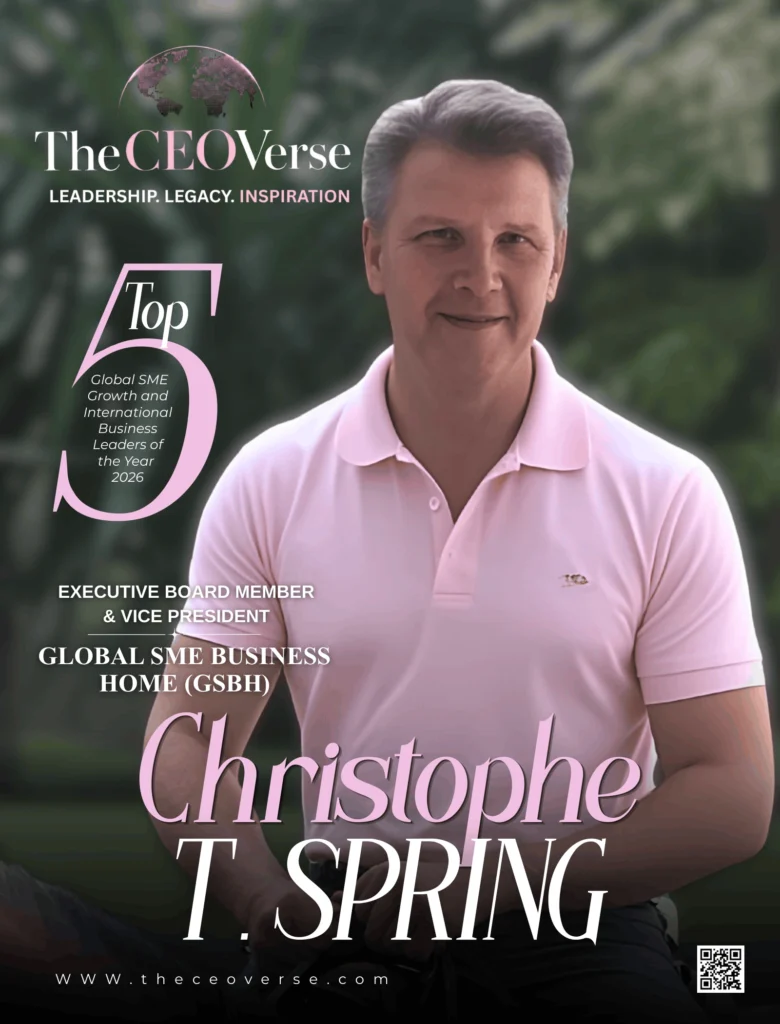
“Top 5 Global SME Growth and International Business Leaders of the Year 2026”
Cover story
Christophe T. Spring
Featured Profile - Christophe T. Spring
The Price of Truth: Inside the Career of Christophe T. Spring
Titles fade. Reputations, if built right, don’t.
Reputation Travels Faster Than Any Résumé
Christophe T. Spring has spent more than four decades working across Europe, North America, the GCC and Asia, and if there is one line that sums up what he took from all of it, it is this: truth often comes at a price, but integrity is priceless.
That is not a slogan he reaches for in interviews. It is something he has tested. There were moments, he says, when speaking openly cost him opportunities and even positions. Asked whether he would choose differently today, his answer is flat. He would make the same decision again, because reputations take decades to build and a single moment to destroy.
The clearest proof of that belief did not come from a strategy document or a quarterly review. It came a few weeks after one of the more difficult stretches of his career, when a new opportunity opened up. Not because of his CV. Because people remembered how he had treated them when things weren’t easy. In a career built on titles and international markets, that single detail says more than most of the rest.
Hard Conversations, Handled With Dignity
Spring’s leadership philosophy did not form in a classroom. It formed across international sales teams, markets developed in more than 36 countries, and conversations conducted in four different languages. Somewhere in that mix, he arrived at a distinction he still holds onto: leadership is not about being liked. It is about being responsible.
For him, the best leaders are the ones willing to have the conversation nobody wants to have. Not because confrontation is the goal, but because avoiding it usually costs more later. What separates his version of this idea from the usual executive talking point is the second half of it. Respect and dignity are not optional extras bolted onto tough decisions. They are the condition under which those decisions get made at all.
Character Is Tested When The Pressure Is Highest
Ask Spring what leadership requires when things go wrong, and the answer arrives without much hesitation. Courage. Leaders, in his view, exist to protect their people, to challenge the status quo when it needs challenging, and to stay true to their principles even when that comes at personal or professional cost.
It is a simple statement, but he backs it with something harder to fake: a willingness to say that character is tested precisely when the pressure is highest, not before and not after. There is also a quieter thread running underneath this, one that surfaces in how he talks about setbacks in general. Standing up, in his framing, was never about never falling. It was about choosing to get back up every single time, a lesson he says was reinforced later in life by a serious hip injury that forced him to rebuild from the ground up.
Weeks Later, A New Door Opened
Has Spring personally paid a price for choosing truth over convenience? More than once, by his own account. Specifically, he points to moments where he stood by loyal employees, questioned decisions that were popular with everyone except him, and defended values that would have been easier to quietly set aside.
None of that, he insists, is something he regrets. Jobs change. Titles disappear. What was left standing, in his telling, was character, and character turned out to be the thing that mattered when a new door opened only weeks after the old one closed. It is a small window into how he actually measures a decision. Not by what it costs in the moment, but by what it is still worth years later.
Titles Fade, Relationships Endure
Roles evolve. Industries change. Markets transform. Spring is comfortable with all of that. What he is not comfortable with is the idea that values should move along with them.
His reasoning is straightforward enough that it barely needs dressing up: people remember how you treated them long after they have forgotten your business card. It is also the closest thing to a personal constant across a career that has otherwise touched almost every continent. Titles fade, in his words. Relationships endure. Everything else in his story tends to circle back to that line in one form or another.
Diplomacy And Business Both Begin With Listening
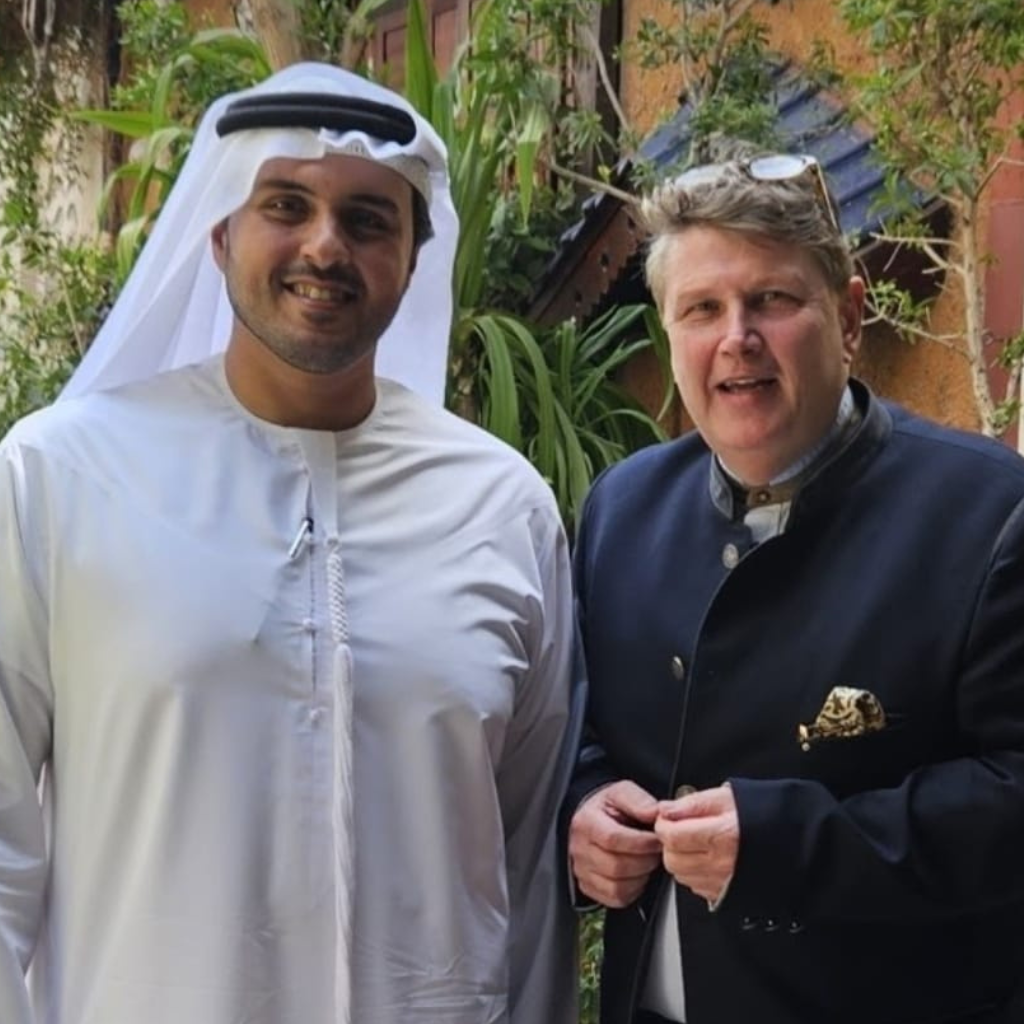
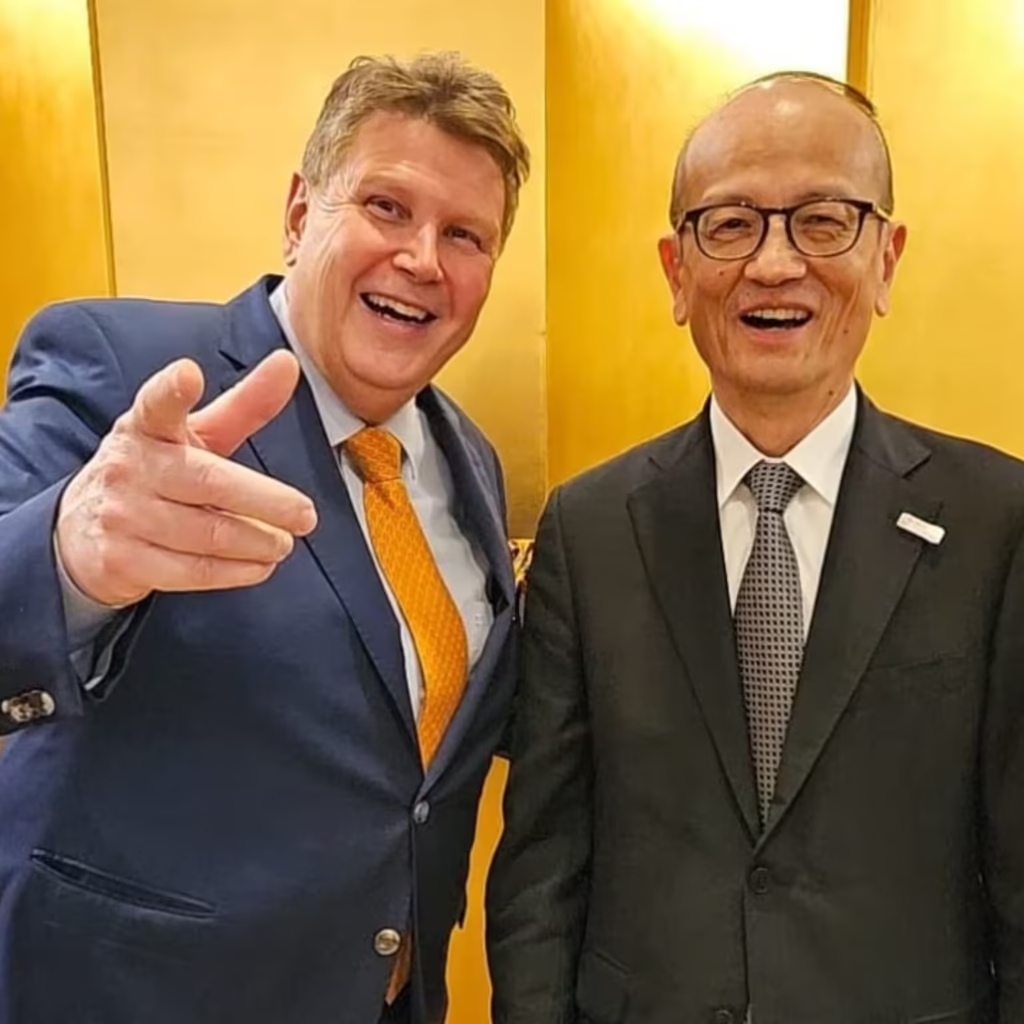
Spring’s international network is not a footnote to his career, it is one of its defining features. Over the years he has built trusted relationships with ambassadors from all five continents, ministers, entrepreneurs, global executives and members of the diplomatic community. Among the moments he singles out are meetings with His Holiness Pope Leo XIV and the Apostolic Nuncio.
These encounters, he says, reinforced something he already suspected. Genuine relationships are built on humility, trust and mutual respect, not on titles. It is a belief that extends naturally into how he sees his current role. Being part of international diplomatic circles is, in his words, an honour, but even more so a responsibility.
Business creates prosperity. Diplomacy creates understanding. Combine the two, he argues, and you get something closer to what the world actually needs: bridges between nations, cultures and people.
The Future Belongs To Those Who Collaborate
That bridge-building language is not just rhetoric for Spring. As Executive Board Member and Vice President at Global SME Business Home, his stated mission has shifted from simply growing businesses to building connections between cultures, industries and people. The future, as he sees it, belongs to those who collaborate, not to those who choose to compete in isolation.
It is a mission statement, but not one he limits to boardrooms and market strategy. It shows up just as clearly in how he spends the time that has nothing to do with business at all.
Lessons No Business School Ever Taught
Away from the boardroom, Spring’s instinct for perspective shows up in less obvious places. Animals have been some of his most consistent teachers. Dogs, he says, remind him of unconditional loyalty. Elephants fascinate him with their intelligence, memory and sense of family.
Horses, though, taught him the most directly. They reward trust, humility and consistency. They have no use for ego, and Spring is fairly direct that this is a lesson no business school ever managed to teach him.
Innovation Begins With Curiosity, Not Technology
Art, architecture and culture round out the picture. They keep him looking at problems from angles he might otherwise miss, feeding a habit of mind that shows up across every market he has worked in.
He is direct about where that habit leads. Innovation, in his experience, rarely starts with technology. It starts with curiosity, and everything else, the tools, the systems, the strategy, tends to follow from there rather than the other way around.
Measured By People Who Still Call Years Later
Ask Spring how he wants his legacy defined and the answer avoids the usual list of positions and awards entirely. He measures his career by the people he helped, the bridges he built, and the trust he earned along the way. Success, in his framing, is measured less by what you achieve for yourself and more by what you enable others to achieve.
He is more specific about this than most executives bother to be. He measures his journey by the people who still call him years later. By friendships that quietly turned into partnerships. By bridges that ended up connecting entire countries, not just companies. By teams that, together, achieved more than any one person in them could have managed alone.
Somewhere underneath all of it sits the same idea he opened with, dressed in different words each time it resurfaces. Leadership was never about being the most powerful person in the room. It was about being the person others trusted when the room got difficult. Titles, in the end, get forgotten. What Christophe T. Spring is betting on is that character does not.