
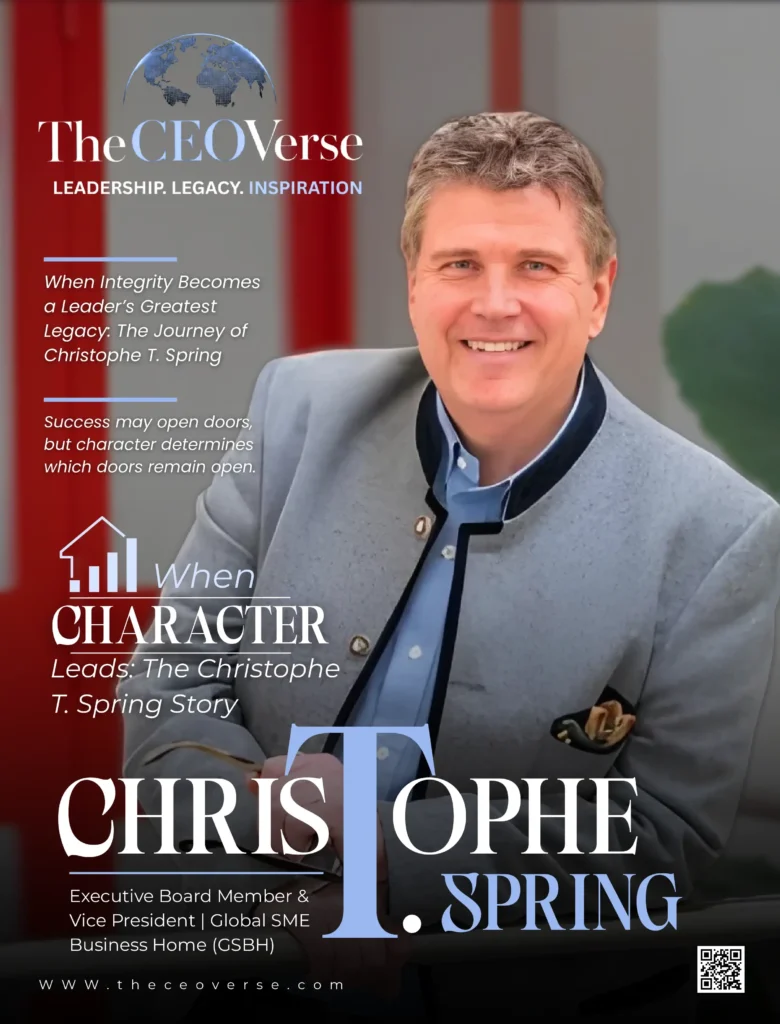
TheCEOVerse • Digital Edition
” When Character Leads: The Christophe T. Spring Story”
Cover story
Christophe T. Spring
Featured Profile - Christophe T. Spring
When Integrity Becomes a Leader’s Greatest Legacy: The Journey of Christophe T. Spring
Across decades, continents and changing business landscapes, Christophe T. Spring has built a career around a principle that becomes clearer with time: success may open doors, but character determines which doors remain open.
A Career Built Beyond Titles
There are careers defined by positions, markets and impressive résumés. Then there are careers defined by the trust left behind. Christophe T. Spring belongs firmly to the latter.
Over more than four decades, his professional journey has taken him across Europe, North America, the GCC and Asia, with business experience spanning more than 36 countries and communication across four languages. Yet, despite the geographical breadth of that journey, one principle has remained remarkably consistent: truth may come with a cost, but integrity carries a value that cannot be measured by a title.
For Spring, this is not an abstract philosophy developed after a successful career. It is a belief shaped by difficult decisions, uncomfortable conversations and moments when doing what he believed was right came with a professional price.
There were occasions when speaking openly affected opportunities and even positions. In many leadership environments, such moments can become sources of regret. For Spring, they became tests of character. Looking back, he does not describe those decisions as mistakes. If faced with the same circumstances again, he would make them in much the same way.
The reason is simple. A professional reputation can take decades to establish, yet only one decision can seriously damage it.
Perhaps the strongest validation of that belief came shortly after one of the more challenging periods of his career. A new opportunity appeared only weeks after an old chapter had closed. It was not his résumé that created the opening. It was the memory people had of how he had conducted himself when circumstances were difficult.
That moment captures something fundamental about his career. The most valuable professional asset is often the one that cannot be listed on a CV.
Leadership Begins Where Difficult Conversations Start
Spring’s understanding of leadership has been shaped less by theory than by experience. Working with international teams, developing markets and navigating different business cultures taught him that leadership is rarely about making everyone comfortable.
It is about accepting responsibility when comfort is no longer an option.
He believes effective leaders must be willing to address the conversations others would rather postpone. Difficult feedback, unpopular decisions, disagreements and moments of accountability are part of leadership, not exceptions to it. Avoiding them may create temporary peace, but it often creates larger problems later.
Yet there is an important distinction in Spring’s approach. Courageous leadership does not require unnecessary confrontation.
For him, difficult conversations should still preserve dignity.
That balance between firmness and respect is central to the way he approaches people. A leader can challenge an employee, question a decision or reject an established way of working without diminishing the person involved. In fact, Spring sees respect as a prerequisite for meaningful accountability.
The objective is not to win the conversation. It is to make the right decision while ensuring that people are treated with dignity throughout the process.
The Real Test Comes Under Pressure
Leadership principles are easy to articulate when circumstances are favourable. Their real value becomes visible when pressure arrives.
Spring’s answer to what leadership requires in difficult moments is straightforward: courage.
He believes leaders have a responsibility to protect their people, question the status quo when necessary and remain faithful to their principles even when doing so creates personal or professional consequences.
That philosophy also shapes his understanding of resilience. Falling is not the opposite of strength. Refusing to rise again is.
This perspective became particularly meaningful after a serious hip injury forced him to rebuild aspects of his life from the ground up. The experience reinforced a lesson that professional success alone could never fully teach: setbacks can alter the path, but they do not have to determine the destination.
The same principle appears repeatedly throughout his career. Challenges may test confidence, reputation and direction, but they can also reveal what remains when circumstances strip away everything superficial.
For Spring, that foundation is character.
Choosing Principles Over Convenience
There have been moments when Spring could have chosen the easier route.
He recalls standing by loyal employees, challenging decisions that were widely accepted and defending values that might have been more convenient to compromise. Those decisions carried consequences, but none became a source of regret.
His reasoning reflects a longer view of leadership.
A position can disappear. An organisation can change. An industry can move in another direction. A professional title can eventually belong to someone else. What remains is the way people remember being treated.
That belief helps explain why an opportunity arriving only weeks after a difficult professional chapter carried such significance for him. It demonstrated that integrity does not always provide immediate rewards, but it can create something more enduring.
Trust travels.
It travels between organisations, industries, countries and generations of professional relationships. A person who has acted with consistency in difficult circumstances often becomes someone others are willing to approach again.
For Spring, that is a far more meaningful measure of success than a title on a business card.
Relationships Outlast Professional Roles
After more than four decades in international business, Spring has witnessed industries evolve, markets transform and leadership roles change. Through all those transitions, relationships have remained the constant.
His perspective is uncomplicated. People may eventually forget a designation, but they rarely forget how they were treated.
That principle has influenced the way he builds professional relationships. Trust is not created through hierarchy. It is developed through consistency, humility and mutual respect.
This becomes particularly significant in an international career. Working across different cultures requires more than commercial knowledge. It requires the ability to understand different perspectives, recognise cultural nuances and listen before assuming.
For Spring, relationships are therefore not a secondary benefit of business. They are one of its most important outcomes.
Where Business Meets Diplomacy
Spring’s international network extends well beyond conventional corporate circles. Over the years, he has developed trusted relationships with ambassadors representing all five continents, ministers, entrepreneurs, global executives and members of the diplomatic community.
Among the notable encounters he values are meetings with His Holiness Pope Leo XIV and the Apostolic Nuncio.
For him, such relationships are meaningful not because of the stature attached to the individuals, but because of what they represent. They reinforce the importance of humility, trust and mutual respect in building genuine connections across borders.
His involvement in international diplomatic circles is something he regards as an honour, but equally as a responsibility.
That distinction matters.
Diplomacy, in Spring’s view, is not simply about formal representation. It is about creating understanding between people who may come from different cultures, economies and national interests.
Business can create prosperity. Diplomacy can create understanding. When the two work together, they can become powerful instruments for building bridges between nations, cultures and communities.
It is a perspective that fits naturally with the role he holds today as Executive Board Member and Vice President at Global SME Business Home.
Building Bridges Instead of Walls
At Global SME Business Home, Spring’s focus extends beyond conventional business growth. His broader mission is centred on connection.
Connecting cultures. Connecting industries. Connecting people.
The philosophy reflects his belief that the future will increasingly belong to those who understand collaboration rather than those who attempt to succeed in isolation.
In a world where markets are becoming more interconnected and professional relationships increasingly cross borders, collaboration is no longer simply a desirable quality. It is a strategic necessity.
Spring’s international experience gives that belief practical weight. Having worked across diverse markets and cultures, he has seen how ideas become stronger when different perspectives are brought into the same conversation.
For him, bridge-building is not merely diplomatic language. It is a way of thinking about business itself.
The Lessons Found Outside the Boardroom
Interestingly, some of Spring’s most meaningful lessons have come from places far removed from corporate life.
Animals have played an unexpected role in shaping his perspective. Dogs have reminded him of unconditional loyalty. Elephants have fascinated him through their intelligence, memory and powerful sense of family.
Horses, however, have perhaps offered the most direct leadership lesson.
They respond to trust, humility and consistency. They do not respond well to ego. Working with them requires patience and an understanding that authority alone cannot create cooperation.
For Spring, that lesson has relevance far beyond the stable. It is a reminder that influence cannot simply be demanded. It has to be earned.
The strongest leaders, much like the strongest relationships, are built through consistency.
Curiosity Is Where Innovation Starts
Spring’s perspective is also shaped by his appreciation for art, architecture and culture. These interests encourage him to look at familiar problems from unfamiliar angles.
That habit of observation feeds directly into his understanding of innovation.
Technology, in his view, is not necessarily where innovation begins.
Curiosity comes first.
The willingness to ask why something is done in a particular way, whether another approach might work better and what can be learned from outside one’s own industry is often the beginning of meaningful innovation.
Technology can provide the tools. Systems can provide the structure. Strategy can provide the direction. But curiosity is what starts the process.
It is an approach particularly relevant to today’s rapidly changing business environment, where innovation is increasingly driven by people willing to challenge assumptions rather than simply adopt the newest technology.

A Legacy Measured in People
When asked to define his legacy, Spring does not begin with positions, awards or corporate milestones.
He looks instead toward people.
The individuals he has helped. The relationships he has built. The bridges he has contributed to creating. The teams that achieved more collectively than any individual could have achieved alone.
Perhaps most tellingly, he measures his journey by the people who continue to call him years after a professional relationship has ended.
Some friendships have evolved into partnerships. Some professional connections have developed into long-term relationships. Some bridges have extended beyond companies to connect people and countries.
These are the outcomes he values most.
They represent a different understanding of achievement, one that moves beyond what a person can accumulate and focuses instead on what a person can enable.
What Remains When the Title Is Gone
Christophe T. Spring’s career ultimately comes back to a principle that has remained consistent through changing markets, countries, roles and circumstances.
Leadership is not about being the most powerful person in the room.
It is about being the person others can trust when the room becomes difficult.
That trust cannot be manufactured through a designation. It cannot be purchased through success, and it cannot be secured by reputation alone. It is earned through thousands of small decisions, especially the difficult ones.
Spring’s professional journey demonstrates that integrity may not always be the easiest choice, and truth may not always be the most commercially convenient one. But over time, those choices can become the foundation of something more valuable than immediate success.
Titles eventually change hands. Positions eventually end. Markets move on.
Character remains.
And if Spring’s four-decade journey offers one defining lesson, it is that the most enduring legacy of leadership is not what people remember about the position you held.
It is what they remember about the person who held it.