TheCEOVerse • Digital Edition
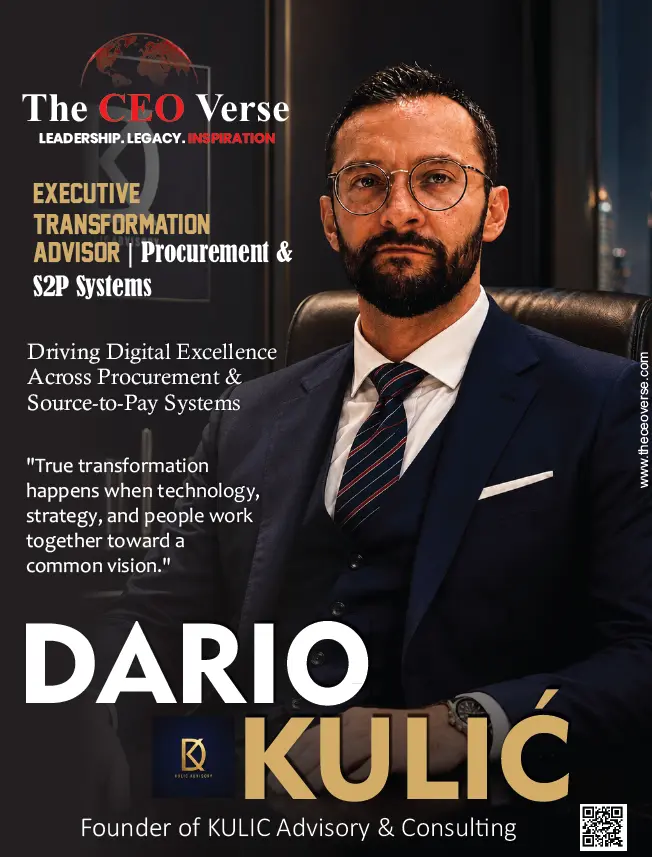
“Executive Transformation Advisor | Procurement & S2P Systems”
Cover story
Dario Kulić
Featured Profile - Dario Kulić
Dario Kulić: The Architect of Executable Transformation
He did not set out to build an advisory firm. He set out to fix the part of transformation that nobody had designed correctly — and eventually realized that required building something of his own.
Organizations Don’t Fail. Their Systems Do.
Dario Kulić spent years watching capable organizations underdeliver. Not because people lacked drive or budget. The problem, as he kept seeing it, was simpler: the execution system had not been designed clearly enough.
His career covers procurement, sourcing, Source-to-Pay, Procure-to-Pay, operating model design, digital automation, and enterprise transformation. The breadth is deliberate. Real transformation problems rarely stay inside one lane.
What the work kept showing him is that transformation fails at the level of structure. Ownership unclear. Decision flow unresolved. Accountability on paper and nowhere else.
That recognition led to KULIC Advisory — built around one purpose: helping organizations move from fragmented initiatives to integrated execution. Clear architecture. Effective transformation.
The Rules He Refuses to Complicate
Kulić works from a principle he states without apology: system over ego. Transformation that depends on individual heroics is fragile. The environment has to be designed so people can execute with clarity.
The rules he applies follow from that. Simplify before you digitize. Define ownership before you scale. Connect decisions to outcomes. Turn strategy into something executable on Monday morning — not a vision document that lives in a shared drive and gets reviewed once a quarter.
He also insists on direct communication. Large organizations tend to hide behind polite ambiguity — language that preserves relationships while obscuring the actual problem. His job is to make the real issue visible without generating unnecessary noise.
Signal over Noise is how he describes that. Not bluntness for its own sake. Cutting through the organizational static that builds up around difficult structural questions nobody wants to name first.
The Numbers Came. Then Came the System.
The milestones in Kulić’s career are mostly internal to the organizations he worked with — procurement and S2P transformation across complex enterprise environments, multi-million value creation through restructuring, negotiation, process redesign, and automation work that actually reduced effort organizations had quietly accepted as permanent.
One example he points to is the Action Bot / P2P automation concept. It showed how digital support can remove significant manual work when process logic and ownership are settled before the technology comes in. The sequencing matters. That is the part most automation projects get wrong — and keep getting wrong.
The larger milestone came after years of pattern recognition across those environments. He built The Kulic Transformation System™ — a structured body of work that translates transformation into ownership design, process architecture, governance clarity, and execution discipline.
Value created in one engagement tends to erode if the architecture that produced it is never understood or institutionalized. The system exists to close that gap.
The Traits That Hold Under Pressure
Resilience comes up first — and not as an abstraction. Transformation environments are politically charged, structurally resistant, and uncomfortable for people inside them. Staying composed when pressure rises is a professional requirement, not a personality trait.
Curiosity runs alongside it. He is less interested in what the problem looks like than in why the system keeps producing it. Organizations frequently present symptoms as root causes, and advisors who accept that framing at face value tend to solve the wrong thing entirely.
Integrity is the third — and in advisory work, it carries a very practical definition. Trust is the real currency. Speaking clearly, challenging respectfully, staying focused on the outcome rather than on theatre or status. That standard does not always make the work comfortable. It does make it worth something.
The Advisory Model He Deliberately Kept Lean
KULIC Advisory’s formats were built around a specific frustration: most organizations in the middle of transformation do not need a large consulting setup. They need a direct answer to a specific question, or a clear read on why execution has stalled.
Open Advisory Hours™ handles exactly that — focused executive sparring for urgent procurement or S2P questions, no large setup required. For organizations where the problem runs deeper, Transformation Architecture Sprints provide structured diagnostic work: find where value is structurally lost, then redesign the execution system around it.
Executive Transformation Advisory is the ongoing format — senior-level sparring on governance, ownership, and decision rights for organizations in sustained change. Interim Transformation Leadership covers situations where execution needs hands-on ownership and the internal capacity simply is not there.
The model stays lean by design. Signal over Noise applies to the advisory structure as much as to the work itself — no unnecessary layers, no bloated engagements, clear architecture and direct execution support.
Building What He Has Always Advised On
The current work at KULIC Advisory reflects the same priorities Kulić has applied across client engagements — turned inward. He is building The Kulic Transformation System™ as a practical set of frameworks covering ownership design, process architecture, governance, and execution clarity. Usable, not ornamental.
Open Advisory Hours™ is being developed as a structured access format for executives dealing with stalled initiatives or unclear ownership. Not every organization has bandwidth for an extended engagement. Most have one specific question that needs a direct answer.
The thought leadership running alongside addresses the structural questions he encounters most consistently. AI will not fix a broken operating model. Procurement, properly designed into the enterprise, is value orchestration — not a cost function sitting at the back of the building.
These are not positions he arrived at recently. They are conclusions from years of watching organizations invest in the wrong layer of the problem.
Five Years. One Executable Direction.
The five-year ambition for KULIC Advisory is specific in direction and deliberately narrow in scope. Kulić wants to build an international advisory platform with one clear territory: transformation architecture, procurement excellence, and execution discipline.
He is not building a consulting factory. Traditional models scale by adding headcount and expanding service lines until the original clarity gets diluted — more noise, less signal. His model scales differently: advisory work, interim leadership, keynote speaking, signature papers, and diagnostic tools that carry the same standard regardless of format or geography.
The question that anchors it is one he returns to consistently: what must change in the system so execution becomes normal? Not exceptional. Normal. That framing shapes the frameworks, the advisory work, and the international presence he is building.
The Structural Problem Nobody Wanted to Name
One persistent challenge in Kulić’s career has been identifying the real problem in environments that are organizationally committed to a simpler explanation. A tool issue that is actually an ownership issue. A governance problem that is actually a decision-rights problem. A data issue that turns out to be an operating model problem wearing different clothes.
The gap between visible problem and structural cause is where most transformation initiatives lose momentum. Organizations are not always being dishonest when they misidentify the issue. The simpler explanation is easier to fund and easier to defend in a leadership meeting.
Naming the structural problem requires patience, pattern recognition, and a willingness to make people briefly uncomfortable in service of something that actually holds.
Working independently raised a different standard. No institutional brand doing half the credibility work. Trust gets built through the quality of the diagnosis and the track record of recommendations that held up when tested against real conditions.
Build Around Problems, Not Titles
The advice Kulić offers professionals building toward leadership starts with structure, not strategy. Do not build a career around titles. Build it around problems you are willing to understand and solve.
That means developing real fluency across finance, process, technology, people, and governance. Leadership decisions sit where those dimensions cross. Leaders who only understand one of them tend to produce solutions that quietly create problems in the others.
He is direct about the difference between visibility and impact. The strongest leaders are not always the most prominent. They create clarity in environments that resist it, build trust with people who are skeptical of it, and help others execute better. Less glamorous than having the strategy. More useful.
AI will change execution speed. The tools will keep shifting. But the organizations that outperform will not be the ones with the best platforms — they will be the ones that got the architecture right before anything else. That has always been the signal worth following.