TheCEOVerse • Digital Edition
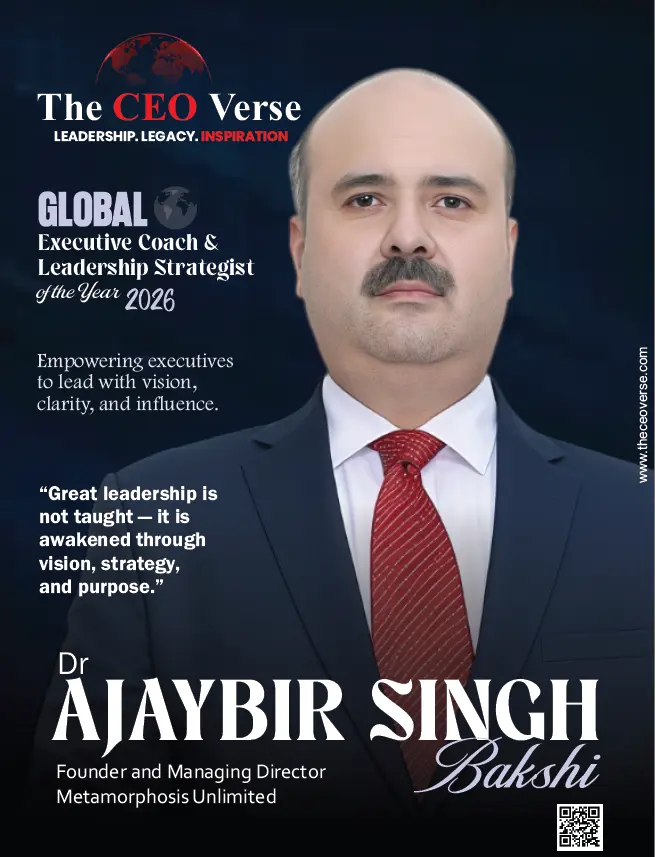
“Global Executive Coach & Leadership Strategist of the Year 2026”
Cover story
Dr Ajaybir Singh Bakshi
Featured Profile - Dr Ajaybir Singh Bakshi
From Boardrooms to Beyond — The Making of a Global Leadership Catalyst
Most leadership careers follow a recognizable arc. You build expertise, you move up, you manage more people than before. Dr. Ajaybir Singh Bakshi followed that arc for three decades — and then deliberately broke from it.
Not because the corporate career had stopped working. Because he had started to see something more useful he could do with everything it had taught him.
He began in HR and organisational development. Not the most glamorous entry point. But probably the most honest one — because when your job is to understand people before strategy, you stop being able to pretend the two are separate. That stayed with him through CHRO and Executive Board Director roles at Prudential and Vodafone. Large organisations, real mandates, real pressure.
In 2016 he founded Metamorphosis Unlimited. Thirty-five years inside large organisations had shown him exactly where leadership breaks — not in strategy documents, but in the gap between what leaders know and what they can actually do under pressure. That gap was what he decided to work on.
Today he works as an Independent Board Director, an ICF-certified coach, a TEDx speaker and an author. The titles matter. But what matters more is the mission behind them — helping leaders and organisations unlock potential, navigate strategic change and build future-ready, high-performance cultures shaped to endure through transformation and uncertainty.
The Principles That Never Moved
He does not talk about this like it is a philosophy. It is closer to a habit.
Continuous learning — not as a performance, as a discipline. Strategic thinking over reactive maneuvering. Authenticity even when it costs something. Execution that is disciplined enough to make ideas real rather than just interesting.
Self-awareness sits underneath all of it. His position has always been that leadership starts with understanding yourself — not as a soft idea but as a practical requirement. Trust follows from that. So does the ability to hold people and performance in the same frame without choosing between them.
Resilience is on the list. Not the kind that gets quoted on slides. The kind you build from watching organisations go through disruption and having to stay steady anyway, usually without acknowledgment, sometimes without result.
He has been doing this long enough that the principles stopped feeling like choices.
A Career Measured in Transformed Lives
The awards exist. Bharat Ratna Samman, citations from Economic Times, Business Today, Forbes India. Speaking slots at the House of Lords in London and WhitePage International in Dubai. These happened.
The credentials are real too — not decorative. Board responsibilities at NITCO Ltd., doctoral qualifications, post-doctoral fellowship, ICF certification at PCC level. Before any of this, two decades inside Vodafone and Prudential, holding CHRO and Executive Board Director mandates at organisations large enough that the decisions actually had consequences.
But the number that actually means something is 200,000. Professionals reached directly or indirectly through Metamorphosis Unlimited since 2016. Thirty-plus CEOs, CXOs, CFOs coached. A hundred and fifty client partnerships — multinationals, public sector enterprises, family businesses, mostly at points where getting it wrong would have cost them badly.
The recognitions are fine. What the work was actually about was the capability left behind in other people. That is a different kind of record.
The Qualities Behind the Consistency
Ask him what drove the results and the answer is not dramatic.
Learning first. Structured, consistent, deliberate — not occasional. He still completes two or three development programs every year. After thirty-five years. Because staying relevant requires staying honest about what you do not yet know. Most people stop doing this earlier than they realise.
Networks second. Not volume — quality of relationship. People who are willing to actually create value together, not just exchange favors when it is convenient. That distinction sounds obvious. It is less obvious in practice.
Resilience third. Staying in the direction you chose when the pressure to change course is loud. He has been inside enough organisational crises to know this separates people more than talent usually does.
None of this is complicated. Most people just don’t do it consistently. That is the whole thing, really.
The Architecture of Transformation
Metamorphosis Unlimited is not a firm that does one thing and calls it transformation. The work sits across the full range of where leadership and organisations actually break down.
Senior end: executive coaching at C-suite level, board advisory, leadership hiring for CEO and CXO mandates, executive compensation design including ESOPs and performance-linked structures.
Organisational level: restructuring and operating model design built around actual productivity and efficiency gaps. Change governance, succession planning, M&A due diligence across the full transaction cycle — pre, during, post. Business strategy through to execution. Leadership development workshops, talent management, diversity and inclusion, HR tech and digitization. These are not peripheral. Leadership transformation that stops at the individual and ignores the system it operates inside tends not to hold.
The diagnostics layer is where a lot of the real work happens. Change readiness assessments, leadership development centres, HR audits, policies and process due diligence. These make the actual problem visible before anything else begins. For organisations that need capability built before they can run it independently, there is a Build-Operate-Transfer model too. Without diagnostics first, everything else is guesswork.
A hundred and fifty client partnerships. MNCs, public sector, family businesses. The pattern across all of them: the presenting problem is rarely the real one.
The Leaders He Is Building Right Now
The sectors are different. BFSI, automotive, pharma, IT, ITeS, FMCG, family-run businesses, public sector. The challenge underneath most of them is similar enough that it stopped being a coincidence.
Leaders who got to where they are through functional excellence now need to think at enterprise level. That transition is harder than it looks. The skills that built the career do not automatically transfer to what comes next. Some do. Some actively get in the way.
Current engagements are focused on that gap — building strategic thinking where operational thinking has dominated, developing executive presence in people whose authority has always come from technical credibility, strengthening global stakeholder capability for organisations moving beyond the contexts they were built in.
A family business in second-generation transition needs something different from a mid-sized IT firm preparing for international scale. The diagnostic runs first. What comes after depends on what it actually finds — not on what the brief assumed it would find.
The Next Five Years — Value Over Volume
Ajay Bakshi is clear about the next phase: it is built around selective depth — partnerships with organisations genuinely committed to transformation, not ones looking for a process to check against a strategy document. That distinction filters out a lot of potential clients. That is the point.
The work itself stays focused on what has always mattered — building strategic thinking and enterprise leadership in people who have outgrown their current frame. Executive presence, leadership branding, organisational effectiveness. Sectors like BFSI, automotive, IT/ITeS, family businesses, public sector — the contexts differ, the gap underneath is usually similar.
Building leadership pipelines that hold. Organisational change that does not revert six months later. Collaborative ecosystems across business, education, social sectors and government. Both organic and inorganic growth pathways are in consideration — but scale is not the measure.
Value created for organisations, for leaders, for the communities they operate in. The right clients understand that distinction already.
Resistance Was the Teacher
The most instructive engagements were not the ones that went well.
Organisations with assumptions so embedded they had stopped noticing them. Senior stakeholders making decisions based on legacy preference more than data. Leadership teams that wanted transformation until it required something from them personally.
The pattern repeated enough that it stopped being frustrating and started being useful. The lesson was not how to push harder. It was how to create conditions where staying the same became more costly than changing. Careful segmentation — finding the organisations and people genuinely open to a different approach. Diagnostics that made the current cost of inaction concrete rather than theoretical. Solutions built for the actual context, not transferred from a previous engagement.
Resistance did not go away. It just became familiar enough to work with. Some engagements still stall. That is the honest version.
For Those Still Climbing
Move toward roles where you are required to create something, not just execute something. The distinction matters earlier in a career than most people think. Execution builds competence. Leadership builds something beyond that. You need both — but the order shapes what kind of professional you become.
Invest in learning as a standing commitment, not a response to a gap. Technical competence erodes faster than people expect. The ones who stay relevant treat development as infrastructure. The ones who don’t tend to notice the gap too late.
Build networks that are actually reciprocal. Not contacts. Relationships where both sides are genuinely creating value. These take longer to build. They are also the ones that exist when you actually need them.
Stay resilient. Harder to teach than the rest. But across decades of watching leadership careers, the pattern is consistent — the ones who lasted were rarely the most talented people in the room. They were the ones who did not stop.
Leadership is built slowly. Most people want it to be faster. It usually isn’t.