TheCEOVerse • Digital Edition
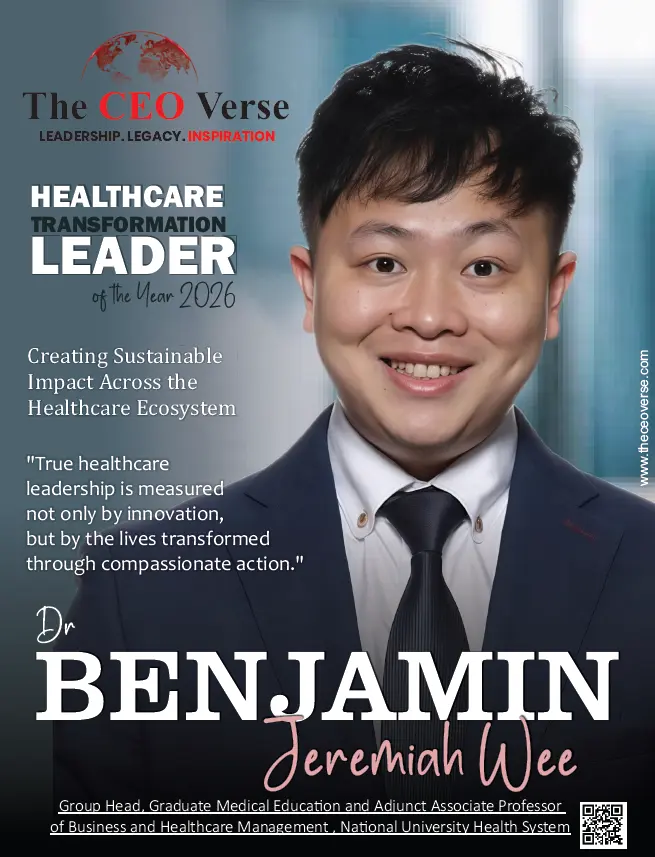
“Healthcare Transformation Leader of the Year 2026”
Cover story
Dr Benjamin Jeremiah Wee
Featured Profile - Dr Benjamin Jeremiah Wee
From the ICU to the Institution
Dr. Benjamin Jeremiah Wee did not set out to lead institutions. He set out to keep people alive. His early years in Singapore’s intensive care units — high-pressure, high-stakes, little margin for error — gave him a view of healthcare that no administrative programme could replicate. At that bedside, a policy decision and its human consequence are rarely more than minutes apart.
That frontline experience left a few things with him that have not shifted. Every change lands on a real person. Leadership matters most when things are uncertain. Whether a healthcare institution holds up usually comes down to how well it supports the people running it, not just the people receiving it.
Over time, he moved into hospital management and administration across Singapore’s academic health sector, picking up portfolios in clinical operations, specialist outpatient services, quality improvement, digital transformation, and business development. Today, he serves as Group Head of the Graduate Medical Education Office at the National University Health System, overseeing residency training across multiple specialties. He also holds an appointment as Adjunct Associate Professor in Healthcare and Business Management — two roles he has always treated as the same work expressed in different rooms.
Transformation Happens Through Trust, Not Authority
The principles Dr. Wee leads by are not borrowed from a framework. Adaptability sits at the centre — healthcare shifts constantly, and leaders who need certainty before they move tend to become obstacles in the environments that need them most. Staying grounded in purpose while remaining flexible in approach is, for him, non-negotiable.
Organisational change does not move through authority alone. The most successful projects he has led were rarely the most technically complex. They were the ones that required genuine alignment across people with different priorities and different definitions of what success looked like. Trust did the work that hierarchy could not.
He keeps returning to a third principle: operational discipline has to stay connected to human-centred leadership. Metrics matter, but healthcare that loses its human element does not become more efficient — it becomes something else. The best institutions are not those that provide more care. They are those designed to provide better care.
Training Doctors Who Lead Healthcare
Two milestones stand apart. The first is his work on large-scale implementation projects within his areas of work the healthcare sector throughout his career — efforts requiring simultaneous coordination across clinicians, administrators, informatics teams, and external partners. Those projects sharpened his instincts around change management and reinforced how much communication determines whether institutional reform holds or collapses.
The second is graduate medical education. Supporting residency programmes and accreditation efforts within Singapore’s academic health sector is, in his framing, a compounding investment. The residents trained today become the clinical heads, programme directors, and hospital administrators of the next decade. The culture they absorb during training is often the culture they reproduce when they hold institutional power. Progress here is not measured in quarters. It is measured in cohorts.
Empathy Carried Him Further Than Expertise
Three qualities have driven most of his professional development, and the order matters. Empathy comes first. Understanding what a protocol change looks like from the perspective of a junior doctor — or a patient navigating a referral process designed for institutional convenience — produces better decisions than any technical analysis alone.
Resilience kept him moving during periods when progress was slow and the path forward was unclear. Institutional change in healthcare rarely produces quick wins. Staying in it long enough to move anything requires learning to absorb setbacks without reading them as permanent verdicts on the work.
Curiosity is the quieter trait, but he credits it with much of his development. He has consistently moved toward complexity rather than away from it — taking on unfamiliar portfolios, asking questions in rooms where he was the least experienced person present. That posture is what separates leaders who keep developing from those who stop and call it expertise.
The Institution Behind the Doctor
The National University Health System is not simply a healthcare provider that also runs training programmes. As one of Singapore’s public academic medical centres, NUHS is structured so that clinical service, research, and education are functionally interdependent — each one designed to strengthen the others. That integration is intentional, and it shapes how the institution approaches workforce development at every level.
Within Dr. Wee’s graduate medical education department, the focus goes beyond clinical competency. The residency model is built around developing doctors who can also lead departments, design better care pathways, and make the case for institutional change when it is needed. Dr. Wee’s office sits at the operational and strategic centre of that work — overseeing accreditation, programme management, and leadership development across specialties.
Five Years. One Direction.
Dr. Wee’s five-year vision is expressed as a direction rather than a target. He wants to contribute to institutions that are more integrated across organisational boundaries, more sustainable in how they use their people and resources, and more deliberately designed around the humans inside them — patients and professionals both.
Within graduate medical education, his intent is to deepen the link between operational leadership and clinical training. Residency programmes that produce technically excellent but institutionally passive doctors are, in his view, a missed opportunity at scale. He also plans to contribute more actively to thought leadership — writing, speaking, and engaging in regional conversations around organisational culture, medical education, and sector redesign. The residents he oversees today will be making decisions affecting hundreds of thousands of patients decades from now. That is the most consequential question his work touches.
Building Cultures Where People Dare to Speak
Dr. Wee’s current work is organised around two priorities. The first is psychological safety — not as a wellness initiative, but as a performance condition. Across the institutions he works with, the pattern is consistent: the teams that catch problems early are almost always the ones where a junior member can raise a concern without first calculating the professional cost of doing so.
The second is operational redesign — using process improvement and digital tools to remove friction that has simply been normalised for too long. Healthcare institutions accumulate legacy workflows the way old buildings accumulate bad wiring. It functions until it doesn’t. His interest is in identifying that wiring before it becomes a crisis, then rebuilding it in ways that work for both the professionals delivering care and the patients receiving it. Both priorities are connected. A team that cannot speak up about a broken process will not fix it.
When Institutions Resist, Relationships Win
Healthcare reform has a predictable obstacle: inertia. Dr. Wee does not romanticise it. Institutions resist change for real reasons — competing priorities, limited resources, and practices that have survived long enough to feel permanent. His approach has not been to overpower that resistance. It has been to build enough relational capital before change begins that the resistance has less room to operate. A compelling vision with no trust behind it is just a presentation.
The second challenge is internal — managing a portfolio that spans leadership, operations, teaching, and strategic projects simultaneously. The lesson he took from it was less about time management and more about clarity of purpose. When everything competes for attention, the question is not which task is urgent. It is which task, left undone, does the most damage to the work that actually matters.
The Leaders Who Last Are Rarely the Loudest
Dr. Wee’s advice to aspiring leaders opens with usefulness — not vision, not positioning. Become genuinely useful to the people and institutions around you before the title arrives. Leadership built on consistent, practical contribution is harder to undermine than leadership built on proximity to the right people.
Technical expertise is necessary but not sufficient. The leaders who create lasting change almost always combine clinical or operational competence with the ability to build trust, stay steady, and communicate across very different perspectives. The expertise gets you in the room. Everything else determines what happens once you are there.
His final point is the one he returns to most in his own work: stay close to the human impact. The metrics, the frameworks, the accreditation cycles — they are tools, not the point. The point is the patient who receives better care because someone upstream made a better decision, and the resident who becomes a better leader because someone invested in them early. Keeping that connection alive, through the bureaucracy and through the long stretches when progress is invisible, is what separates leaders who endure from those who simply occupy positions for a while.