TheCEOVerse • Digital Edition
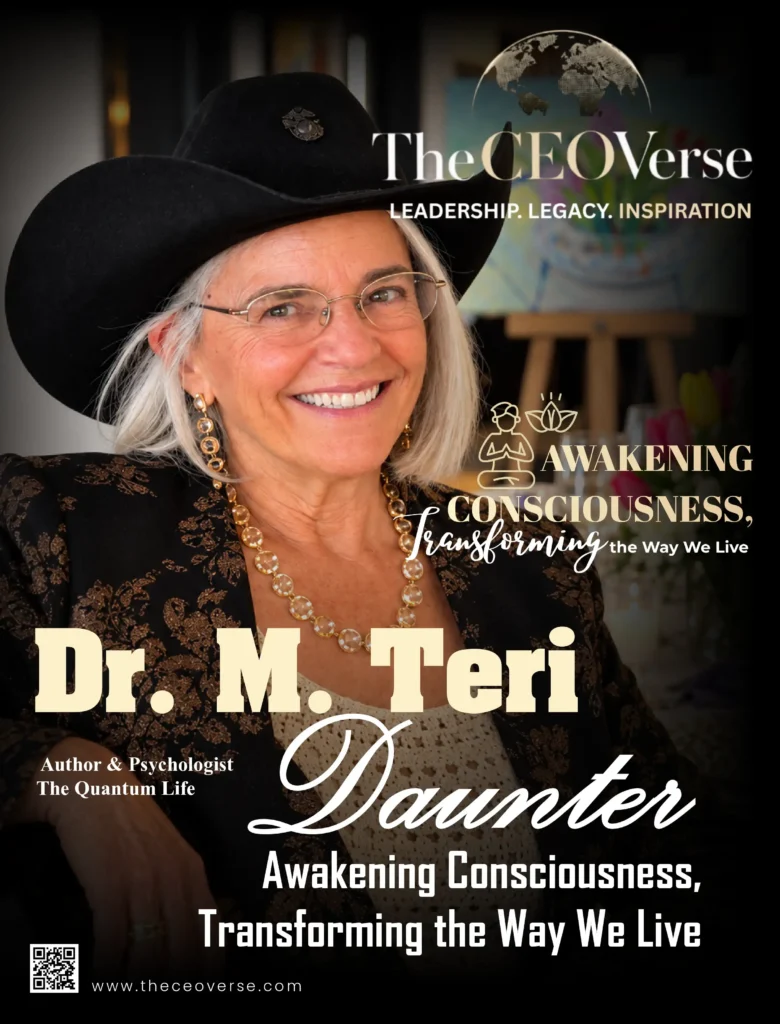
“Dr. M. Teri Daunter: Awakening Consciousness, Transforming the Way We Live”
Cover story
Dr. M. Teri Daunter
Featured Profile - Dr. M. Teri Daunter
A Child Between Two Worlds
Long before she became a psychologist, an artist, a Reiki Master Teacher, or the author of an award recognized book, Teri Daunter was a ten year old girl standing in the wreckage of everything she knew.
She was born on Malta, the small Mediterranean island where history lies in layers of limestone and every street seems to remember someone. She was the youngest of ten children, in a world where identity was handed to you in the cradle. Your family, your language, your neighbourhood, your place in the long line of people who came before. Then, at ten, she was lifted out of it and set down in the United States, in a new language, a new culture, and a new set of unspoken rules.
Most children in that position simply survive the transition. Daunter did something quieter and more unusual. She watched herself. “If I am no longer in Malta, surrounded by everything that defined me, who then am I?” The question arrived at an age when most of us are still collecting our first answers, and it never left her.
Looking back, she describes that upheaval as an unexpected gift. A child who loses her homeland, her language and her extended family learns early that identity is not a fixed possession. It is partly a costume stitched together from the surrounding environment. She saw herself adapting her behaviour to fit each new expectation, and she began to suspect that people build entire selves around such adaptations without ever noticing they have done so. There is, she came to believe, a profound difference between who we are and who we have learned to become.
That suspicion would take her through four decades of clinical practice, two doctoral degrees, thousands of hours of meditation, and eventually to the book that carries her name around the world. At the time, though, she was only a child with a very large question and a very small vocabulary to hold it.
A Lifetime Spent Understanding the Human Condition
In 1982, Dr. Teri Daunter opened Family Psychological Services in Petoskey, Michigan, a lakeside town in the northern reaches of the state. It was a long way from Malta, geographically and culturally, but it suited the work she was about to do. Her specialty was marriage and family therapy, and she has now been in continuous practice for over four decades.
Family therapy is a certain kind of education. A person who sits with a single client sees one story. A person who sits with a couple or a family sees how stories collide, how one person’s wound becomes another person’s trigger, and how a sentence spoken at the dinner table in 1985 can still be shaping a marriage in 2025. Daunter trained at Union Institute and University in Cincinnati, Ohio, earning a doctorate in psychology with a focus on behavioural medicine, and she brought a wide lens to her cases. In working with families, she says, she sees the whole gamut of human behavior and need. Over the years she has accumulated roughly 60,000 clinical sessions, a number that is hard to hold in the mind. Each one was a person, or a pair, or a household, trusting a stranger with the most private rooms of their lives.
From the start, she leaned toward the natural. She trained as many people as possible in mindfulness meditation and favoured gentle, natural approaches to healing wherever she could. Today, natural healing consultations are the foundation of her work. Her practice is physically anchored in Petoskey, but video consultations reach clients around the world.
Over those years, though, a question kept rising out of the sessions, and it was the same question the ten-year-old had asked on a new continent. Beneath the anxiety, the anger, the grief, the arguments over money and the silences between spouses, who exactly was the person experiencing all of this? Who was the one having the thoughts, feeling the fears, clinging to the beliefs?
Psychology gave her excellent tools for describing the contents of a mind. It was less equipped to say what, or who, was doing the observing. She did not abandon her profession over this gap. She is careful to say that psychology did not fail her. But she began to sense that the clinical conversation, however skilled, might be circling something it could not quite reach.
The Day Her World Divided in Two
Then came an event that Daunter describes as dividing her life into “before” and “after.”
She is reserved about the details. What she will say is that it was an overwhelming experience, an encounter with what she calls the Light world, and that it shattered the carefully constructed world she had lived in until then. In that moment, she states, she understood that nothing exists outside of Consciousness, and that everything is a movement of Consciousness. She touched something that felt infinitely more real than ordinary life, and, in the same instant, recognized that the life she had been living was a kind of fiction.
Anyone who has had a moment of that magnitude knows the difficulty of what follows. Daunter puts it as a question. How does a person go back to the ordinary after glimpsing the extraordinary? How do you explain the Infinite when someone asks you how was your day? She was a respected psychologist with a practice, clients, colleagues and a reputation. She could not simply file the experience under a diagnostic heading and move on. Nor did she want to. The challenge was to carry it into a profession built on a different vocabulary, and to keep serving the people who depended on her while her own inner landscape was being redrawn. The earth world became very low resolution. She had to learn to live in two different worlds simultaneously.
What she did next was typical of her. She did not retreat from rigor, and she did not retreat from the experience. She studied. Her doctoral work in quantum oriented integrative medicine, which led to a Ph.D. in Quantum Advanced Medicine and gave her a second doctorate, expanded her understanding of how mind, body and consciousness relate. The conclusion she reached was a reconciliation rather than a rebellion. As she puts it, psychology asks, “What is the mind?” Quantum medicine asks, “From where does the mind emerge?” The two questions, she decided, could inform one another. That marriage of disciplines became the foundation of what she now calls Quantum Life Therapy.
Silence as a Practice, Not a Luxury
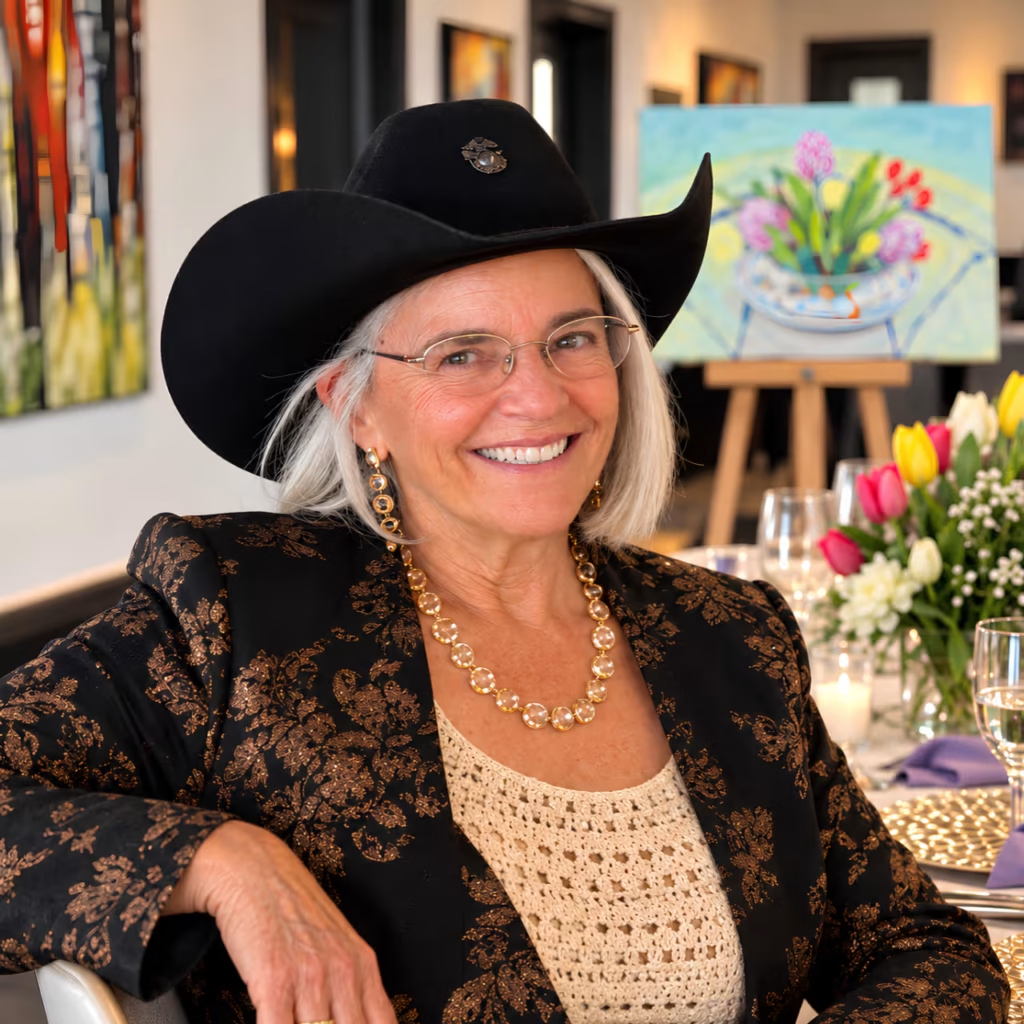
If one practice holds Daunter’s whole life together, it is meditation. She has meditated for more than forty years, and she speaks of it without any of the breathlessness of the recent convert. For her, it is not an accessory to a busy life. It is the ground on which the life stands.
She describes stillness as something other than escape. In a civilization saturated with information, opinion and constant stimulation, she argues, we mistake mental noise for awareness. When people finally sit quietly, they discover how much internal commentary has been running unnoticed. Replaying the past, rehearsing conversations, bracing for futures that may never come. Her invitation is modest. Five minutes, a steady breath, and the simple act of noticing thoughts without immediately following them.
Her claims for deeper practice are bolder. She speaks of meditation as a bridge to what she calls Infinite Creative Intelligence, and she links stillness to coherence in the brain, citing the synchrony associated with gamma waves, the fastest brain rhythms, and the clarity and focus that accompany them. A quantum jump, she says, does not come from trying harder. It comes from settling into coherence. Readers can weigh these ideas for themselves, and she is careful to note that her computer metaphor for consciousness, the body as hardware, conditioning as software, and awareness as something more like the wider network the machine connects to, is a metaphor and not a scientific proof. What is beyond dispute is the consistency of the practice behind it. Four decades of daily stillness is a data set of its own.
Her teaching on this subject can be reduced to a single instruction that she offers readers of any background. Before you enter the world, enter silence. Look in. Go in. She insists that there is an inner stillness no circumstance can destroy, not illness, not loss, not disappointment, not even success.
When the Brush Picked Her Up
Something curious happened in those meditations. Art arrived.
Dr. Teri Daunter had never studied art. She had no training in composition, pigment or technique. But some years into her meditation practice, she found that she could not not paint. Images pressed through her during stillness, and she began to sit in front of blank watercolor paper, meditate, and wait to see what emerged. She calls the results spirit inspired work, and in 2010 she gave this second life a name, TATTVA Art Works, operating from Petoskey.
The art found its audience. She was invited to mount a solo exhibition of her paintings, nearly fifty of them. When she asked the gallery director why her work had been chosen, the answer was one she treasures. Because her paintings made viewers ask more questions than they gave answers. For a psychologist whose whole career is organized around the power of a good question, it was perhaps the highest compliment available.
She has a theory about why art matters in healing. Words, she says, cannot carry everything. Color, light, movement and form can communicate experiences that resist explanation, and painting can become an experience of presence rather than an attempt to impose a predetermined structure on the world. In her own life it has been another doorway into the same silence.
A Teacher’s Mandate from Across the World
Her path into Reiki is one of the more striking threads in her story, and it began long before the art. Since 2000, Dr. Teri Daunter has served as a Reiki Master Teacher, teaching the Usui Reiki Method through Reiki One Source Academy. Students come to her from around the world, and she trains them remotely through to their third degree and teacher certifications.
The origin of this vocation, in her telling, was not a career decision. She describes being instructed, in meditation, to teach Reiki globally by Paramahansa Yogananda, the spiritual master of India, whose devotee she remains. It is the kind of statement that may stretch the comfort of some readers, but it fits the pattern of her whole life. Guidance that arrives in stillness and is then carried out with practical discipline. She has now taught Reiki practitioners internationally and says she has witnessed what she calls remarkable healings.
The thread connecting psychology, painting, meditation and Reiki is a stubborn one. In each, she is trying to reach beyond habitual interpretation and the ordinary categories through which we explain ourselves to ourselves. Each practice is a different instrument aimed at the same horizon.
The Book That Would Not Wait
Nothing in her career prepared her for the experience of writing The Quantum Life, least of all because she did not plan to write it.
For two years, something had been pressing on her from within. She did not know what it was. She assumed it might be another work of art, since painting had erupted through her in the same unbidden way. Then, abruptly, it became clear that the pressure wanted words. “I became the pen in the hand of a writing Consciousness,” she says. “I couldn’t not write.”
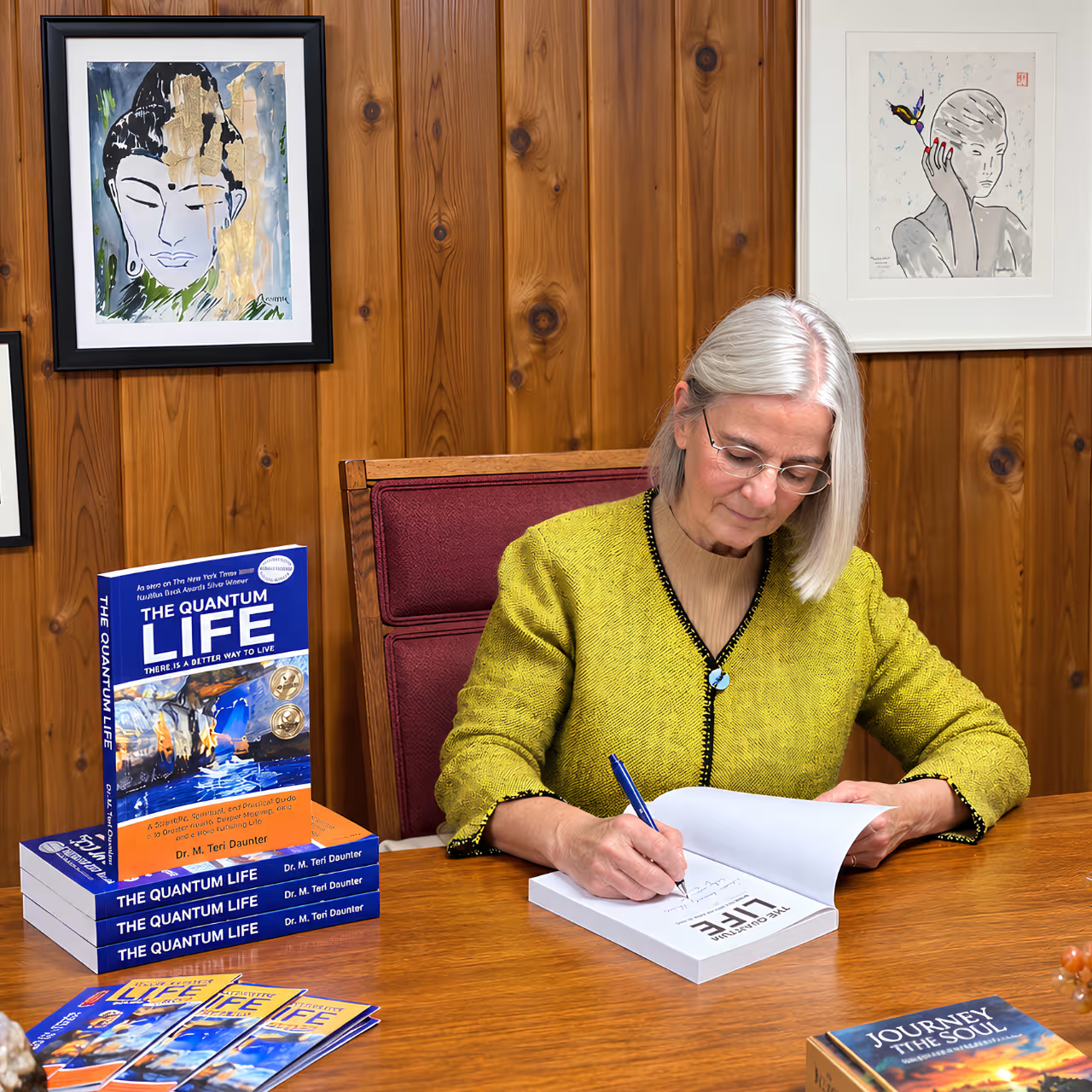
The book that emerged, The Quantum Life: There Is a Better Way to Live, is part philosophy, part clinical observation, part spiritual provocation. She calls it her soul’s harvest. Its premise draws on everything she had seen in her consulting room. For decades she had watched people spend enormous emotional energy trying to satisfy expectations they had never consciously chosen. They lived by inherited definitions of success, worthiness, love and happiness, and they had never questioned where those definitions came from. The tragedy, as she sees it, is that people can spend an entire life becoming who they believe they are supposed to be, without ever discovering who they actually are.
The book does not whisper. Daunter argues that normal is not the same as healthy, that normal can be functional neurosis dressed up as success. From birth, she writes, we are taught to divorce ourselves from ourselves, from each other and from silence, and the irony is that we do not notice the divorce because everyone around us is divorced too. We are born human and then conditioned by narrative. Her central message fits into seven words. There is no power outside of you. None.
She is quick to say what the sentence does not mean. It is not a denial that external forces exist, or that other people can wield real power over our lives. It does not tell anyone to dismiss experts or refuse help. It is a claim about psychological surrender. The habit of handing our inner authority to approval, judgment and conditioning. A mature person, she says, can listen to professional advice, weigh competing views, examine the evidence, and still take conscious part in decisions about her own life. Genuine self awareness includes recognizing the limits of our own understanding.
Reception: Provocation and Praise
Readers have responded in kind. One described the book as pure cerebral “spiritual detonation”. Another review joked that it might cause excessive self-awareness and an uncontrollable urge to break free from mental chains. Independent literary reviewers have tagged Dr. Daunter as “a spiritual whistleblower”, a label she wears with some amusement, honor and pride.
Critical response has been thoughtful. A reviewer for Pacific Book Review noted that the book might at first glance read as a series of well intentioned rants, then compared it to the essays of Emerson and argued that closer reading reveals a gold mine of insight. The reviewer observed that Daunter pulls in ideas from quantum theory and entanglement alongside what he called ageless wisdom, and that she singles out inherited orthodoxy as the culprit behind many of our limitations. Promotional materials for the book compare its scope to the work of Wayne Dyer, and reviewers have praised her ability to render complex ideas in an accessible way.
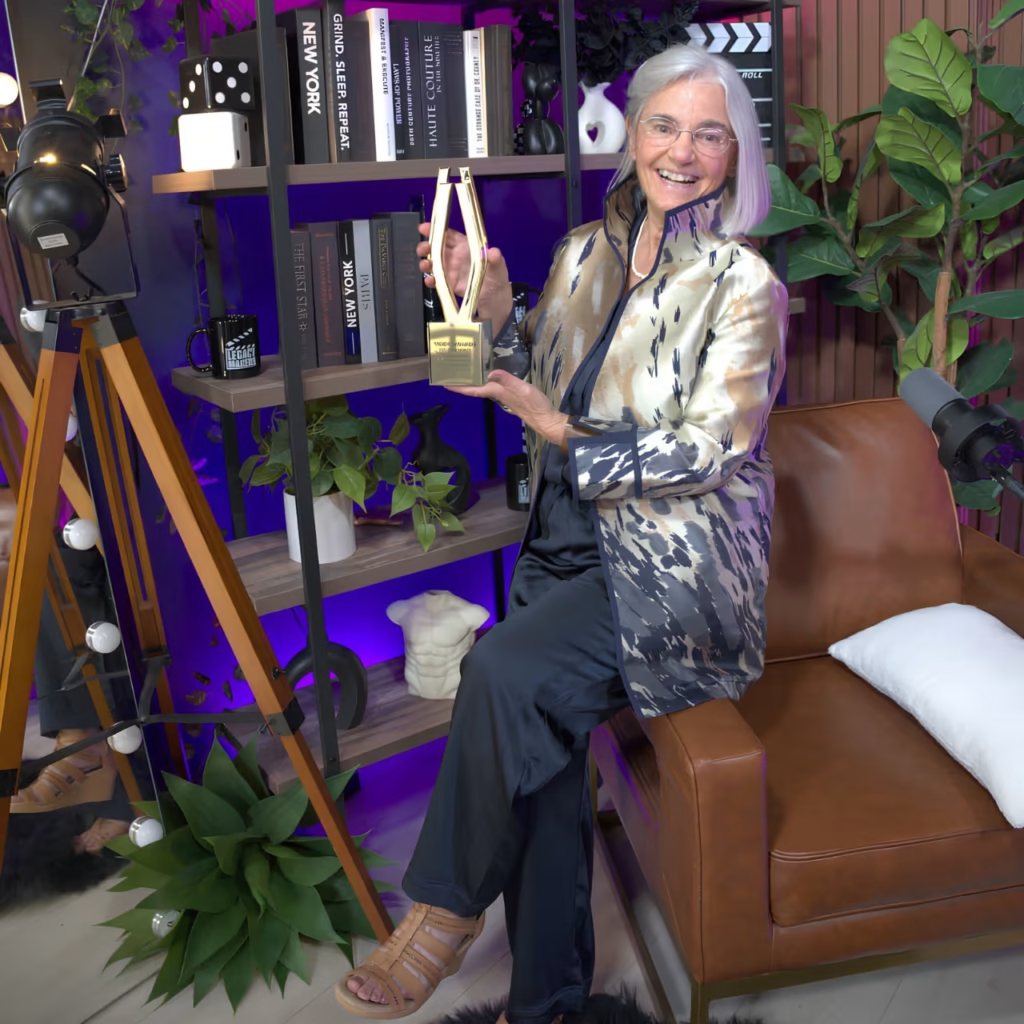
The honors followed. The Quantum Life received the Nautilus Silver Book Award, and it was named a finalist for both the Eric Hoffer Book Award and the Montaigne Medal, the latter an additional distinction from the Hoffer program for the most thought provoking books, those that illuminate, progress or redirect thought. Daunter herself was also named an Author of the Year finalist. For an independent voice working outside the conventional publishing machinery, these recognitions matter. The Hoffer program in particular exists to champion small, academic and independent presses.
The book has also travelled. It has been translated into Spanish, as La Vida Cuántica, and German, reaching readers across cultures and languages. Daunter has appeared on a long list of podcasts and interview programs, including conversations with Chris Voss, Marianne Pestana, Saras Naidoo, Jason Gobeli, Maria Verdeschi and Sophie Campise, as well as Inside Success TV. A documentary has also been filmed about her life journey and The Quantum Life and will drop on Amazon Prime in 2027 under the title: There Is No Power Outside of You. None. Her website describes the book as a movement and not merely a book, and the language is not entirely marketing. The movement is a conversation, one reader at a time, about waking up before the mask becomes permanent.
How She Works: A Different Question in the Room
For clients, the philosophy shows up in a simple change of opening move. Conventional therapy tends to begin with “What is wrong?” Daunter begins with “What is this experience revealing about the way you understand yourself and your world?” Her website phrases it a little differently. Rather than asking what is wrong, she asks what is being expressed.
The distinction is practical. She gives the example of someone who feels rejected whenever another person disagrees with them. On the surface, the problem is conflict. Underneath, the real question is why another person’s independent opinion feels like a threat to one’s worth. Once people start examining the assumptions beneath their reactions, they often find that their emotional responses are not inevitable. They come, at least in part, from the meanings attached to events. In couples and families, this matters enormously, because partners and relatives are rarely responding only to each other. They are responding to their own histories and expectations.
She is also unusually gentle about human brokenness. People, in her view, are not broken. They are asleep at the wheel. Anxiety may be the residue of repeated uncertainty. A compulsion to comply may come from learning that love must be earned. A belief that worth equals achievement may be an adaptation that once made sense. None of these patterns indicates personal inadequacy. They are old solutions that may no longer serve, and healing begins by asking whether they still do.
Her listening for the signs of an inherited life is attentive. She suggests paying attention to the small phrases that rule our days. “I should,” “I must,” “What will people think?” If you were not worried about approval, rejection or disappointing others, would you still make this choice? An outwardly successful person who feels emptiness, resentment or exhaustion in private may be living inside a role rather than a self. The roles themselves are necessary, she says, whether dutiful child, accommodating spouse or endlessly available parent. The trouble starts when we can no longer tell the difference between performing a role and being a Self. And she is firm that authenticity is not selfishness. It is self care, the willingness to stop abandoning oneself in pursuit of acceptance.
Change, she acknowledges, is hard. Knowing that a pattern is destructive does not dissolve it, because the pattern feels true precisely because it is familiar. What helps is the interruption. The moment someone pauses to ask what they are feeling, what they are assuming, what meaning they are assigning, and who is doing the thinking. Supported by behavioural practice and appropriate therapeutic help, repeated awareness can gradually reshape even long standing habits.
Taking the Art of Healing to the World
What gives her work its reach is not only its philosophy but its accessibility. Her practice takes individuals, couples and families, and the website describes each pathway plainly. For individuals, a personalized space to move beyond diagnosis toward clarity and meaningful change. For couples, help in understanding the deeper patterns that shape their connection. For families, work with the household as a system in which each person influences the whole. Video consultations carry all of this beyond Michigan’s borders, and her Reiki training carries a second strand of service to students worldwide.
Her service also looks forward. When asked what a better society might look like, she imagines schools that teach children not only to read, count and achieve, but to examine how they interpret themselves and their world. A child who learns that a thought is not necessarily a fact, that an emotion need not dictate behaviour, and that someone’s disapproval does not cancel one’s worth, would grow up with a different kind of freedom. Families might stop passing unresolved emotional patterns from one generation to the next. Success itself might be redefined, measured less by status and wealth and more by integrity, meaningful relationships and ethical responsibility. She does not claim that self awareness alone can cure injustice or structural inequality, but she argues that a society of people better able to examine their assumptions would have a stronger foundation for change.
She calls it a global education in sovereignty, and she thinks it should begin at birth. In an age when children are told, in her words, that they are fodder for the algorithm, the idea of teaching them that power does not reside outside themselves is not small.
A Lifelong Conversation with the Unknown
It is tempting, when telling any life, to look for the straight line between its beginning and its end. Daunter’s life has more of a spiral. A ten-year-old girl in a foreign country asks who she is without the things that defined her. Decades later, that same woman sits in a clinical room in Petoskey, in front of the sixty thousandth client, asking essentially the same thing on that person’s behalf. She has since taken the question through psychology, through quantum medicine, through meditation, painting, Reiki and a book that took hold of her and would not let go.
The challenges in her story are the ones she names with candor. The displacement of an immigrant child, the shattering of a settled worldview, the delicate work of holding a clinical profession and a mystical experience in the same hands, and the courage of publishing a book that cheerfully calls normal life a kind of neurosis. She does not present these as obstacles overcome so much as teachers consulted.
Asked what single message she would want everyone to keep, she does not hesitate. Enter the silence before you enter the world. She likens our relationship to Consciousness to a fish that has never noticed water. And she hopes that her work, in the end, will keep a certain regret from arriving too late. The realization, at the end of life, of having lived someone else’s life.
Her own conclusion is simple, and it is the line she most wants to outlast her. There is no power outside of you. None. Not as a boast of human omnipotence, she says, but as a reminder that we need not surrender our inner authority to the identities, expectations and limitations we inherited.
For the leaders, founders, young learners, people who spend their days managing expectations, metrics and other people’s definitions of success, her question may land with unusual force. Who is doing the thinking? It is not a comfortable question. But a woman who has spent more than forty years asking it of others, and of herself, insists that it is the beginning of a better way to live.