TheCEOVerse • Digital Edition
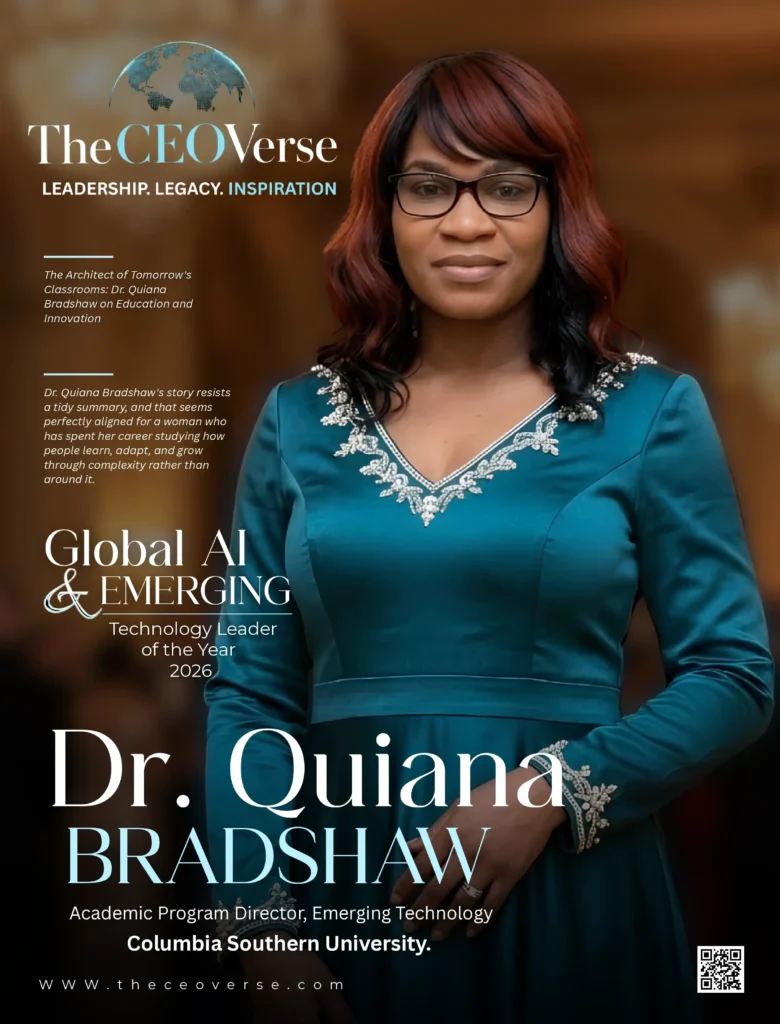
“Global AI & Emerging Technology Leader of the Year 2026”
Cover story
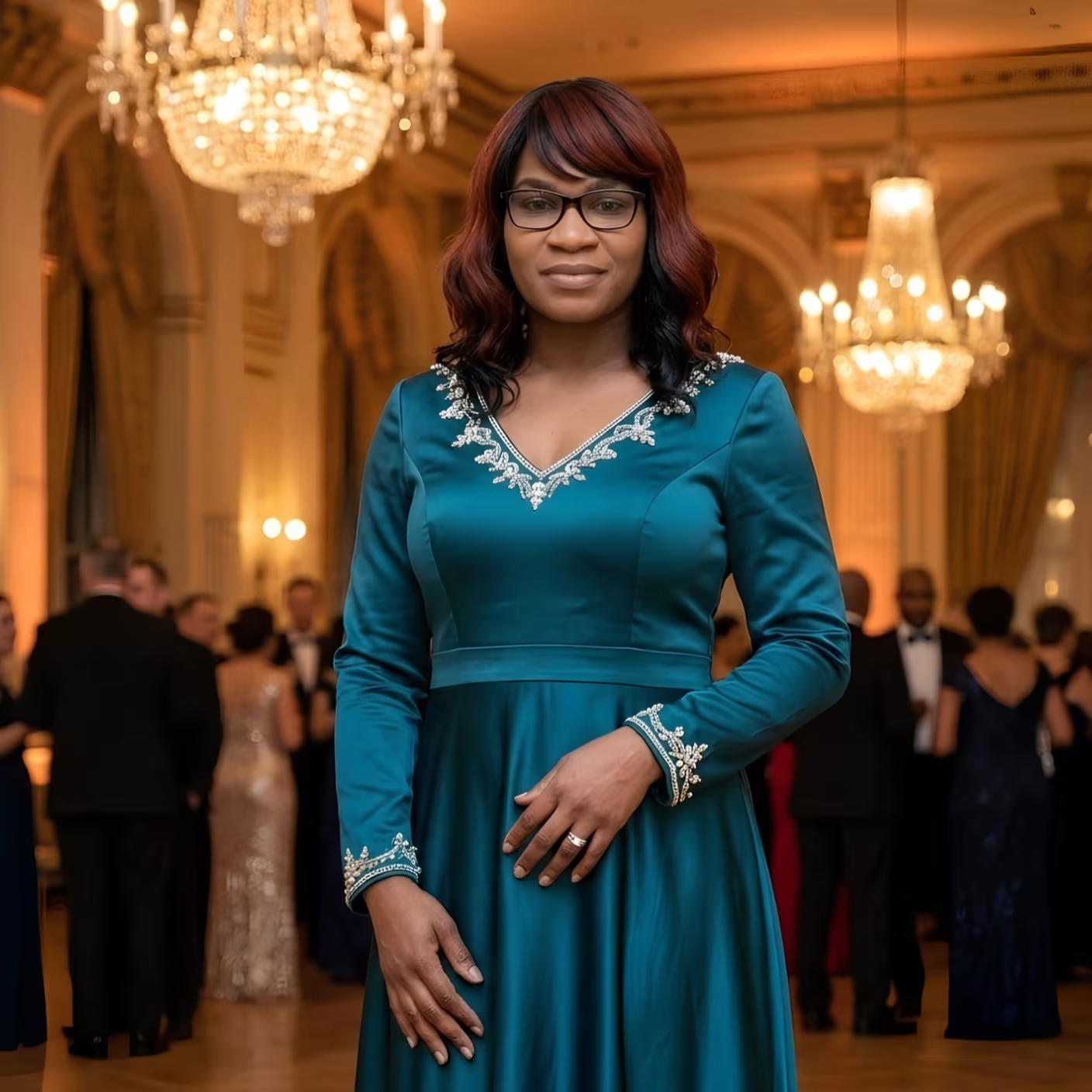
Dr. Quiana Bradshaw
Featured Profile - Dr. Quiana Bradshaw
The Architect of Tomorrow’s Classrooms: Dr. Quiana Bradshaw on Education and Innovation
There are stories that inspire because they shine with the effortless light of success, and then there are those that ignite because they rise from the ashes of survival. A stubborn resilience that eventually becomes the foundation for something far greater than the life that bore it. Dr. Quiana Bradshaw’s story belongs wholly to the latter. Today, she stands as an Academic Program Director of Emerging Technology at Columbia Southern University, a Doctor of Computer Science, a published researcher in artificial intelligence, immersive worlds, game-based learning, and a respected voice shaping the futures of artificial intelligence and data science education. Yet, to trace the constellation of her achievements, one must first journey back to a quiet morning in February 2011. A morning that arrived without warning and very nearly stole away her ability to see the world at all.
The Morning Everything Changed
On February 7, 2011, Quiana Bradshaw was a doctoral candidate pursuing her Doctor of Computer Science degree, working as an adjunct professor, and busy building the academic career she had worked years to earn. She had no history of diabetes. She had no warning. And then, without any prior diagnosis, she slipped into a diabetic coma with a blood glucose level of 1,100. A number so extreme it is rarely survivable without immediate, aggressive intervention.
She woke up three days later, disoriented and trying to piece together what had happened to her body. But the coma was only the first blow. As she regained consciousness, she realized she could not see. She was temporarily blind, and for an entire week, no one, including herself, knew whether her sight would ever return.
For most people, that would be devastating. For a woman in the middle of a doctorate in computer science, a field built on screens, code, and visual precision, it felt like the ground had opened beneath her entire future. She spent eight days in the hospital, fighting to stabilize physically while quietly wrestling with a far heavier question. If her vision didn’t come back, what would happen to the dream she had spent years building?
From Darkness to Direction
Recovery is rarely a straight line, and Quiana’s was no exception. Faced with a body that no longer felt familiar and a future that suddenly felt uncertain, she made what she now describes as one of the hardest decisions of her academic life. She took a 14-week leave of absence from her doctoral program.
It is worth sitting with what that decision actually meant. She had already invested years into her Doctor of Computer Science degree. Stepping away, even temporarily, felt, in her words, like putting her dream on hold with no guarantee of when, or whether, she would be strong enough to pick it back up. Some people she considered friends told her outright that she should just quit. Yet, quitting was never part of her DNA. She had two young children counting on her example, and giving up simply wasn’t a message she was willing to pass down.
Then, exactly one week after her release from the hospital, the answer she had been praying for arrived. Her vision returned. For Quiana, it wasn’t just a physical recovery. It felt like the return of possibility itself. She emerged from that season healthier, more intentional, and more determined than she had ever been before. It was from the grace of our God, Yahuah that I had the strength to turn things around.
A Second Chance Becomes a New Purpose
When Quiana returned to her doctoral program after those 14 weeks away, she came back changed. She was no longer simply working toward a diploma. She wanted her education to mean something far beyond her own achievement. Her experience navigating a life altering diagnosis while pursuing a technology degree planted a very specific idea in her mind, one that fused her personal struggle with her professional expertise.
She began pursuing Institutional Review Board (IRB) approval to design an application aimed at helping students with diabetes manage their blood glucose levels while juggling the intense demands of doctoral level work. It was a deeply personal answer to a problem she understood better than almost anyone. How do you keep a chronic condition from quietly derailing an ambitious academic life? Her long-term goal is to continue refining that idea and pursue trademark protection, so it can eventually reach and help others living with diabetes. What could have been the single event that ended her academic career instead became the spark for a project designed to help other people avoid that same fear.
Motherhood in the Middle of a Doctorate
While Quiana was rebuilding her health and her academic momentum, life did not pause to accommodate her recovery timeline. During the second year of her doctoral studies, she and her husband welcomed their first child. During the third and final year of the program, they welcomed their second. Her daughter, Nadia, was just six months old when Quiana officially became Dr. Quiana Bradshaw, completing her Doctor of Computer Science. Two years later, she and her husband welcomed a son.
In that stretch of her life, Bradshaw was simultaneously a new mother, an adjunct professor, a doctoral student, a wife, and a woman learning to live with a diagnosis that had arrived without warning. There were days, she admits, when exhaustion won and she questioned whether she had anything left to give. But she kept moving forward. She ultimately graduated six months later than her original target date, still within the same calendar year, and rather than viewing that delay as a blemish on her record, she has come to see it as part of the story that makes the achievement meaningful. Her dissertation, “Learning Game Design Characteristics through the Study of Flow and the Elemental Tetrad in the World of Warcraft & Minecraft,” was recognized as a significant contribution to the field of game-based learning. A fitting first chapter for a career that would go on to blend technology, education, and human resilience.
From Adjunct to Architect of Innovation
Bradshaw’s professional climb has been anything but a straight escalator ride. She began her academic career as an adjunct professor, then moved into a role as assistant professor of computer science, later becoming lead faculty for data science and artificial intelligence. And eventually stepping into her current role as Academic Program Director, Emerging Technology at Columbia Southern University. Along the way, she has also held faculty positions at institutions including Purdue University Global, Campbellsville University, Southern New Hampshire University, and Judson University, where she was recognized for her contributions to the field of game-based learning in academia.
What stands out about that trajectory isn’t just the upward movement, it’s the consistency of theme running through every title. Whether she was teaching foundational computer science courses or shaping curriculum around artificial intelligence, Quiana has remained anchored to one central idea. Technology should be built and taught in ways that genuinely serve the people using it, not just impress the people building it. That ideal now shapes how she guides the next generation of students moving through Columbia Southern University’s Emerging Technology programs, many of whom are navigating their own version of the uncertainty she once faced.
A Scholar’s Passion for Play and Purposeful Design
Long before gamification became a familiar buzzword in corporate training decks, Bradshaw was studying it seriously. As a researcher, not a trend follower. Her academic work has focused heavily on game-based learning, virtual world simulations, and the design characteristics that make digital environments genuinely educational rather than simply entertaining. Her dissertation research, which examined the concept of flow and the “elemental tetrad” framework within the immersive worlds of World of Warcraft and Minecraft, explored how deeply engaging game mechanics could be intentionally translated into effective learning experiences.
Her published work extends across multiple academic conferences and publications, including presentations at the IEEE, Gatherverse AI Summit, Colleges and Community (TCC) Worldwide Online Conference, where she examined educational game simulation in academic environments, and contributions exploring how emerging media and virtual worlds could reshape the future of instruction. It is research that sits at a rare intersection. Technical rigor paired with genuine curiosity about how people actually learn, remember, and stay motivated. That same curiosity now drives her current focus on artificial intelligence and data science. These are the fields she approaches not as abstract technical disciplines, but as tools that, used well, can expand opportunity for people who might otherwise be left behind by rapid technological change.
The Village Behind the Vision
Ask Quiana who helped her survive the hardest season of her life, and she doesn’t hesitate. God (Yahuah), her husband and her sister, Leah, were the two people who stood beside her hospital bed, who learned to administer her insulin, who supported her recovery day by day when she couldn’t manage it alone. When she had to step away from her doctoral program, they were there. When she had to relearn how to live with a diagnosis she hadn’t seen coming, they were there too. God (Yahuah) has given me a second chance to get it right with her life and health.
Beyond her immediate family, she credits her longtime best friend Susanne Schepe, who has offered guidance and encouragement for years, even from across the distance of Germany. Being a part of the wider circle that helped carry her forward. She also speaks openly about her faith as a source of strength throughout the ordeal, describing it as the constant presence that gave her the endurance to keep going when the outcome was still unknown. For Quiana, none of her accomplishments exist in isolation. They are the product of partnership. Of mentors, colleagues, students, researchers, and loved ones who each contributed knowledge, encouragement, or simply presence at the right moment.
Standing on Ground She Built
Quiana doesn’t shy away from discussing the professional rejection she has faced. She has applied to numerous organizations and, at times, been denied a seat at the table. Occasionally hearing the discouraging suggestion that she should simply be “ordinary,” or messages implying she didn’t belong in certain rooms at all. Rather than let that shrink her ambitions, she used it as fuel. Her mindset, as she says, shifted into overdrive. If the door wasn’t opening the way she expected, she would build something worth walking through it for.
That resilience is woven into how she now talks about success. She has reframed her personal narrative around a simple but powerful distinction. Quiana doesn’t measure her greatest accomplishment by the doctorate, the professorships, or the leadership title. She measures it by the fact that she refused to let the most difficult season of her life convince her that her story was over.
Judging Innovation, Giving Back to the Field
Quiana’s commitment to advancing technology and education doesn’t stop at her own institution’s walls. Since 2016, she has served as a judge for the CODiE Awards, one of the technology industry’s longest running recognition programs, evaluating innovative products shaping the future of education and technology. Since 2018, she has also served as a Game Judge for the International Serious Play Awards at the Serious Play Conference, an honour reserved for professionals with deep, sustained experience in game-based learning and simulation design.
These roles are more than professional credentials. They reflect Quiana’s ongoing investment in a field she believes in deeply. Judging emerging products and games means staying at the leading edge of educational technology, evaluating what genuinely moves the needle for learners versus what merely looks impressive on the surface. It’s service work in the truest sense. Unpaid, demanding, and driven entirely by a desire to see the field grow stronger.
A Word for the Next Generation
When asked what advice she would offer someone just starting their own journey, Dr. Bradshaw doesn’t offer polished platitudes. She offers something closer to hard won wisdom. She reminds people that unexpected challenges are inevitable. Setbacks, disappointments, delays, moments of real doubt about whether you have what it takes to keep going. She has lived every one of those moments herself, from a diabetic coma she never saw coming, to temporary blindness, to a 14 week pause in a degree she had already invested years into.
Her central message is that none of those circumstances have the power to determine how a story ends. You don’t need everything figured out, she says. You don’t need to know the exact path forward. You simply need to be willing to take the next step, however small that step might be on a given day. Ask for help when you need it. Learn from setbacks instead of being defined by them. And resist the temptation to compare your timeline to anyone else’s. A delay is not failure, a detour is not being lost, and a setback is not the end of the chapter.
The Chapter Still Being Written
Today, Dr. Bradshaw views her recognition and her platform not as a finish line, but as an expansion point. Professionally, she sees her ongoing work in emerging technology, data science, game-based learning, digital twins, and artificial intelligence as an opportunity to help people not just adapt to the future, but actively participate in shaping it. She’s especially focused on students and emerging professionals who look at their own circumstances, including health challenges, non-traditional paths, unconventional timelines, and quietly wonder whether they belong in the room at all.
Her answer to them is the same lesson she had to learn about herself. A starting point does not determine a destination, and a setback does not disqualify anyone from the future they’re working toward. Personally, the recognition has deepened her intentionality. About nurturing the relationships that carried her through her hardest season, about protecting her health, and about staying present in her roles as wife, mother, scholar, and leader all at once.
Dr. Quiana Bradshaw’s story resists a tidy summary, and that seems perfectly aligned for a woman who has spent her career studying how people learn, adapt, and grow through complexity rather than around it. She went from a diabetic coma and temporary blindness to a completed doctorate, two children born mid program, a rising academic career, and a body of research shaping how technology is taught to the next generation. She did it while being told by some that she should expect less, and while quietly deciding, again and again, to expect more of herself instead.
Her story is, by her own description, still being written. But if the chapters so far are any indication, whatever comes next will carry the same signature that has defined everything before it. An unwillingness to let interruption become an ending, and a determination to turn her hardest season into an inspirational lesson to keep going.