
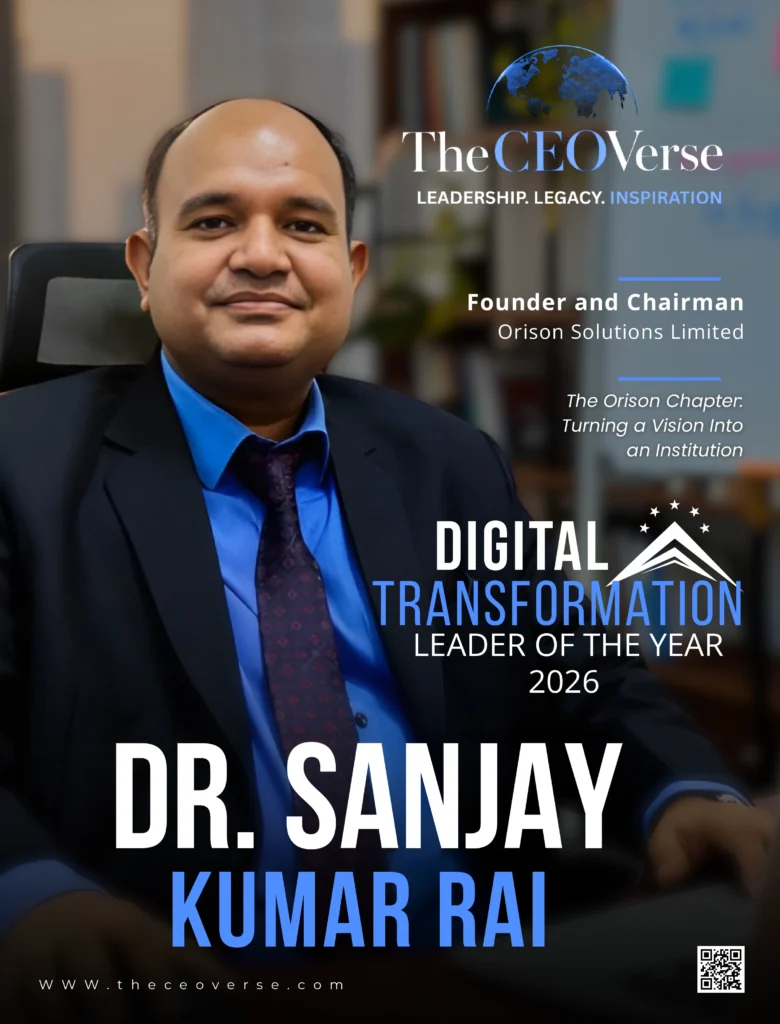
TheCEOVerse • Digital Edition
“Digital Transformation Leader Of The Year 2026”
Cover story
Dr. Sanjay Kumar Rai
Featured Profile - Dr. Sanjay Kumar Rai
The Leader Building Africa’s Digital Future
Oftentimes, innovators measure their careers by the systems they have implemented, the projects they have completed or the technical niches they have mastered. Then there are leaders for whom technology becomes something larger. A means of changing how organizations think, operate and prepare for the future. Dr. Sanjay Kumar Rai belongs to the second category. His journey has unfolded across more than two decades of information technology, enterprise transformation and digital innovation, eventually taking him into leadership positions where technology is no longer simply a function to be managed. It becomes a strategic instrument for growth, resilience and transformation.
Today, Rai stands at the intersection of several forces reshaping modern business. Artificial intelligence, cybersecurity, cloud computing, enterprise automation, digital infrastructure and the development of technology talent. As the Founder and Chairman of Orison Solutions Limited, he has built his expertise around helping organizations move from traditional operating models toward more intelligent, secure and scalable digital ecosystems. His extensive involvement in technology initiatives across African markets serves as another example of his influence in the region’s digital transformation. But the most interesting way to understand Rai is by understanding the mission he has been trying to accomplish and successfully doing so time and time again, across several stages in his career. How can technology solve a real business problem? How can organizations become more resilient because of digital transformation? How can emerging technologies be made useful rather than merely fashionable? How can African businesses build capabilities suited to their own realities rather than simply copy models developed elsewhere? And perhaps most importantly, how can technology empower people rather than make them secondary to the systems they operate?
From Technical Expertise to Strategic Vision
Every originator eventually encounters a defining transition. At the beginning of a career, the focus is often understanding systems, solving problems, learning platforms and mastering processes. As responsibility expands, the questions become increasingly strategic. It is no longer enough to ask, Can this technology work? A leader has to ask, Why does the organization need it? What problem is it solving? What will change after implementation? And what happens next? That evolution is central to Rai’s story. His evolution from technical leadership into strategic roles involving large scale IT processes, enterprise transformation programmes and multicultural teams are some of the examples of his experience across African markets, which have placed him in an environment where technology decisions cannot be separated from business realities. For Dr. Sanjay Rai, that transition appears to have changed the way he sees technology itself. An ERP platform represents a chance to connect departments that previously operated independently. A cloud solution becomes a mechanism for flexibility and scalability. A cybersecurity system is a way of protecting business continuity and institutional trust. And the value of artificial intelligence lies in what organizations can accomplish with it. This shift of looking at technology as an organizational capability is perhaps one of the most important elements of Rai’s transformation. It is also what distinguishes a technical specialist from a strategic technology leader.
Africa Changed the Way He Thinks About Transformation
Dr. Sanjay Rai’s journey became particularly distinctive because of the environment in which much of his leadership experience developed. Africa is not a single technology market but a continent of different economies, infrastructure environments, regulatory frameworks, industries, cultures and levels of digital maturity. Rai has spent years working within that diversity. Being extensively involved in major technology initiatives across government departments, financial institutions, universities and industrial organizations in Africa expose a technology leader to a reality that cannot always be understood from a distance. Hence, digital transformation happens inside organizations with legacy systems, limited resources, different skill levels, established cultures and sometimes considerable resistance to change. Rai’s experience in these environments has helped shape his belief that transformation has to be contextual. The solution that works for a large financial institution may not be the solution required by a university. The needs of a government institution may be very different from those of a manufacturing company. And a technology model developed for a highly mature digital economy may not automatically translate into an emerging market. This is where Dr. Rai’s role becomes more than implementation. He becomes an interpreter, someone who has to translate technological possibilities into practical organizational outcomes.
He Saw Opportunity Where Others Saw Gaps
One of the strongest elements running through Rai’s African journey is his interpretation of the continent’s digital challenges. Infrastructure gaps, cybersecurity concerns, digital literacy and access to advanced technologies can easily be viewed as obstacles. Rai has increasingly viewed them as opportunities. His interest in Africa is driven by the continent’s enormous potential and the opportunities created by gaps in infrastructure, digital literacy, cybersecurity and access to advanced technology. That perspective suggests that Rai does not approach emerging markets with the assumption that they simply need to reproduce the technological path followed by developed economies. Instead, he sees the possibility of leapfrogging. In some cases, organizations can move directly toward cloud based infrastructure. They can adopt intelligent automation without carrying the same layers of legacy technology. They can build cybersecurity architectures designed for today’s threats rather than yesterday’s. They can use AI to create new efficiencies without having to repeat every stage of conventional automation. For Rai, therefore, Africa is not simply a market where technology is being deployed. It is a laboratory for understanding what technology can make possible when organizations are willing to rethink established models. That perspective has helped shape his larger vision.
The Orison Chapter: Turning a Vision Into an Institution
If Dr. Sanjay Rai’s earlier career taught him how technology works, building Orison Solutions taught him how to build an organization around a technology vision. Creating a technology company requires strategy, relationships, trust, the ability to understand markets, and ultimately the people who can execute. Most of all, it needs resilience when the original plan inevitably meets reality. Dr. Sanjay Rai’s creation and leadership of Orison Solutions therefore represents one of the most significant chapters in his professional path. The company has developed a broad portfolio spanning enterprise software, infrastructure, cybersecurity, cloud services, consulting and digital transformation. Its work spans across East Africa and its engagement with organizations seeking technology driven growth. But those capabilities are best understood through Rai’s larger ambition. He has sought to create not simply another technology vendor, but a strategic technology partner capable of understanding the relationship between business problems and digital solutions. That means looking beyond the sale of an individual product, but understanding what the customer is trying to achieve. And then asking which combination of technologies, people and processes can help make that outcome possible. That is a very different proposition from simply selling technology. It is transformation consulting with execution behind it.
His Systems Reflect His Philosophy
The technologies associated with Rai’s work tell an interesting story. There are different systems serving different purposes, yet together they reveal a consistent idea in Rai’s thinking. Organizations perform better when their information, processes and people are connected. Consider the problem from Rai’s perspective. Finance generates information, procurement generates information. Similarly, HR, sales, operations, customer interacts also generate information. If those streams remain trapped in disconnected systems, management receives only fragments of the organization’s reality. Rai’s approach seeks to change that. The technology becomes a bridge. It allows information to move. It creates greater visibility and reduces repetitive work. It gives leaders a clearer foundation for decision making. This is why his work with enterprise systems cannot simply be described as software implementation. For Rai, integration is a leadership issue. The ultimate goal is to help an organization become more coherent.
The AI Question: What Can Intelligence Actually Change?
Artificial intelligence represents perhaps the most dramatic technological shift of Rai’s current era. But Dr. Sanjay Rai’s approach to AI is interesting precisely because it does not begin with the technology. It begins with the problem. The emergence of AI powered solutions, intelligent automation and generative AI has expanded the possibilities available to organizations working with Orison and its technology ecosystem. Yet Rai’s larger philosophy demands more than adoption. For him, the relevant questions are practical.
Can this technology reduce processing time?
Can it improve customer experience?
Can it identify threats earlier?
Can it help employees make better decisions?
Can it reduce operational friction?
Can it create an entirely new business opportunity?
Those questions reveal something fundamental about Rai’s leadership. He is not interested in innovation as theatre. He is interested in innovation that creates measurable value. That distinction will become increasingly important as businesses confront an overwhelming amount of AI hype. The winners will not necessarily be the organizations that deploy the most AI. They will be the organizations that understand where AI genuinely changes the economics of their business. Rai’s role, therefore, is not simply to introduce AI. It is to help organizations understand where intelligence belongs.
Cybersecurity Became Part of His Transformation Worldview
The deeper an organization moves into the digital world, the more exposed it becomes. This is one of the contradictions at the centre of Rai’s work. The technologies that create opportunity can also create vulnerability. Cloud systems create flexibility, but they require strong governance. Enterprise platforms improve integration, but they concentrate valuable information. Digital customer channels improve convenience, but they also create new attack surfaces. Artificial intelligence can improve security, but it can also be exploited by attackers. Dr. Sanjay Rai’s response has been to treat cybersecurity as inseparable from digital transformation. Orison’s cybersecurity portfolio encompasses identity and access management, vulnerability and penetration testing, endpoint protection, application security, database security, email security and security information and event management. But behind those technical categories lies a much broader idea. Dr. Rai wants the organizations he works with to become resilient. Protection is important. Recovery is equally important. The objective is to create organizations that can detect threats, respond quickly and continue functioning when disruption occurs. That is why cybersecurity, in Rai’s world, ultimately becomes a business issue. It protects not only information but continuity and trust. Moreover, it protects the future that digital transformation is supposed to create.
The Hardest Transformation Is Often Human
For all his interest in advanced technology, Rai’s leadership story repeatedly returns to something much more fundamental, that is people. Technology does not transform an organization by itself. People transform organizations using technology. An ERP system can be sophisticated, but it cannot overcome employees who do not understand why it matters. A cloud platform can be powerful, but it cannot compensate for a team that lacks the skills to use it effectively. An AI solution can generate extraordinary insights, but someone still has to interpret those insights and make decisions. Rai therefore places significant emphasis on team development, mentorship and knowledge sharing. His leadership profile describes his work with diverse IT professionals and his commitment to creating collaborative, high performing environments. That is a strategic necessity. As technology becomes more complex, no individual leader can know everything. The strongest leaders therefore become multipliers. They develop people who can think independently. They create specialists who can solve problems. They encourage employees to take ownership. And they create teams that are capable of continuing the mission even when the leader is not in the room. That is the kind of leadership Dr. Sanjay Rai increasingly represents.
His Greatest Scalable Asset May Be People
A technology platform can be replicated. A software product can be upgraded. A service can be expanded. But a culture of learning is much harder to copy. Rai’s emphasis on mentorship and professional development reflects his understanding of that reality. Every employee who learns becomes part of the organization’s future. Every young technology professional who gains confidence becomes another potential leader. Every project that transfers knowledge strengthens the ecosystem beyond the immediate engagement. This becomes particularly significant in Africa, where the next stage of digital transformation will require not only technology investment but human capability. Dr. Rai has increasingly positioned himself not just as a technology executive but as a mentor, speaker and knowledge contributor. Being an author and researcher, with books and writing across areas including cybersecurity, artificial intelligence, digital transformation, leadership, software testing, digital marketing, business ethics and education, serves another example of his authority in the field. This intellectual dimension adds another layer to his story. Dr. Sanjay Rai is not simply trying to implement what he already knows. He is actively documenting, sharing and expanding knowledge. For a leader operating in a rapidly changing industry, that may be one of the most sustainable forms of influence.
From the Boardroom to the Page
Rai’s recent emphasis on authorship offers an unusual window into his personality as a technology leader. He has described writing not simply as a way to add titles to his professional profile, but as a means of documenting experience, simplifying complex subjects and inspiring students, professionals and future leaders. That philosophy is consistent with his broader approach to leadership. Technology can create knowledge, leadership can distribute it, writing can preserve it. Mentorship can pass it to another generation. Taken together, these activities extend Rai’s influence beyond the organizations he directly leads. His work becomes part of a larger conversation about how technology can shape business and society. This is particularly visible in his writing around cybersecurity and digital transformation, where the objective is not merely technical education but encouraging people to think critically about the changing technological landscape. It is the teacher within the technologist.
Leadership Tested by the Realities of Africa
A leader’s philosophy is easiest to understand when circumstances become difficult. Rai’s African experience has provided no shortage of such circumstances. Technology transformation in emerging markets can involve infrastructure limitations, cybersecurity threats, resistance to digitalization, scalability challenges and differences in organizational maturity. These are the challenges that influenced his leadership approach. These conditions require adaptability. A leader cannot assume that the original plan will always survive contact with reality. Dr. Sanjay Rai’s evolution has therefore involved learning how to balance ambition with practicality. He has had to work across different cultures. He has had to lead diverse teams. He has had to manage complex technology projects. He has had to build client confidence. And he has had to keep looking toward the future while ensuring that today’s systems actually work. That combination, vision and execution, is one of the defining characteristics of his leadership.
The Discipline Behind His Vision
Digital transformation is often discussed in terms of innovation. But Dr. Sanjay Rai’s career demonstrates why execution deserves equal attention. A transformation programme can fail because requirements were misunderstood. It can fail because employees were not adequately prepared, data migration was poorly managed or that security was treated as an afterthought. It can fail because timelines were unrealistic and the leaders lost focus halfway through the project. Rai’s professional profile emphasizes his involvement in taking strategic IT projects from initiation through completion while managing risks and maintaining quality and alignment with organizational goals. This is where his leadership becomes tangible. Vision determines where an organization wants to go. Execution determines whether it gets there. Dr. Sanjay Rai’s role lies between those two worlds. He must understand the ambition while remaining close enough to implementation to recognize what can go wrong.
Recognition Along the Way
Dr. Sanjay Rai’s professional journey has gained massive recognition, including the International Achievers Award, Global Choice Award and Best CEO Award, as well as the Best CEO and Most Inspiring Business Leader, providing an external marker of his journey. But awards are ultimately snapshots. Leadership is a continuing process. According to Dr. Sanjay Rai, he more meaningful measure of his work lies in what happens beyond the recognition.
Do organizations become stronger?
Do teams become more capable?
Do clients gain greater confidence in technology?
Do young professionals find new opportunities?
Does innovation create measurable value?
Does digital transformation contribute to sustainable growth?
Those are harder questions, but also more important ones. For Rai, recognition can validate the journey, but it cannot replace the journey.
The Leader Behind the Technology
Dr. Sanjay Rai’s recent authorship with Mrs. Soni Rai on women’s empowerment reflects an interest in social and inclusive development beyond conventional technology subjects. The work addresses themes including education, financial independence, political participation, legal awareness, health rights and digital inclusion. It suggests that Rai’s idea of technology leadership is connected to a broader understanding of society. Digital transformation is not only about companies becoming more efficient.
It can also influence access.
It can influence education.
It can influence participation.
It can influence economic opportunity.
For Rai, technology therefore sits within a larger ecosystem of human development. That perspective makes his leadership story more multidimensional. He is not simply interested in what machines can do, but what people can accomplish when machines are used intelligently.
The Need of The Hour
The time is of the essence. The world is entering an era in which the distinction between technology strategy and business strategy is disappearing. CEOs are increasingly expected to understand AI. Boards are increasingly concerned about cybersecurity. Employees are adapting to automation. Customers expect digital experiences. Data is becoming one of the most valuable organizational assets. And emerging markets are looking for ways to use technology not merely to modernize existing systems but to leap into entirely new models of growth. Dr. Sanjay Rai’s career sits directly within this transition. His journey from technical expertise to strategic leadership mirrors the transformation happening inside businesses themselves. Technology is no longer the department in the corner. It is becoming the architecture around which organizations are built. That makes leaders who can understand both technology and business increasingly important. Rai’s experience gives him precisely that perspective.

What the Next Chapter Demands From Him
The next phase of Rai’s career will arguably be more challenging than the previous one. The technologies are moving faster. Artificial intelligence is accelerating. Cybersecurity threats are becoming more sophisticated. Organizations are demanding measurable returns on technology investments. And competition among technology providers is intensifying. For Rai, staying ahead will require exactly what has defined his career so far, that is continuous evolution. He will have to keep asking difficult questions. Which technologies genuinely matter? Which innovations will survive beyond the hype? How can African businesses become more competitive through digital transformation? How can cybersecurity become predictive rather than reactive? How can AI become accessible and useful to organizations of different sizes? How can technology talent be developed at the scale required by Africa’s ambitions? And how can Orison continue to evolve from a technology solutions provider into a trusted strategic partner? Those questions point toward the next chapter.
Building More Than Digital Systems
Perhaps the most comprehensive method to understand Dr. Sanjay Kumar Rai is to look at the pattern beneath his different initiatives. His work in enterprise systems is about creating connected organizations. His work in cloud is about creating agility. His work in cybersecurity is about creating resilience. His work in AI is about creating intelligence. His work in automation is about creating efficiency. His work in mentorship is about creating capability. His work as an author is about creating knowledge. And his leadership of Orison is about bringing these pieces together into an institution capable of creating long term value. Seen this way, the technologies stop looking like separate projects. They become chapters in one larger leadership story. Rai is building digital systems, certainly. But more importantly, he is building organizational capabilities.
The Measure of a Leader Is What Remains After the Project
There is a natural tendency to measure technology executives through numbers. May it be the projects delivered, systems deployed, partnerships signed, clients acquired or awards won. Those measures matter. But Dr. Sanjay Rai’s journey suggests a deeper standard. What remains after the project? Does the organization know more than it did before? Can its employees operate more effectively? Can its leadership make better decisions? Is its data more secure? Can it recover faster from disruption? Can it adapt to new technologies? Has the organization developed the confidence to continue transforming even after the consultants and implementation teams have left? If the answer is yes, then the technology has done something more important than simply functioning. It has changed the organization. And that is ultimately the kind of transformation Dr. Rai appears to pursue.
A Future That Is Still Being Built
Dr. Sanjay Kumar Rai’s story is still unfolding. He has already moved through several stages of professional evolution. From technical expertise to strategic leadership, from individual projects to organizational vision, from technology implementation to talent development and thought leadership. But the landscape around him continues to change. AI will become more deeply embedded in business. Cybersecurity will become more intelligent. Cloud environments will continue to evolve. Enterprise systems will become increasingly automated. Data will become more central to decision making. And African businesses will continue searching for ways to turn digital transformation into economic advantage. Dr. Sanjay Rai will have to evolve with all of it. But that is perhaps exactly what his journey prepares him to do. His story has never been defined by loyalty to a particular technology. It has been defined by curiosity about what technology can make possible. That curiosity has taken him from technical leadership to enterprise transformation, from transformation to entrepreneurship, from entrepreneurship to mentorship, and increasingly from mentorship to thought leadership. The next stage may demand an even broader role. Not simply technology leader. Not simply entrepreneur. But ecosystem builder. Someone who can bring together technology, business, people and social impact. Someone who can help organizations move beyond digitization toward genuine digital maturity. Someone who can help Africa shape its own technological future rather than merely consume technologies created elsewhere.
The Man Behind the Transformation
Ultimately, the story of Dr. Sanjay Kumar Rai is not really a story about ERP, cloud, AI or cybersecurity. Those are the tools. The real story is the man using them. It is the story of a technology professional who evolved into a strategic leader. Of a leader who entered an unfamiliar and challenging market environment and saw opportunity. Of an entrepreneur who turned experience into an institution. Of an executive who understood that technology transformation without people is incomplete. Of a mentor who believes knowledge should be shared. Of an author who sees writing as another form of leadership. And of a technology visionary who understands that Africa’s digital future cannot simply be imported. It has to be built around the continent’s own needs, ambitions and possibilities. That is why Dr. Sanjay Rai’s journey matters. He represents a generation of technology leaders for whom the boundaries between IT, business strategy, cybersecurity, innovation and social development are becoming increasingly difficult to draw. His work sits precisely in that space. And perhaps that is where the most important transformations of the next decade will happen. Not inside a server. Not inside an algorithm. Not inside a cloud. But at the intersection of technology and human ambition. For Dr. Sanjay Kumar Rai, that intersection has become a career, a philosophy and increasingly, a mission. Africa’s digital future is still being written. Rai intends to have a hand in writing it.