TheCEOVerse • Digital Edition
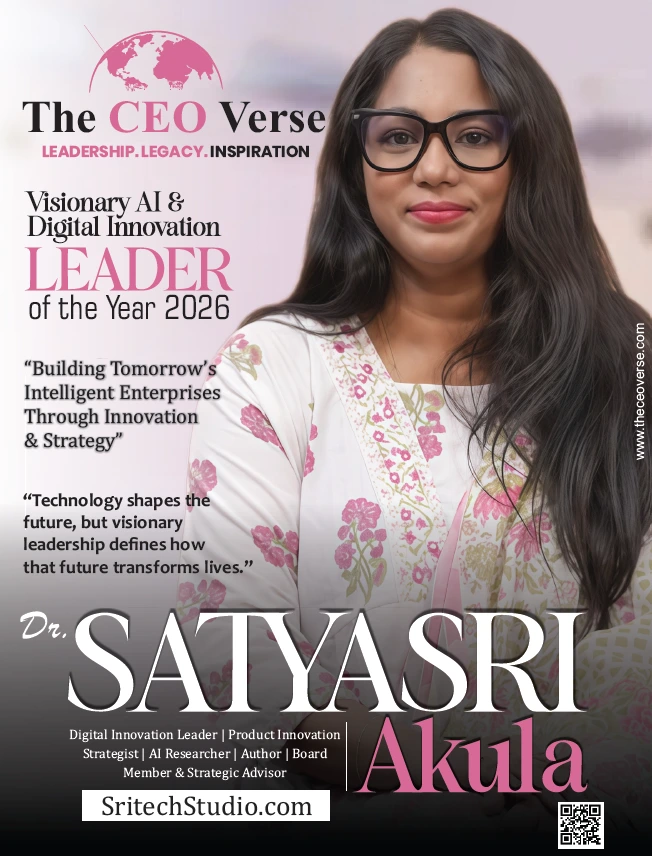
“Visionary AI & Digital Innovation Leader of the Year 2026”
Cover story
Dr. Satyasri Akula
Featured Profile - Dr. Satyasri Akula
The Curiosity That Built a Career
Dr. Satyasri Akula has spent her career chasing one question most organizations never bother to ask properly: what actually happens when technology works the way it is supposed to. Her path runs through digital systems, enterprise transformation, artificial intelligence, and strategic leadership, all built around that single, persistent question. That question took her from early curiosity about digital systems into large-scale initiatives meant to modernize how businesses operate and make decisions at scale.
The academic record backs the practitioner instincts. She completed postgraduate studies in Data Science and Business Analytics at the University of Texas at Austin, which sharpened the analytical and strategic thinking she now applies to enterprise problems. Her doctoral research went further, taken up at the Swiss School of Management in Rome, where she examined how organizations build sustainable competitive advantage through emerging technology, not by simply adopting it but by knowing what to do with it once it’s in place.
Today she carries several titles at once: Digital Innovation Leader, Product Innovation Strategist, AI Researcher, Author, Strategic Advisor. The overlap between them is intentional. Her work sits in the space where AI, analytics, and transformation frameworks have to function as one system, not three separate initiatives sitting in three separate silos, managed by people who don’t talk to each other.
The Principles Behind Sustainable Success
Ask her what has carried her through and she starts with learning. Technology moves fast enough that curiosity stops being optional, it becomes the baseline requirement for staying useful in the field. She describes leaders as needing to remain lifelong students of innovation, not because it sounds like the right thing to say, but because the alternative is falling behind quietly and not noticing until the gap is already too wide.
The second idea runs closely alongside: innovation without strategic alignment doesn’t transform anything. Technology that isn’t connected to business goals, governance structures, and the people running the organization tends to stay technology, interesting, possibly impressive, but separate from actual outcomes. Her approach treats scalability and practicality as requirements built in from the start, not layered on afterward when something doesn’t work.
Collaboration closes the loop. She holds that innovation works best when different perspectives are genuinely in the room, and that building strong teams and investing in mentoring pays off more reliably than any single idea. The three don’t operate in isolation. Learning feeds strategy, strategy requires people willing to execute it, and none of it holds together without the kind of collaborative environment that makes people want to contribute in the first place.
Recognition That Followed the Work
The achievement she returns to most is operational, not ceremonial. Leading AI-driven innovation initiatives that take messy, complicated organizational environments and rebuild them into intelligent, adaptive systems. That is the work she considers most consequential, the rest followed from it.
Being featured in Forbes India’s print edition stands out next, and she is straightforward about why. It recognized contributions to digital innovation and leadership that were already underway, not a campaign built around visibility for its own sake. Around the same period, she authored two books, Leadership – The Art of Inspiring Others and Corporate Finance Unveiled: Insights & Applications, both extensions of thinking she already applies in her consulting and advisory work.
IEEE Senior Member status reflects sustained contribution to technology and innovation on a global platform, not a single project or a single year of output. She also serves as an IEEE Climate Change Community Ambassador and reviews work for international research journals, roles that keep her inside the global research conversation rather than commenting on it from the outside.
The Traits Behind Every Decision
Every long career collides with stretches of uncertainty, and she does not pretend otherwise. Resilience, for her, means staying persistent through those periods rather than waiting for the picture to clear before moving. It is less a natural personality trait and more something she has had to practice, repeatedly, in moments where the easier option was to slow down.
Curiosity sits right next to it. Her drive to keep learning, to understand where technology is heading before it fully arrives, shows up in both her academic and professional choices, the two were never really separate tracks running in parallel. They fed each other. Empathy comes in as the third, and she treats it as structurally inseparable from leadership rather than something bolted on as an afterthought. Leadership that delivers results without understanding the people producing them, in her view, is only doing part of the job.
The three reinforce each other in practical ways. Resilience without empathy turns rigid and brittle over time. Curiosity without resilience burns out before it delivers anything. Together, they are what she credits for the professional relationships she has built and for the kind of leadership that has held up across different contexts and different challenges.
Innovation Built as One Connected System
Through SritechStudio and her broader professional work, her focus sits across digital innovation strategy, AI-driven enterprise transformation, intelligent product ecosystems, leadership consulting, and strategic advisory. The organizations she works with leave with modernized operations and sharper decision-making capability. That is the practical output. The thinking behind it is less tidy than that.
What separates her approach is the refusal to treat innovation as isolated technology adoption. She builds toward ecosystems instead, where data intelligence, AI, governance, and leadership are designed to function together from the ground up, not assembled after the fact into something that technically connects but doesn’t actually operate as one. It is harder to build and harder to explain to a boardroom, which may be part of why fewer organizations actually do it well.
Responsibility sits alongside all of it. Technological advancement, in her framing, has to be balanced against ethical leadership and long-term organizational impact, not as language dropped into a proposal to satisfy a compliance checklist, but as a real constraint on what gets built, how fast, and for what purpose.
Building Systems While Building People
Her active work right now is centered on AI-driven enterprise innovation: intelligent automation, data-driven decision systems, and digital transformation strategies for organizations that are still figuring out what those words mean in practice. One project has been particularly central, an AI-powered supply chain innovation initiative designed to improve operational efficiency, planning accuracy, and real-time decision-making. Supply chain problems are not theoretical. The gaps are visible and costly, which makes the work concrete in a way that research alone rarely is.
In parallel, she stays present in research and mentoring through IEEE communities, academic collaborations, and international conferences. SritechStudio is expanding at the same time, not just as a consulting operation but as a platform for conversations about emerging technology, innovation leadership, and what intelligent enterprises look like once you strip the marketing language away from them.
Mentoring is not a side project. It runs alongside everything else because she believes the work continues past any individual initiative, and the people who carry it forward need someone willing to invest time in them before they are ready to lead anything on their own.
Five Years of Building Beyond Business
Her five-year vision for SritechStudio is specific: position it as a global platform for digital innovation, AI strategy, leadership development, and knowledge-sharing. The ambition is not scale for its own sake. She is clear about wanting to contribute toward intelligent enterprise ecosystems that make organizations more adaptive and resilient, not just more efficient in the short term while accumulating technical debt and dependency in the background.
Research expansion is part of the roadmap, particularly in AI governance, enterprise innovation frameworks, and leadership strategy for organizations being reshaped by technology faster than their cultures can keep up. Beyond business outcomes, the larger goal is collaboration between industry professionals, researchers, and people just starting to find their place in the innovation space.
Technology and leadership working together responsibly, against problems that are actually real. That is the version of the next five years she is building toward.
Turning Representation Into Resolve
The technology sector does not wait for anyone to catch up, and she names that directly as one of the harder realities of the journey. Staying ahead requires constant learning and strategic thinking just to keep pace, not to lead, just to stay relevant. That alone would be a sufficient challenge for most careers in most fields.
But there is a second one she does not minimize. As a woman in technology leadership, representation and inclusion were not abstract policy concerns. They showed up in actual rooms, during actual decisions, in moments where she had to prove capability that, frankly, should not have required repeated proof. She chose to treat those moments as something to push against rather than absorb, using them to advocate for greater diversity within the industry rather than simply moving past them.
What carried her through both was not a single framework. It was staying grounded in knowledge, building professional networks that were real rather than performative, engaging consistently with global research communities, and refusing to stop investing in her own learning even when it would have been easier to rely on what she already knew. The challenges did not disappear. They became part of the record.
The Advice She Carries to the Next Generation
Her advice to professionals working toward leadership roles starts with curiosity and adaptability, not as personality traits to aspire to, but as functional requirements for anyone trying to combine technical expertise with strategic thinking in a field that won’t hold still. She is specific that the future belongs to people who can do both at once. Specialists who picked one lane and maximized it are useful, but they are not the ones shaping where things go next.
Career advancement is not the full story, in her view. Integrity, empathy, and resilience matter alongside the technical credentials, sometimes more. Leadership is not a title, it is what happens when someone creates real impact, empowers the people around them, and drives change that outlasts their own involvement. She returns to that distinction often enough that it reads less like a prepared answer and more like something tested and kept.
Her final point is the plainest. Technology will keep changing. The tools in use today will be replaced. Human values, collaboration, and the willingness to stay accountable to something beyond the next product cycle don’t expire. Believe in the work. Stay consistent. Keep learning.