TheCEOVerse • Digital Edition
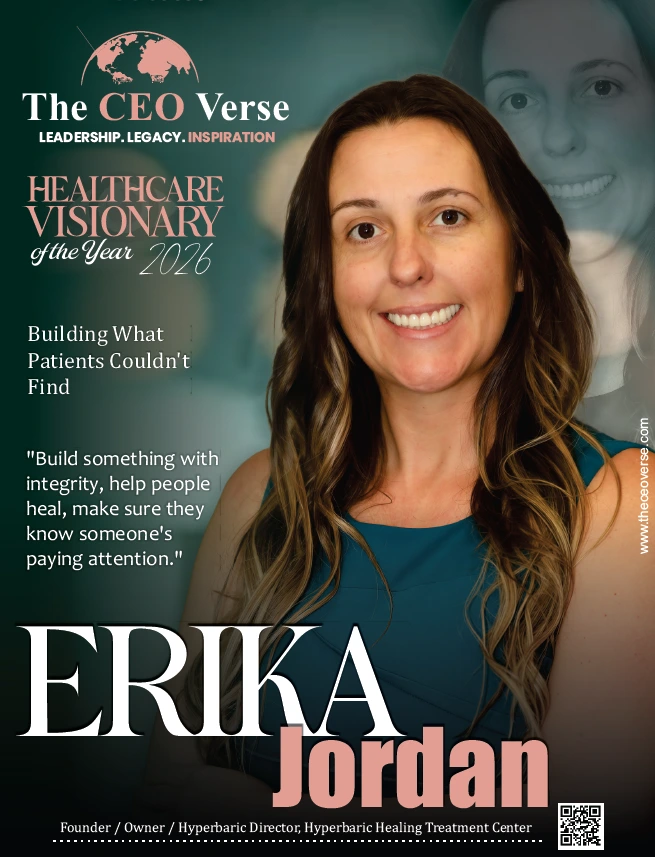
“Healthcare Visionary of the Year 2026”
Cover story
Erika Jordan
Dive into the complete magazine profile and explore the story, leadership, and impact behind the individual featured in this edition.
Featured Profile - Erika Jordan
Building What Patients Couldn’t Find
Erika Jordan spent 10 years in the hyperbaric medicine sector before venturing out on her own, and now brings nearly 20 years of experience to the field. She came up through the clinical side first: DMS, EMT, then Certified Hyperbaric Specialist, the kind of background that teaches you the operational details nobody puts in a brochure. Staffing, safety checks, how a chamber actually runs on a Tuesday morning when something goes slightly wrong.
That time taught her what hyperbaric oxygen therapy could actually do. Complex wounds, radiation injury, surgical complications, trauma cases that weren’t healing on their own timeline. She watched it work for patients who’d run out of other options. What she didn’t see, at least not in Central Florida, was a place built around that kind of care that wasn’t tied to a hospital. Something private, calmer, still serious about safety but not built like a hospital wing.
So she built it. Hyperbaric Healing Treatment Center started as one location. It’s now three: Orlando, New Smyrna Beach, Leesburg. Growing wasn’t really the point for her, or not the main one. What she comes back to is simpler: patients walking in scared and walking out with some hope restored. That’s the part she calls her biggest accomplishment, not the expansion numbers.
The Standards Behind The Growth
Ask Jordan what guides her decisions and she doesn’t hesitate: safety, integrity, education, consistency, patient-centered care. Said like that it sounds like a wall plaque. In practice it means every protocol, every staff training session, every leadership call gets run through one filter first. Does this keep people safe. In hyperbaric medicine, where the stakes of getting it wrong are not abstract, that filter matters more than most.
Education sits right next to it, and for a specific reason. HBOT is still widely misunderstood, by patients, by some providers, by the public at large. When people actually understand the science behind it, the safety protocols, what it can and can’t do, they make better decisions about their own care. Jordan treats that understanding as part of the job, not an afterthought.
The harder lesson came with growth. Passion got the first location open. It doesn’t run three locations. For that you need communication that’s actually clear, accountability that holds at every level, training that’s consistent, reporting that tells you what’s really happening. Systems, in other words. The unglamorous infrastructure that lets quality survive expansion instead of getting diluted by it.
Underneath all of it is something simpler. Every patient walking through the door has a story, and Jordan’s view is that the job starts with meeting that story, with compassion, with professionalism, and yes, with hope. Not as a tagline. As the actual operating principle.
From One Location To National Mention
The founding of HHTC is the milestone Jordan points to first. Opening the first location was the expected achievement. What came after surprised her more: the model scaled, the team held quality across multiple sites, and there was clearly more demand than one location could meet.
What HHTC became known for wasn’t just growth. It was the rigor underneath it: real protocols, emergency preparedness, patient monitoring that doesn’t slip. That consistency got noticed outside the industry too. HHTC was mentioned in a New York Times article on hyperbaric oxygen therapy. Jordan sees it less as recognition and more as a reminder. The standards held up under scrutiny, and now there’s more responsibility to keep educating people on what safe, medically guided HBOT looks like.
There’s also the trust built with referring physicians, surgeons, and specialists, quieter than a press mention but harder to earn.
Outside the clinic, Jordan has spent eight years with the American Cancer Society and Making Strides Against Breast Cancer Orlando, and still sits on the committee. She talks about it as work that lets her stand with survivors, honor families, and contribute to something that matters to her personally.
The Qualities That Hold Leadership Together
Three traits come up when Jordan talks about what’s carried her: resilience, passion, and accountability. None of them are surprising on their own. What’s worth noting is how she connects them to the actual texture of running a healthcare business. Regulations that shift, staffing that’s never fully solved, financial pressure that doesn’t announce itself in advance, patients whose concerns are real and immediate.
Resilience, for her, isn’t a personality trait so much as a requirement. You don’t get to opt out of the hard years. Passion is what keeps the work feeling like more than a business, and for Jordan, having watched hyperbaric therapy change outcomes for real patients, that’s not a difficult thing to hold onto.
Accountability is the one she frames as central to leadership itself. Her logic is straightforward: if you expect a certain standard from your team, you have to be willing to model it yourself first. Leaders who ask others to show up a certain way while exempting themselves don’t keep that credibility for long. It’s a simple idea. Living up to it consistently is the hard part.
The Line Between Care And Comfort
HHTC’s core offering is hyperbaric oxygen therapy, delivered in what Jordan describes as a safe, patient-centered environment. That covers insurance-approved indications, radiation injury and other recognized conditions, and extends to provider-directed off-label care where it’s appropriate and properly supervised.
What separates the center from some of the wellness-oriented HBOT providers that have popped up elsewhere is, in Jordan’s words, fairly direct. This isn’t a spa model. Trained staff, provider involvement, real safety protocols, emergency preparedness, ongoing patient monitoring, that’s the baseline, not an upsell.
At the same time, the centers are designed to feel less intimidating than a hospital. Patients arriving are often already dealing with a stressful or discouraging diagnosis. The goal is a space where the clinical rigor is fully intact but the experience doesn’t add to that stress, somewhere people feel supported and informed rather than processed.
Growing Without Losing The Standard
Two things sit on Jordan’s plate right now, and they’re connected in a way that isn’t obvious at first. The first is provider education, closing the gap between what HBOT can actually do and what most referring providers currently assume about it. A lot of referrals still come in shaped by outdated or incomplete information.
The second is more mechanical. A new location means new staff, new routines, new everything, and the work isn’t building those from scratch so much as making sure they match what already exists elsewhere. Same monitoring checklist. Same emergency drill. Same tone with patients walking through the door for the first time. Jordan isn’t in the room at every site every day, which means the systems have to carry the standard when she can’t.
Growth That Earns Its Reputation
Jordan’s five-year view for HHTC isn’t about location count. It’s about what people think of when they hear the name. “We are not a spa model” is how she describes the center today, and the same line applies to where she wants it in five years.
The bigger shift she’s watching is external. As HBOT gets more attention publicly, the line between medically guided therapy and wellness marketing with an oxygen tank attached is going to blur for a lot of people. Jordan sees part of HHTC’s job as helping patients tell the difference, through consistency, not campaigns.
The other half is internal. Strength, in her view, tracks with people, not locations or equipment. Developing leaders inside the organization is as much a part of the plan as any new site.
Earning Trust In A Misunderstood Field
The biggest obstacle, in Jordan’s telling, hasn’t been operational. It’s been perception. HBOT works well when used appropriately, but confusion about it runs deep, among patients, among some providers, and in the public conversation generally. That doesn’t resolve on its own. It takes the same education and consistency that shows up everywhere else in how she runs things, applied here specifically to changing minds rather than running a clinic.
Jordan doesn’t pretend the path was smooth. There have been stretches of real uncertainty, pressure that doesn’t show up on a balance sheet, sacrifices that don’t make it into a profile like this one. What kept her going, by her account, was staying close to the patients and families the work is actually for.
The Work Comes Before The Title
Jordan’s advice to anyone aiming for leadership is direct. Get good at the actual work before expecting anyone to follow you. Learn it from the ground up. Ask the questions that feel basic. Stay teachable longer than feels comfortable.
Leadership, in her view, isn’t a title. It’s responsibility, consistency, communication, and service, in that order. People follow leaders who are honest and dependable, who work alongside them rather than just direct from above.
Systems matter too. Passion gets things started, but systems make growth sustainable once that initial momentum fades. Every obstacle, in her framing, is something you can learn from if you’re willing to look at it.
Outside HHTC, Jordan is a wife and a mother. Build something with integrity, help people heal, make sure they know someone’s paying attention, that’s the goal she keeps coming back to.
Hyperbaric medicine isn’t a business she ended up in. It’s a responsibility she chose to take on.