
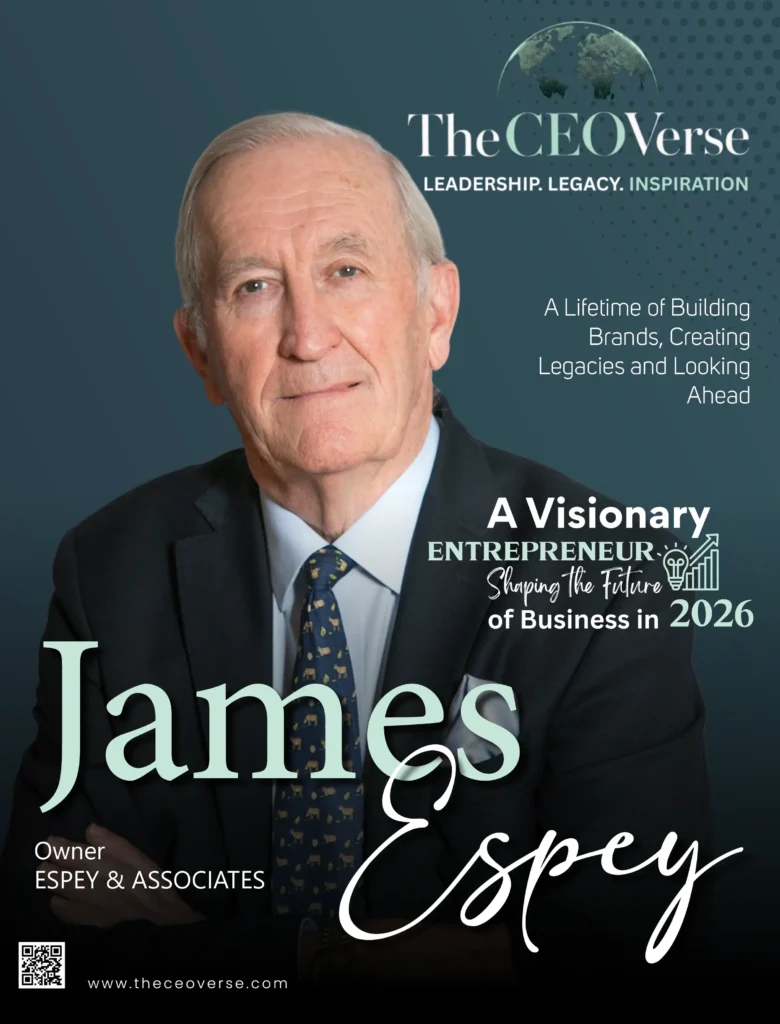
TheCEOVerse • Digital Edition
“A Visionary Entrepreneur Shaping the Future of Business in 2026”
Cover story
James Espey
Featured Profile - James Espey
James Espey: A Lifetime of Building Brands, Creating Legacies and Looking Ahead
At six years old, James Espey began a journey that would take him through decades of international business, brand development and industry leadership. His childhood was far removed from the boardrooms and global business conversations that would later define his career. Following his parents’ divorce in 1950, he was sent to boarding school in Cape Town, South Africa. Returning home meant an eight-day train journey, twice a year, for the next ten and a half years.
He does not describe those early years as a hardship. In retrospect, he believes they helped shape his independence and outlook. Sport played its part, as did education and an ability to focus on what lay ahead rather than dwell on what had already happened.
That forward-looking attitude has remained central to his professional life. At 83, as Chairman of Wiltshire Distilling Company, Espey continues to approach business with the same emphasis on preparation, learning and long-term thinking that began during his school years. For him, experience has reinforced a simple belief: progress comes from staying focused on the future and remaining committed to the work required to reach it.
The Business of Vision, Patience and Preparation
After decades of building successful brands, Espey has little interest in reducing entrepreneurship to a single formula. When asked to identify one principle that consistently produces the right outcome, he challenges the premise itself. Business, in his experience, rarely works through one principle alone.
Instead, he offers a practical calculation: have a clear vision, maintain focus, and double both the time and cost you initially expect a project to require.
It is a lesson drawn from experience rather than pessimism. Ambitious projects often demand more resources and patience than their original plans suggest. Entrepreneurs who expect everything to proceed within an ideal budget and timeline may struggle when reality becomes more complicated. Preparing for those demands makes it easier to remain committed when challenges arise.
Alongside this practical outlook are three qualities he considers essential: integrity, consistency and courage. They are not abstract values reserved for corporate statements. They influence everyday decisions, relationships and the ability to sustain a business vision over time.
For Espey, a strong business foundation requires both ambition and realism. Vision establishes the destination, focus keeps the organisation moving, and preparation helps it remain on course when the journey takes longer than expected.
A Legacy That Extends Beyond Commercial Success
Espey’s career has contributed several successful brands and generated billions of pounds for the UK economy. These achievements represent a substantial record of commercial contribution, but they are not the first accomplishment he chooses when discussing the work that matters most to him.
Instead, he points to the creation of the Keepers of the Quaich, a society established to recognise individuals who have made significant contributions to the Scotch whisky industry.
What makes the organisation particularly meaningful to him is its purpose. It was created without a profit motive, bringing people together to honour and support an industry rather than to generate commercial returns. Espey sees a distinction between building successful businesses and creating something that benefits an entire sector without expecting a financial reward.
The society’s twice-yearly gatherings take place at Blair Castle in Scotland, with members of the Scottish nobility serving as patrons. Its speakers have included former US President Ronald Reagan, retired South African President F. W. de Klerk, Prince Charles and Princess Anne.
One particularly memorable example of Espey’s determination to bring influential voices to the platform was his personal request to Ronald Reagan over lunch in New York.
The achievement reflects another dimension of his entrepreneurial outlook: leadership can create value beyond the boundaries of an individual business. An organisation built to recognise collective contribution can leave a different kind of legacy, one rooted in service to an industry and the people connected to it.

Three Convictions That Have Guided Six Decades
When Espey reflects on the qualities that have shaped his career, three convictions consistently emerge.
Integrity comes first. He believes it must be genuine and demonstrated through actions rather than simply presented as a professional value. Trust is difficult to establish without it, and long-term business relationships depend on maintaining it consistently.
His second conviction is the importance of people and teamwork. Espey believes in building capable teams without allowing personal ego to interfere with collective achievement. He often expresses this through the familiar principle that TEAM stands for Together Everyone Achieves More.
For him, teamwork is not merely a positive sentiment. It is an operational approach in which individuals contribute their abilities towards a shared objective. Strong leadership means recognising that success rarely belongs to one person alone.
The third conviction is persistence. Staying on the road, as he describes it, means refusing to abandon a worthwhile objective simply because progress becomes difficult. Short-term obstacles should not automatically be mistaken for permanent barriers.
These beliefs have remained consistent across decades of brand building, leadership responsibilities and industry initiatives. Their value, in Espey’s view, comes from applying them repeatedly rather than simply acknowledging them.
Witchmark: A New Chapter in English Whisky
At 83, Espey remains actively involved in what he describes as his last major project: Wiltshire Distilling Company. Located on Lord Margadale’s estate, approximately fifteen miles from Stonehenge, the company produces Witchmark, a brand named after a local mark in the area.
The project reflects his continued interest in building brands with a clear identity and a connection to their surroundings. Witchmark uses local water and locally sourced grain, placing regional resources at the centre of its production approach.
Environmental responsibility is also part of the company’s positioning. It has received recognition as the second-highest environmentally responsible whisky company in the United Kingdom.
As Chairman, Espey sees an opportunity to contribute to the development of English whisky as a category with its own identity and international potential. He believes that when produced authentically and with the right commitment, English whisky has a meaningful future.
He describes Witchmark as his final major undertaking, but there is no sense of retreat in the ambition behind it. He remains confident in the team, the direction and the opportunity to establish a distinctive position in the market.
For someone who has spent much of his career developing brands, the appeal is clear: there is still room to build something with lasting value.

Taking an English Whisky Brand to the World
Witchmark’s five-year ambition is to become the leading English whisky brand worldwide. International expansion is already part of the company’s thinking, with India among the markets receiving serious consideration.
Espey approaches this ambition with the same combination of confidence and measured execution that has characterised his earlier work. Global aspirations do not necessarily require hurried expansion. Entering markets responsibly, understanding their conditions and developing the brand carefully are important parts of the process.
His experience across different industries and business environments has reinforced the importance of patience. Expansion that moves too quickly can create pressures that undermine the very foundations a brand needs to succeed.
The objective is therefore to build international recognition without losing the identity and authenticity that distinguish Witchmark. The company has an opportunity to introduce English whisky to a wider audience while remaining connected to its local origins.
For Espey, India represents an exciting possibility within that broader international outlook. It is another opportunity to take a carefully developed brand into a new market and build relationships that support its long-term growth.
Overcoming the Obstacles That Slow Progress
Espey does not identify one dramatic crisis as the defining challenge of his career. The difficulties he remembers most are often less visible: negativity, institutional resistance and bureaucracy.
Negativity can make ambitious ideas harder to pursue, particularly when people focus on reasons why something cannot be achieved rather than what is required to make it work. Bureaucracy creates a different kind of friction, becoming increasingly difficult to navigate as organisations and processes grow larger.
His response has been consistent: keep moving.
Rather than allowing resistance to determine the direction of a project, Espey believes in maintaining focus and continuing the work. Persistence is not necessarily about ignoring obstacles. It is about refusing to let temporary difficulties become the final judgement on a worthwhile ambition.
That attitude connects his earliest experiences to his later business career. The circumstances have changed considerably since his childhood journeys to Cape Town, but the principle of looking ahead and remaining committed has stayed with him.

Advice for Entrepreneurs Building Beyond the Short Term
Espey’s advice to aspiring entrepreneurs and business leaders is direct. First, understand that many people in any industry are primarily focused on their own interests. Those who want to build something meaningful must recognise this reality while learning how to stand apart through their contribution.
He encourages people to make difficult professional decisions when necessary, including changing jobs when an environment no longer supports their development. However, he places equal importance on how individuals conduct themselves when leaving an organisation. Speaking negatively about a former employer can damage professional relationships and reputation. The company someone leaves today may become a future business partner or even acquire their organisation tomorrow.
Courage, commitment and tenacity are qualities he repeatedly emphasises. He also advocates taking a minimum ten-year view of professional and business development. Short-term targets and bonus cycles can encourage people to prioritise immediate results at the expense of building something sustainable.
A longer perspective allows entrepreneurs to make decisions based on where they want to be in the future rather than what produces the quickest reward today.
His advice also extends to international business relationships. When travelling, he encourages people to learn a few words of the local language, experience local food and respect the culture of the people they meet.
Communication requires awareness of different backgrounds and perspectives. The language that comes naturally to one person may be a second, third or even fourth language for the person across the table. Recognising that difference is part of building meaningful international relationships.
Espey describes the world as a small village, a perspective shaped by years of professional experience across different markets and cultures.
A Career Still Looking Forward
James Espey’s professional journey demonstrates that entrepreneurship is not defined solely by the number of businesses established or the commercial value generated. It is also reflected in the people brought together, the industries strengthened and the institutions created to recognise collective achievement.
His work across successful brands, the establishment of the Keepers of the Quaich and his continued involvement with Wiltshire Distilling Company represent different expressions of that contribution.
At 83, he continues to invest his attention in Witchmark and its ambition to become a leading English whisky brand internationally. The project carries the experience of a lifetime in business, but it also represents a willingness to pursue new opportunities rather than simply rely on past accomplishments.
The principles guiding him remain remarkably consistent: integrity in relationships, teamwork without ego, courage in decision-making and the tenacity to stay committed over the long term.
From a six-year-old boarding school student travelling across South Africa to an entrepreneur and industry leader continuing to build at 83, Espey’s story is ultimately one of perspective. Circumstances change, markets evolve and projects demand patience, but a clear vision and the determination to keep moving can continue to create opportunities.
His next chapter is still being written, one carefully considered step at a time.