
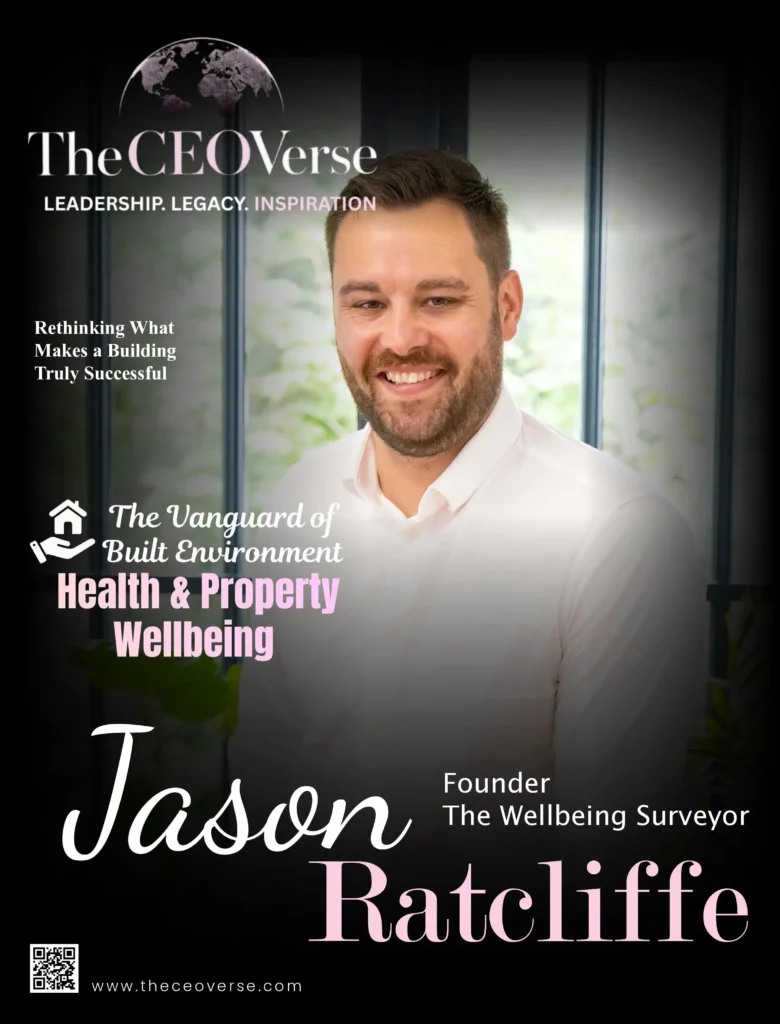
TheCEOVerse • Digital Edition
“The Vanguard of Built Environment Health & Property Wellbeing”
Cover story
Jason Ratcliffe
Featured Profile - Jason Ratcliffe
Rethinking what makes a building truly successful
For Jason Ratcliffe, Founder and Wellbeing Surveyor at The Wellbeing Surveyor, the built environment represents something far more significant than the physical structures surrounding everyday life. Homes, workplaces, schools and healthcare facilities influence how people sleep, breathe, concentrate, recover and experience their surroundings. Yet these human consequences have historically received less attention than the conventional measures used to evaluate buildings.
This gap became the foundation of Ratcliffe’s professional vision. His work challenges the traditional boundaries of property assessment by bringing human wellbeing into conversations that have long centred on structural condition, maintenance and building performance.
His background in surveying provided a practical understanding of the built environment. Further study in public health, sustainability and research expanded that knowledge, allowing him to examine buildings through a broader lens. He recognised that a property could satisfy conventional standards while still raising important questions about the experience of its occupants.
The Wellbeing Surveyor emerged from this perspective, developing an approach that connects property assessment with the health and quality of life of people. Its work now reaches beyond consultancy into research, education and innovation.
Ratcliffe’s philosophy is captured in a simple but powerful principle: “Buildings should not simply stand for longer; they should help people live better.”
When everyday experiences reveal a larger problem
The need for a different approach becomes clearer when considering the experiences of homeowners. Across thousands of conversations, Ratcliffe encountered people describing poor sleep, recurring respiratory problems, headaches, fatigue and discomfort within their living environments.
These accounts brought an important dimension of building performance into focus. While a conventional inspection might identify damp, maintenance concerns or structural defects, the wider implications for the people living in the property require a more comprehensive perspective.
For Ratcliffe, these experiences were not isolated observations to be dismissed. They pointed towards a wider need to understand the relationship between indoor environments and human wellbeing.
This is where The Wellbeing Surveyor seeks to contribute. Rather than treating building health and human health as separate subjects, its approach considers how surveying, environmental science, public health and sustainability can work together to create a more complete understanding of properties.
As Ratcliffe puts it, “We measure more than buildings, we seek to understand how buildings influence people.”
A perspective strengthened through personal recovery
Ratcliffe’s commitment to wellbeing also carries a personal dimension. A brain haemorrhage fundamentally changed his outlook, with recovery bringing lessons in patience and resilience that no textbook could fully provide.
The experience deepened his appreciation of the relationship between surroundings and personal wellbeing. It brought greater awareness of how environments can influence recovery, concentration and stress, reinforcing the importance of looking beyond physical structures when considering the conditions in which people live.
Rather than allowing this difficult experience to define his future, Ratcliffe used it to strengthen his sense of purpose. His work became increasingly centred on evidence-led approaches that could contribute to real improvements in people’s lives.
That commitment continues to shape his professional decisions. The emphasis is not simply on identifying what is wrong with a building, but on advancing knowledge that can help make the built environment more supportive of human health.

Turning research into practical understanding
An important part of The Wellbeing Surveyor’s direction lies in expanding the evidence surrounding healthy buildings. Alongside its consultancy work, the practice invests in pioneering research, independent product evaluation and the development of healthy building evidence.
Some initiatives remain confidential until their publication or launch, but their underlying objective is consistent: making healthy buildings measurable, practical and accessible.
This focus is significant because improving property wellbeing requires more than awareness. It requires reliable evidence, meaningful assessment and approaches that can be applied in real environments.
By connecting professional surveying with research and other areas of expertise, Ratcliffe is working towards a more integrated understanding of building health. The intention is to help bridge the distance between what research identifies, what professionals can measure and what occupants actually experience.
The discipline of knowing which opportunities matter
Building a practice around an emerging area also requires clarity about priorities. Earlier in his career, Ratcliffe associated progress with accepting opportunities and maintaining constant activity. Experience gradually changed that perspective.
He now evaluates projects through a more fundamental question: does the work genuinely improve people’s lives or advance knowledge?
This principle has become central to his decision-making. It helps distinguish meaningful opportunities from activity that may create visibility without contributing to the wider mission.
The approach also reflects his belief that innovation depends on curiosity and a willingness to challenge familiar assumptions. He encourages professionals entering the field to read widely, remain open to learning and concentrate on meaningful problems rather than pursuing titles or awards.
For Ratcliffe, asking better questions is often more valuable than repeating established answers.
A profession built through shared knowledge
The development of healthier buildings cannot rest with surveyors alone. It requires contributions from researchers, clinicians, engineers, architects, environmental specialists and technology innovators.
Ratcliffe recognises that each discipline brings a different perspective to the challenge. Researchers can strengthen the evidence base, healthcare professionals contribute an understanding of health, while those working in the built environment can help translate knowledge into practical assessment and application.
Through partnerships, he is working to connect these areas of expertise and encourage collaboration across professional boundaries. This wider network is intended to accelerate evidence-based progress and give healthy building principles a stronger place within industry discussions.
His own journey has benefited from similar collaboration. His wife Sophie has supported him throughout the process, while mentors from surveying, medicine, academia and environmental science have challenged him to explore ideas more deeply.
Equally important have been the thousands of conversations with homeowners. Their experiences have reinforced his conviction that property wellbeing is not an abstract professional concept. It is an issue that affects everyday life.
Visibility with a purpose
For Ratcliffe, professional recognition is valuable when it creates opportunities to advance an important conversation. Articles, keynote appearances and interviews help introduce healthy building principles to wider audiences, encouraging people to consider how their surroundings may influence their wellbeing.
He does not regard visibility as an achievement in itself. Its real value lies in the conversations it generates and the awareness it helps build.
Looking ahead, his ambition is to expand research, education and international collaboration while establishing The Wellbeing Surveyor as a recognised voice in the healthy buildings field.
This ambition extends beyond the growth of an individual practice. Ratcliffe wants to contribute to a broader shift in how the industry evaluates property, with human wellbeing becoming a more established consideration alongside safety, sustainability and structural performance.
Making wellbeing a standard, not an afterthought
People spend approximately ninety per cent of their lives indoors, yet the influence of indoor environments on health remains an area that deserves greater attention.
Ratcliffe believes the expectations surrounding buildings must evolve. Safety and sustainability are essential, but they should not represent the final measure of a successful property. Buildings should also support the people who occupy them.
“Healthy buildings should become as normal as seatbelts and smoke alarms,” he argues.
This vision places human wellbeing closer to the centre of building design and assessment. It calls for a future in which homes, schools, workplaces and healthcare facilities are considered not only in terms of their physical condition, but also through their potential contribution to people’s quality of life.
Achieving this change will require continued research, professional collaboration and greater public understanding. It will also require a shift in expectations, so that healthy environments become an ordinary requirement rather than an additional consideration.
Advancing a new standard for the built environment
Jason Ratcliffe sees The Wellbeing Surveyor as part of a much larger movement towards a healthier relationship between people and the places they inhabit.
His ambition is not limited to establishing a recognised consultancy or building a personal professional legacy. He wants to help influence the standards and expectations that future generations will inherit.
If people eventually regard the wellbeing impact of a property as naturally important as its structural safety or sustainability, the work will have contributed to a meaningful transformation.
That is the direction behind Ratcliffe’s journey: bringing together evidence, professional expertise and lived experience to redefine what buildings should deliver.
The next chapter of the built environment should not be measured solely by how efficiently buildings operate or how long they remain standing. It should also be measured by how well they support human life. For Ratcliffe, advancing that understanding is both the purpose of The Wellbeing Surveyor and the beginning of a much wider movement.