
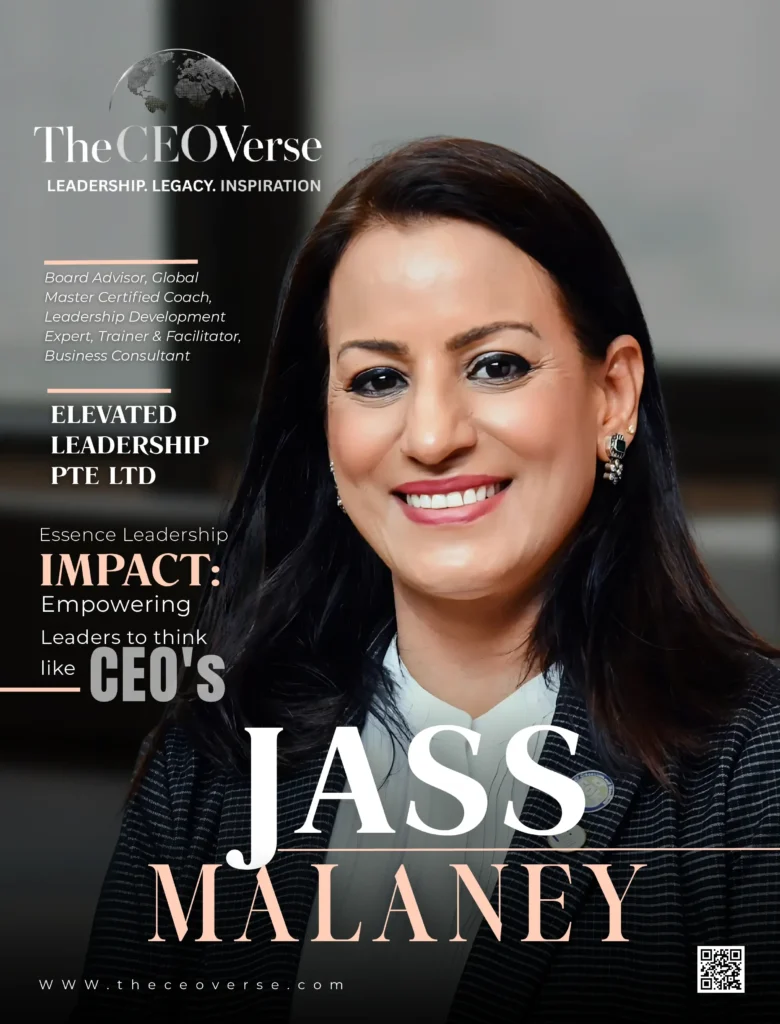
TheCEOVerse • Digital Edition
“Essence Leadership Impact: Empowering Leaders to think like CEO’s”
Cover story
Jass Malaney
Featured Profile - Jass Malaney
Jass Malaney: Elevating Leadership from Mindset to Meaningful Business Impact
Leadership is often measured by the scale of responsibility a person carries: the size of the organization they lead, the number of people reporting to them, the revenue they influence, or the strategic decisions that sit on their desk. Yet the most consequential dimension of leadership is often less visible. It is the capacity to remain clear when circumstances become complex, to make decisions when certainty is unavailable, to bring people together around a common purpose, and to turn strategy into execution. Leadership has always been about that deeper capacity for Jass.
With more than three decades of global leadership, business, and coaching experience, Jass has built a career at the intersection of organizational performance and human potential. As a Board Advisor, Global Master Certified Coach, Leadership Development Expert, Trainer & Facilitator, and Business Consultant, she works with C-suite executives, managing directors, and high-potential leaders as they navigate some of the most consequential moments in their careers.
Her approach is grounded in a conviction shaped by years inside complex organizations: leadership cannot be developed effectively from the outside in. Before leaders can influence organizations, they must understand themselves their strengths, values, behavioral patterns, blind spots, and the impact they have on others. That belief is at the heart of Elevated Leadership Pte Ltd and its five-step Elevated Mindset methodology.
But the philosophy did not emerge in a classroom. It was forged through a career that began at 19, developed inside The World Bank, moved through business transformation and turnaround assignments in Singapore, and eventually evolved into executive coaching and leadership development. Her story is therefore not simply that of a coach who advises leaders.
It is the story of a leader who spent decades learning what makes organizations work—and what prevents them from doing so.
A Young Leader in a Global Institution
Jass’s corporate journey began at the age of 19 when she joined The World Bank as an intern. At the time, she was pursuing a Bachelor of Commerce in Economics and had developed strong computer skills, particularly in transforming data into graphs used in economic reports. What initially appeared to be a technical capability became an entry point into a much larger education.
Working alongside leading economists exposed her to the relationship between economic theory, government projects, organizational systems, infrastructure, financial sustainability, and people. She travelled with project teams working with regional governments and gained an early understanding of how large institutions operate across different cultures and environments. Then came an opportunity that would accelerate her leadership development.
The division in which she worked received significant funding to expand into a satellite office. She found herself involved in establishing the operation, from procuring office space to hiring people and building the team. By the age of 23, she was leading her first team with P&L responsibility, including team members considerably older than she was.
Her managers did not simply give her a title. They gave her increasingly difficult assignments. One of her bosses, John Middleton, repeatedly entrusted her with projects designed to stretch her capabilities. His message was simple: “I know you can do it.” He also gave her a description that stayed with her. He called her “Unflappable,” someone reliable and effective under pressure. In retrospect, the word captures a characteristic that would become central to her professional identity.
She learned early that leadership is not about having every answer. It is about having the composure to confront complexity, the willingness to learn, and the confidence to take responsibility. The World Bank years gave her something equally valuable: a global perspective. She learned that organizations may operate in different industries, countries, and cultural environments, but many of their fundamental challenges remain remarkably consistent. Systems have to work. People have to collaborate. Resources have to be allocated effectively. Leaders have to make decisions. And strategy has to become execution. Those lessons would later become the foundation of her coaching philosophy.
From Global Organizations to Business Turnarounds
Her career after The World Bank expanded her understanding of leadership from institutional systems to commercial realities. After moving to Singapore, she worked as a management consultant, often with organizations experiencing operational or financial difficulties. These assignments demanded more than theoretical recommendations. They required identifying what was preventing a business from performing and then taking practical steps to change its trajectory.
One notable engagement involved A&W Restaurants, where she reviewed 17 outlets and worked on reducing costs through vendor engagement. Her analysis went beyond cost reduction. She concluded that the business was moving deeper into debt and that cash management was becoming a fundamental problem. She recommended that the business be sold, a decision that was eventually taken by the board of Scotts Holdings.
At another recruitment organization facing significant difficulties, she was brought in as a Branch Manager. Within six months, the business reached breakeven and began clearing its debts. Within nine months, it had become profitable. Jass subsequently founded her own boutique search firm. Within three months, it reached breakeven, while client referrals helped the business expand. These experiences gave her a commercial lens that continues to distinguish her approach to leadership development.
People development cannot exist in isolation from business performance. A leader may have excellent interpersonal skills, but if strategy is not executed, the organization suffers. A team may be highly motivated, but without effective systems and accountability, performance eventually deteriorates. A senior executive may possess exceptional technical expertise, but if they cannot delegate, influence stakeholders, or develop successors, their effectiveness becomes constrained. This understanding would later become central to her work with executives.
She had seen organizations struggling not because they lacked intelligent people, but because leadership, systems, execution, and organizational priorities were not sufficiently aligned.
The question that increasingly interested her was therefore not simply how businesses could become more efficient. It was how leaders could become more effective.
The Turning Point: From Experience to Coaching
Her transition into professional coaching began in 2002, but it was the culmination of years of accumulated experience. After working across corporate and consulting environments, she had developed a strong understanding of strategy, operations, organizational systems, people management, recruitment, and business performance. Coaching gave her a framework through which she could bring those experiences together while focusing directly on the individual behind the leadership role.
Her daughter provided one of the pivotal prompts. After watching her mother continually invest in courses and professional development, she asked when she was going to start training others. The question forced a realization. Perhaps the knowledge she had accumulated was not meant to remain her own.
Jass began exploring coaching more deeply and embarked on extensive self-development, studying neuroscience, human psychology, emotional intelligence, and multiple coaching methodologies. The transformation was significant. She discovered that many of the challenges leaders face are not caused by a lack of intelligence or ambition. They are often caused by patterns that leaders themselves cannot easily see. The executive who struggles to delegate may believe the problem is that the team is not capable enough. The leader who continually works beyond capacity may believe that only they can guarantee quality.
The executive who struggles with stakeholder relationships may believe others are simply difficult. The leader who hesitates during a transition may believe they need more information. Coaching creates the space to examine these assumptions. It helps leaders move from reacting to understanding. And understanding creates the possibility of deliberate change.

Building Elevated Leadership
Her experience as President of the International Coaching Federation Singapore Chapter further reinforced her belief in structured leadership development. During her tenure, the organization’s membership grew from more than 200 to more than 800, while engagement, systems, standard operating procedures, and opportunities involving government tenders also developed. The experience demonstrated to her that sustainable growth requires more than enthusiasm. It requires systems, structure, leadership, and collective ownership.
From this foundation, she developed the five-step Elevated Mindset methodology and established Elevated Leadership Pte Ltd. Today, the organization offers executive coaching, assessment centres, customized training, team coaching, women-in-leadership programs, board retreats, and keynote speaking, partnering with executive, HR, and learning-and-development teams. The common objective across these offerings is to connect leadership development to organizational effectiveness. Jass’s approach begins with the individual but does not end there.
She works with leaders to understand their internal drivers and behavioral patterns while simultaneously considering organizational culture, stakeholder expectations, business strategy, and team dynamics.
A CEO operates within a board environment. A managing director operates within a business model. A functional leader operates within an organizational system. Every executive operates within a network of stakeholders whose expectations, interests, and perceptions influence the success of decisions. Consequently, leadership development must account for both the person and the environment.
The C-Suite as a Different Leadership Environment
Jass’s work with senior executives reflects this understanding. At the C-suite level, the nature of leadership changes. The problems become less clearly defined. The consequences of decisions become larger. The number of stakeholders increases. The margin for error becomes narrower. And the leader often has fewer people with whom they can openly test their thinking. This is where she positions herself as a “thinking partner” and reflecting board.
Her clients engage her during critical inflection points: when taking on a first C-suite role, receiving an expanded mandate, transitioning into a larger portfolio, managing a major organizational change, preparing for succession, or considering the legacy they want to leave. In such situations, executives do not necessarily need another person telling them what to do. They need someone capable of asking the questions that help them think more clearly.
Jass’s role is to create that space. Her coaching engagements focus on decision-making, delegation, succession planning, executive presence, strategic thinking, communication, resilience, and translating strategy into execution. The commercial objective remains clear: help leaders perform at an elevated level so that the business can grow.
This is why her corporate experience matters. She understands the difference between advice that sounds compelling and advice that can survive contact with organizational reality.
Measuring What Leadership Reveals
She also brings assessment into leadership development. She is certified in the full Hogan Suite of Assessments for high potentials and works with tools including Hogan, Harrison, CliftonStrengths, and 360-degree assessments. These instruments provide insights into leadership styles, strengths, cultural fit, potential derailers, behavioral risks under stress, and the alignment between leadership impact and business expectations.
Her work as a Lead Assessor includes designing and facilitating Assessment and Development Centres, including virtual centres for global banking organizations where executives are evaluated through high-pressure simulations involving decision-making, communication, and resilience. For boards, this work has strategic implications. Leadership assessment is not simply about identifying who performs well today.
It is about determining who may be capable of performing at the next level, what development is required, where potential risks exist, and how succession decisions can be strengthened. In this context, leadership development becomes part of organizational risk management.
The wrong leadership appointment can affect culture, talent retention, stakeholder confidence, and business performance. Conversely, identifying and developing the right leaders creates organizational resilience. Jass’s role is to bring behavioral insight and structured assessment into that decision-making process.

Leadership from the Inside Out
At the philosophical center of her work is self-awareness. She believes leaders must understand themselves before they can consistently influence others. This does not mean leadership should become inward-looking. Quite the opposite. The purpose of self-awareness is to improve external impact.
When leaders understand their own tendencies, they can recognize when those tendencies are helping or hindering performance. They can understand how others experience them. They can identify behaviors that become counterproductive under pressure. They can adapt their leadership without abandoning their values.
This is particularly important for executives because the impact of their behavior multiplies with organizational scale. A small lapse in judgment at an individual level may have limited consequences. At the executive level, the same behavior can affect an entire leadership team. That is why Jass emphasizes the connection between mindset and execution. A leader’s mindset influences decisions.
Resilience as a Leadership Discipline
Jass’s own approach to resilience is deeply personal. She meditates each morning and uses the practice to establish perspective before beginning the day. When difficult circumstances arise, she describes taking a few deep breaths, separating emotion from context, and approaching the situation from an elevated perspective before deciding how to move forward. It is a simple practice with a significant leadership implication.
Executives make decisions in environments filled with pressure. Emotional reactions are inevitable, but they do not have to dictate behavior. The ability to pause creates space between stimulus and response. That space can change the quality of a decision.
Her coaching incorporates neuroscience-based practices and emotional intelligence because she sees leadership as both cognitive and behavioral. Leaders must understand not only what they think, but also how their emotional responses affect their actions. Resilience, in this context, is not the ability to absorb unlimited pressure. It is the ability to recover perspective.
The Woman Leader’s Responsibility to Herself
Her views on women in leadership are equally grounded in practical experience. She believes women leaders must invest in themselves not only through professional development but also through health, rest, relationships, support systems, and sustainable routines.
Her advice is straightforward: take care of your health, get adequate rest, plan holidays, establish reliable support for children where necessary, and build teams capable of operating effectively without constant dependence on the leader. These are not peripheral considerations.
They are business fundamentals. A leader who becomes indispensable to every operational decision has not created a scalable organization. A leader who cannot step away has not built resilience into the business. For women in particular, Jass believes that establishing strong support structures is critical to sustaining leadership ambitions over the long term.
She also advocates mentorship and professional coaching as mechanisms for overcoming self-limiting patterns. Professional women may achieve senior positions through years of hard work and continuous development and still find themselves struggling to reach the next level. The barrier is not always capability.
And sometimes it is behavior that has become so habitual that the leader no longer recognizes its impact. Self-awareness can make those patterns visible. Coaching can help transform that awareness into action.
A Philosophy of Continuous Growth
Jass’s own career embodies the principle she teaches. She has never regarded learning as a phase that ends with formal education. Her academic qualifications span economics, strategic management, human resources, and digital business innovation. Her professional development includes multiple coaching certifications and specialist methodologies.
During the pandemic, when many organizations were focused on immediate disruption, she pursued further education in digital business innovation to remain aligned with emerging trends. Her message is clear: leaders cannot rely on yesterday’s knowledge to solve tomorrow’s problems. This is especially true in an environment where business models, technology, workforce expectations, and organizational structures are changing rapidly.
Continuous learning is therefore not simply an intellectual exercise. It is a leadership responsibility. The same principle applies to coaching itself. A coach who stops developing eventually loses the ability to challenge leaders whose environments are changing faster than their own expertise. She continues to expand her knowledge because her clients operate in increasingly complex environments.

Recognition and Influence
Jass’s work has earned recognition across leadership, coaching, and public service. Among her distinctions are the Singapore Prime Minister’s Award in 2002 for her Telephone Reminder Services suggestion, which was implemented in a hospital and generated savings before being adopted more broadly by service providers. She received the Global Leadership Coaching Award from the World Coaching Congress in 2013 and has been recognized among leading global leadership coaches.
She was recognized as Best Management Leadership Coach in Singapore through the South East Asian Business Awards and was elected Global Board Director of the Professional Coaches Board of the International Coaching Federation in 2023. She has also served as President of ICF Singapore, a registered mentor coach, and in leadership roles within the international coaching community. Her influence extends into speaking, media, professional conferences, podcasts, and business and human-resources publications. Yet the breadth of her experience may be more significant than any individual recognition.
She has worked across healthcare, retail, financial services, recruitment, professional associations, nonprofits, and global organizations. That exposure has reinforced a central lesson: industries differ, but leadership challenges often converge around the same fundamentals—clarity, accountability, people, execution, resilience, and trust.
Looking Toward the Next Chapter
Her next chapter is centered on expanding the reach of the ideas that have shaped her career. The launch of Elevated Mindset in 2026 represents a natural progression of that ambition. Her forthcoming book is intended to extend her thinking beyond individual coaching relationships and into a broader conversation about how leaders can elevate their mindset and take greater ownership of their impact.
For someone whose career has been built around developing people, the move into thought leadership is a logical evolution. She also sees her future through the lens of contribution. She wants to continue coaching, mentoring, speaking, writing, developing people, and enriching communities. That aspiration extends beyond corporate success.
Her involvement as a grassroots leader and her commitment to underrepresented communities reflect a broader belief that leadership should create value beyond the boundaries of an organization. It should strengthen the communities in which leaders operate.
Beyond the Title
The most revealing way to understand Jass’s career may be to look beyond the titles she has accumulated. That philosophy is elevation. Jass has spent her career helping people and organizations move from one level of capability to another. Her early corporate experience taught her how organizations operate. Her turnaround assignments taught her how leadership affects commercial performance. Her coaching journey taught her how deeply individual mindset influences organizational outcomes. Her work with senior executives taught her that leadership at the highest level requires both strategic clarity and personal mastery.
The result is an approach to leadership development that refuses to separate the human being from the business leader. The two are inseparable for her. A leader who knows the strategy but does not understand their own impact may struggle to execute it. A leader who understands people but cannot make difficult commercial decisions may fail to create sustainable performance. A leader who can deliver today’s results but cannot develop tomorrow’s leaders may leave the organization vulnerable. True leadership requires the integration of all three.
That is why her work begins with the individual but ultimately points toward the organization. Her purpose is to help leaders elevate their mindset, take ownership, and become their best version. The ambition is not perfection.
And perhaps that is the most enduring lesson of Jass’s own journey. From a 19-year-old intern working alongside economists at The World Bank to a 23-year-old team leader, from turning around struggling businesses to establishing her own enterprise, from discovering coaching to advising senior executives and shaping the coaching profession, her career has been defined by a willingness to learn, adapt, and step into the next challenge. She once received a watch from a mentor who called her “Unflappable.”
Decades later, the quality remains visible not as an absence of pressure, but as the ability to meet pressure without losing perspective. In a business environment where leadership is increasingly tested by uncertainty, complexity, and accelerating change, that capability carries significant value. Because organizations do not ultimately transform themselves.
And when the people at the top learn to lead with greater clarity, courage, self-awareness, and purpose, the impact travels through every layer of the enterprise. That is the space Jass has chosen to occupy. Not simply developing leaders.