TheCEOVerse • Digital Edition
“Leaders Who Dare: Top Visionaries of Our Time”
Cover story
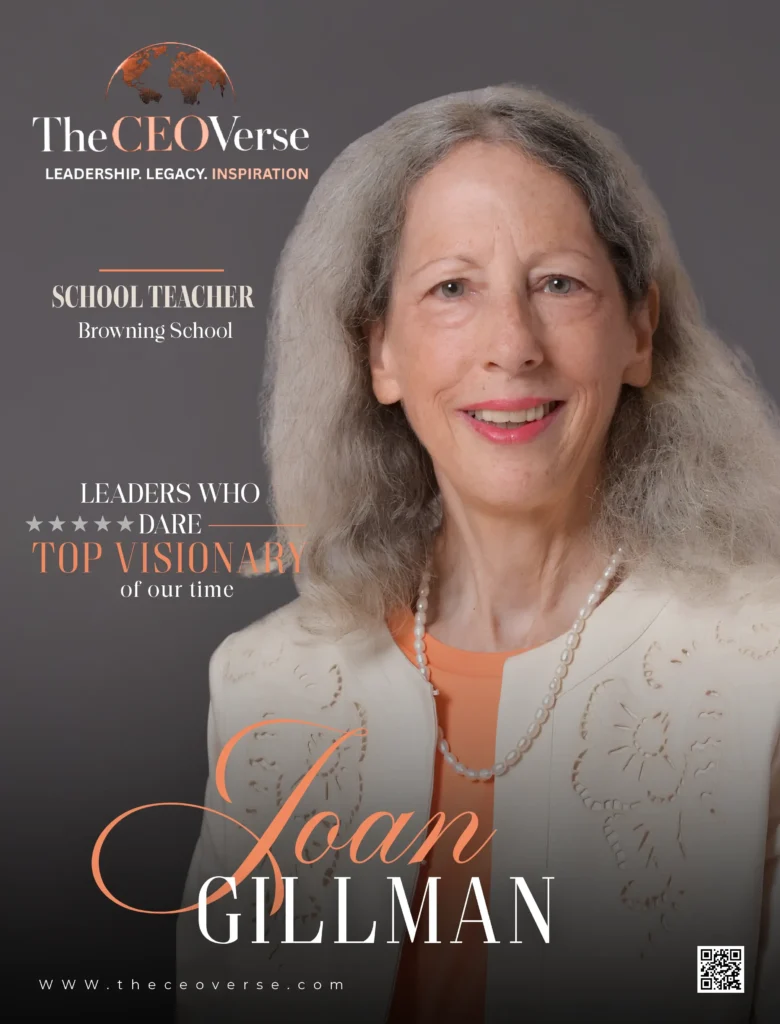
JOAN Gillman
Featured Profile - Joan Gillman
The Alchemist of Curiosity: How Joan Gillman Turned a Childhood of Wonder Into a 44 Year Legacy in Science Education
Once upon a time, there was a child who could never just simply watch the snow fall but had the tendency of catching the storm in her palms to measure what others only admired. She wanted to know the temperature, the barometric pressure, the rate of accumulation, and a photograph of it too, just in case the numbers alone don’t capture the magic. Long before she ever stood in front of a classroom, Joan Ava Gillman was already living like a scientist. Mixing powders and liquids in her bathroom sink hoping to invent something new, building shoebox robots with her older brother, and constructing an entire miniature metropolis out of Kenner building sets and Lincoln Logs, a place the two siblings proudly named Kinderkamack Village.
It would be easy to dismiss these as simply the charming footnotes of a happy childhood. But for Joan Gillman, today a celebrated Lower and Middle School Science Teacher at The Browning School in New York City, a Marquis Who’s Who honoree, an IAOTP Top Educator of the Decade, and now a United Nations representative, those snow tunnel afternoons and backyard experiments were the earliest brushstrokes of a life’s purpose. Little did she know that the instinct to question, to build, and to include her brother’s friends in every game and every project would one day become the exact philosophy she uses to teach hundreds of children each year. Curiosity is a birthright, and every child deserves a chance to shine.
This is the story of a woman who has spent more than four decades proving that science, at its best, is not a subject you memorize, it is a way of experiencing the world.
The Making of a Teacher, Long Before the Classroom
Joan’s path to teaching did not begin with a single defining moment, it accumulated, quietly, across a childhood and adolescence saturated with service. In high school, where a community service requirement was baked into the graduation criteria, she found her calling almost by accident. She volunteered to teach elementary schoolchildren how to play the recorder, tutored small groups struggling with math, and organized playground games, deliberately designed so that every child, not just the naturally athletic ones, had a moment to shine. It was a small thing, structuring a kickball game so no one felt left out, but it caught the attention of her school’s headmistress, who admired how instinctively Joan understood inclusion long before it became an educational buzzword.
That instinct kept expanding. She taught swimming at her local Jewish Community Center, working patiently with children who had special needs, easing their fear of the water one lesson at a time. During the week, she filled in as a substitute ballet teacher at a local dance studio, delighting in watching young students discover the joy of movement. Looking back, Joan describes these years as the scaffolding for everything that came after. As she says, “This importance of inclusiveness has framed how I teach. I believe it is important to give each child an opportunity to shine.”
The truly formative chapter, though, came while she was completing her Master’s degree in education. As a student teacher at P.S. 47, a junior high school for the deaf, Joan worked alongside profoundly deaf science students in grades seven through nine. Her cooperating teacher, a woman Joan still describes with reverence, had a gift for translating sophisticated science into something tactile and visual. During an electronics unit, the students didn’t just learn about circuits from a textbook, they built a miniature amusement park with working rides and attractions, wiring their own working models. Watching this unfold, something clicked permanently into place for Joan. Science is best understood through the hands, not just the ears. Hands on learning would become the signature of everything she built afterward.
Forty Four Years, Eight Schools, and One Constant Philosophy
Joan Gillman’s professional journey reads like a map of the New York and New Jersey school landscape. She earned a Bachelor of Arts in Education, summa cum laude, from Felician College (now Felician University) in Rutherford, New Jersey, in 1980, and followed it with a Master of Arts in Education from New York University’s School of Education, Health, Nursing, and Arts Professions, now known as the Steinhardt School of Culture, Education, and Human Development, in 1982.
Her career began the same year, as a fifth grade teacher at St. Angela Merici School in the Bronx, and from there her path wound through Joytown Kent Elementary School, the Bede School in Englewood, New Jersey, the Professional Children’s School in New York, where she spent two decades teaching all academic subjects for grades 4 and 5 as well as 6th grade math and science, and also ran the Student Government for the middle school, Anna C. Scott Elementary School in Leonia, New Jersey, and Yeshivat Noam in Paramus. In 2008, she joined the Calhoun School in New York City as a fifth and sixth grade science teacher, staying a full decade before, in 2018, she found her long term home at The Browning School. An all boys independent school founded in 1888, where she currently teaches science across second, fourth, and sixth grade, and leads the K8 Green Team.
Across every one of those classrooms and every one of those grade levels, one thread never broke, Joan’s refusal to accept a “one size fits all” approach to teaching. “This certainly doesn’t work for clothes,” she says with characteristic wit, “and it definitely doesn’t work for education.” Each child, she insists, arrives with a distinct set of needs, and it is the teacher’s job, and not the student’s burden, to find the approach that unlocks understanding.
Straw Rockets, Baby Elephants, and the Art of Making Science Unforgettable
Ask any of Joan’s former students what they remember most, and there is a good chance the answer involves a straw rocket or an elephant. Her Fourth Grade Straw Rocket unit has become something of a signature, students design rockets built from straws, clay nose cones, and fins, experimenting with launch angles and measuring flight distances outdoors before returning inside to analyze their data like true researchers. They fail, recalibrate, and launch again, a process Joan considers the most valuable part of the lesson. “The learning doesn’t stop with the first trials,” she explains. “Even if they have not succeeded with their first try, they have a second chance to see if they can get their rocket to travel further.”
For her second grade engineering unit, she abandons tests altogether in favor of a story. A family of elephants, a mother, a father, and two babies, goes for a walk, and the young ones wander too far ahead, ending up stranded on the far side of a bridge. The challenge for the students is deceptively enormous for seven year olds. To design and build, from recycled materials and craft supplies, a bridge sturdy enough to bear the weight of two adult elephants and two calves. It is science, engineering, mathematics, and art fused into a single afternoon of pure delight. And, not incidentally, it is exactly the kind of interdisciplinary thinking Joan believes the future of education demands.
With her middle schoolers, the approach shifts but the philosophy doesn’t. She opens new units with a striking phenomenon designed to spark curiosity, builds lessons that connect to what students already know, and sets up labs where they test hypotheses and draw their own conclusions, all while making herself available most mornings before school for anyone who needs extra help. It is a level of accessibility that speaks to a deeper conviction that no child should be left behind simply because a concept didn’t land the first time.
A Green Thumb for Growing Changemakers
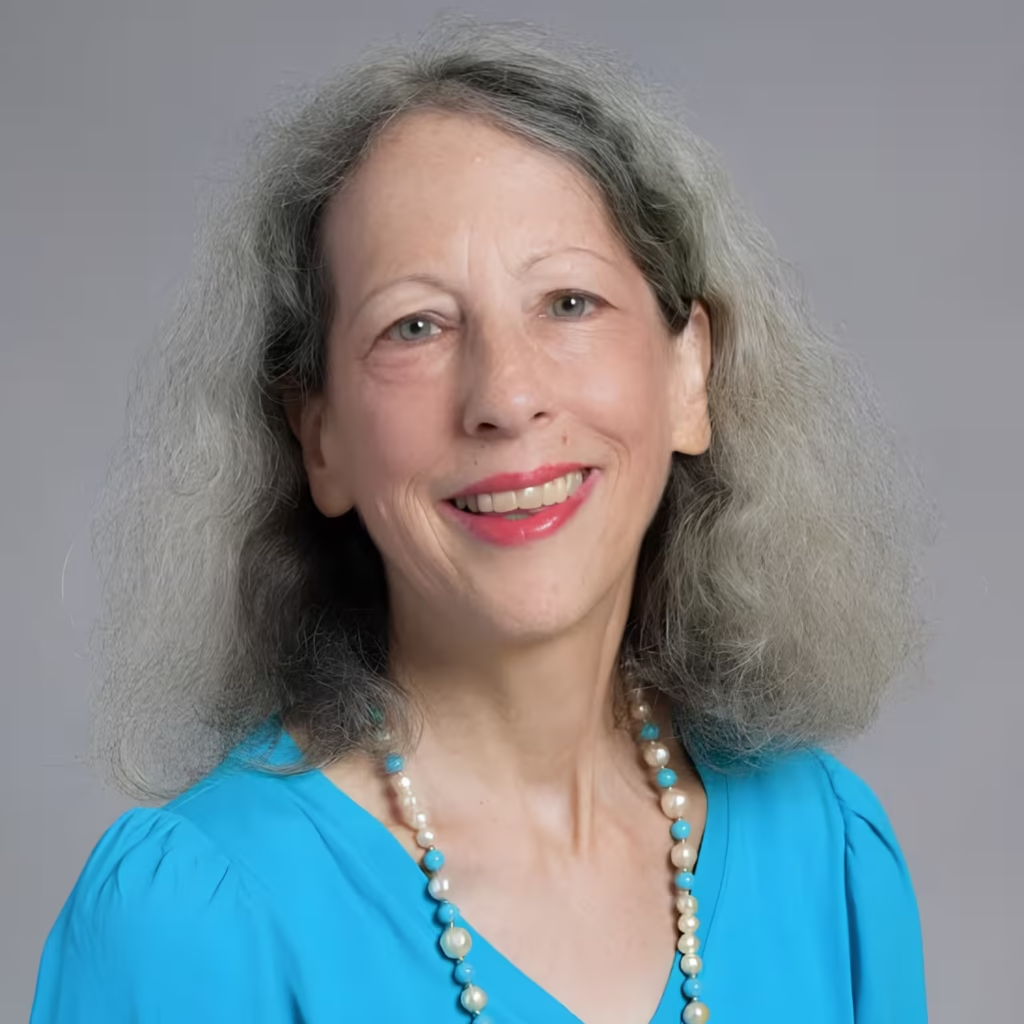
Beyond the classroom, Joan channels her passion for the planet into her role as leader of The Browning School’s Green Team, a student led initiative she has shaped into something far bigger than an after school club. Under her guidance, students post a weekly “Green Action of the Week,” organize park cleanups in Central Park (drawing students out of bed and into the park by 7:30 on a Monday morning, no small feat), plan Biodiversity Week challenges, invite guest speakers, and run fundraisers for causes ranging from hurricane relief to broader environmental initiatives.
“To nurture leadership qualities in young students, you must encourage them to develop compassion for living things and a passion to be a positive changemaker,” Joan says. It is a philosophy she extends well past Browning’s walls. Students have told her that lessons on global water scarcity inspired them to join the Green Team in the first place, evidence that her classroom’s ripples travel further than she may even realize.
When the World Gets Heavy: Teaching Through Crisis
Not every chapter of Joan’s career has been straightforward, and she is candid about the moments that tested her. Her very first year of teaching, in the South Bronx, greeted her with a question she wasn’t prepared for. “Are you staying for the whole year?” It was a fair question in a system that saw high staff turnover, but Joan had made her commitment, and she intended to honor it, even when it meant running six different reading levels simultaneously in a single fifth grade classroom, with student abilities spanning from second grade to tenth grade.
In 1986, tragedy interrupted an otherwise ordinary science lesson. Joan was teaching sixth graders who had been eagerly following the Challenger space shuttle mission, thrilled that a teacher was among the astronauts aboard, when news of the disaster broke. Suddenly, Joan wasn’t just teaching science, she was guiding eleven year olds through grief and fear, choosing her words with enormous care so she could answer their questions honestly without frightening them further. “This experience really opened my eyes,” she reflects, “to how important the role of a teacher can have in the life of a student.”
Decades later, the COVID-19 pandemic presented an entirely different kind of challenge. How do you run a hands on science lab through a screen? Joan’s solution was pure ingenuity. She emailed students and parents in advance with lists of household items so they could assemble their own kitchen labs, then conducted her demonstrations live online, walking families through investigations step by step. Parents later told her they were amazed at how interactive she made remote learning feel, a phrase that, to Joan, validated years of believing that engagement is a mindset, not a room.
Even her move to The Browning School carried its own quiet challenge. She had built her career largely around upper elementary and middle school students, and suddenly found herself also teaching second grade. She embraced it fully, and today insists she loves teaching her youngest students every bit as much as her oldest. Proof that adaptability, for Joan, isn’t a forced skill but a genuine curiosity about every age and every kind of learner.
A Symphony on the Side
Ask Joan what she does outside the classroom, and you will discover an entirely different dimension of her creativity. She is a classically trained pianist and violinist who performs with the Bergen Philharmonic Orchestra, the North Jersey Symphony, and, in the summer months, The August Symphony Orchestra. At least four times a year, she sets aside her lesson plans to volunteer at nursing facilities, playing classical piano and violin for residents. “It feels so wonderful to raise up the spirits of the residents,” she says, a sentence that could just as easily describe her effect on eight year olds mid straw rocket launch.
A Decade of Distinctions
If Joan Gillman’s early years were about quietly building a philosophy, her recent years have been about the world catching up to notice it. In 2017, the Calhoun School honored her with its Urhy/Thompson Award, a recognition reserved for faculty who embody the spirit of a beloved colleague. A moment Joan describes as one of the happiest of her career, a validation for all of her years of dedication to her students’ education.
From there, the accolades have arrived in a steady, almost dizzying stream. Marquis Who’s Who has named her among its Top Educators, its Who’s Who of Professional Women, and honored her with a Lifetime Achievement Award and recognition in its Who’s Who of Humanitarians and Philanthropists. Her work has been profiled in Fortune Magazine’s October/November 2025 issue, in Forbes Magazine, in Insight Magazine, in the National Digest Magazine, and in World’s Leaders Magazine. Kappa Delta Pi, the international education honour society, named her a “Legacy Member.”
The year 2024 alone brought a remarkable cluster of honors. The CXO Time Award for Most Inspiring Educator in Science Education, a spot on CXO Time’s Visionaries of Success list as one of the Top 10 Leaders Shaping the Future, and recognition from CIO Views Magazine as one of the Top 10 Empowering Women Leaders of the Year. In 2025, The Executive Lens named her among its Top 5 Women to Know in its Icons of Influence feature, and MSN News featured her in a piece titled “5 Female Leaders Who Went from Vision to Victory.”
Perhaps most meaningful to Joan has been her relationship with the International Association of Top Professionals (IAOTP), which named her “Top Educator of 2025,” a distinction she calls one of the true highlights of her career, before returning in 2026 to name her “Top Educator of the Decade,” add her to their list of “Top 50 Fearless Leaders” and “Top 25 Global Impact Leaders,” and, most recently, name her “Woman of the Year.”
In early 2026, her list of honours gained a new, distinctly global dimension. Joan was appointed to the Forttuna Education Council’s Global Advisory Board, joining an international collective of leaders shaping business growth, human well being, and institutional excellence across sectors. Weeks later, in March 2026, came what may be the most striking recognition yet, her appointment as a United Nations Representative to the AWWG at the United Nations Economic and Social Council (ECOSOC). Of the appointment, Joan said it “is both a privilege and a responsibility,” adding that she looks forward to “contributing meaningfully to global dialogue, policy advocacy, and multi stakeholder collaboration aligned with the United Nations Sustainable Development Goals, particularly in areas of sustainable development, inclusive growth, and international cooperation.” She added, “I am grateful for the trust placed in me and look forward to working alongside global leaders, policymakers, civil society organizations, and fellow representatives to support initiatives that create measurable, long-term impact. Thank you to everyone who has supported this journey. I remain committed to service, collaboration, and advancing solutions that contribute to a more sustainable and equitable future.” It is, in many ways, the natural extension of a Green Team advisor’s decades long instinct to think beyond her own classroom walls.
Scholarship, Service, and Spreading the Word
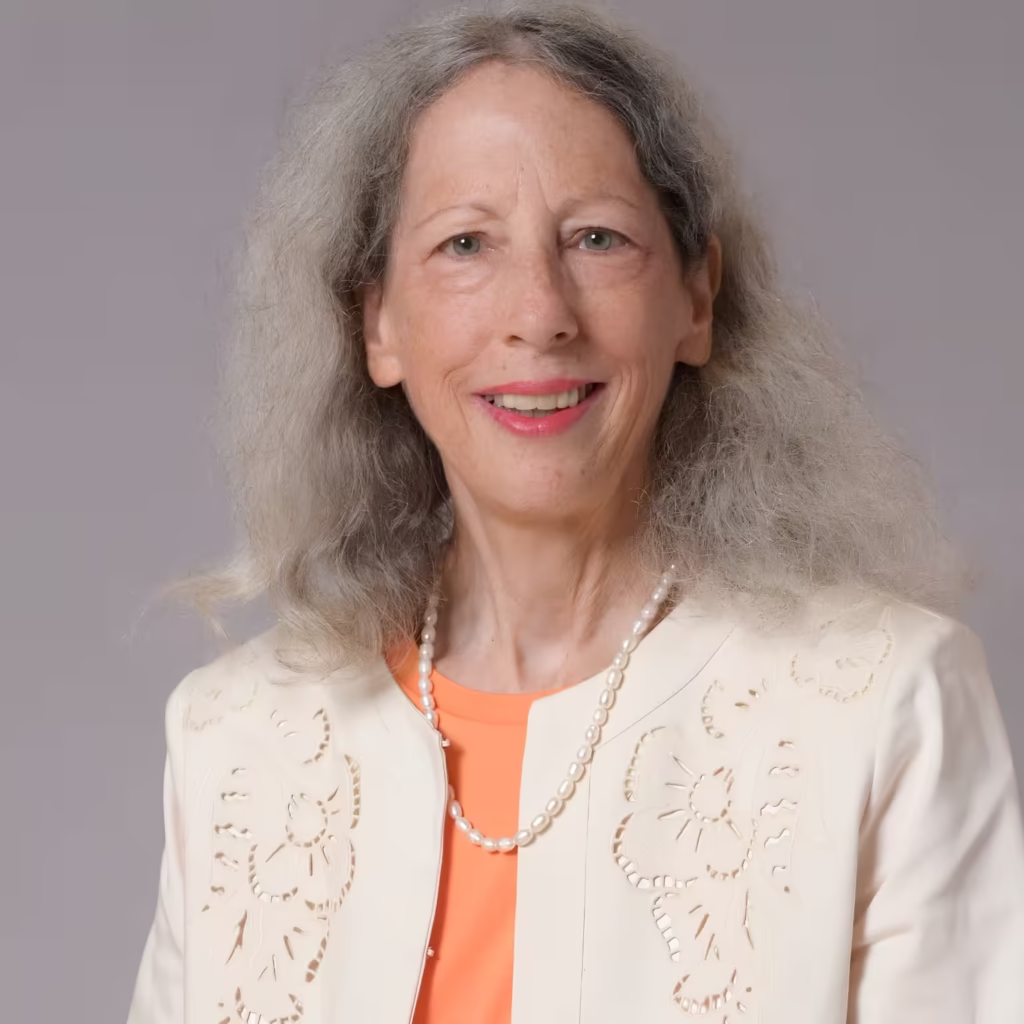
Awards aside, Joan has quietly built a substantial body of professional scholarship. She has authored numerous articles for respected publications, including the STANYS Bulletin and Science and Children, the latter published on behalf of the National Science Teaching Association. She is especially proud of her curriculum “Straw Rockets Are Out of This World,” originally published by Science and Children in 2013 and later reprinted in the 2016 book “Bringing STEM to the Elementary Classroom.” More recently, she contributed materials to a new title from Corwin Publishers, “What Teachers Want to Know About Teaching Climate Change,” and in 2011 developed a curriculum on “The Great Japanese Earthquake and Tsunami,” which earned her a grant from Cornell University’s East Asian International Studies program. Her scientific curiosity has even reached beyond Earth’s atmosphere, she was once recruited as a teacher ambassador for NASA’s Mars Atmosphere and Volatile Evolution (MAVEN) mission.
Joan has long served as a Subject Area Representative (SAR) for the elementary level in New York City on behalf of STANYS, the Science Teachers Association of New York State, attending monthly leadership meetings, running workshops at the organization’s annual conference, and helping recruit guest speakers for online programming. She has taken her expertise on the road (and often to the podium) at conferences hosted by the National Science Teaching Association, the NSTA STEM Conference, STANYS, the Science Council of New York City (SCONYC), the NYSAIS Diversity Symposium, and STEMTeachersNYC, even helping plan the SCONYC conference itself in the spring of 2024. She is also an active member of SEEDS, the Science Educators for Equity, Diversity, and Social Justice, a nonprofit dedicated to building transformative, equitable science education for all students. Notably, in 2019 she became a certified National Geographic educator after completing a rigorous three part certification process that included designing lesson plans and producing a capstone video, and in the summer of 2022 she completed a five week course to become a certified Modern Classroom Project educator.
A School Built on Curiosity, Honesty, Dignity, and Purpose
Joan’s current professional home, The Browning School, provides a fitting backdrop for her work. Founded in 1888 in New York City, Browning is an all boys independent school serving more than 400 students from kindergarten through twelfth grade. Its mission to “create men of intellect and integrity to contribute meaningfully to our world” is anchored by four guiding values. Curiosity, Honesty, Dignity, and Purpose. The school’s commitment to equitable, research based educational practices isn’t treated as an add on, it runs through every layer of the curriculum, designed specifically to meet the developmental needs of boys and to help them feel respected, encouraged, and challenged as learners. It is, in many ways, an ideal match for a teacher who has spent her entire career insisting that every child deserves an individualized path to understanding. In the summer of 2024, Browning began implementing the Next Generation Science Standards (NGSS) across its Middle School science courses, and Joan has worked closely with colleagues to update both her middle school and lower school curricula to align. Proof that even after four decades, she remains committed to evolving alongside her field rather than resting on institutional memory.
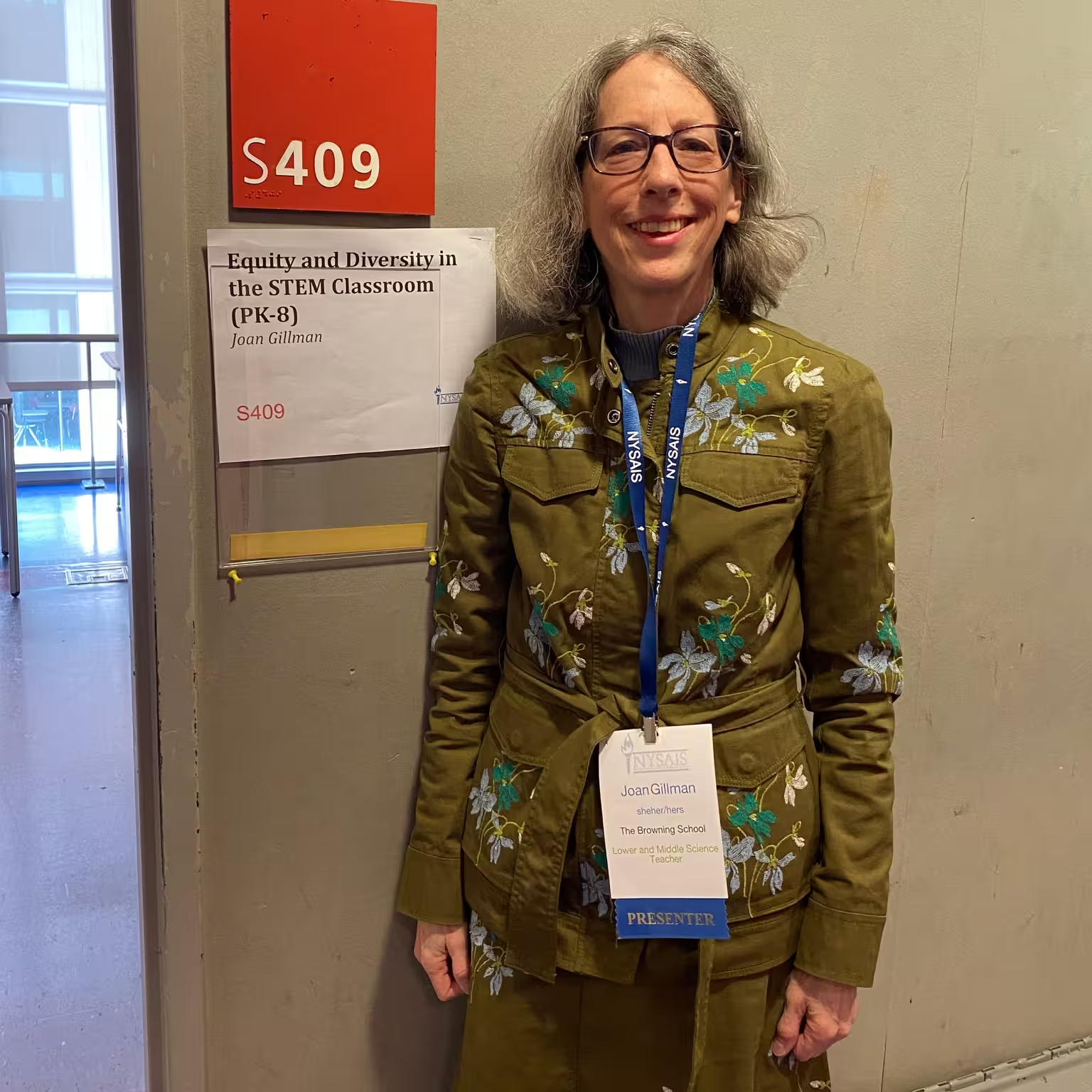
Looking Toward Fifty Years — and Beyond
At an age when many educators are contemplating retirement, Joan Gillman is looking ahead to a new milestone, fifty years in teaching. Next season will bring its own reinvention, she will step away from teaching across two divisions to focus solely on the lower school, and for the first time in her career, she will add kindergarten to her teaching roster. It’s a return, in some sense, to where her instincts began, with the youngest learners, the ones still measuring snowstorms with yardsticks and building cities out of Lincoln Logs, not yet aware of what their curiosity might become.
Her vision for the future of education is characteristically holistic. She believes curriculums must grow more interdisciplinary, breaking down the artificial walls between subjects so that students understand, as she puts it, that learning doesn’t take place in isolation because the world itself doesn’t work that way. And she credits her own longevity in the profession to a relentless commitment to professional development. Workshops, courses, and conferences that have kept her enthusiastic about her distinguished career for forty four years and counting.
To aspiring educators and leaders hoping to make their own mark, Joan’s advice is refreshingly unpretentious. Keep learning, she says, the field will keep changing, and so must you. Keep your sense of humour, because there will be difficult days, and patience wears thin without laughter. And never be afraid to ask for help, even after decades in the profession, she still leans on the collective wisdom of the educators around her. “Teaching is a very challenging and exhausting career,” she says, “but it is still one of the most rewarding professions you can choose. Keep up your spirits. The best days are just ahead of you.”
The Measure of a Life Well Taught
It would be tempting to reduce Joan Gillman’s story to a list of titles and trophies. Top Educator of the Decade, Woman of the Year, UN Representative, published author, orchestral violinist. But the truest measure of her impact is far less quantifiable, it is the ninth grader who joined the Green Team because a sixth grade lesson on water scarcity moved him to act. It is the deaf science student who, decades ago, wired a working amusement park ride and, in doing so, taught a young student teacher the value of hands on learning that would ripple through forty four years of classrooms. It is every straw rocket that flew a little farther on its second launch, and every second grade bridge that held, improbably, the weight of four small elephants made of plastic.
From a childhood spent chasing snowstorms and building imaginary villages, Joan Ava Gillman built a life dedicated to a single, quietly radical belief that curiosity, nurtured with patience and creativity, can change the trajectory of a child’s entire life. Forty four years in, with a kindergarten classroom and a UN appointment both waiting for her this year, it is clear she has no intention of putting that belief down anytime soon.