
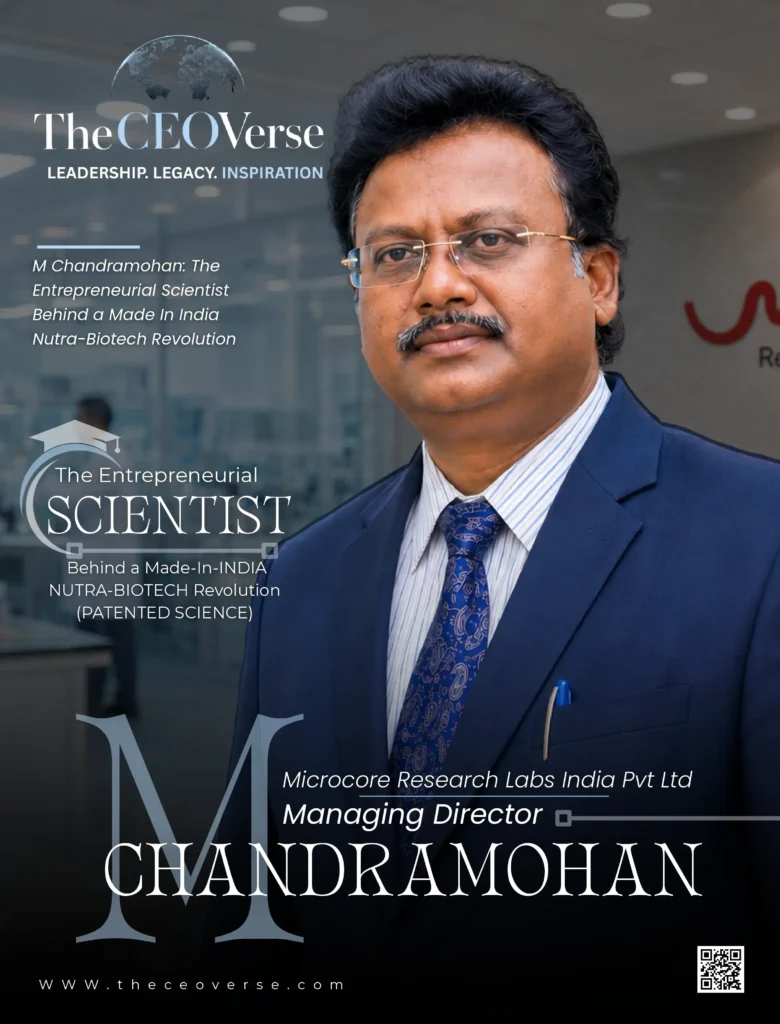
TheCEOVerse • Digital Edition
“The Entrepreneurial Scientist Behind a Made-In-INDIA NUTRA-BIOTECH Revolution (PATENTED SCIENCE)”
Cover story
M Chandramohan
Featured Profile - M Chandramohan
M Chandramohan: The Entrepreneurial Scientist Behind a Made In India Nutra-Biotech Revolution
For certain minds, no daily oddity is too small to escape scrutiny. A true investigator like that cannot walk past an everyday mystery without stopping to pick it apart. For M. Chandramohan, Managing Director of Microcore Research Laboratories India Pvt Ltd, that mystery arrived not in a research paper or a conference hall, but at the breakfast table. He noticed that the idlis made by the elder women in his family turned out softer, lighter and better fermented than the ones made by the younger cooks, even when the rice, the lentils and the method looked identical on paper. Most people would have called it experience, or a grandmother’s touch. Chandramohan called it a question worth answering. That single observation, chased with a young researcher’s stubbornness, would eventually grow into a biotechnology company that today holds patents, clinical validations and a regulatory distinction no other Indian company in its category can claim.
Chandramohan’s fascination with science took root during his school years in Tamil Nadu and matured into a serious pursuit of microbiology through his undergraduate studies. It was during his postgraduate years in Applied Microbiology at Presidency College, Chennai, where he completed his Master’s degree in 2001, that the idli and dosa puzzle found its proper home. Rather than treating traditional food preparation as folk wisdom outside the reach of science, he treated it as a legitimate research question. Could generations of kitchen practice actually be encoding a biological principle nobody had bothered to decode?
Over roughly six months, he studied the microbial ecology of traditional batter fermentation, tracking the naturally occurring organisms at work and their relationship to how well a batter rose. It was unglamorous, patient science , the kind that rarely makes headlines, but it planted an idea in him that would outlast the thesis itself. Biology already knows how to solve most of its own problems. The scientist’s real job is to listen carefully enough to understand how. He credits his professor and head of department at the time, Dr. Rajarajan, with giving that early curiosity room to grow into a disciplined line of inquiry, rather than dismissing it as a student’s passing fascination.
What happened next surprised even him. A copy of that undergraduate thesis found its way to Biocon, where researchers saw its relevance to the emerging world of probiotics and microbial biotechnology. A college project about soft idlis had quietly opened the door to India’s biotech industry.
Learning to Connect Scientific Excellence with Business Strategy
Chandramohan joined Biocon as a Trainee Scientist, a role that shifted his frame of reference from academic curiosity to industrial reality almost overnight. Six years at the company immersed him in microbial metabolism, bioprocess engineering, strain improvement and the unglamorous but essential discipline of taking a laboratory result and making it repeatable at scale. It was here that he absorbed a lesson that still governs how Microcore operates. A scientifically interesting discovery is only the starting line. The real test is whether it can be turned into something reproducible, scalable and commercially viable.
Two figures from that period left a lasting imprint. He speaks of Mr. Shri Kumar Suryanarayanan, under whom he worked in R&D, as a strategic mind who could connect deep scientific understanding with the practical demands of running a process floor. Someone who taught him that good biotechnology needs as much discipline as it does discovery. And in the organisation’s departmental review meetings, he had the rare opportunity to observe Dr. Kiran Mazumdar Shaw at close range, watching how she moved fluidly between the language of science and the language of business. That back and forth, knowing when a scientific opportunity was worth chasing and when a promising idea needed to be tested against commercial reality, reshaped his own ambitions. He no longer wanted to sit on just one side of that divide. He wanted to be the kind of scientist who could carry an idea the entire distance, all from hypothesis to hospital shelf.
Crafting Something Uniquely His
In 2007, with what he describes as the encouragement and blessing of both mentors, Chandramohan left the security of an established organisation to found Microcore Research Labs. For him, the decision carried a condition he set for himself before he set it for anyone else. Microcore would not simply repackage the molecules or technologies he had worked on at Biocon. If he was going to build a company, it would stand on ideas that were unmistakably his own.
That single act of self discipline gave the young company its character from day one. Instead of following a well trodden path, Chandramohan turned his attention toward Tamil Nadu’s own backyard. Its traditional knowledge, its indigenous raw materials, its industrial byproducts that everyone else treated as waste. He wanted to look at ordinary, overlooked materials through a scientific lens and ask what they could become if someone bothered to ask. It was the idli experiment all over again, just at industrial scale. Take something familiar, refuse to accept the obvious explanation, and see what science reveals underneath.
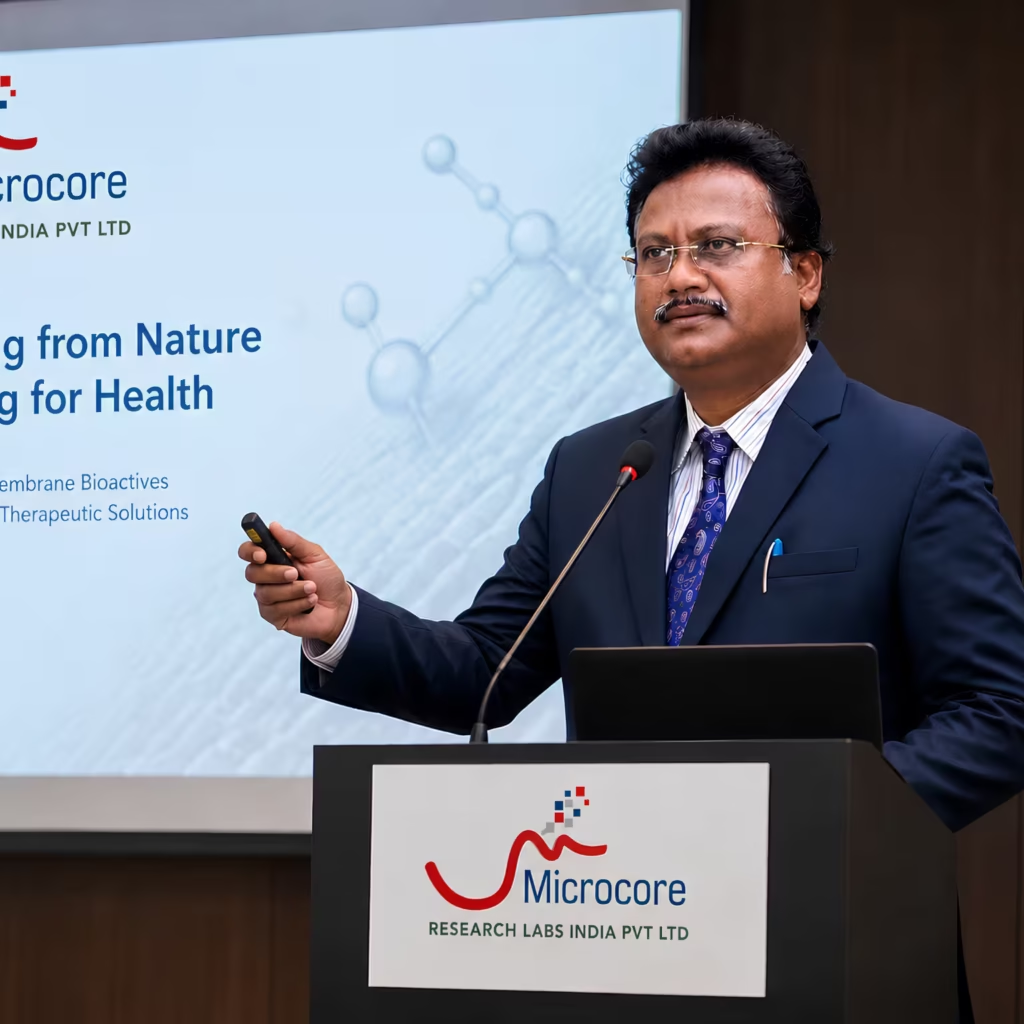
The company took its present form around this belief that scientific curiosity should never stop at a laboratory bench. It had to travel further, through process engineering, scale up, validation and manufacturing, until it reached the market as something people could actually use. Today, Microcore’s research and manufacturing infrastructure spans facilities in Erode and Karur in Tamil Nadu, and its in house R&D carries recognition from India’s Department of Scientific and Industrial Research. A fitting return for a company built on the conviction that home grown science deserves a global stage.
Nine Years Before the First Real Breakthrough
Founding a company is one thing, surviving the years before it produces anything the market wants is another altogether. Nearly a decade separated the incorporation of Microcore in 2007 from its first major product reaching commercial scale in 2016. Chandramohan does not dress up that period as a smooth ascent. Research, in his telling, rarely moves in a straight line. For every experiment that worked, there were several that didn’t, and many more that had to be run again and again before they gave up a usable answer.
What carried the company through, he says, was less a stroke of genius than a stubborn kind of discipline. The refusal to treat a failed experiment as a verdict on the idea itself, and the willingness to keep refining until the science held up under pressure. It is a theme he returns to often that innovation is less about brilliance and more about resilience, repeated over a long enough timeline that it starts to look, from the outside, like inevitability.
Creating Impact, Not Just Inventory
The product of that patience is a company that now positions itself firmly in the science first end of India’s nutraceutical industry. A segment more often associated with commodity powders and interchangeable capsules than with patents and clinical trials. Microcore’s portfolio centres on Natural Egg Shell Membrane, Undenatured Collagen Type II and a family of bioactive formulations aimed at joint, bone, skin and connective tissue health, alongside a B2B arm that develops customised ingredients and formulations for partner brands.
At the heart of this work sits what the company calls its Epitope Integrated Collagen Technology, an approach that, in Chandramohan’s explanation, does something conventional collagen supplements were never built to do. Rather than simply supplying structural amino acids and hoping the body makes use of them, the technology delivers bioactive peptide sequences that the body actively recognises and responds to, triggering cellular signalling for collagen regeneration, supporting cartilage repair and improving how well the compound is actually absorbed. It is the difference, as he frames it, between a product that is merely present in the body and one that instructs the body to do something.
That scientific rigour has translated into a regulatory distinction that Chandramohan is visibly proud of. Microcore holds PA II approval from India’s food safety regulator, FSSAI, for a proprietary molecule with an authorised health claim, a recognition the company says makes it the only one of its kind in India in this category. For a founder who began his career questioning why nobody had scientifically explained an everyday kitchen phenomenon, there is a certain symmetry in ending up as the architect of a molecule whose claims are backed by data strong enough to satisfy a national regulator.
The Hardest Fight Isn’t in the Lab
Ask Chandramohan about the most difficult phase of his career, and the answer isn’t about a failed batch or a funding crunch. It’s about perception. India’s nutraceutical market, he explains, is saturated with brands making near identical claims across bone, joint, immunity and skin health, and a large part of that market operates on the lazy assumption that all ingredients are essentially interchangeable. Reducing carefully validated bioactives to commodities that compete on price rather than science.
Correcting that mindset, he says, has been a longer and more frustrating battle than any experiment. His response has been to shift the conversation his partners and marketers have with the world, away from what an ingredient is and toward what it actually does inside the body. Microcore now invests deliberately in helping brand partners understand mechanism of action, structural specificity, bioavailability and clinical substantiation, arming them with the vocabulary to compete on evidence rather than discount pricing. It is, in effect, an educational mission wrapped inside a commercial one. Convincing an entire industry that not all molecules that look alike behave alike.
Three Rules That Run the Company
Pressed on what has made him effective as a leader, Chandramohan doesn’t reach for an inspirational abstraction. He names three concrete habits. Quality consciousness, delivering ahead of deadlines, and perseverance. Quality, in his formulation, isn’t a checkpoint at the end of a process but something built into every stage of it. A standard he insists on whether the work in question is a clinical trial or a customer service call. On timelines, his philosophy is almost contrarian in an industry known for slippage. Rather than working toward a deadline, he pushes his teams to be ready before it, arguing that early delivery buys an organisation the flexibility to absorb the unexpected without sacrificing quality. And on perseverance, he treats setbacks as raw material rather than obstacles. Proof, in his view, that a leader’s job is to keep moving the goalpost of what the organisation is capable of, rather than waiting for conditions to become easy.
These aren’t values he keeps confined to a mission statement. He traces them back to his own apprenticeship. Watching how Biocon’s leadership balanced scientific ambition with commercial discipline, and credits an unusual second education for sharpening them further. Nearly two decades spent advising more than 500 companies across sectors as diverse as family businesses, professional corporates and large conglomerates. That exposure, he says, taught him that there is no single formula for building an organisation. Only a shared reliance on trust, discipline and the willingness to keep learning from people who run their businesses very differently from the way he runs his.
A Wall of Recognition, Read Differently
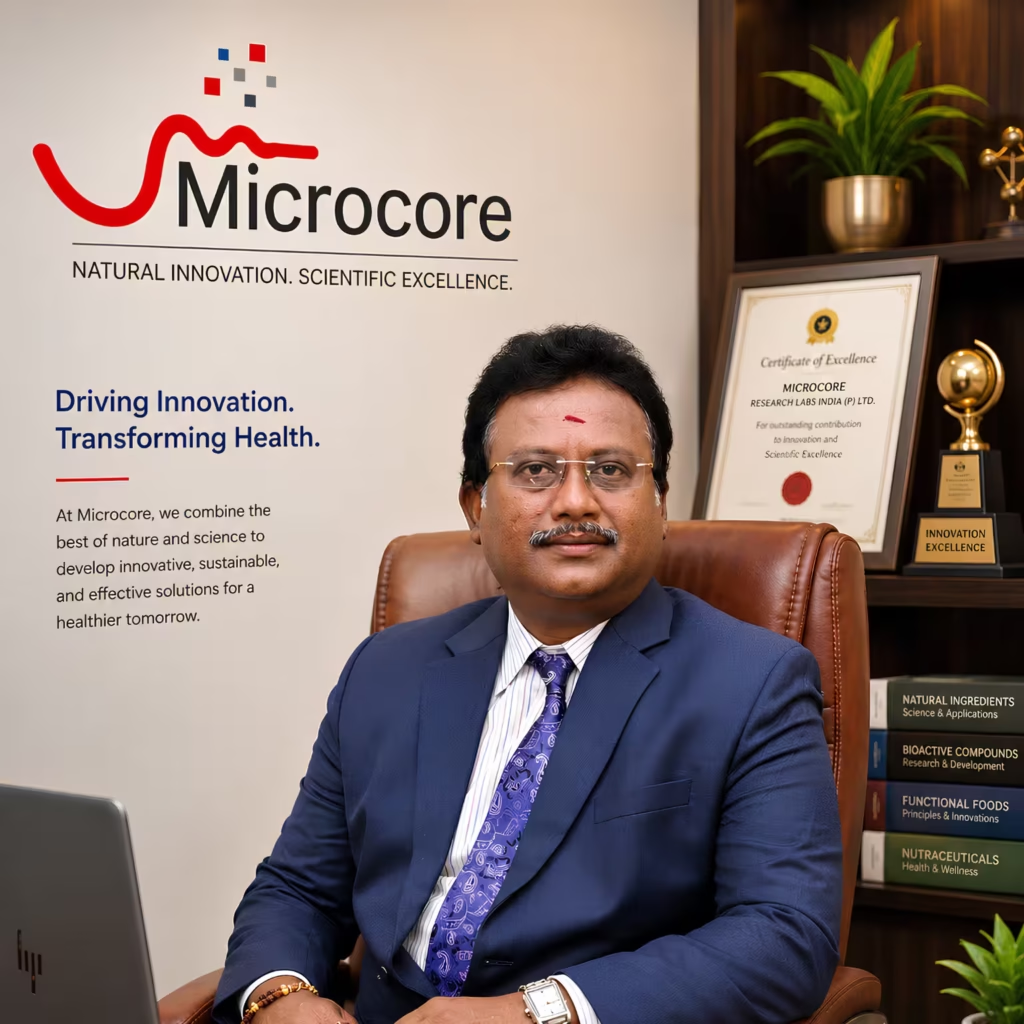
Over the years, that combination of scientific persistence and business instinct has earned Chandramohan a long list of recognitions, stretching back to a Bharathiar University rank holder honour in 1998 and a Best Researcher Award in 2000 for identifying a microbial cause of dextran loss in sugar processing. Early proof that his instinct for solving overlooked problems predates Microcore itself. Biocon honoured him with Bio Contribute Awards in the early 2000s, presented in recognition from Kiran Mazumdar Shaw herself. Later years brought the A.P.J. Abdul Kalam Excellence Award, the Mother Teresa Excellence Award and the India Top 100 SME Award, among others, while 2026 alone has brought Microcore cover story recognition across multiple business publications, including features naming Chandramohan among the country’s most game changing leaders and Microcore among India’s leading nutraceutical R&D companies.
He tends to describe these honours less as personal trophies and more as validation of an underlying method. Evidence that a company built on indigenous science, tested patiently and marketed on evidence rather than noise, can hold its own against much larger, better funded competitors.
The Part of the Story That Isn’t About Business
Beneath the scientific rigour and the entrepreneurial discipline sits a quieter set of convictions that Chandramohan is careful to separate from the language of strategy. He speaks of humility, self discipline and faith as the anchors of his personal life, and describes a belief that genuine charity should be extended to those in need without any expectation of recognition or publicity. Something done, in his words, sincerely enough that it need not be noticed by anyone but does not go unaccounted for. It is a value system that sits somewhat apart from the boardroom vocabulary of KPIs and market share, and he treats it as no less central to how he measures a life well spent. Not only by what an organisation achieves, but by the trust it earns and the lives it quietly touches along the way.
Where the Science Goes Next
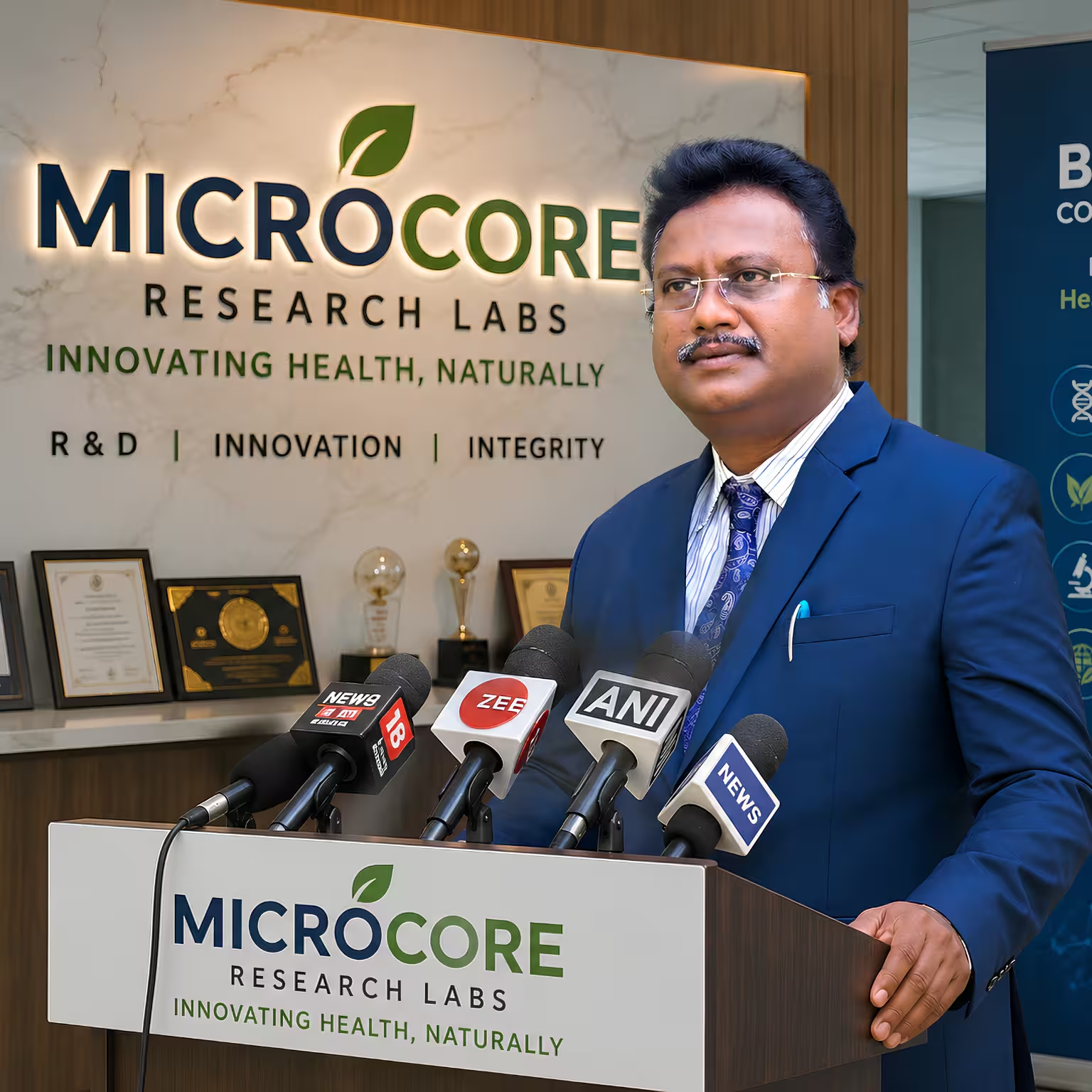
Microcore’s ambitions today extend well beyond the joint health and bone health categories that built its reputation. The company is developing translational applications in wound healing for cuts and thermal burns, post surgical tissue regeneration, endoscopic delivery systems for peptic ulcer healing, and advanced approaches to bone repair and cartilage regeneration. Work that pushes the epitope integrated platform from the nutraceutical shelf toward genuine therapeutic territory. Chandramohan frames the company’s trajectory as a steady climb from early stage discovery through preclinical and clinical validation toward scalable, global commercialisation, with the long term goal of establishing Microcore as a recognised name in bioactive driven regenerative medicine rather than merely a well regarded supplement manufacturer.
Advice to the Next Generation
Asked what advice he would offer the next generation of entrepreneurs, Chandramohan resists the idea that he has any advice to give at all. Only a perspective, earned the hard way. Endurance, he says, is the real currency of success. The setbacks that come with building something from nothing are not evidence of failure but material for growth, and the leaders who last are the ones who can spot an opportunity even inside a defeat, willing to examine their own shortcomings honestly enough to come back stronger. It is a philosophy that traces a clean line back to where his story began. A young researcher who looked at something as ordinary as a plate of idlis, refused to accept the easy explanation, and kept asking questions until the answer became a company.
Nearly three decades on, M. Chandramohan’s journey reads less like a single dramatic leap and more like a long, deliberate fermentation of its own. Curiosity slowly proving itself into research, research maturing into engineering, and engineering finally rising, patiently, into something the world now recognises as Microcore.