TheCEOVerse • Digital Edition
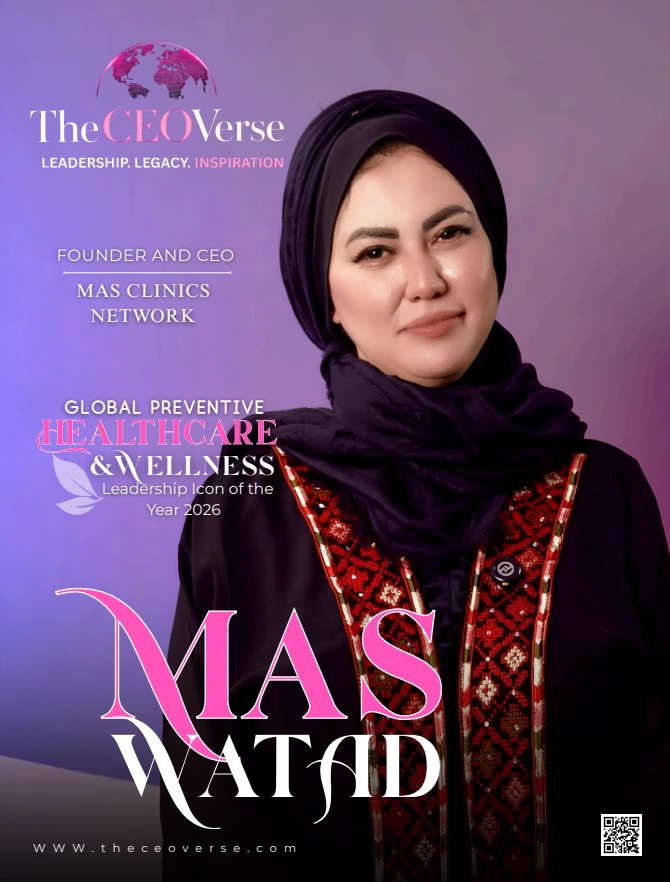
“Global Preventive Healthcare & Wellness Leadership Icon of the Year 2026”
Cover story
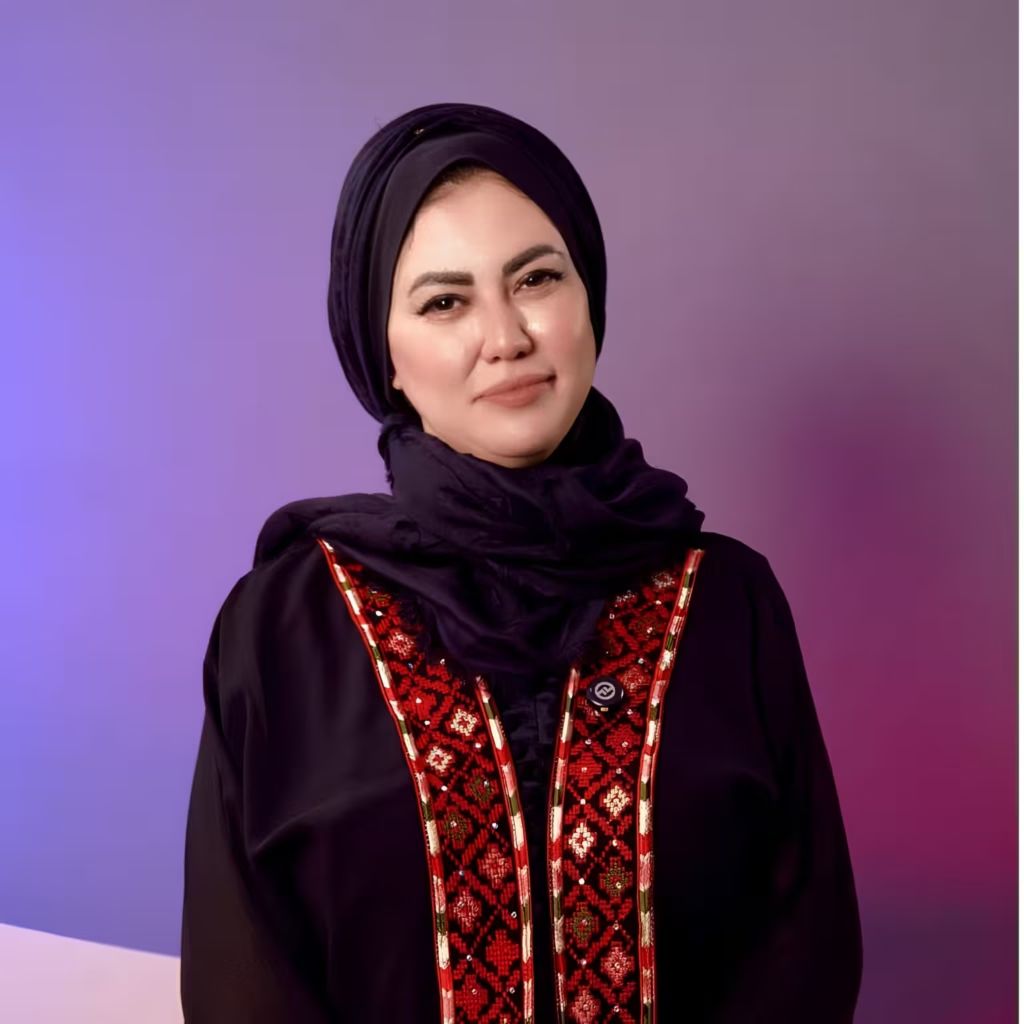
Mas Watad
Featured Profile - Mas Watad
Mas Watad: The Woman Who Refused to Separate Health from Culture
Sometimes, ambition in a person is sparked by a wondering thought rather than a calculated career path. For Mas Watad, that question was deceptively simple. What if better health did not require people to give up the food, culture, habits, and identity that made them who they were?
Long before phrases such as digital health, AI enabled wellness, behavioural science and health tech ecosystem became part of the entrepreneurial vocabulary, Watad was already working with their underlying premise from the ground up. Her starting point was not a technology laboratory or a venture capital boardroom. It was the everyday reality of Arab families, kitchens, communities and women trying to make healthier choices without being asked to abandon their traditions.
Today, Watad is the Founder and CEO of Dawsat International and the Founder and CEO of Mas Clinics Network, with more than two decades of experience spanning clinical nutrition, preventive health, wellness, entrepreneurship, media, community engagement and digital transformation. Her work has reached more than one million people and generated more than 60,000 documented success stories across health and wellness initiatives. But the numbers, she insists, are not the story. Behind every statistic is a woman who regained confidence, a family that changed its habits, a community that learned to think differently about health, or someone who discovered that a healthier life was possible without disconnecting from the life they already knew. That distinction explains the unusual arc of Watad’s career. She has never really been building a diet business, a clinic network or a technology platform in isolation. She has been building a relationship between people and health. And now, as artificial intelligence transforms what is possible in healthcare, she is taking that relationship into its next technological chapter.
Before the Startup, There Was a Mission
Watad’s entrepreneurial story did not begin with the conventional desire to become an entrepreneur. It began with clinical nutrition. Her academic foundation in dietetics and clinical nutrition gave her the scientific framework to understand food, health and behavior. But working directly with communities taught her something textbooks alone could not. Knowing what people should do is not the same as helping them actually do it. A recommendation can be scientifically perfect and practically useless. A diet can be nutritionally balanced and culturally impossible. A health campaign can contain excellent information and still fail to change a single behaviour. Watad became interested in the space between knowledge and action. Her answer was to move closer to the people she wanted to serve. Instead of approaching nutrition as a set of instructions handed down by an expert, she began listening to the realities surrounding food. Family routines, traditions, social expectations, emotional relationships with eating, and the influence women can have on the health of an entire household. That philosophy eventually became the foundation of Dawsat. Healthy living should fit into people’s lives rather than demand that their lives be rebuilt around it.
Dawsat’s methodology originated in 2003, when Watad developed a points based system for classifying foods and began building a wellness approach around traditional Arab cuisine. Rather than asking Arab families to replace familiar foods with an imported model of healthy living, she began looking at how the foods people already ate could become part of a sustainable approach to wellness. Why should an Arab family have to translate its kitchen into somebody else’s nutritional language? Why should traditional dishes automatically be treated as obstacles? Why couldn’t grape leaves, kofta, familiar breads, family meals and regional flavours become part of a healthier lifestyle? That was where Watad saw the opportunity. Not in replacing culture with health, but in designing health solutions that understood the context in which people actually live.
Turning a Kitchen into a Health Platform
The Dawsat System began as a methodology, but it did not remain one. What started as a community based approach expanded through clinics, groups, educational initiatives, media, publications and eventually digital channels, contributing to more than 60,000 documented success stories. The underlying insight remained consistent, that is behaviour changes more effectively when people can recognize themselves in the solution.
Dawsat’s evolution demonstrates how Watad has approached innovation throughout her career. She did not abandon the original methodology when new technologies appeared. She adapted the delivery model, taking knowledge and behavioural support that had once been delivered face to face and progressively extending it through media, digital communities and technology. The medium changed, the reach expanded, the mission remained intact. That ability to evolve without losing the original problem she set out to solve has become one of the defining characteristics of her leadership.
For Watad, innovation has never meant technology for its own sake. It means identifying the real barrier preventing people from changing and then building a better way around it. That principle is now becoming particularly important as she develops the next generation of Dawsat.
The Power of a Room Full of Women
Before algorithms and applications entered the conversation, Watad understood another form of scale, which is to bring people together. For 15 consecutive years, she founded and led an annual health and wellness conference that became a major community platform, at times bringing together as many as 3,000 women at a single event. The conferences brought together women from different religious, cultural and social backgrounds alongside government ministries, public figures, healthcare organizations and private sector partners. It was health education, community building, and women’s empowerment all together. And it demonstrated something that has remained central to Watad’s philosophy. Health can create common ground to strengthen one’s belonging with their own people. A conversation about nutrition could become a conversation about confidence. A health lecture could become a professional networking opportunity. A wellness gathering could bring together people who might otherwise never have occupied the same room. The significance of those events was therefore not simply the number of attendees. It was the network they created.
Over 15 years, Watad was developing an understanding of communities that would later become an important foundation for her digital health ambitions. She was learning not only what health information people needed, but how they responded to it, what motivated them, what prevented change and how social environments influenced individual decisions. Those lessons cannot easily be replicated by technology. They have to be learned from people.
When a Magazine Becomes a Movement
The next breakthrough came in the form of media. Watad founded Dawsat Magazine as a health and nutrition publication aimed at making accessible, practical health information available to Arabic speaking audiences. What began as a single page initiative grew into a broader community platform. The publication became another mechanism for taking health information beyond the clinic. A clinic reaches the person who walks through its doors. A magazine can reach the kitchen. And when the subject is nutrition, the kitchen is where theory eventually becomes behaviour. Watad understood this early. Her work also moved into television. She hosted Mas Kitchen with Dawsat and appeared on MBC’s Kalam Nawaem, while participating in nutrition conferences and public health events across the region. The media became an extension of the same objective. To make scientific knowledge accessible, practical and relevant to everyday life. In retrospect, it was an early form of health content strategy, built years before the current explosion of digital creators, wellness platforms and health tech brands.
The Entrepreneur Learns That Impact Needs Infrastructure
Every long entrepreneurial journey eventually reaches a point where passion alone is no longer enough. For Watad, some of the hardest lessons were not the visible challenges of entrepreneurship, but the less glamorous ones. Governance, boundaries, financial uncertainty, partnerships, accountability and the emotional cost of carrying responsibility for people and a mission simultaneously. She speaks candidly about periods when she gave more than she received and about experiences in which relationships and partnerships did not honour the investment she had made. Those experiences changed her understanding of leadership. For years, she believed being a good leader meant giving endlessly. Eventually, she learned that generosity without boundaries can become vulnerability. The lesson was organizational as much as personal. A powerful vision does not automatically produce a sustainable organization. Impact must be supported by governance. Purpose must be accompanied by financial discipline. Ideas need intellectual property protection, contracts, accountability, clear ownership and systems. A founder’s ability to sacrifice cannot be the business model. That realization marked an important evolution in Watad’s thinking. The early entrepreneur asks, How many people can I help?
The experienced executive asks another question. Can the organization continue helping them without depending entirely on me? For Watad, sustainability is not a retreat from purpose. It is a way of protecting it. Creating impact is an achievement. Building something capable of continuing that impact without the founder carrying everything alone, she believes, is legacy.
Abu Dhabi and the Platform for a Regional Future
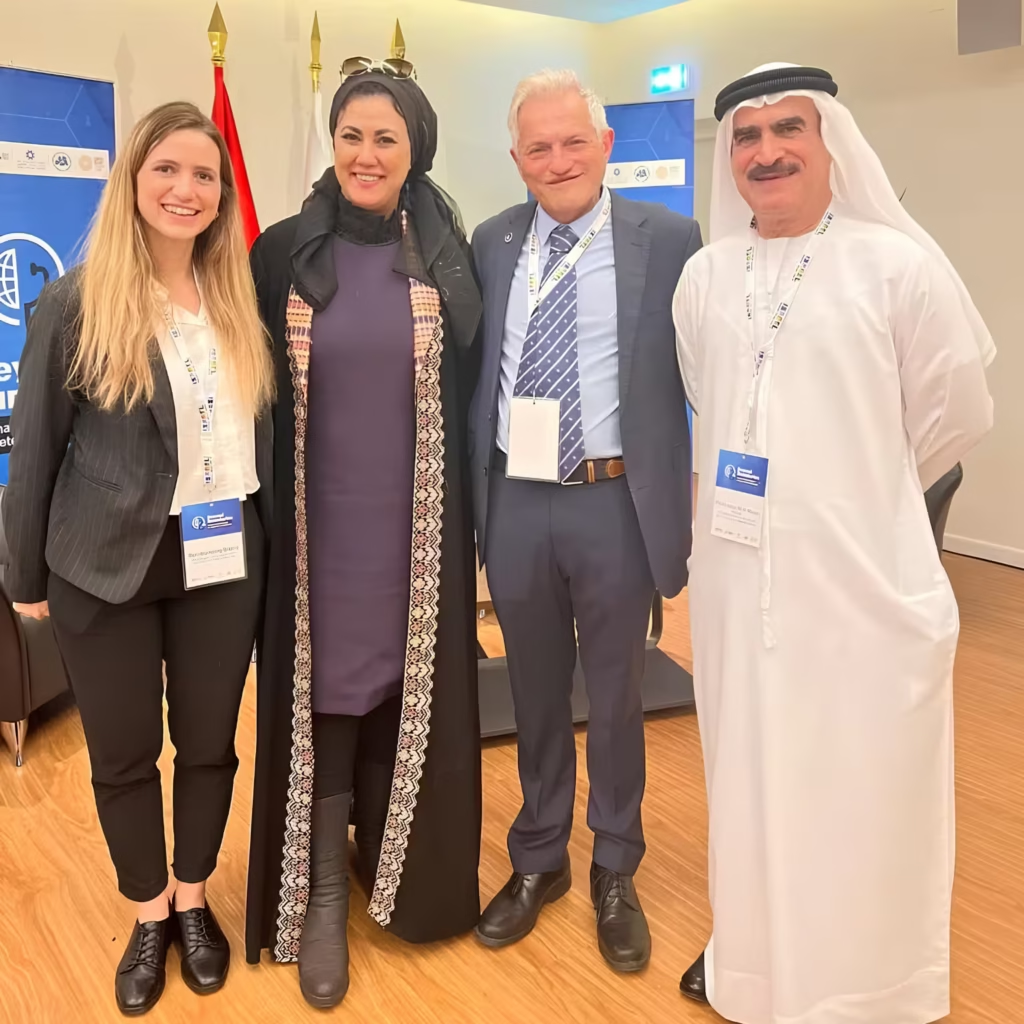
Moving to the UAE became the platform from which Watad began shaping the next regional chapter of her work. She arrived with more than two decades of experience across clinical nutrition, preventive health, community programs, media, entrepreneurship and wellness. Yet entering a new ecosystem still required her to rebuild relationships, establish new institutional connections and demonstrate how that experience could translate into a different market environment. Abu Dhabi offered something more consequential than a new location. It gave her a base within an ecosystem shaped by ambition, innovation, entrepreneurship and institutional collaboration, prompting her to think beyond individual nutrition programs toward scalable healthcare and technology solutions.
Her professional direction consequently broadened. The focus became not only how to deliver preventive health, but how to build systems capable of delivering it at scale. To connect preventive healthcare, digital technology, behavioural science, data and artificial intelligence with a deep understanding of Arab communities.
That is the foundation of the next phase of Dawsat International. From the UAE, Watad is positioning her work for the wider Middle East, building on years of direct experience with Arab families and communities while developing technology enabled models that can extend beyond individual clinics, programs or geographic boundaries. She is not attempting to take a conventional health platform and simply localize it for Arabic speaking markets. Her ambition is to build solutions around the realities of those markets from the outset. For a region where healthcare systems are increasingly focused on prevention, personalization and digital transformation, that intersection is significant. Technology can provide scale. Behavioural science can help explain change. AI can enable personalization and responsiveness. But the effectiveness of a health solution ultimately depends on whether it makes sense to the person using it. Watad’s work is increasingly positioned at that intersection with Abu Dhabi serving not merely as a chapter of her personal journey, but as the strategic base from which she is building a broader Middle Eastern vision.
From Offline Experience to Intelligent Health
Watad’s career has crossed multiple eras in the way health information reaches people. The first was offline health education, including clinics, conferences, community groups, face to face consultations and public engagement. The second was digital health, taking established methodologies, educational content and community support into online environments where they could reach people beyond geographic boundaries.
The third is the one she is actively building now, that is intelligent, AI enabled preventive health. This is not simply a question of putting an existing diet program into an application. Watad is developing a new generation of health and wellness solutions that can use artificial intelligence, personalization and data while drawing on more than two decades of real world experience working with Arab communities. The distinction is critical. Digitization can make a service accessible. Intelligence can potentially make it responsive. The next generation of Dawsat is being shaped around that difference, combining behavioural understanding, preventive health principles, digital technology and AI to create more personalized and scalable approaches to wellness. The technology is new, yet the underlying knowledge is not. It has been built over years of expertise and thousands of documented outcomes. That accumulated experience is now becoming the foundation for what Watad describes as the transition from digital health to intelligent health.
Why Arabic Health Tech Needs More Than Translation
There is a fundamental difference between translating healthcare technology into Arabic and designing healthcare technology with Arab communities in mind. The first changes the language. The second changes the underlying understanding. After more than two decades of working directly with Arab communities, Watad has developed a detailed understanding of food traditions, family dynamics, social expectations, motivations and barriers to healthier living. That knowledge now informs the technology she is building. A platform can translate the name of a dish. It takes cultural understanding to recognize what that dish represents within a family. An algorithm can recommend reducing a particular food. A culturally informed system must account for whether that food is part of hospitality, family gatherings or daily life. A generic wellness program can recommend exercise. But a contextually aware solution asks whether the suggested routine fits the user’s schedule, environment and social reality. This is the principle behind Watad’s next generation of Dawsat. AI enabled health solutions built around the people they are intended to serve. Technology can be replicated, applications can be rebuilt, algorithms will continue to improve. But the behavioural knowledge required to make technology genuinely relevant is accumulated over time. That is the asset Watad is carrying into this next chapter.
The Founder Who Became an Ecosystem Builder
Watad’s role is not only limited to being a founder, but she is someone who connects people, strategy and opportunity. That is visible in the breadth of her current focus, including executive leadership, strategic partnerships, business development, market expansion, government and institutional relations, health tech, organizational development and social impact. It is also reflected in how she approaches teams. The next generation of Dawsat, she believes, needs health professionals who understand people, technologists who understand scale, institutions that understand systems, and investors who understand both purpose and commercial sustainability. That ecosystem mindset matters most in healthcare, where the most consequential innovations rarely come from a single discipline. The founder’s job is no longer just to have the idea but to create the conditions for that idea to become an institution.
One Million People, But One Person at a Time
It is tempting to look at a career like Watad’s through its headline numbers. More than 20 years, more than one million people reached, more than 60,000 documented success stories. Fifteen years of annual conferences, thousands of women brought together at individual events. A magazine, clinics, digital platforms, media appearances, and international speaking engagements. Now, a new technology driven phase. These numbers tell the story of scale. But Watad’s philosophy repeatedly brings the conversation back to the individual. One woman, one family, one changed habit. One person who learned that a healthier life was possible. That may explain why the central purpose of her work has remained remarkably stable despite the changing business models around it. The business evolved from clinical practice to community wellness, from community wellness to media, from media to digital health, and now toward AI enabled preventive health. The delivery mechanisms changed, yet the human outcome remained the measure.
A Different Definition of Influence
Watad’s relationship with media has been evolving. In 2026, she has been recognized as a content creator and positive influencer, while emphasizing that she never set out to become an “influencer” in the conventional sense. For more than two decades, she has produced health education, written, spoken publicly, led initiatives, organized conferences and built platforms. The audience came as a consequence of the mission. Not the other way around. Her recent professional reflections place the emphasis on influence as something earned through meaningful work rather than simply accumulated through follower counts. This is also evident in her massive audience and digital presence across platforms. The underlying philosophy is straightforward. True influence is measured by the lives improved and the trust earned, not merely by the size of the audience. In an era where personal branding can sometimes precede substance, Watad represents an older and increasingly valuable model of influence, which is to build the expertise first and allow the reputation to become an extension of the work.
The Next Chapter Is About Building Forward
Today, Watad is emphasising upon a significant restructuring of the business. A new digital platform, a new application, a renewed team, a stronger organizational foundation and a more ambitious technology driven vision. From the perspective of a founder who has spent decades building it, it means refusing to become trapped by the success of the past. Watad does not want to recreate the Dawsat of 20 years ago. She wants to take what those 20 years taught her and build for the next 20. Many legacy businesses struggle because they protect yesterday’s model rather than yesterday’s knowledge. Watad’s approach is different. Preserve the knowledge, the relationships and the cultural understanding, while allowing the operating model to evolve. The objective is to create what she describes as a trusted health and wellness platform for the Middle East, one that combines preventive health, behavioral science, digital technology and artificial intelligence. The ambition may be regional. The foundation, however, is deeply personal.
Beyond Capital: Building the Right Circle Around the Vision
The next stage requires more than a good idea, rather it requires capital, technology, talent, and the right institutional relationships. Watad is clear she is looking for aligned capital, investors and partners who understand both the commercial opportunity and the social value of preventive health in the region. The wrong capital can distort a mission driven company as easily as the right capital can accelerate one. The opportunity is real. Across the Middle East, healthcare systems are confronting a growing burden of chronic and lifestyle related conditions, even as consumers become more digitally engaged and AI opens new possibilities for personalization. But the next generation of health platforms won’t win simply because they contain AI, they’ll win because they use AI to solve problems people actually have. That is where Watad believes her accumulated experience matters most.
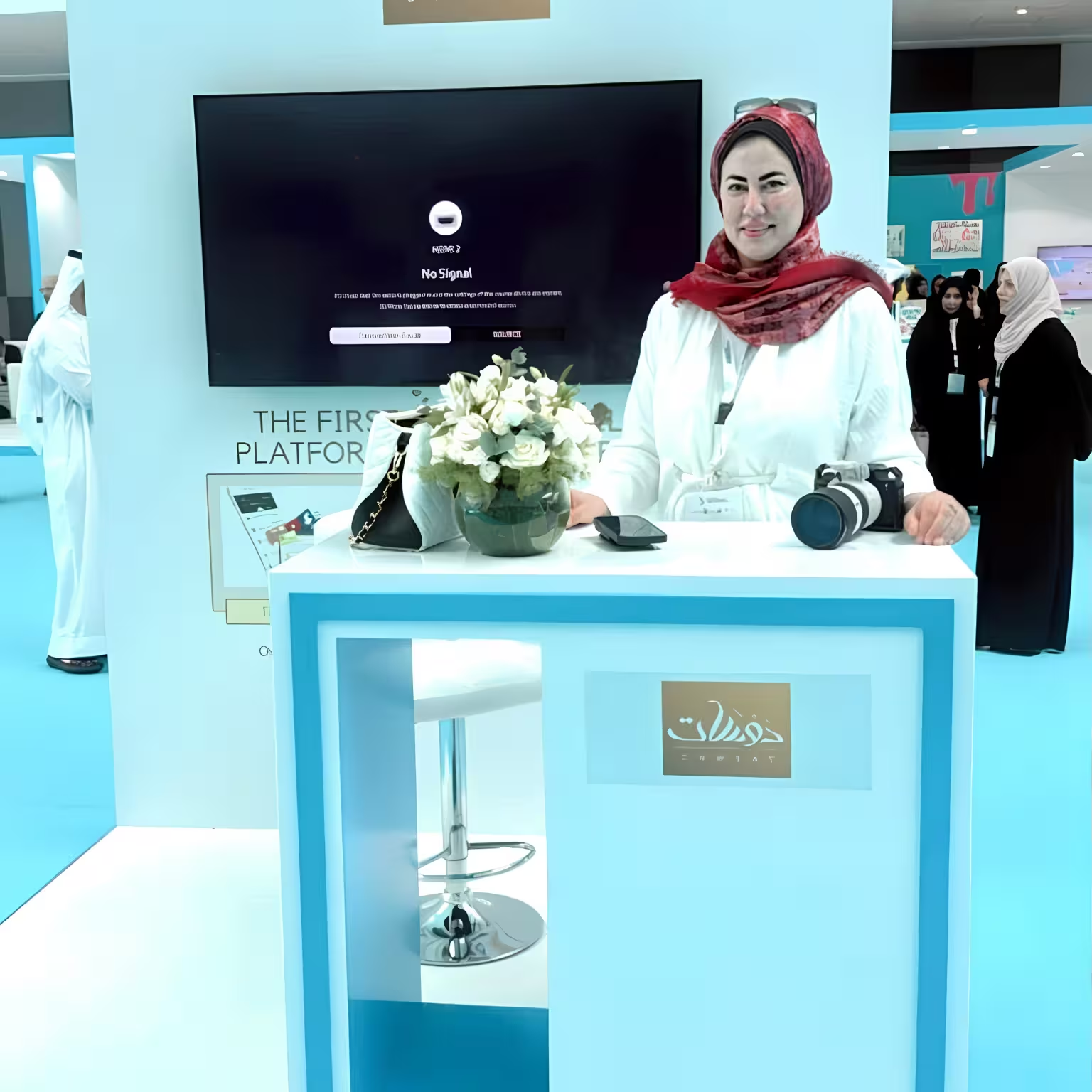
Building the Next 20 Years
There is something fitting about the fact that Watad’s next ambition is emerging at the intersection of two forces that have defined her career, human behaviour and technology. She began by trying to change behaviour through food, then she learned to influence it through community. Eventually, She expanded the conversation through media, and finally scaled access through digital tools. Now she is building AI enabled systems that can take decades of accumulated knowledge and apply it in new ways. The objective is not to make healthcare less human, but to make technology better equipped to respond to human realities. AI can process information at extraordinary speed. But the effectiveness of an AI enabled health solution depends on the quality of the context it is given and the relevance of the guidance it produces. That is where Watad’s experience becomes strategically important. She has spent decades observing the relationship between food, behaviour, family, motivation and health. Now she is translating that experience into a technological framework designed for greater personalization and scale. The result is a different kind of health tech proposition, not technology looking for a problem, but technology being built around a problem Watad has spent more than 20 years understanding.
A Leadership Philosophy Built Through Reinvention
If there is a defining characteristic of Watad’s career, it is adaptability. Clinical dietitian, community educator, entrepreneur, clinic founder, publisher, conference organizer, media personality, digital health entrepreneur, strategic executive, and now, a builder of AI enabled preventive health solutions. The titles changed, the ambition expanded, yet, the central purpose remained. That is why her advice to the next generation is less about choosing the perfect career path and more about developing the capacity to evolve. Do not wait for permission. Do not confuse speed with success. Build knowledge, understand the numbers, protect your work, build credibility, choose the right people. And do not be afraid to change direction. A first idea does not have to become a final identity. Watad’s own career demonstrates that evolution can be cumulative rather than disruptive. Every stage can become infrastructure for the next.
The Measure of a Legacy
The most revealing part of Mas Watad’s story may be the way she defines success. Not by the title, not by the company, not by the number of conferences, not by the size of an audience, not even by the number of people reached. Instead, she asks a series of deceptively simple questions.
Did someone learn because you taught?
Did someone work because you opened a door?
Did a woman discover her professional potential because you gave her an opportunity?
Did a family become healthier because knowledge finally reached them in a language and context they understood?
Those questions transform the meaning of entrepreneurship. A company becomes more than a commercial entity. A conference becomes more than an event. A magazine becomes more than a publication. An application becomes more than software. Leadership becomes more than a title. It becomes the ability to create conditions in which other people can change their lives. That is ultimately what connects the different chapters of Watad’s career, science translated into practical behaviour, expertise translated into education, community knowledge translated into scalable systems, and now decades of experience translated into a new generation of intelligent technology.
The Story Is Still Being Written
There is a temptation, whenever a business magazine profiles an accomplished founder, to write the story as though the final chapter has already been completed. Watad resists that framing. She sees recognition not as a conclusion, but as a bridge. She is proud of what she has built, yet describes herself as standing at the beginning of one of the most important chapters of her professional life. That may seem unusual for an entrepreneur with more than two decades behind her. But it makes sense when viewed through the trajectory of her career. She has already experienced the transformation from offline health education to digital health. Now she is actively building toward the next transformation, from digital health to intelligent, AI enabled preventive health. The question has evolved. The first era asked, “How can we bring health information to more people?” The next asks, “How can technology make that health guidance more personalized, preventive and relevant to the people receiving it?”
For the Middle East, that question carries particular significance. The region does not simply need more health applications. It needs solutions capable of understanding the communities they are built for, integrating preventive health principles with behavioural science, digital technology and artificial intelligence. It needs technology that can scale while remaining relevant. And it needs innovation grounded in real world experience rather than technology alone. That is the opportunity Watad is pursuing. She has spent more than twenty years building the clinical knowledge, community relationships, methodologies and practical experience behind the model. Now she is putting those assets to work in a new technological context. The question is no longer whether the original idea can create impact. The question is how far that impact can travel when decades of community experience meet the capabilities of AI, digital platforms and regional partnerships. For a founder, that requires ambition. For an executive, it requires discipline. For an innovator, it requires the willingness to build what does not yet exist. And for Mas Watad, the next chapter is no longer about beginning again. It is about building forward. From Abu Dhabi, she is positioning the next generation of Dawsat for a wider Middle Eastern stage, connecting preventive healthcare, behavioural science, culturally relevant wellness and artificial intelligence into a vision for intelligent health. Her mission remains familiar. The infrastructure is evolving, the technology is advancing, the ambition is becoming regional. And the story, by her own definition, is still being written…..