
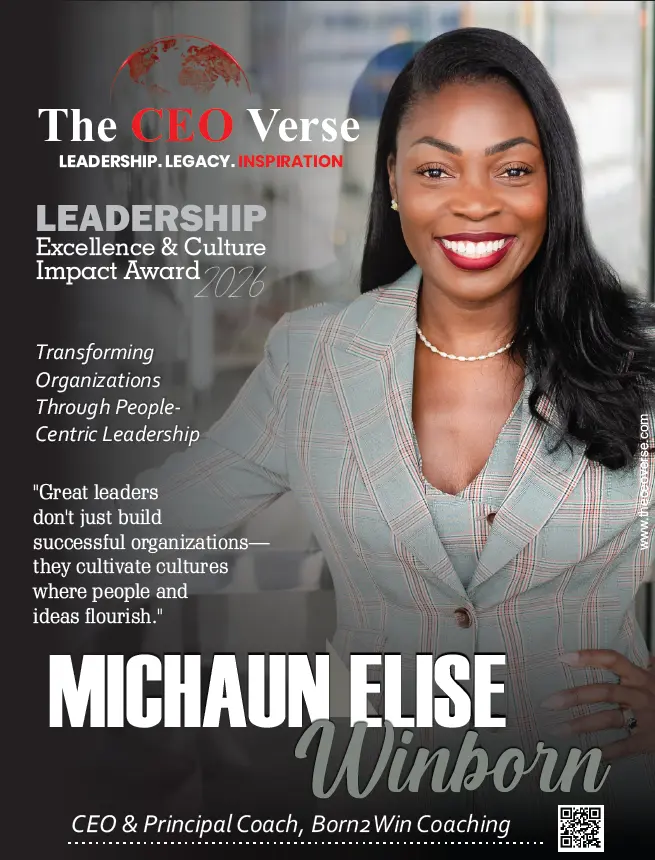
TheCEOVerse • Digital Edition
“Leadership Excellence & Culture Impact Award 2026”
Cover story
Michaun Elise Winborn
Dive into the complete magazine profile and explore the story, leadership, and impact behind the individual featured in this edition.
Featured Profile - Michaun Elise Winborn
FROM THE STAGE TO THE BOARDROOM
She didn’t start in a boardroom. She started on a stage.
Theatre performance was Michaun’s first serious training ground — not a phase she passed through, but a foundation she carried forward. She learned how to read a room before she ever sat in a corporate meeting. She learned how people listen, how they shut down, what makes someone lean in and what makes them disconnect. Those aren’t skills that leave you. She brought them into every professional environment she entered afterward, often without naming them, but always using them.
When she moved into corporate environments, she noticed quickly that most leadership problems weren’t strategic. They were human. People not hearing each other. Teams not trusting their managers. Leaders saying the right things in the wrong way, or avoiding the conversation entirely because discomfort felt like a reason not to have it.
She spent just over a decade at JP Morgan Chase. The roles changed — operations, talent development, DEI leadership — but the thread running through all of it stayed consistent. She was always trying to understand what was actually happening underneath the surface of whatever organizational problem was in front of her. Not the stated problem. The real one. That skill, more than any specific credential, is what built her reputation inside the organization and beyond it.
Today she leads Born2Win Coaching while also serving as Senior Manager of Diversity, Equity & Inclusion at United Way of Central Ohio. The two roles sit alongside each other deliberately — one lets her build something of her own, the other keeps her connected to the broader nonprofit and community sector. Both feed the same mission.
THE QUIET ARCHITECTURE OF GREAT LEADERSHIP
Ask Michaun what drives her work and she doesn’t reach for mission statements. She talks about curiosity first — and she means something specific by it. Most leadership failures aren’t failures of strategy. They’re failures of attention. A leader stops asking questions and starts making assumptions. Curiosity interrupts that pattern. It slows things down just enough to ask a better question before reaching for an answer.
The second thing she comes back to is honesty paired with compassion. Not honesty as a blunt instrument — the version that delivers a hard truth and calls the discomfort the other person’s problem. Honesty that stays accountable to dignity. Says what needs to be said, clearly, without using truth as a reason to be unkind.
But the principle she has built the most around is simpler: awareness without behaviour change doesn’t move anything. Organizations spend significant time on culture conversations that never translate into different decisions inside real meetings and real teams. That gap is what her two core frameworks were built to close.
The CDR Framework — Curiosity. Data. Relationships. — is a decision-making tool that asks a leader to pause before acting and check three things: Am I being curious enough about what’s actually happening? What does the data — not my perception — tell me? And what is the state of the relationship I’m operating inside? It works in performance reviews, in conflict, in moments when the instinct is to move fast and the smarter move is to pause.
The WIN Method — Wake. Interrupt. Navigate. — addresses something more immediate. The moment a leader recognizes a blind spot or habitual pattern driving a decision. Wake is the awareness. Interrupt is the choice not to follow the habitual response. Navigate is the deliberate move toward a better one. Short enough to use in real time.
A LEGACY LONGER THAN ANY JOB TITLE
The professional milestones are real and worth stating plainly.
At JPMorgan Chase, she helped redesign an accountability framework tied to representation and leadership impact — not cosmetic DEI work, but structural changes to how the organization measured and reported on inclusion at the highest leadership level. She contributed to learning initiatives that reached thousands of leaders across the enterprise. She managed DEI analytics that shaped executive-level decision-making and informed cultural strategy at scale. That work required both technical rigor and the ability to navigate organizational politics without losing the thread of what the work was actually for.
Launching Born2Win Coaching was its own milestone — not because starting a business is inherently significant, but because of what it required. It meant stepping away from the infrastructure of a large institution and building something from the ground up that reflected her own values and vision.
But the milestone she returns to most isn’t a corporate one, and it isn’t recent.
For 37 of its 38 years, Michaun has been connected to The Benefit Concert Association, an organization that raises funds for Nationwide Children’s Hospital’s Heart Center. She started as a volunteer alongside her family. The association isn’t something she discovered professionally or joined for visibility. It has simply always been part of her life. Over the last three years, she has served as a board member and emceed the annual fundraising gala. Thirty-seven years is not a gesture toward community involvement. That kind of consistency is a choice, made quietly, long before anyone was measuring it or including it in a profile.
She has also served on additional nonprofit boards, partnered with organizations like Dress for Success Columbus, and facilitated leadership development for women, students, and emerging professionals across Central Ohio. The corporate career and the community work have always run in parallel. That wasn’t accidental. It reflects a view of leadership she has held consistently — that influence without service is incomplete.
EMOTIONAL INTELLIGENCE IS NOT SOFT. IT’S THE STRATEGY.
Three traits come up when Michaun describes what has actually carried her through — not the traits she aspires to, but the ones that have done real work across different roles, organizations, and seasons of her career.
Emotional intelligence is the first. Her ability to read environments, navigate difficult conversations without escalating them, and build trust with people who don’t share her background or worldview has been foundational across every role she has held. In a field where the work often involves helping leaders confront uncomfortable truths about their own behavior, that capacity isn’t optional. It’s the thing that makes the rest of the work possible.
The second is adaptability. Her career has crossed theatre, operations, HR, DEI strategy, facilitation, and executive coaching. That’s not a scattered path — it’s a wide one. Being able to move between disciplines, translate ideas across different audiences, and apply what she learned in one context to a completely different one has compounded into a professional advantage that narrow specialization doesn’t produce.
The third is courage. Much of what she does requires telling people things they don’t necessarily want to hear about their leadership, their organizational culture, and their blind spots. Not in a way designed to land hard, but in a way designed to land true. That requires something beyond competence. It requires the willingness to stay in the discomfort of a conversation long enough for it to actually be useful.
THE PRACTICE THAT CHANGES ROOMS
Born2Win Coaching was built around one central premise: behavior, not awareness, is where change actually happens.
The services reflect that premise directly. Executive coaching, corporate facilitation, leadership workshops, keynote speaking, and advisory support for organizations navigating culture challenges, retention concerns, or leadership transitions — all of it is designed to move beyond the awareness stage and into the behavioral one. The question Born2Win is always working toward isn’t “do your leaders understand inclusion?” It’s “what do your leaders actually do differently in their work relationships ?
The work draws from emotional intelligence, cultural intelligence, behavioral science, and operational leadership experience. Those aren’t separate tracks — they inform each other. A leader who understands the behavioral science behind bias but lacks emotional intelligence will still mishandle the conversation. A leader with high emotional intelligence but no practical framework will still freeze in the moment that requires action. Born2Win’s approach is built around the intersection of all of it — the self-awareness, the framework, and the practiced skill of applying both under pressure.
THE WORK THAT CANNOT WAIT
Right now, Michaun is running several things simultaneously.
She is expanding Born2Win Coaching’s offerings for both corporate and nonprofit clients. Through Dress for Success Columbus, she is facilitating “She Thrives” — a seven-week professional skills training built around workshops, role-play, and group discussion designed to strengthen communication, confidence, and leadership capacity in women actively working to move their careers forward.
She is also consulting with the National Fund for Excellence in American Indian Education — work that has stretched her into broader strategic consulting, organizational development, and project management in a sector she hadn’t previously worked in directly. That stretch was intentional.
She continues building thought leadership through speaking, LinkedIn content, and community partnerships. The pace isn’t performative. The work is needed now, and waiting for a more organized moment doesn’t serve anyone.
A NATIONAL FIRM WITH COMMUNITY ROOTS
The five-year vision for Born2Win Coaching is national reach — a recognized leadership development and consulting firm working with corporations, nonprofits, and institutions across the country. The ambition is real, and so is the specificity behind it. She is not describing growth for its own sake. She is describing a firm known for measurable behavioral transformation, not just awareness-building — one that can demonstrate that the leaders it works with actually lead differently afterward.
She is also in the development stage for a nonprofit mentorship arm of the business, grounded in the belief that leadership development and career guidance should be more accessible at the community level. While executive coaching is often financially out of reach for many individuals, she also sees a growing opportunity to support nonprofits serving new Americans and other underserved populations through mentorship, skill-building, and professional development. The initiative is designed to help people strengthen confidence, navigate workplace culture, build leadership capacity, and access the kinds of guidance and networks that can significantly impact long-term career mobility and community success.
Joining a speaker bureau is also in progress, which will expand her keynote reach beyond the networks she has built organically. Through all of it, Columbus stays central. Not as a base of operations she runs out of while looking elsewhere, but as a community she is genuinely invested in and accountable to.
THE PIVOT THAT BECAME THE PLAN
When her DEI position was eliminated at JPMorgan Chase, the timing wasn’t what she would have chosen. She is honest about that. It was disruptive — professionally and personally. She had spent years building expertise and relationships inside that institution, and losing the role required her to trust her own accumulated experience at a moment when the external structure she’d been operating within was suddenly gone.
The transition into full-time entrepreneurship happened sooner than planned. Born2Win Coaching existed before the elimination as an idea — but building it as her primary focus required a different level of commitment and a different relationship with uncertainty.
She also had to navigate building a DEI- aligned business in a moment when the space had become politically contested. Organizations that had publicly committed to inclusion work were quietly pulling back. She learned to communicate the impact of culturally intelligent leadership in ways that resonated across the business while remaining true to the purpose of the work.
Looking back, she describes it as a season that was right even if it wasn’t planned. The pivot opened her current role at United Way of Central Ohio, expanded her consulting work into new sectors, and pushed her to fully invest in something she had been building cautiously. The difficulty of the transition doesn’t disappear in that framing. But the pivot, unwanted as it was, became the plan.
MOVE BEFORE YOU FEEL READY
The advice she gives aspiring leaders doesn’t start with strategy or positioning. It starts with self-awareness — and she means it more specifically than that phrase usually implies.
Understanding how your behavior, communication, and decisions actually land on other people isn’t a soft skill to develop after you’ve figured out the technical parts of your role. It is the work. Leaders who skip it tend to build teams that function in their presence and struggle in their absence, because the team is managing around them rather than learning from them.
She pushes back, consistently, on transactional networking. Relationships built when you need something from someone are fragile and people can usually sense the architecture. The relationships that have mattered most in her career were built through genuine investment over time. Community, mentorship, collaboration that didn’t have an immediate payoff. That takes longer. It also lasts.
And then the thing she returns to most: don’t wait for permission to lead. Leadership shows up in how you influence people, what you’re willing to say when it would be easier to stay quiet, how consistent you are when no one is measuring it. The title either comes eventually or it doesn’t. The leadership is already there or it isn’t.
She moved before she felt ready. More than once. It is not advice she offers abstractly. It is what she actually did — and what she would do again.