
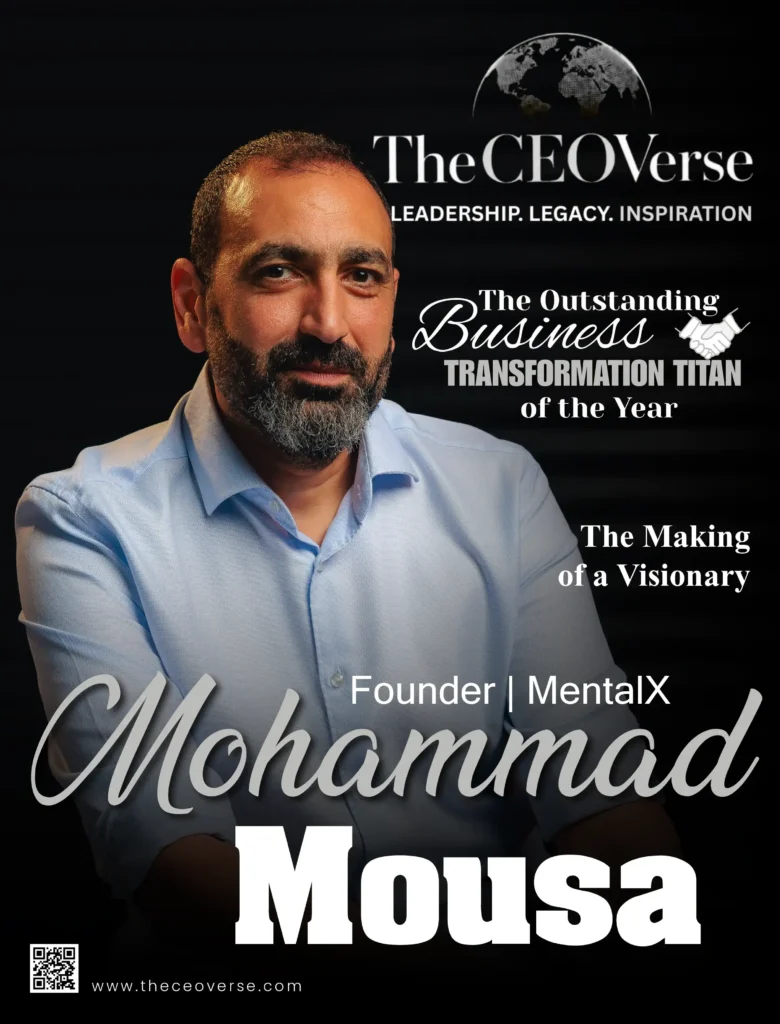
TheCEOVerse • Digital Edition
“The Outstanding Business Transformation Titan of the Year”
Cover story
Mohammad Mousa
Featured Profile - Mohammad Mousa
Mohammad Mousa: The Outstanding Business Transformation Titan Of The Year
Visionaries tend to find the spotlight, but true execution happens in the shadows. While others chase the opening acts of technological hype, leaders like Mohammad Mousa focus on the unglamorous aftermath. The moment the consultants pack up, the strategy decks are shelved, and a real business has to deliver results. For over twenty years spanning four continents, government halls, and hyper growth startups, Mousa has earned a distinct reputation. He is the fixer organizations summon when a grand vision stalls out somewhere between a PowerPoint slide and the profit and loss statement.
Today, that exact principle anchors his work as the Founder of MentalX. The firm exists to answer the quiet, persistent question that has defined his entire career. Why do brilliant strategies constantly wither in the gap between ambition and execution? To find the answer, you have to look past the modern corporate boardroom and return to the root. To an era of simple, burning curiosity, long before artificial intelligence became a boardroom buzzword.
The Making of a Visionary
In 1999, a year when most of the business world still associated AI with science fiction rather than spreadsheets, Mousa co founded a company built around real time, speech to speech translation technology. It was, by any measure, an absurdly early bet. The infrastructure to support such an ambition barely existed. The market for it was smaller still. And yet Mohammad Mousa was drawn not to the novelty of the technology, but to something more fundamental. The way technology, business, and people intersect to create actual progress.
That distinction matters, because it explains almost everything that came after. Mousa was never enamored with technology for its own sake. He was captivated by outcomes. By the idea that innovation is only meaningful when it solves a real problem for real people. That 1999 venture taught him a lesson that would resurface again and again throughout his career. A brilliant idea, on its own, changes nothing. It is only when an idea is paired with disciplined execution that it becomes value.
Over the following decades, that early conviction sent him on a winding, deliberately varied path. Through entrepreneurship, global consulting, telecommunications, cybersecurity governance, digital trust, and some of the most ambitious national transformation programs in the Middle East, Africa, and Europe, he would go on to work inside organizations as different as IBM, Rackspace, PwC Middle East, NTT DATA, and Emirates German Security Printing (EGSP). A unique public-private partnership between the German federal state printer and the UAE’s Ministry of Interior. Each of these chapters added a new layer to a belief that has never really changed. Meaningful progress only happens when vision, people, technology, and execution move in the same direction.
The School of Experience
It’s easy, in hindsight, to describe a career as a coherent narrative. It rarely feels that way while it’s happening. At PwC Middle East, Mousa built governance frameworks designed to strengthen digital trust and cybersecurity for government institutions. The unglamorous, foundational work that determines whether a nation’s digital infrastructure can actually be trusted by the people who depend on it. At EGSP, he stepped into one of the most technically and politically sensitive assignments of his career. Leading the UAE’s ePassport transformation, a national scale identity program where the margin for error was essentially zero.
Programs like that don’t just test technical competence. They test a leader’s ability to hold together dozens of stakeholders with different incentives, different timelines, and different definitions of success. It was here that Mousa began to understand something that would later become the intellectual backbone of MentalX. Organizations rarely fail because they lack a good strategy. They fail because the connective tissue between strategy and delivery, including the ownership, accountability, trust, and alignment is missing.
Then came Careem. If EGSP taught him the discipline of government grade precision, Careem taught him the opposite muscle entirely. Speed. Joining the ride hailing giant during a period of explosive growth, Mousa found himself supporting the company’s technology compliance program in the middle of one of the region’s most closely watched corporate events. Its landmark acquisition. High growth technology businesses operate on a different clock than governments or global consultancies. Priorities shift weekly, sometimes daily, and the leaders who thrive are the ones who can move without losing the plot. It was a masterclass in agility under pressure. Proof that the principles he’d built in slower moving institutions could hold up even when the ground was shifting beneath him.
By the time he’d added emerging market development across the Middle East and Africa to his résumé, Mousa had accumulated something rare. A working knowledge of how transformation actually behaves across wildly different environments. Public and private, fast moving and heavily regulated, mature markets and emerging ones. Few executives get to see that many versions of the same underlying problem play out in that many different settings within a single career.
When Challenges Became Catalysts
Ask Mousa about the hardest parts of his journey, and he doesn’t point to a single dramatic failure or a public setback. He points instead to something quieter and more persistent. The grinding difficulty of leading complex transformation initiatives that involve multiple stakeholders, competing priorities, and levels of uncertainty that no slide deck ever fully captures.
Transformation, he’s fond of pointing out, looks exciting from the outside. Bold announcements, ambitious roadmaps, confident timelines. From the inside, it looks like resistance. Discomfort. Conflicting interests that were never going to be reconciled by a workshop. Obstacles nobody planned for. Decisions that have no clean answer, only trade offs.
Those experiences forged resilience, certainly. But what Mousa emphasizes more is adaptability. A distinction he draws carefully. Earlier in his career, he believed that success was about finding the right answer. Identify the correct strategy, execute it faithfully, and the results would follow. Experience eventually rewired that belief. Today, he holds a different conviction. Success comes from continuously adjusting course while staying committed to the destination. Leadership, in his framing, isn’t about possessing complete certainty, a luxury that complex transformation almost never affords anyone. It’s about maintaining clarity and confidence precisely when certainty is impossible.
The Cost of Moving Forward
If there’s one mistake Mousa returns to more than any other when reflecting on his own leadership evolution, it’s the fact that for years, he believed working harder, personally, would solve complex problems. Like many ambitious leaders, he felt an almost reflexive responsibility for everything happening under his watch. Every decision, every outcome, every fire that needed putting out.
The shift, when it came, wasn’t dramatic so much as clarifying. He realized that leadership isn’t about doing more yourself, it’s about enabling other people to do more. The moment he moved from personally controlling outcomes to deliberately empowering capable people around him, the quality of the results improved dramatically. And in ways that scaled far beyond what any single person, however talented, could produce alone.
That reframing now sits at the center of how Mousa evaluates leadership, both his own and that of the executives he advises. He doesn’t measure a leader by how many decisions they personally make. He measures them by how many capable leaders they create around them. A subtle but important distinction that separates leaders who build organizations from leaders who simply run them.

The Force Behind the Founder
For all his emphasis on individual leadership philosophy, Mousa is unusually insistent that none of his milestones belong to him alone. Mentors, colleagues, customers, executives, entrepreneurs, team members, and, tellingly, even competitors, have all shaped his thinking in ways he readily credits. But when pressed on who influenced him most, his answer is less about individuals and more about experience itself. Leading organizations. Building businesses from nothing. Managing failures that stung. Navigating uncertainty without a map. Working across cultures and countries that operate on entirely different assumptions about business, hierarchy, and trust.
Each of those experiences challenged something he thought he knew and expanded his understanding of what leadership actually requires. It’s a worldview that leaves little room for the myth of the solitary genius founder. No meaningful success, in his telling, is ever achieved alone. Every milestone reflects the accumulated contribution of people who supported, challenged, and believed in the work long before the outcome was guaranteed.
That belief extends naturally into how he thinks about partnerships and teams. Some of the most meaningful outcomes of his career, whether inside government led national programs, private enterprise, or his own entrepreneurial ventures, were the product of diverse teams rallying around a shared objective, not individual brilliance. And the mechanism that made those partnerships work, he argues, was never process or contract. It was trust. When trust exists between people, ideas move faster, problems get solved before they calcify, and people take genuine ownership of outcomes rather than waiting to be told what to do. Organizations, he likes to say, move at the speed of trust. And so do the partnerships that hold them together.
Born From a Pattern: The Founding of MentalX
By the time Mousa began seriously conceiving of MentalX, he had already spent the better part of two decades watching an identical pattern repeat itself, industry after industry, geography after geography. Boards would approve ambitious strategies. Budgets would be allocated. Consultants would be brought in. And then, months later, the promised transformation would quietly stall. Not because the strategy was flawed, but because the organization never built the discipline to carry it out.
What differentiates his approach, even now, is where he chooses to start. Most transformation conversations begin with technology, including the tools, platforms, methodologies. Mousa starts somewhere else entirely. With outcomes. His focus has always been on understanding how organizations actually create value, where that value quietly leaks out of the system, and what specifically prevents good strategy from becoming a measurable result. Across every sector he’s touched, he’s observed the same root cause behind stalled transformation. It’s rarely a strategy problem. It’s a disconnect between execution, accountability, ownership, and trust.
That observation became the founding insight of MentalX. An end to end commercial transformation firm built to integrate strategy, commercial excellence, AI, technology, operations, and governance into a single execution focused model. Rather than scattering them across disconnected specialties the way traditional consulting often does. The firm’s guiding philosophy is deliberately compact, almost mantra like. Change the Game. Own Relevance. Deliver Value. Three phrases, but each one doing real work. Because in Mousa’s view, innovation only matters when it produces outcomes that show up in performance, not just in strategy documents.
Since its founding, MentalX has positioned itself across the EMEA region, working with organizations navigating government facing transformation. Banking and payments, platform and digital services, trust infrastructure, and large scale organizational change. The same terrain Mousa has spent his career learning to read.
Before It Tips, Turn It
Perhaps the most distinctive piece of Mousa’s philosophy, the one that seems to synthesize everything else he’s learned, is a subtle reframing of how leaders should think about crisis. Most organizations, he observes, focus their attention on tipping points, because that’s the moment a problem finally becomes visible to everyone, when it’s already loud and urgent and impossible to ignore. But by then, the most valuable window for action has usually already closed.
Mousa argues that real leaders train their attention differently. Toward turning points, the earlier, quieter moments when change is still genuinely possible, before a challenge has calcified into a crisis. Every major failure, missed opportunity, or setback, he believes, was once a turning point waiting to be noticed. The obstacle most organizations face isn’t a lack of awareness that something needs to change. It’s ownership. The absence of someone willing to treat a shared challenge as a personal responsibility. The moment that shift happens, he says, momentum follows almost automatically. It’s a value he applies not just to how he advises clients, but to how he approaches leadership and life more broadly. The biggest opportunities are usually visible only to the people willing to look before the rest of the world realizes there’s anything to see.
A Word for the Next Generation
When asked what advice he’d offer someone just starting out, Mousa doesn’t reach for the usual playbook of career hacks or five year plans. His answer is simpler, and in some ways harder to practice consistently. Stay curious. Of everything he’s carried across a career spanning multiple industries, multiple continents, and multiple waves of technological disruption, curiosity is the one asset he credits above all others. The thing that let him keep learning as markets, technologies, and entire industries shifted underneath him.
He pairs that advice with a second, related principle. Pursue value creation before recognition. Recognition, he notes, may or may not follow. It’s fickle, and often arrives on its own unpredictable schedule, if it arrives at all. Value creation, by contrast, compounds reliably over time. Success follows relevance. Relevance follows value. It’s a simple equation, but one that took him years of watching both patterns play out to fully internalize.
Recognition as Responsibility
As MentalX continues to grow, Mousa is careful about how he frames the recognition that comes with it. He describes it not as a destination, but as a responsibility. Grateful for the opportunities to share his journey and contribute to broader conversations about transformation, but insistent that recognition only matters when it opens doors for other people. To help organizations navigate increasingly complex environments, to contribute new thinking, and to inspire the next generation of leaders coming up behind him.
That responsibility, in practical terms, means continuing to build MentalX and sharpen its thinking around execution. Because for Mousa, the work was never really about proving a single idea correct. It was about proving, again and again, across industries and geographies, that meaningful transformation only happens when people, technology, strategy, trust, and purpose move together toward a shared goal. Not technology alone. Not strategy alone. Not leadership alone. All of it, moving in the same direction. The same conviction that sent a curious young entrepreneur into an improbable AI startup back in 1999, and the one still guiding him today.
If there’s a single thread that runs through Mohammad Mousa’s story, it’s a refusal to separate vision from delivery. He has spent a career proving that the hardest part of business isn’t imagining what’s possible. It’s having the discipline to actually make it happen. And at MentalX, that’s precisely the game he’s still playing.