
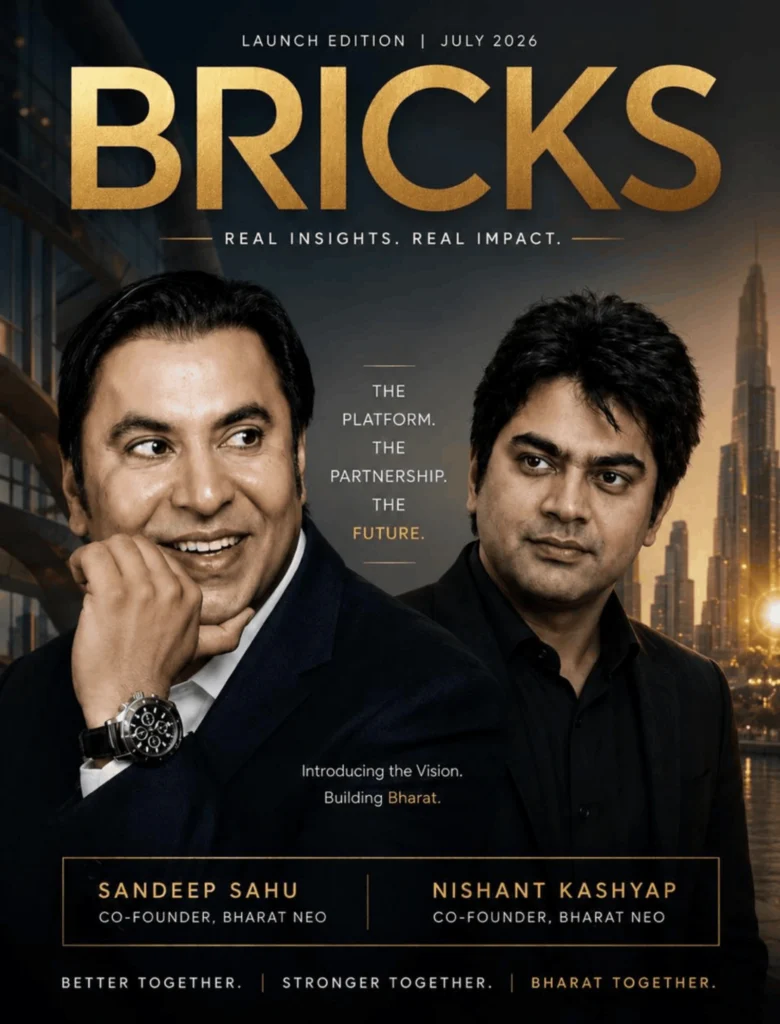
TheCEOVerse • Digital Edition
“The Visionaries Behind Bharat Neo “
Cover story
Bricks
Featured Story - The Visionaries Behind Bharat Neo
How Two Entrepreneurs Set Out to Redefine Home Buying in India
Every meaningful transformation begins long before a product is launched or a company is incorporated. It begins with individuals who look at familiar systems and ask whether they can be made better.
India’s real estate sector has witnessed extraordinary growth over the past few decades. New skylines have emerged, cities have expanded, and homeownership has become an aspiration shared by millions. Yet, amid this remarkable progress, one aspect of the journey has remained unchanged: the experience of the homebuyer.
For most buyers, purchasing a home continues to be an individual pursuit. Families spend months researching projects, comparing prices, arranging finances, consulting advisors, and negotiating independently, often wondering whether they have made the right decision or secured the best possible value. The overall process demands significant financial commitment while offering very little collective advantage. For many, this was simply the way the market functioned.
For Sandeep Sahu and Nishant Kashyap, however, it became a question worth exploring.
Rather than accepting long-standing practices as inevitable, the two entrepreneurs began examining why one of life’s most significant investments continued to rely so heavily on fragmented decision-making. Their conversations were driven less by disruption for its own sake and more by a genuine curiosity about whether technology, collaboration, and better systems could create a more informed experience for buyers.
That shared curiosity eventually gave rise to Bharat Neo. But before it became a platform, it was a perspective. Shaped by two founders whose strengths, experiences, and outlook complemented each other in meaningful ways.
Different Paths Leading to a Shared Vision
Strong partnerships are rarely built on similarity alone. More often, they are forged through complementary strengths united by a common purpose.
For Sandeep Sahu, entrepreneurship has always been about solving problems that matter. His approach reflects a long-term view of value creation, where sustainable businesses are built not merely by responding to market demand but by identifying structural challenges that deserve thoughtful solutions. Throughout the evolution of Bharat Neo, his focus has remained firmly on defining the platform’s larger purpose, establishing its guiding principles, and ensuring that every strategic decision aligns with a vision that extends well beyond commercial success.
Nishant Kashyap brings an equally important dimension to that vision.
With a deep interest in technology-led innovation and digital systems, he has consistently viewed technology as a means of simplifying complexity rather than adding to it. His expertise lies in translating ideas into practical frameworks, designing workflows, developing digital architecture, and creating systems that are capable of supporting meaningful collaboration at scale. Individually, their strengths occupy different spaces.
Together, they form a partnership where strategic thinking and technological execution work together in harmony. This balance has become one of Bharat Neo’s defining characteristics. While one founder continually asks what the future of home buying should look like, the other explores how technology can responsibly help make that future possible.
Looking Beyond the Transaction
Every entrepreneur reaches a point when observation begins to outweigh assumption. For Sandeep and Nishant, that moment came through a closer examination of how people actually navigate the home-buying journey.
They observed a market where buyers invested enormous amounts of time gathering information, visiting projects, comparing options, and negotiating independently. Even after months of effort, many were still left with lingering questions. Had they negotiated effectively? Were they paying a fair price? Could there have been a better way to approach such an important decision?
At the same time, developers faced their own challenges. Identifying serious buyers, managing fragmented enquiries, and engaging with qualified demand often required significant time and resources.
The more the founders studied these dynamics, the clearer it became that the challenges were interconnected rather than isolated. Buyers and developers were operating within the same ecosystem, yet both experienced inefficiencies created by a process that had changed very little over the years.
Instead of viewing these realities as unavoidable characteristics of the industry, they began asking a different set of questions.
- What if buyers no longer had to navigate the process entirely on their own?
- What if technology could organise demand rather than simply display supply?
- And what if greater transparency could strengthen confidence for everyone involved?
Making Observation an Opportunity
Ideas that reshape industries rarely arrive in a single moment of inspiration. More often, they take shape gradually through conversations, careful observation, and an unwillingness to accept that “this is just how things work.”
For Sandeep Sahu and Nishant Kashyap, the idea behind Bharat Neo emerged in much the same way. As they reflected on the realities of India’s home-buying landscape, one pattern became impossible to ignore. Buyers were making what was often the biggest financial commitment of their lives, yet the process itself remained surprisingly fragmented. Every individual searched alone, negotiated alone, and made decisions with only a partial view of the market.
The imbalance wasn’t simply about pricing. It was about information and self-confidence. Most of all, it was about the absence of a system that empowered buyers before asking them to make life-changing decisions.
The founders began to ask themselves a simple question: if people with similar aspirations naturally come together in so many aspects of life, why should buying a home remain such an isolated experience? That question became the spark.
Not because it immediately revealed the solution, but because it challenged an assumption the industry had long accepted. Instead of asking how properties could be marketed more effectively, they began asking how buyers could be served more thoughtfully. It was a subtle shift in perspective, yet one that changed everything.
A Different Way of Looking at Real Estate
Entrepreneurs often speak about identifying gaps in the market. Sandeep and Nishant preferred to look for gaps in experience. This distinction is crucial. For them, real estate was never just about buildings, inventory, or transactions. It was about people standing at one of the most significant crossroads of their lives. Young professionals purchasing their first apartment, growing families searching for more space, parents investing in their children’s future, or individuals fulfilling a dream years in the making.
Behind every property search was a deeply personal story. Yet the buying experience itself often felt transactional, fragmented, and unnecessarily complex. The more they explored the ecosystem, the more they realised that many of its inefficiencies were not the result of bad intent. Rather, they had become accepted practices over time.
Buyers struggled to access meaningful information in one place. Developers, on the other hand, invested considerable effort engaging with enquiries that did not always translate into genuine purchase intent. Both sides were working towards the same outcome, but through a process that often created friction instead of confidence. For the founders, this was about asking whether the experience could be improved for everyone involved. That philosophy continues to define the way they think about innovation today.
Building With Principles Before Products
Many startups begin by developing a product and then searching for a market. This duo approached the journey differently. Before discussing technology, they spent considerable time defining the principles that would shape whatever they eventually built. Transparency had to be more than a marketing phrase; it needed to be reflected in the way people experienced the platform.
Collaboration had to create genuine value rather than become another industry buzzword. Technology had to simplify decisions instead of overwhelming people with more information. And trust—perhaps the most valuable element in any high-value transaction had to be earned through consistency, clarity, and thoughtful design. These ideas became the foundation of countless discussions between the two founders. Every conversation brought new questions.
- Could technology make the buying journey feel less intimidating?
- Could better organisation lead to better decisions?
- Could buyers approach one of life’s biggest investments feeling more informed than uncertain?
The answers would not emerge overnight. But with each discussion, one thing became increasingly clear. If they were going to build something meaningful, it could not simply improve the existing process. It had to encourage people to think about home buying in an entirely different way.
Beyond Building a Business
Ask many entrepreneurs what motivates them, and the answers often revolve around growth, innovation, or market opportunity. Spend time understanding Sandeep and Nishant’s journey, however, and another theme begins to emerge. The duo’s purpose behind their empire. There is a quiet belief that businesses create lasting value when they solve problems that genuinely matter to people’s lives. That belief shaped Bharat Neo from its earliest conversations.
The platform was never envisioned as an end in itself. Rather, it became the expression of a much broader idea that technology should strengthen trust, simplify complexity, and help people make better decisions at moments that truly matter. For the founders, success is measured not only by the scale of a business but by the confidence it helps create.
Because when families invest in a home, they are investing in much more than property. They are investing in stability. In aspirations. In the future they hope to build. And any business that becomes part of that journey carries a responsibility far greater than facilitating a transaction.
From an Idea to a Shared Vision
Every venture begins with an idea. Every idea rarely grows into a vision. For Sandeep Nishant, the conversations that first questioned the traditional home-buying journey gradually evolved into something much larger. They were no longer asking how technology could improve an existing process. They were asking how an entirely different mindset could reshape the experience for everyone involved.
That thinking became the foundation of Bharat Neo. Rather than positioning the platform as just another participant in India’s real estate ecosystem, the founders envisioned it as a reflection of a belief they had come to share that informed buyers, transparent processes, and meaningful collaboration have the potential to create stronger outcomes for everyone.
In many ways, Bharat Neo is less a starting point than the result of a long period of observation, discussion, and deliberate thinking. The platform is simply where those ideas found a home.
Leadership Rooted in Perspective
Leadership is often associated with bold decisions and ambitious goals. Yet some of the most enduring leaders are distinguished by something quieter. It is the ability to keep asking better questions. Throughout their journey, Sandeep and Nishant have demonstrated that mindset repeatedly.
Instead of chasing short-term trends, they have focused on building with intention. Instead of measuring success solely through growth, they have remained committed to creating something that delivers meaningful value over time.
That perspective has shaped not only the platform they are building but also the culture behind it. There is a shared understanding that trust cannot be demanded; it must be earned. That innovation has little value if it complicates rather than simplifies people’s lives. And that technology, no matter how sophisticated, should always serve human needs before anything else. These principles continue to influence every stage of their entrepreneurial journey.
Looking Beyond Today’s Market
India’s real estate sector is entering a period of remarkable transformation. Rapid urbanisation, expanding infrastructure, digital adoption, and changing consumer expectations are reshaping how people discover, evaluate, and purchase homes. The industry is evolving, and with it, so are the expectations of today’s buyers.
Sandeep and Nishant see this evolution as an opportunity. This evolution for them is to adapt new thinking and methodologies to enhance efficiencies and value for customers. They believe the future of home buying will be defined by greater transparency, better-informed decisions, and stronger collaboration across the ecosystem. Buyers will increasingly expect clarity instead of complexity. Developers will benefit from engaging with more organised and informed demand. Technology will continue to play an important role, but only when it enhances the human experience rather than replacing it.
Their vision reflects patience as much as ambition. They are not attempting to reinvent real estate overnight. Instead, they hope to contribute to a gradual shift in how the industry thinks about the people it ultimately serves.
More Than Founders
It is easy to describe Sandeep-Nishant as entrepreneurs. They are founders, strategists, & problem-solvers, certainly. But those titles capture only part of their story. At the heart of their partnership is a shared conviction that meaningful businesses are built by understanding people before designing solutions. That progress comes from challenging assumptions with curiosity rather than criticism. And that lasting impact is created one thoughtful decision at a time.
Those beliefs have shaped Bharat Neo from the very beginning. They also explain why this journey is about far more than launching a platform. It is about encouraging a different conversation around home ownership—one where buyers feel empowered, information is more transparent, and trust becomes an integral part of the experience rather than an afterthought.
Whether or not Bharat Neo ultimately transforms the way India buys homes will be determined over time. What already stands out, however, is the mindset that inspired its creation. Every meaningful change begins with someone willing to look at a familiar problem differently.
For these founders, that willingness became the first step in a journey that continues to unfold. One built not simply on entrepreneurship, but on the belief that when purpose, technology, and people come together, they have the power to redefine industries.
Editor’s Note
This feature introduces the people behind Bharat Neo and the thinking that inspired its creation. In our next cover story, “Building Trust Before Buildings,” we take a closer look at the philosophy that guides the founders’ buyer-first approach and explore why trust not transactions lies at the heart of their long-term vision.
Featured Story - Building Trust Before Buildings
The Philosophy That Inspired Bharat Neo’s Buyer-First Revolution
Industries are built on transactions. The most enduring ones, however, are built on trust. Real estate is no exception. Long before agreements are signed or keys are handed over, every home purchase begins with something far less tangible: a family’s confidence that they are making the right decision. It is confidence in the information they receive, the people they engage with, and this confidence depicts an organization as one of the largest financial commitments of their lives, being made with clarity rather than uncertainty.
It isn’t always a lack of information that creates uncertainty. Sometimes, it is the absence of context. Information can be abundant, yet still leave people unsure of what it actually means. This observation became one of the defining ideas behind Bharat Neo. For founders Sandeep Sahu and Nishant Kashyap, the conversation was never limited to how homes are bought. It was about how confidence is built. They believed that before technology could improve the buying experience, there needed to be a stronger foundation, one rooted in trust, transparency, and thoughtful participation.
This philosophy has remained central to every conversation surrounding Bharat Neo. Because while buildings shape skylines, trust shapes decisions. And decisions shape lives.
Why Trust Still Feels Elusive
Buying a home is not like any other purchase. Impulsive buying of homes is never visible. People buy homes after years of planning, disciplined saving, and countless conversations around dining tables, office cafeterias, and family gatherings. Every decision carries emotional weight alongside financial responsibility. That is precisely why uncertainty feels so significant.
The founders observed that most buyers were not necessarily looking for more choices. In today’s digital world, choices are everywhere. What they often lacked was confidence. Confidence that they had enough information. These are subtle concerns, yet they influence every stage of the buying journey. For the duo, this was never simply a market inefficiency. It was a human challenge.
People were expected to make life-changing decisions while navigating an ecosystem that often relied on fragmented information, individual negotiations, and disconnected experiences. The issue wasn’t that people lacked determination. It was the process that frequently placed the burden of certainty entirely on the individual buyer.
Empathy Towards the Buying Journey
For decades, the home-buying process has followed a familiar rhythm. A buyer begins searching. The typical process is as follows:
- Projects are shortlisted
- Site visits are arranged
- Negotiations begin
- Gradually, the dream home finds the buyer
It is a journey that millions of Indians have undertaken, each largely following the same path, yet almost always alone. Sandeep and Nishant found themselves questioning something many people rarely stopped to consider. Why had individual negotiation become the default?
Across countless industries, people naturally benefit from shared knowledge and collective experiences. Communities compare products before making purchases. Professionals seek advice from peers. Investors study the market sentiment before making financial decisions.
Yet when it comes to buying a home, often the single largest investment of a person’s life, buyers continue to approach the process in isolation. The founders were not suggesting that every buyer’s decision should be the same, far from it. Every family’s priorities, financial circumstances, and aspirations are unique. What intrigued them was something else entirely.
Could buyers retain complete independence while still benefiting from greater collaboration, stronger information, and a more transparent process?
Trust Is Built Long Before a Contract Is Signed
For Sandeep and Nishant, one belief has remained remarkably consistent throughout their journey. Trust isn’t created at the end of a transaction. It begins much earlier. It begins with the very first interaction, or the first piece of information a buyer reads. The first question they ask is whether they receive an honest answer.
In many industries, trust is often treated as something that follows success. Deliver a good product, offer good service, and trust will naturally come. Real estate is different. When people decide to buy a home, they’re not simply purchasing square footage. They’re making a decision that will shape their lives for years, sometimes decades. The financial commitment is significant, but so is the emotional one. Every choice carries hope, responsibility, and often the dreams of an entire family.
Putting Oneself in the Buyer’s Shoes
One of the qualities that defines thoughtful entrepreneurs is empathy. Before trying to solve a problem, they spend time understanding how people actually experience it. That is precisely the perspective Sandeep and Nishant adopted. Instead of beginning with properties, projects, or transactions, they began with the buyer. Imagine searching for a home. You compare dozens of projects. Visit multiple locations over the weekends. Speak with brokers, developers, banks, family members, and friends.
Every conversation offers a slightly different opinion. Every website presents another set of choices. Every negotiation feels like starting from scratch. Gradually, a decision is formulated. Yet even after everything is signed, a familiar question often lingers in the back of the buyer’s mind.
“Did I really make the best decision I could?”
The founders recognised that this question wasn’t necessarily a reflection of the market. It was a reflection of the experience. People weren’t looking for perfection, reassurance, and clarity. For the confidence that comes from making an informed decision rather than an uncertain one. That distinction became incredibly important.
Partnerships Aren’t as Appreciated
The founders also found themselves reflecting on another simple reality. Human beings rarely make important decisions completely alone. Discussions and seeking the right advice are the most common aspects. People do the following things:
- Ask colleagues for advice before accepting a job offer.
- Seek recommendations before choosing a doctor.
- Compare reviews before booking a hotel.
- So naturally, the value is shared knowledge because it helps us see what we might otherwise miss.
So why should home-buying be any different?
This question gradually became one of the philosophical pillars behind Bharat Neo. Not because Sandeep and Nishant believed every buyer should think alike. Quite the opposite. Every buyer’s journey is unique, and every final decision should remain entirely personal. But they also believed something equally important. People become stronger decision-makers when they have access to better information, broader perspectives, and the confidence that comes from knowing they are not navigating the journey in complete isolation.
For them, collective buying was never about taking away individual choice. It was about strengthening it. It was about creating an environment where collaboration becomes a source of confidence instead of compromise, where buyers continue to make their own decisions but do so with greater clarity, better context, and a stronger sense of assurance. Because in the end, trust isn’t created by asking people to believe. It is created by giving them reasons to.
A Philosophy Before a Platform
When people talk about innovation, the conversation often revolves around technology. New platforms, tools, features. For the founders, innovation has always meant something deeper. Technology, in their view, is never the starting point. It is simply the expression of an idea. Before any solution can create value, it must first be guided by a philosophy that genuinely understands the people it hopes to serve.
That is why Bharat Neo was never envisioned as just another real estate platform. It was envisioned as an opportunity to encourage a different way of thinking. A way of thinking where buyers are respected not merely as participants in a transaction, but as individuals making one of the most meaningful decisions of their lives. A philosophy where transparency is not reserved for the final stages of the journey, but becomes part of every interaction.
Envisioning the Future
The Indian real estate sector is changing. Buyers today are more informed than ever before. They ask better questions, compare more options, and expect greater clarity throughout the buying journey. Their expectations are evolving, and understandably so.
Sandeep and Nishant believe this shift presents an opportunity not only for businesses to innovate, but for the industry to rethink how it engages with the people at its centre.
They envision a future where trust is no longer treated as something that must be earned after a transaction has taken place, but as the foundation upon which meaningful relationships are built.
Editor’s Note
Every philosophy eventually takes shape through action. In our next feature, “Inside Bharat Neo,” we move from the ideas that inspire the founders to the platform itself, exploring how their buyer-first philosophy is translated into a structured technology ecosystem designed to encourage informed participation, meaningful collaboration, and a more transparent home-buying experience.
Featured Story - Inside Bharat Neo
India’s Buyer Intelligence & Demand Aggregation Platform Explained
Every industry experiences a defining moment one where technology stops simply digitising old habits and begins reimagining the way people experience them. Banking is no longer just about opening an account; it is about intelligent financial ecosystems. Retail has evolved beyond product catalogues into personalised shopping journeys. Travel platforms no longer merely book flights; they anticipate preferences, recommend experiences, and simplify decisions before travellers even know what they need.
Real estate has undoubtedly embraced digital transformation too. Finding a property today is infinitely easier than it was a decade ago. Buyers can browse thousands of listings, compare neighbourhoods, explore floor plans, take virtual tours, and connect with developers in just a few clicks. Yet despite all this progress, one part of the journey has remained surprisingly familiar.
Families still spend months navigating multiple websites, speaking with brokers, comparing projects, arranging finances, and negotiating independently. Information has become abundant, but clarity often remains elusive. Buyers are surrounded by options, yet many still reach the final stage wondering whether they have truly explored every opportunity or made the most informed decision possible.
For Sandeep and Nishant, this was a gap in perspective. They believed the industry had become remarkably efficient at displaying homes. But perhaps it had not spent enough time understanding the people looking for them. That simple observation became the foundation of Bharat Neo.
Not as another real estate portal competing to showcase more projects, but as a platform designed to organise buyer intelligence before presenting opportunity. A platform that asks different questions, follows a different logic, and ultimately seeks to create a more structured relationship between buyers, developers, and technology. It is a subtle shift in thinking. Yet it has the potential to transform the entire buying experience.
A Buyer’s Platform
Most digital real estate platforms start with supply. Thousands of projects are listed. Buyers filter by location, price, configuration, or amenities before beginning what is often a lengthy process of comparison and evaluation. Bharat Neo approaches the journey from the opposite direction. Instead of beginning with buildings, it begins with people.
- Who is the buyer?
- What kind of home are they hoping to find?
- What stage of the journey are they in?
- Are they exploring possibilities, actively planning a purchase, or already prepared to make a decision?
These questions appear simple, but together they reveal something far more meaningful than a property search alone ever could.
Behind every enquiry is a different story. A young professional purchasing a first apartment has different priorities from parents looking for a larger family home. Someone investing for the future thinks differently from someone searching for a place to settle after retirement. Treating every buyer as though they are on the same journey inevitably creates a fragmented experience.
Bharat Neo seeks to change that. Rather than viewing buyers as anonymous leads moving through a sales funnel, the platform is designed to understand individual needs before facilitating meaningful engagement. The objective isn’t simply to connect people with properties; it is to create an experience that feels more relevant, more organised, and ultimately more thoughtful. This buyer-first approach reflects the philosophy we explored in the previous feature. Technology should adapt to people. Not the other way around.
Data for Buyer Intelligence
We live in an age where information is everywhere. In fact, information has never been the problem. Anyone searching for a home today can access countless listings, project videos, pricing guides, online reviews, market reports, social media discussions, and expert opinions within minutes. Yet more information does not automatically create better decisions. Sometimes, it creates the opposite.
The challenge is no longer finding answers. It is understanding which answers matter most. This is where Bharat Neo introduces one of its defining ideas: its Buyer Intelligence Framework. Rather than simply collecting information, the platform seeks to organise it into meaningful insights. Preferences such as location, budget, apartment configuration, purchase readiness, financing preparedness, and engagement stage are viewed not as isolated data points, but as pieces of a larger picture.
Imagine walking into a library containing thousands of books but no catalogue. Every answer is technically there, yet finding the right one becomes overwhelming. Now imagine a knowledgeable librarian who understands exactly what you are looking for and guides you to the most relevant section.
Its purpose is not to make decisions on behalf of buyers, nor to influence their choices. Instead, it seeks to organise complexity, helping buyers navigate the market with greater clarity and confidence while preserving complete freedom of choice. In doing so, the platform shifts the conversation from information overload to informed participation.
Innovation Built on Proprietary Thinking
One of the distinguishing characteristics of Bharat Neo is that its innovation extends beyond software development. The platform has been conceived around a structured Buyer Intelligence and Demand Aggregation Framework that brings together buyer profiling, intelligent demand organisation, collaborative engagement, and technology-enabled workflows into a unified methodology.
Recognising the originality of this approach, Bharat Neo has initiated intellectual property filings to protect its core framework. This reflects the founders’ long-term commitment to developing not merely a digital platform, but a proprietary methodology that combines technology, governance, and structured buyer participation in a way that seeks to address long-standing challenges within the home-buying ecosystem.
While the platform will continue to evolve, the emphasis on intellectual property underscores an important principle: meaningful innovation is not defined only by software code, but by the originality of the systems, processes, and frameworks that shape how people experience an industry.
A Smarter Way to Understand Demand
One of the most distinctive aspects of Bharat Neo is that it treats demand as something to be understood before it is acted upon. Traditionally, demand only becomes visible after buyers begin reaching out to developers, making enquiries, scheduling visits, or entering negotiations. By that stage, valuable context has already been lost.
Bharat Neo attempts to understand buyer intent much earlier in the journey. Through its structured onboarding and Buyer Intelligence Framework, the platform develops a clearer understanding of buyer preferences before introducing relevant opportunities. This creates the foundation for a more organised ecosystem, one where meaningful engagement is driven by insight rather than assumption.
Possibilities built around collaboration rather than isolation. Around organised participation instead of fragmented negotiations. Around communities of buyers who, while making independent decisions, may discover greater value through shared intent. Those ideas form the beating heart of Bharat Neo, and they are what truly set the platform apart from anything the market has traditionally known.
Collective Intelligence
Perhaps the most distinctive idea behind Bharat Neo is one that challenges a long-standing assumption within real estate that every buyer must navigate the journey alone. For decades, individual negotiation has been the accepted norm. Every buyer researches independently, approaches developers separately, and enters discussions armed only with their own knowledge and negotiating position.
Bharat Neo introduces a different possibility through Demand Aggregation. The concept is refreshingly straightforward. When buyers with similar aspirations, whether defined by location, budget, property type, or purchase timeline, are intelligently identified, they can be organised into structured Buyer Clusters. These communities are not created to influence personal decisions or reduce individual choice. Instead, they create an environment where buyers benefit from shared intent while retaining complete control over every decision they make.
Within this model, partnership becomes a source of strength rather than compromise. It is also where the idea of Collective Savings begins to emerge. The platform does not promise predetermined financial outcomes or guaranteed discounts. Instead, it recognises a principle that has shaped countless industries: organised demand often creates opportunities for more transparent, efficient, and meaningful engagement. By encouraging structured participation rather than fragmented conversations, Bharat Neo seeks to create an environment where buyers and developers can engage with greater clarity and confidence.
Technology quietly powers this entire experience. Through features such as Smart Match, the platform analyses buyer preferences and intelligently connects participants with opportunities that genuinely align with their needs. Rather than overwhelming users with endless options, Smart Match is designed to surface the opportunities that are most relevant to their stage of the journey, making the search process feel less like navigating a maze and more like receiving thoughtful guidance.
Complementing this is Gateway Access, which serves as a structured point of engagement between organised buyer communities and participating developers. Instead of disconnected interactions, the platform encourages a more consistent flow of information, helping both sides communicate through a transparent and organised framework.
Supporting these capabilities is an AI-driven framework that works quietly in the background. Its purpose is not to replace human judgement or automate life-changing decisions. Instead, artificial intelligence helps organise information, identify meaningful patterns in buyer preferences, and support more relevant community formation. The final decision always remains with the buyer; technology simply helps make that decision with greater context.
Together, these elements form a carefully structured workflow. Buyers begin by sharing their preferences, move through intelligent profiling and community formation, engage with relevant opportunities, and receive decision support throughout the process. Every stage has been designed to reduce uncertainty, improve transparency, and create a more organised buying experience without taking away the personal nature of the decision itself.
Ultimately, Bharat Neo is more than the sum of its technology. It is an attempt to reimagine how people experience one of life’s most significant milestones. By bringing together Buyer Intelligence, Demand Aggregation, structured workflows, and responsible artificial intelligence, the platform reflects a belief that better technology should create better conversations, not simply faster transactions.
As India’s real estate landscape continues to evolve, platforms will inevitably become more intelligent. But intelligence alone will never define the future. The platforms that leave a lasting impact will be those that understand people before processes, organise relationships before transactions, and use technology to strengthen trust rather than replace it. That is the ambition behind Bharat Neo. And it is this buyer-first ecosystem that sets the stage for the next chapter of India’s home-buying journey.
Editor’s Note
Technology may be changing the mechanics of home buying, but the larger transformation extends beyond any single platform. In our concluding cover feature, “The Future of Property Buying Has Begun,” BRICKS explores how changing buyer expectations, intelligent digital ecosystems, and collaborative innovation could reshape the future of India’s real estate industry.
Featured Story - The Future of Property Buying Has Begun
Why Bharat Neo Could Transform the Way India Buys Real Estate
For generations, buying a home in India has represented far more than a financial transaction. It is a milestone woven into aspirations, family legacies, and long-term security. Yet despite the emotional and economic significance of owning property, the journey to get there has remained surprisingly fragmented. Buyers navigate an overwhelming maze of listings, brokers, paperwork, financing hurdles, legal due diligence, and pricing inconsistencies, often relying on fragmented information and individual bargaining power to make one of the biggest decisions of their lives.
The irony is striking. India has witnessed remarkable digital transformation across industries. Banking, retail, healthcare, and mobility have all embraced technology to simplify customer experiences. Real estate, however, has evolved more slowly. While digital platforms have undoubtedly made discovering properties easier, they have done comparatively little to redefine the buying process itself. The search may have become digital, but the experience remains largely traditional.
This disconnect presents one of the industry’s greatest opportunities. Rather than asking how buyers can find properties faster, a more meaningful question is beginning to emerge: how can the entire property-buying journey become smarter, more transparent, and more collaborative? It is precisely this question that Bharat Neo seeks to answer.
Instead of positioning itself as another property marketplace, the organization is introducing a fundamentally different philosophy, one that shifts the conversation from individual transactions to collective value creation. In doing so, the platform is attempting to reshape how buyers and developers interact, negotiate, and ultimately build trust within one of India’s most significant economic sectors.
Beyond Property Listings
India’s residential real estate market has grown tremendously over the past two decades. Urban expansion, infrastructure development, and rising aspirations have created unprecedented demand for housing across metropolitan cities as well as emerging urban centres. Yet the mechanics of property buying have remained remarkably unchanged.
A prospective buyer typically begins by searching across multiple portals, contacting brokers, visiting numerous sites, comparing inconsistent pricing structures, understanding legal documentation, evaluating financing options, and eventually negotiating independently with developers. Every stage introduces complexity, uncertainty, and information gaps.
Developers face an equally challenging landscape. Customer acquisition costs continue to rise, marketing expenditures consume significant budgets, and converting interested prospects into committed buyers often involves lengthy sales cycles. Even genuine buyer intent can become diluted across multiple intermediaries.
The result is an ecosystem where inefficiencies exist on both sides of the transaction. Technology has undoubtedly improved visibility, but visibility alone does not eliminate friction. Having access to thousands of listings does not necessarily translate into better purchasing decisions or stronger negotiating positions. In many ways, digital discovery has solved only the first chapter of a much longer story. This is where the organization proposes a notable shift, not by adding another layer to the existing system, but by reimagining the underlying dynamics that define it.
Collective Strength
One of Bharat Neo’s defining ideas is both simple and transformative: individual buyers possess limited negotiating power, but collective buyers represent meaningful market influence. Historically, every homebuyer has entered negotiations independently, often without visibility into broader market demand or the leverage that naturally accompanies larger purchasing groups. The establishment seeks to change this dynamic by bringing buyers together through a structured, technology-enabled ecosystem.
Rather than treating every customer as an isolated transaction, the platform encourages collective demand formation. Buyers interested in similar locations, developments, or investment opportunities can become part of a larger purchasing community, creating opportunities for collective engagement with developers. This concept reflects a broader shift taking place across modern digital ecosystems.
Collective intelligence, community participation, and network-driven value creation have transformed industries ranging from transportation and finance to commerce and hospitality. The team applies similar thinking to real estate, where collaboration has historically been limited despite shared interests among buyers. By organising demand rather than merely displaying supply, the platform introduces a fresh perspective into an industry that has long been driven by fragmented decision-making.
Establishing Trust Leveraging Technology
Technology’s greatest contribution is not simply automation; it is the ability to create confidence. In real estate, confidence often proves more valuable than convenience. Buyers want transparency, clarity, predictability, and informed decision-making. Developers seek qualified prospects, streamlined engagement, and operational efficiency. Both benefit from processes that reduce uncertainty.
Bharat Neo positions technology as the connective tissue that links these expectations. Artificial intelligence, digital governance frameworks, and integrated workflows are intended to simplify interactions that traditionally involve multiple disconnected touchpoints. Instead of treating every stakeholder independently, the platform envisions an ecosystem where information flows more efficiently among buyers, developers, architects, channel partners, and other participants in the housing value chain.
The objective is not to replace human relationships but to strengthen them through greater visibility and structured collaboration. In an industry where trust often develops slowly, technology becomes less about replacing people and more about reducing ambiguity.
Empowering Buyers is the Aim
Perhaps the most compelling aspect of the organization’s vision lies in its understanding of what modern buyers increasingly expect. Today’s homebuyers are more informed than ever before. They conduct extensive online research, compare multiple projects, evaluate neighbourhood infrastructure, study developer reputations, and carefully analyse financing options before making commitments.
Yet despite this access to information, many still feel isolated during the purchasing journey. Bharat Neo addresses this challenge by encouraging participation rather than passive browsing. Buyers become part of a broader community where collective demand creates opportunities for better engagement, stronger market visibility, and potentially more favourable commercial discussions.
Equally important is the psychological dimension. Purchasing property often carries significant emotional weight. Uncertainty surrounding pricing, negotiations, documentation, and project credibility can create considerable stress. Platforms that improve transparency and simplify decision-making therefore deliver value that extends beyond financial outcomes. The future buyer is unlikely to seek only more choices. They will seek greater confidence. That subtle distinction could redefine customer expectations across the industry.
Creating New Opportunities
Innovation in real estate cannot succeed by benefiting only one side of the market. Developers operate within increasingly competitive environments where project launches compete for attention across crowded digital channels. Marketing investments continue to rise, while customer acquisition becomes progressively more complex.
Bharat Neo’s collaborative model introduces a different proposition. Instead of engaging disconnected individual enquiries, developers gain opportunities to interact with organised communities of interested buyers. Collective demand can potentially improve sales efficiency while reducing the uncertainty associated with fragmented lead generation.
This also encourages more meaningful conversations between developers and prospective homeowners. Rather than focusing exclusively on transactional selling, developers can engage with communities whose interests are already aligned around specific projects, locations, or housing aspirations. Such alignment has the potential to improve conversion quality while fostering stronger long-term customer relationships.
In an increasingly experience-driven economy, this evolution is instrumental. Successful developers are no longer judged solely by the buildings they construct, but by the confidence they inspire throughout the buying journey.
A Platform Dedicated to Collaborations
Perhaps the most distinctive element of Bharat Neo is that it does not appear to view itself merely as a technology platform. Its broader ambition is ecosystem creation. Real estate has traditionally operated through multiple disconnected participants buyers, developers, architects, consultants, financial institutions, legal professionals, and channel partners each contributing independently to the final transaction.
The team envisions greater coordination among these stakeholders, creating an environment where collaboration replaces fragmentation. This philosophy aligns closely with broader digital transformation trends across industries.
Today’s most influential platforms succeed not because they own every process, but because they enable meaningful interactions among diverse participants. Value emerges through connectivity rather than control. Applying this principle to real estate has the potential to reshape not only transactions but also long-term industry relationships.
Looking Beyond Transactions
Every transformative business begins by identifying a problem that has become so familiar people stop questioning it. For decades, property buying has largely been accepted as an inherently complicated process. Complexity became normal. Fragmentation became expected. Individual negotiation became the default.
Bharat Neo challenges these assumptions. Its long-term vision extends beyond simplifying individual purchases. By encouraging collective participation, leveraging technology, and building stronger stakeholder ecosystems, the company is advocating for a more connected model of housing engagement.
Initiatives such as the Bharat Infra Yojana further reinforce this broader perspective by positioning housing accessibility and collaborative development within a larger national conversation around infrastructure and urban growth. Whether this model ultimately becomes a defining feature of India’s real estate future will depend on adoption, execution, and the industry’s willingness to embrace new ways of working. Yet the underlying premise is difficult to ignore. The next phase of PropTech may not be about offering more listings, faster searches, or increasingly sophisticated filters. It may instead focus on redesigning relationships.
A Look into the Future
India stands at a fascinating intersection. Rapid urbanization, growing middle-class aspirations, digital maturity, and infrastructure investment are collectively reshaping the country’s housing landscape. At the same time, buyers are demanding greater transparency, developers are pursuing higher operational efficiency, and technology continues to redefine expectations across every industry.
These converging forces create fertile ground for innovation. Bharat Neo represents one emerging vision of what that innovation could look like: a future where buyers no longer navigate the market alone, developers engage more intelligently with organised demand, and technology serves as an enabler of trust rather than merely a facilitator of transactions.
The future of property buying will almost certainly extend beyond digital catalogues and online listings. It will revolve around ecosystems that create confidence, encourage collaboration, and generate value for every participant involved.
If India’s next chapter in real estate is defined not simply by smarter buildings but by smarter ways of buying them, then platforms built on collective participation rather than isolated transactions may well shape the industry’s evolution. The future of property buying, in that sense, may not begin with the next property launch. It may begin with rethinking how people come together to buy one.