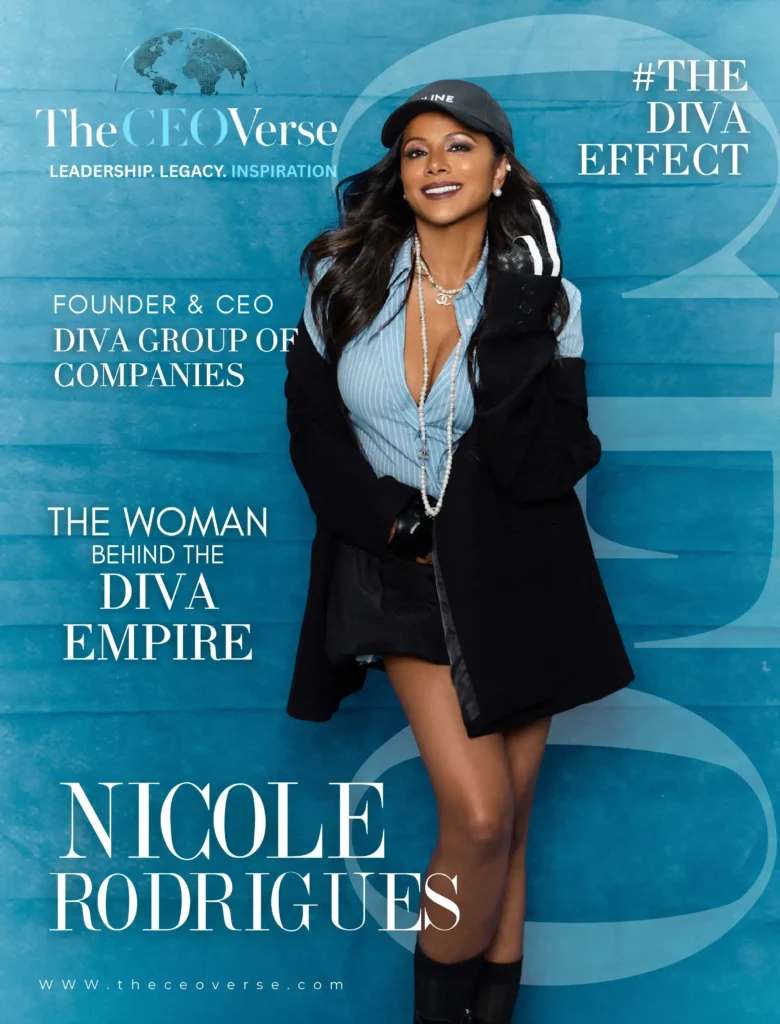
TheCEOVerse • Digital Edition
“The Visionary Entrepreneur Redefining Business, Investments & Media in 2026”
Cover story
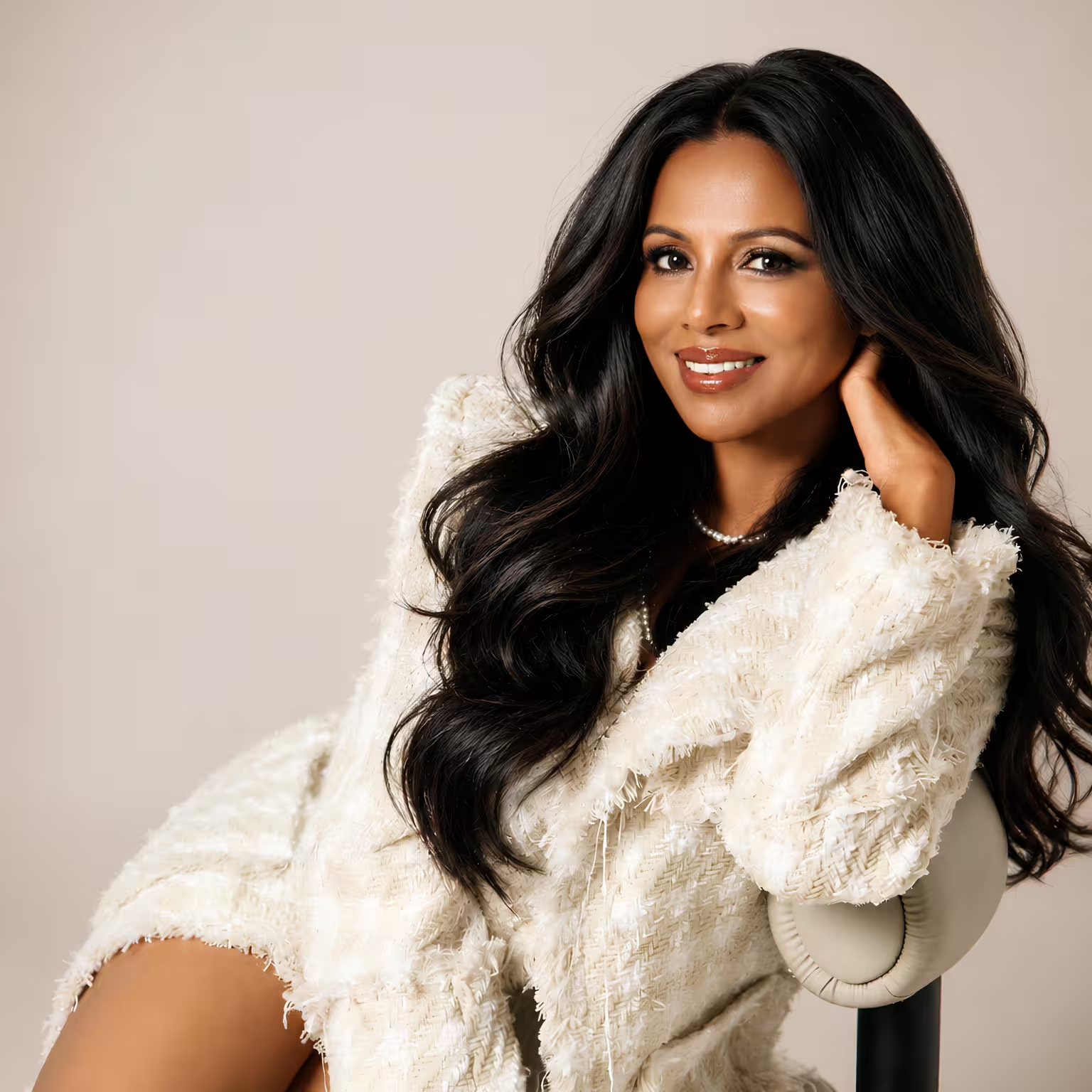
Nicole Rodrigues
Featured Profile - Nicole Rodrigues
THE ARCHITECT OF REINVENTION
Inside the World of Nicole Rodrigues, Founder & CEO, Diva Group of Companies
The Founder & CEO of Diva Group of Companies, on transforming a modelling agency into a diversified business group, building wealth through entrepreneurship and property, institutionalising leadership, and why reinvention may be the most valuable skill of all.
A CITY OF DREAMERS, A WOMAN WHO OUTGREW HER OWN
There is a particular kind of light that falls over the Palm Jumeirah in the late afternoon, gold, unhurried, the kind that makes even a skyline look like it is still deciding what to become. It is fitting light for Nicole Rodrigues, the Founder and CEO of Diva Group of Companies, a woman who has spent more than two decades doing exactly that. Deciding, again and again, what she and her business would become next.
Today, from Dubai, Rodrigues runs an empire that spans talent management, production, events, fashion, real estate, business consulting and asset development, and a growing portfolio of investments. She has walked stages to accept CEO of the Year honours, appeared on Forbes and Arabian Business power lists, and recently stepped in front of the camera again as an investor on the Amazon Prime series Dream Deals. But none of that was where she started. None of it was even close.
To understand Nicole Rodrigues, you have to go back, past the mansion, past the headlines, past the polished stage lighting of award ceremonies, and to a version of her life with no capital, no privilege, and no business plan at all. Just ambition, instinct, and an unshakeable belief that circumstances were never meant to be a ceiling.
THE GIRL FROM COCHIN WHO BUILT BEYOND BORDERS
Nicole Rodrigues was born in Cochin, Kochi, India, into a family rooted in more conventional professions, engineering and healthcare among them. It was not a household that expected its daughter to walk into modelling, let alone build a multi industry conglomerate out of it. But even as a teenager, Rodrigues was drawn to a different kind of future. She stepped into modelling at just sixteen, and her talent did not go unnoticed for long, noted Indian fashion designer Vikram Phadnis discovered her, and that early recognition became the launchpad for a professional modelling career that would eventually carry her across borders, onto runways, and ultimately into Dubai.
Dubai, she says, was never a random landing point. It mirrored her own philosophy long before she understood that it did. Think bigger, move faster, reinvent continuously, and never be afraid of what has not been done before. It was in this city, one built quite literally on the audacity of imagining something out of sand and sea, that she decided to stop being only the face in front of the camera and start being the person building the business behind it.
Rodrigues recounts, “My story did not begin with capital, privilege or a perfectly written business plan. It began with ambition, instinct and an extraordinary belief that my circumstances did not have to define the size of my future.”
More than two decades ago, she founded Diva Modelling and Events, stepping into an industry that was, at the time, fragmented, informal, and largely unregulated. Where others saw an unglamorous mess of freelance bookings and handshake deals, Rodrigues saw an opening: a chance to build something structured, professional and scalable in a sector nobody had thought to professionalise. It was a modest beginning by any measure. It would not stay modest for long.
FROM ONE AGENCY TO AN EMPIRE: THE DIVA EVOLUTION
Over the following years, Rodrigues expanded into property investment, business consulting and lifestyle businesses, a trajectory that would eventually turn a single modelling agency into the sprawling Diva Group of Companies. A year after founding Diva Modelling and Events, she launched Diva Holdings, moving into high end real estate and eventually building a substantial portfolio of prime real-estate assets. In 2010, she established NM Investments, extending the group into consulting and accounting services. The following year brought two more ventures, Diva Laundry and Diva Salon, rounding out a business ecosystem built, layer by layer, on the same instinct, that almost anything can be turned into something more valuable than it currently is.
“I have always been fascinated by transformation,” she says, “transforming an idea into a company, a property into an asset, a young person into a professional, or an obstacle into an opportunity.”
She describes her own approach in refreshingly unromantic terms. “I did not wait until I felt completely ready. I started. Then I learned. Then I built. Then I rebuilt. And I am still building today.” It is a cycle, not a straight line, and Rodrigues insists that is exactly the point. “The greatest thing entrepreneurship taught me is that your beginning has very little to do with your destination. What matters is whether you are prepared to keep expanding the person you are in order to accommodate the future you want.”
THE GROUP TODAY: FROM AGENCY TO INSTITUTION
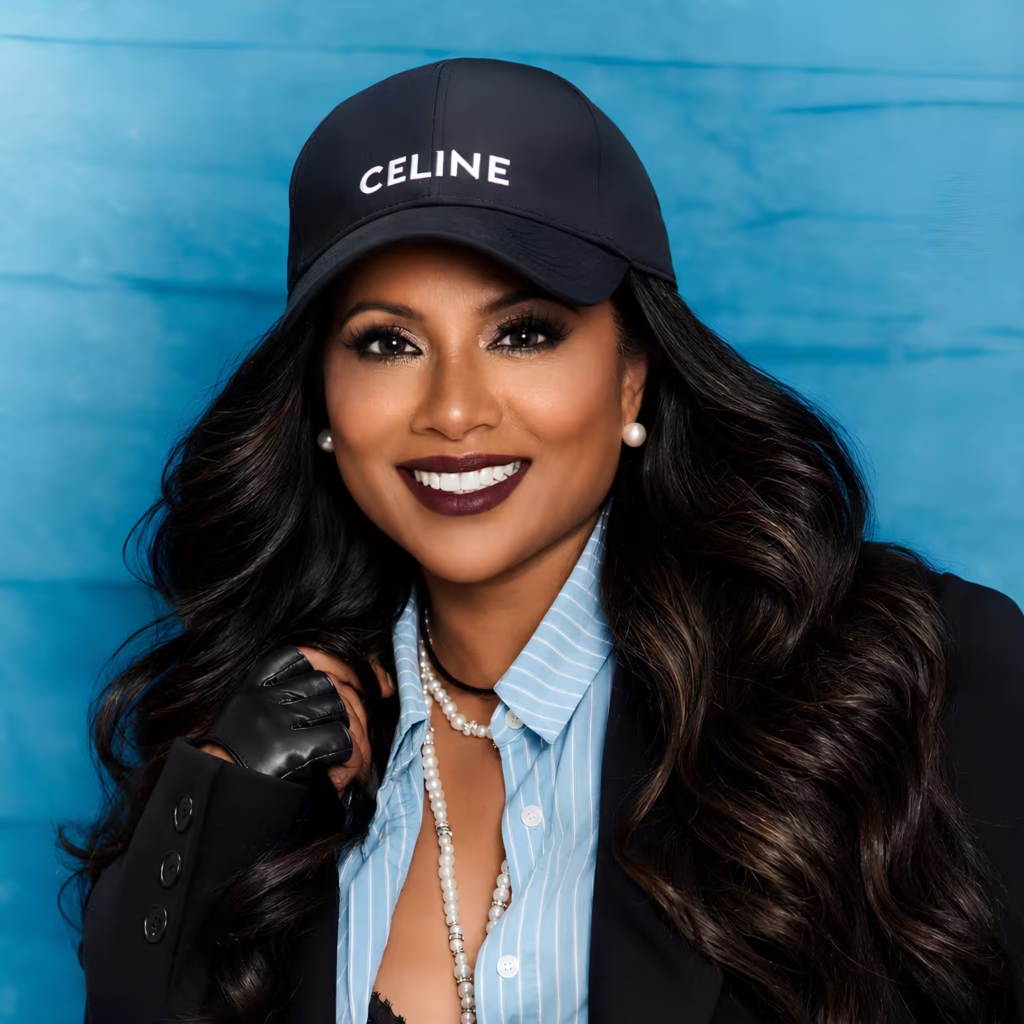
Two decades after Diva Modelling and Events opened its doors, the business Rodrigues leads looks almost nothing like the early agency startup at the time, and that, she says, is entirely by design. The original modelling and events business has since evolved into Diva Talent, Production & Event, a full service arm that brings casting, talent representation, live production and large scale event execution under one roof rather than splitting them across outside vendors. Sitting above it is Diva Group of Companies, the parent structure through which Rodrigues now oversees a portfolio that has grown far beyond entertainment.
Property remains one of the group’s most significant pillars. Through Diva Holdings, Rodrigues has built a real estate portfolio spanning dozens of prime properties, and in recent years has moved deliberately from being purely a property investor to an active developer and contractor, taking projects on from acquisition through construction and delivery, rather than holding assets at arm’s length. “I don’t just want to buy an asset and wait,” she says of the shift. “I want to be involved in creating it.” Production, meanwhile, continues to operate as a discipline in its own right within the group. Content, activations and creative execution for regional and international brands, run alongside the talent business rather than folded into it, a reflection of how specialised each arm has become.
Technology is the other axis along which Rodrigues is deliberately steering the group’s next phase. She talks about digital transformation as an operational necessity, replacing manual bookings and spreadsheet driven workflows with searchable talent databases, digital contracts, performance tracking and, increasingly, artificial intelligence tools that can match talent to briefs faster and more precisely than manual casting ever could. “The businesses that survive the next decade,” she says, “will be the ones that let technology do the repetitive work, so people can focus on relationships and creativity.”
That same discipline shapes her investment strategy more broadly, which today spans real estate, private markets and reinvested profits from across the group, guided by a preference for assets and businesses she can actively influence rather than hold passively. Family wealth and legacy planning have increasingly entered that conversation too, not simply preserving what has been built, but structuring it to pass intelligently to the next generation. That, ultimately, is what institutionalising the business for the next generation means to her. Building Diva Group into something that can be run, and improved, by people other than herself, with systems, accountability and structures resilient enough to outlast any single founder, including its own. She describes herself as a founder who has repeatedly transformed businesses, capital and assets, and who is now moving from entrepreneur to investor and institution builder. It is a description that captures both how far Diva has travelled since the very beginning, and precisely where Rodrigues intends to take it next.
In 2026, that evolution continues to unfold. Diva Talent, Production & Event remains the foundation, but Rodrigues has steadily built out Diva Development and Diva Contracting alongside it, extending the group’s reach from property investment into development and contracting, and, increasingly, into media and production. At every stage, the underlying goal remains the same, institutionalising the group for the next generation, so that what she has built continues to grow beyond her.
THE LONELINESS BEHIND THE GLAMOUR
Every entrepreneurial success story, when you scratch beneath the surface, is also a survival story, and Rodrigues does not pretend otherwise. Behind the mansion, the magazine covers and the awards sits a far harder chapter. Building businesses while raising two children, navigating brutal economic cycles, navigating difficult partnerships, changing relationships and hard-earned lessons in trust, making financial decisions with no guarantee they were the right ones, and, at times, grieving people she loved while still being expected to show up, composed, for a company that depended on her.
Nicole says, “Entrepreneurship can look glamorous from the outside, but leadership is often lonely. There are moments when everyone turns towards you for the answer while you are still trying to find the answer yourself.”
It would be easy for a founder in her position to package pain into an inspirational cliché. Rodrigues resists that. She is careful, almost insistent, about not romanticising struggle. “Pain itself does not make you stronger. What you do with pain does,” she says. What her hardest chapters gave her, she explains, was not scar tissue to display but a genuine shift in operating discipline, she emerged from every major setback more commercially aware, more disciplined, and considerably more selective about who she let close to her business and her life.
That shift also changed the question she asks herself when something goes wrong. “I don’t spend years asking, ‘Why did this happen to me?’ I ask, ‘What is this trying to teach me, and what am I going to do next?'” It is a small linguistic change with an outsized effect, trading victimhood for velocity. As she puts it herself, “Life will occasionally break the version of you that has become too small for where you are going. Do not mistake reconstruction for destruction.”
THE DIVA DIFFERENCE: WHY SHE NEVER STOPPED ASKING “WHY”
If there is one trait that separates Rodrigues from a purely operational CEO, it is her refusal to accept an industry norm simply because it is the norm. She describes her own thinking style as commercial, creative and instinctive, operating simultaneously rather than in sequence. And it is this triad, she says, that has shaped her career more than any single strategic decision.
Early on, she made a deliberate choice not to let Diva become “simply an agency that receives a brief, books talent and sends an invoice.” Instead, she pushed her teams to interrogate the client’s entire problem. What are they actually trying to achieve? Who is the audience? Could talent, production, events, locations, technology, content and execution be brought together under one roof instead of being fragmented across five different suppliers? That single question, “Could this be integrated rather than outsourced?” is arguably what turned a modelling agency into a diversified group of companies.
“Technology alone is not innovation,” she says. “Sometimes innovation is simply having the courage to question an industry habit that everyone else accepts.” She further shares, “The future rarely belongs to the person who knows the old rules best. It belongs to the person brave enough to ask whether those rules still deserve to exist.”
Her default question, she says, is deceptively simple. “Why are we doing it this way?” If the honest answer is only, “Because this is how it has always been done,” her interest is immediately piqued. As she puts it, “Innovation begins where unquestioned convention ends.”
TRUST, GOVERNANCE, AND THE LESSON THAT COST HER THE MOST
Ask Nicole Rodrigues about her hardest professional lesson, and she does not point to a failed product line or a bad market call. She points to people, specifically, to what happens when generosity is not matched by structure. By her own admission, she is naturally generous. When she believes in someone, she tends to hand them access, opportunity, knowledge, relationships, and room to grow. Earlier in her career, she assumed loyalty would simply follow opportunity as a matter of course. It doesn’t. “People have different values, ambitions and interpretations of loyalty,” she says now, a lesson that reshaped how she runs Diva today. It taught her a distinction she now considers foundational to good leadership. “Good governance is not mistrust. It is respect for the relationship.” Clear contracts, defined responsibilities, documented processes, transparency and accountability, she argues, protect everyone involved, not just the founder at the top.
The other hard won lesson sits alongside it. Delaying a difficult decision rarely makes it easier. “Entrepreneurs often lose more through indecision than through wrong decisions,” she says. Today, she describes her process as a blend of instinct and infrastructure, she trusts her gut, but insists the numbers, contracts and structure back it up before she moves. “Trust people with your heart if you choose, but build businesses with systems. Character creates relationships, but governance protects them.”
THE PEOPLE WHO BUILT THE BUILDER
No founder story, however self driven, happens in isolation, and Rodrigues is quick to reject the myth of the self made entrepreneur. “No successful person is truly self made,” she says. “We may make our own decisions, but we are shaped by parents, mentors, children, partners, employees, clients, friends, and sometimes even by our critics.”
Her parents, she says, gave her part of the foundation from which she built her own identity and resilience. But it is motherhood, raising her daughter Victoria and her son Victor, that she describes as having most profoundly reshaped her definition of success. “Once you become responsible for another generation, ambition evolves,” she explains. “You stop thinking only about what you can achieve and begin thinking about what you can build that will outlive you.”
She is equally candid about the role played by people outside her family. Mentors, colleagues, employees and clients who opened doors or challenged her thinking at pivotal moments, and, perhaps counterintuitively, the people who doubted her. “Believers give you confidence. Critics give you fire. Both can be useful,” she says. “Some people enter your life to support your journey, others enter it to strengthen your journey. Wisdom is learning to be grateful for both.”
BUILDING PEOPLE, NOT JUST A COMPANY
As Diva Group has scaled across multiple business lines and increasingly across multiple markets, Rodrigues has had to make the transition every founder eventually faces: from entrepreneur to institution builder. The group has executed projects and built relationships across markets including Qatar, Kuwait, Bahrain, Turkey, India and Pakistan. “A founder may carry the original vision,” she says, “but no meaningful organisation can remain dependent on one individual forever.”
Working with teams across nationalities, cultures, personalities and generations has been, in her telling, one of the distinct advantages of building a business in Dubai, a city defined by its diversity. But diversity alone does not create a strong organisation, she notes, it requires clarity. People need to understand exactly what success looks like, what they personally own, and how their contribution connects to the larger purpose of the company. “Leadership is not controlling every decision,” she says. “It is creating an environment where good decisions can be made even when you are not in the room. If you want to go faster, become exceptional. If you want your vision to outlive you, build exceptional people.”
WHAT SHE WOULD TELL HER YOUNGER SELF
Rodrigues’s advice to young entrepreneurs starting out today is, notably, less about strategy and more about psychology. She is blunt about the paralysis she sees in a generation with more access to technology, information and global connectivity than any before it, and yet one that is, in her observation, frequently frozen by comparison. “They see somebody else’s Chapter 20 on social media and become discouraged with their own Chapter 1,” she says.
Her advice is unambiguous. Start before you feel ready. Your first business may fail. Your first idea may be wrong. None of that determines the future, the real competitive advantage is simply staying in the game long enough to become exceptionally good at it.
The other non negotiable, in her view, is reputation. “Money can be earned again. Companies can be rebuilt. Investments can recover,” she says. “But character compounds just like capital does.” Above all, she warns against building an identity around applause. “When you require validation, people control you. When you know who you are, you become extraordinarily difficult to stop. Do not spend your youth trying to look successful. Spend it becoming so capable that success eventually has no choice but to find you.”
AWARDS AND RECOGNITION
Over the course of her career, Rodrigues’s business acumen has earned recognition across several of the region’s most notable platforms.
- Forbes Middle East, Top Indian Leaders in the Arab World, 2014
- Dubai SME 100, 2015
- Indian CEO Awards, 2014
- Asia Pacific Entrepreneurship Awards, 2015
- CPI Stars of Business, 2015
- Gulf Capital SMEinfo Awards, 2012
- Arabia500, 2011
- Indian Innovator Award, 2016
- Golden Brick Award, 2018
But for Rodrigues, none of these milestones function as an ending point. “I don’t see awards as finishing lines,” she says. “I see them as punctuation marks. They allow us a moment to reflect before the next sentence begins.” Her ambitions today, she says candidly, are larger than they were twenty years ago. “Real legacy is infrastructure. Did you build companies that created livelihoods? Did you create opportunities? Did you leave behind intellectual, financial and ethical capital? Did people become stronger because their lives intersected with yours?” That, she says, is what interests her now. “The next chapter is not about proving that I can build. I have already proved that to myself. It is about deciding what is truly worth building next.”
ON BEING AN AMBITIOUS WOMAN
Perhaps the most striking part of Rodrigues’s reflections is the one she volunteers unprompted, a pointed observation about the particular, contradictory expectations placed on ambitious women. “I think we speak a great deal about women succeeding, but not enough about the complexity of being an ambitious woman,” she says. Women, in her view, are frequently expected to be strong but never intimidating, successful but endlessly available, financially independent but not too powerful, loving mothers while somehow behaving as if motherhood requires no time, and decisive leaders while remaining universally liked.
Her response has been to simply stop trying to satisfy those contradictions. “I believe women are entitled to ambition. We are entitled to wealth. We are entitled to leadership. We are entitled to motherhood, femininity, vulnerability, reinvention and power, simultaneously,” she says. “One identity does not cancel another.” Nicole Rodrigues states, “You do not need to become less of yourself to become more successful.”
THE NEXT CHAPTER, WRITTEN ON HER OWN TERMS
Rodrigues is unusually insistent on the idea that reinvention does not have an expiry date. A life, much like a business, can and should be allowed to change direction more than once. “Too many people become prisoners of identities that once served them,” she says. Her counter argument is simple and repeated with conviction. “At 30, you can begin again. At 40, you can begin again. At 50, you can begin again. You don’t expire because another decade passes. Never let society tell you when your most important chapter was supposed to happen. Write it yourself.”
Asked, finally, for the one thought she would want readers to walk away with, Rodrigues does not talk about wealth or company valuations. She measures her life instead by evolution, by a private checklist she says she returns to often. Did I become wiser? Did I become braver? Did I create value? Did I open doors? Did I raise strong children? Did I leave something better than I found it? “Because ultimately,” she says, “a successful life is not simply a collection of achievements. It is a collection of choices. And every morning we are given another opportunity to make one that changes the direction of everything that follows.” She says, “Build wealth. Build businesses. Build people. But above all, build a life whose value cannot be measured only in numbers.”
Two decades after she arrived in Dubai with nothing but ambition and instinct, that sentence reads less like advice and more like a description of the life she has already built, and the one she clearly intends to keep expanding.