TheCEOVerse • Digital Edition
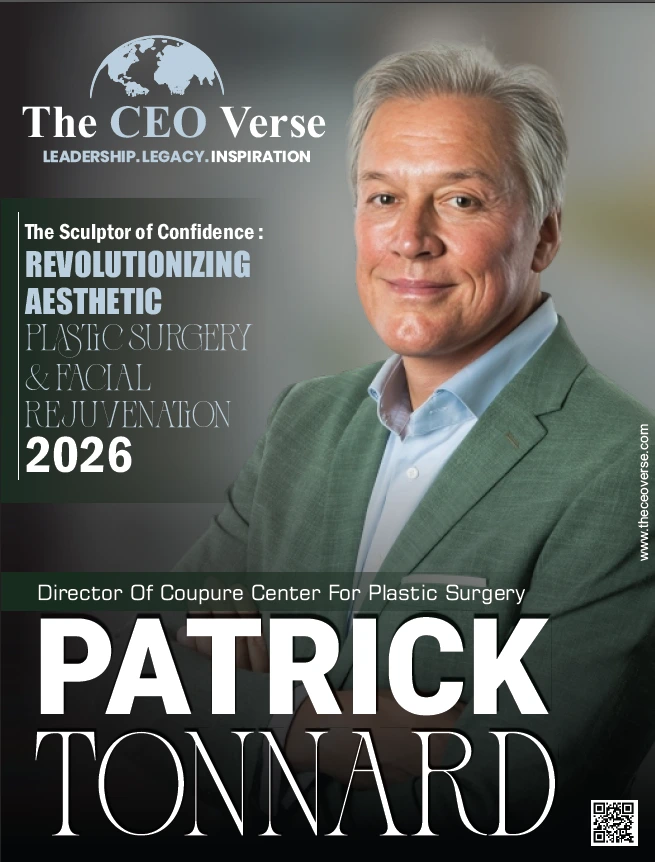
“The Sculptor of Confidence : Revolutionizing Aesthetic Plastic Surgery & Facial Rejuvenation 2026”
Cover story
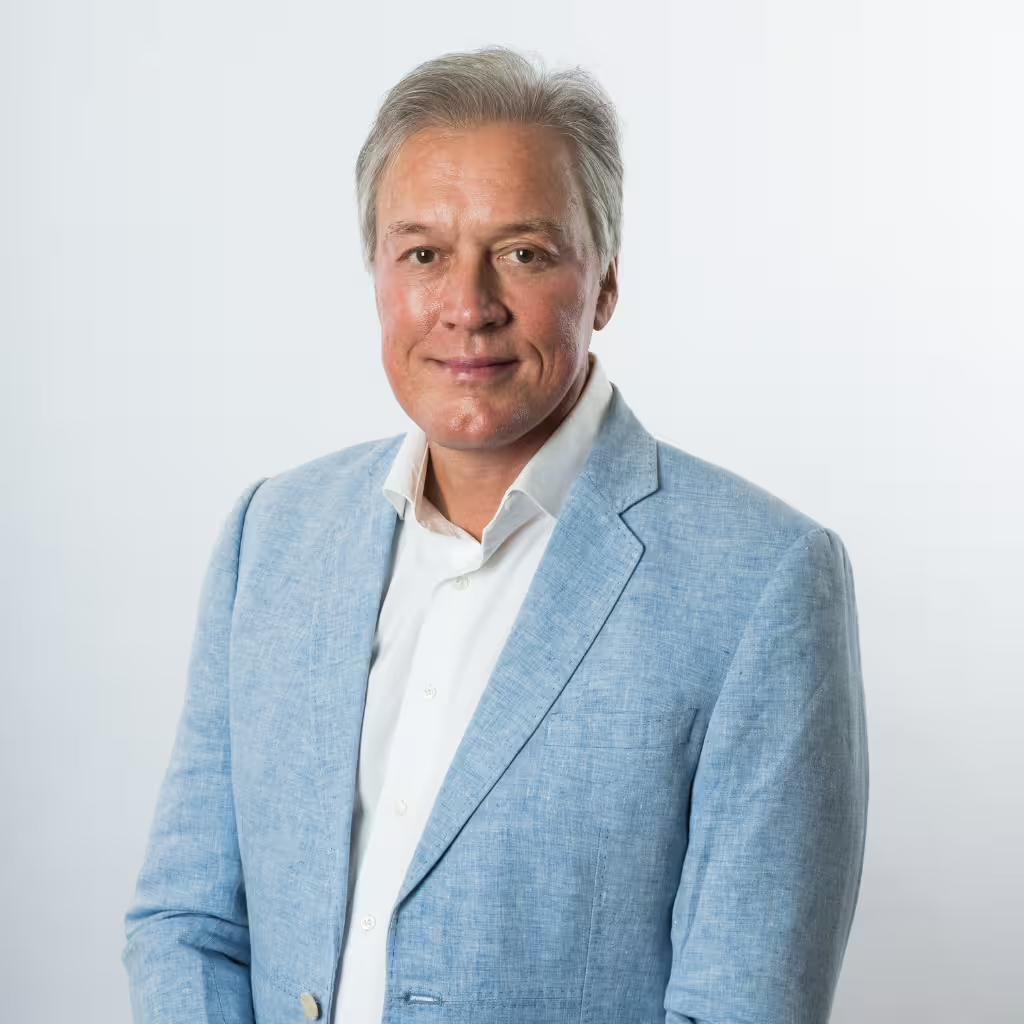
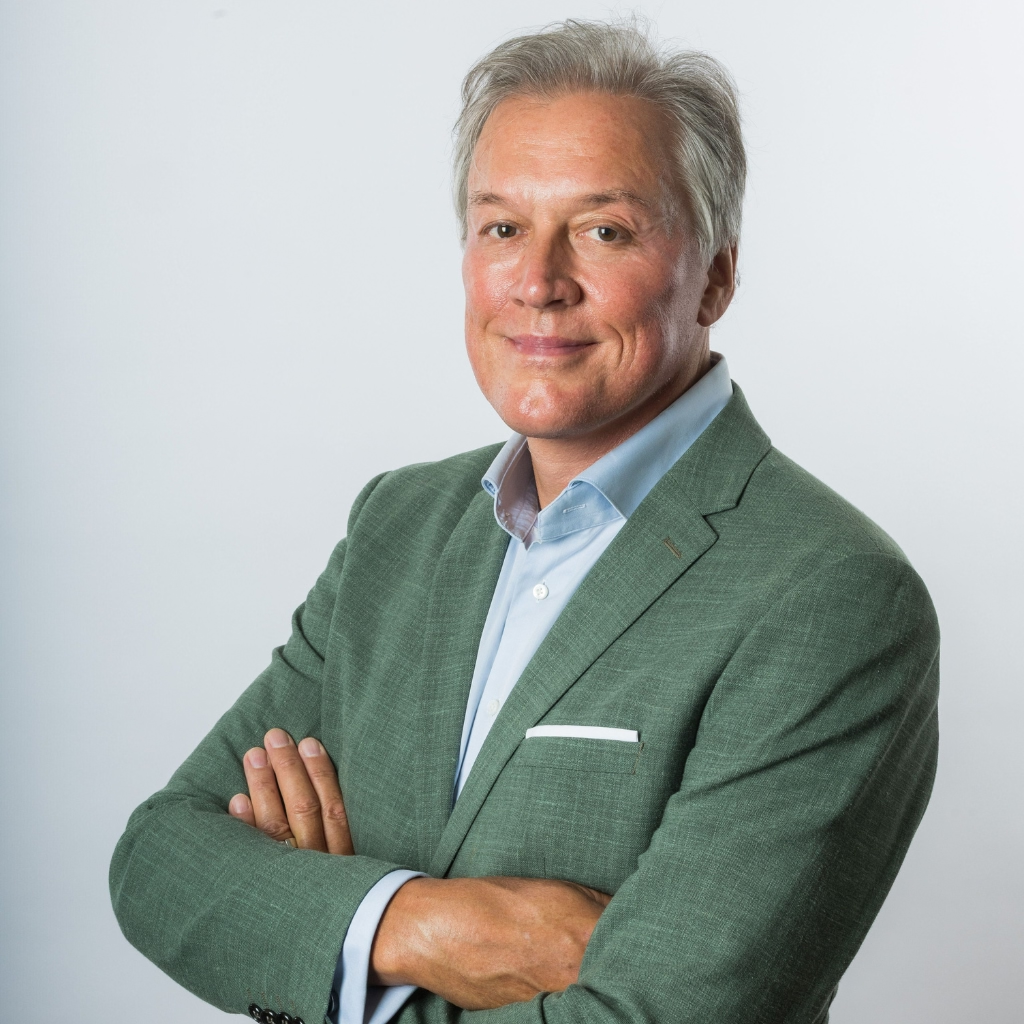
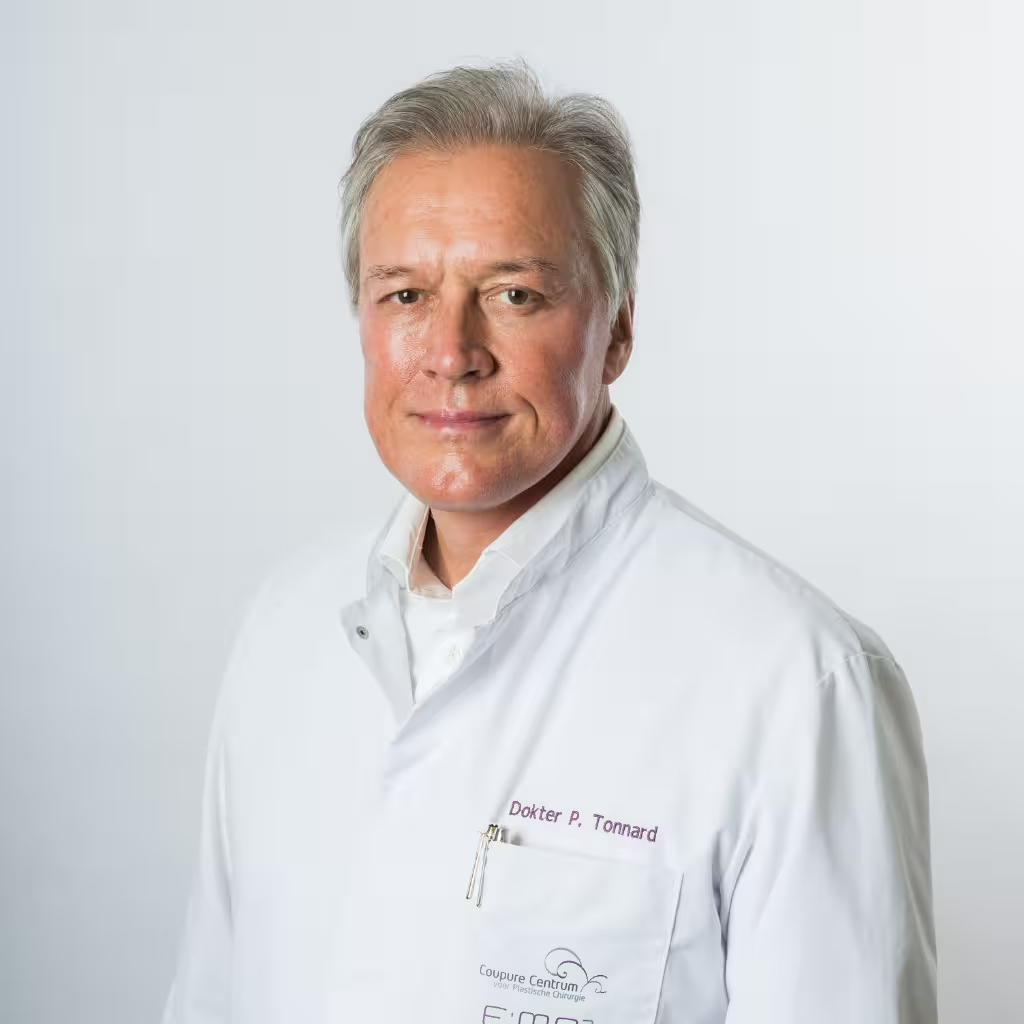
Patrick Tonnard
Featured Profile - Patrick Tonnard
Some surgeons chase perfection. He chased the question underneath it.
The Surgeon Who Never Stopped Questioning
There is a persistent myth about innovation. People like to imagine breakthroughs as sudden flashes of genius, a single moment that changes the course of a career. Patrick Tonnard has never bought that story. For more than three decades, his work has rested on a simpler, more uncomfortable habit: refusing to accept that something is right just because it has always been done that way.
His work has reshaped modern facial rejuvenation surgery. The MACS-lift alone has influenced thousands of surgeons worldwide, and his research into Nanofat opened a line of inquiry that regenerative medicine is still working through. Ask him about any of it, though, and he steers the conversation elsewhere. He is more likely to discuss biology than surgical technique, curiosity than success, questions rather than answers.
That instinct did not begin in an operating theatre. It began earlier, in a childhood spent picking apart explanations instead of accepting them, whether the subject was nature, mechanics, or the mechanics of the human body itself. Medicine, in his view, only advances when practitioners are willing to challenge their own assumptions, including the ones they were trained to trust.
By the time he reached plastic surgery, that instinct had a name. Curiosity before career.
The Surgeon Who Chose to Restore, Not Reinvent
Medicine was the natural destination for that kind of curiosity. Plastic surgery, though, offered something more specific, a specialty that sat at the meeting point of anatomy, engineering, psychology and human emotion, where technical precision had to coexist with an understanding of how people see themselves.
What pulled him toward it, though, was never beauty. It was restoration.
He speaks about this distinction carefully, almost insistently. Patients arrive after trauma, after congenital conditions, after simple time has taken something from them. The goal was never to build a different person. It was to help someone recognise themselves again. In an era shaped by filters and algorithmic beauty standards, that is not a small claim. It is closer to a quiet argument against the entire aesthetic industry’s obsession with transformation.
The Trade-Offs Everyone Else Accepted
When Tonnard began practicing, facial rejuvenation had one job: tighten the face. Lift the skin, remove the excess, smooth the surface. The results looked impressive in photographs. They did not always hold up under scrutiny.
Tension on the skin. Long recoveries. Results that occasionally looked more manufactured than natural. Limited conversation about what any of this meant for tissue health over the long run. Most surgeons treated these as the acceptable cost of doing the job. Tonnard treated them as an open invitation to ask whether the job was being done correctly at all.
Were surgeons respecting the biology of the face, or simply forcing living tissue into positions it was never built to hold? That question sat at the centre of everything that followed. Innovation, he decided, should not make surgery more aggressive. It should make it more intelligent.
Respecting Tissue Where Others Just Operated
No serious breakthrough happens in isolation. Tonnard’s closest collaborator for decades has been Dr. Alexis Verpaele, a partnership that has lasted not because the two men always agreed, but because they were willing to challenge each other without protecting their egos in the process.
Their conversations kept circling one deceptively simple question. What if better anatomy could replace greater force? Instead of asking how to pull tissue tighter, they asked how to restore facial architecture while disturbing as little of it as possible.
The answer became the MACS-lift, the Minimal Access Cranial Suspension technique. Its value was never in complexity. A shorter incision, carefully mapped suspension vectors, and a granular understanding of anatomy combined to produce natural results with less trauma and a faster recovery. At the time, the prevailing wisdom said less invasive surgery meant less effective surgery. Tonnard and Verpaele believed the opposite.
What followed was not a quiet correction inside one clinic. Surgeons began arriving in Ghent from across the world to learn the technique firsthand. Scientific publications followed. Lectures took the idea across continents. A method that started as two men questioning conventional wisdom in a room together gradually became part of how facial rejuvenation surgery is taught and practiced globally. “It demonstrated something much more important,” Tonnard says. “Innovation becomes meaningful only when it serves biology rather than the surgeon’s ego.”
The Organ Everyone Ignored
Success, for most people, becomes a resting point. For Tonnard, it became a prompt for a new set of questions. “The moment everyone starts agreeing with you,” he says, “is probably the moment you should begin asking new questions.”
While the rest of the field refined the mechanics of lifting tissue, his attention drifted somewhere else entirely. Fat. For decades, adipose tissue had been treated as little more than packing material, removed where there was too much of it and injected where there was too little. Its worth was measured in volume and nothing else.
That explanation never sat right with him. Patients who received fat grafts kept showing improvements in skin texture and quality that volume alone could not explain. Most surgeons dismissed this as a subjective impression. Tonnard read it as biology trying to say something the profession had not yet learned to hear. As research into adipose tissue’s vascular network and regenerative capacity advanced, the picture came into focus. Fat was not simply filling space. It was communicating.
That single realisation reshaped his understanding of what surgery could do. Traditional rejuvenation worked through mechanics: lifting, tightening, repositioning. Biology works through an entirely different language, one built on cellular signalling, inflammation control and collagen remodelling. The implication was hard to ignore. Perhaps the future of the field would not depend on how skilfully tissue was manipulated, but on how intelligently the body’s own regenerative systems were supported.
That thinking produced Nanofat, a product designed not to add volume but to activate repair. Its reach has since extended well beyond aesthetic surgery. For Tonnard, its real contribution was more conceptual than clinical. Fat was no longer replacing what had been lost. It was helping tissue recover a vitality that biology itself had begun to lose.
The Symptoms Were Never the Disease
That shift changed how Tonnard thinks about aging altogether. Conventional aesthetic medicine treats aging as a list of visible faults: wrinkles, laxity, pigmentation, lost volume. Fix each one and the face looks younger. He considers that view incomplete.
“The visible signs of aging are not the disease,” he says. “They are the symptoms.”
Underneath every wrinkle sits a biological process. Changes in vascularity. Altered cellular communication. Low-grade chronic inflammation. A slow decline in the tissue’s own ability to regenerate. Seen this way, facial rejuvenation and wound healing stop looking like separate disciplines. Both depend on restoring vascular integrity. Both require careful inflammatory regulation. Both come down, in the end, to regeneration.
It is not a metaphor he uses loosely. It has become the intellectual spine of most of his current research.
Cells Don’t Respond to Advertising
Few corners of medicine move as fast, or get marketed as aggressively, as aesthetic surgery. New devices and injectables arrive every year, most promising results that outpace the evidence behind them. Tonnard has become one of the field’s more outspoken skeptics of that pattern, insisting that new technology be judged by biological standards, not commercial ones.
Technology itself, he argues, is neutral. Its value depends entirely on how it interacts with living tissue, not on how convincingly it is marketed. “Biology keeps its own accounting,” he says. “Marketing may create excitement, but cells don’t respond to advertising.” That stance has occasionally put him at odds with the industry’s enthusiasm for the next new thing. He accepts the friction. Scientific progress, he argues, has never depended on consensus. It depends on evidence. History backs him up here. Many of medicine’s most important advances were once dismissed as improbable, unnecessary, or simply wrong before they were proven right. A scientist’s job was never to defend what is already accepted. It is to test it.
That conviction eventually found its way onto the page. His forthcoming book, To Cut or Not to Cut, due in 2026, is not really about whether surgery should give way to less invasive procedures, despite what the title suggests. It is a challenge to the way modern aesthetic medicine frames aging itself. The real question it asks is harder. How should a physician decide what actually serves the patient? The answer, in his framing, has nothing to do with whether the tool is a scalpel or an injectable. It comes down to biology. Does the treatment respect living tissue? Does it preserve the body’s capacity to regenerate? Does it work with biology, or against it?
These are not questions confined to aesthetic medicine. They speak to a wider shift taking place across healthcare, where regenerative biology is increasingly shaping orthopaedics, cardiology, neurology, oncology and longevity research. In that sense, To Cut or Not to Cut is not simply a book about surgery. It is a book about medicine’s next chapter.
Working With Biology, Not Against It
If one idea defines Tonnard’s current thinking, it is this: medicine has to move past repairing damage and start learning how to support regeneration. Artificial intelligence will sharpen diagnostics. Genomics will personalise treatment. Robotics will improve precision. None of it replaces the intelligence already sitting inside living tissue.
“The greatest medical innovations of the coming decades,” he says, “will not emerge because we become better at controlling biology. They will emerge because we finally learn how to work with it.”
Ideas Are Not Protected, They’re Tested
There is an old line in medicine that experience teaches more than textbooks. Tonnard would probably push back on that. Experience, in his view, only teaches the people willing to keep questioning their own conclusions.
After more than three decades of practice, thousands of procedures, and surgeons trained on nearly every continent, he speaks with a kind of confidence that comes from revision rather than certainty. “I’ve changed my mind many times,” he says. “If your ideas never evolve, you’re probably no longer paying attention.”
That instinct runs through his partnership with Dr. Alexis Verpaele too. Their conversations resemble debate more than agreement. Assumptions get challenged before they get accepted. Nothing reaches the operating room without surviving scrutiny first. “We don’t protect ideas,” he says. “We test them.”
That same culture extends to Coupure Centrum, the Ghent clinic the two built together into one of Europe’s more respected centers for facial rejuvenation. Visitors expecting a rigid hierarchy usually find something else. Surgeons debate cases with nurses in the room. Researchers sit in on consultations. Support staff are treated as contributors to patient care rather than assistants standing outside it. Every publication, every lecture, every refined technique carries more than one name behind it, even when only one signs the paper. Medicine, Tonnard insists, has always been a team sport.
Anatomy First, Procedure Last
Nowhere is this philosophy more visible than in the classroom. Thousands of surgeons have made the trip to Ghent expecting to learn a facelift technique. Most leave thinking differently about biology instead. “The first thing young surgeons usually ask is how to perform a particular operation,” Tonnard says. “My answer is almost always the same. First understand anatomy, then understand biology. Only then should you learn the procedure.”
It is advice that reflects a deeper philosophy. Techniques evolve. Technology becomes obsolete. Scientific understanding keeps expanding. Anatomy does not change, and biology has no interest in trends.
That is why he has never really thought of himself as a technician. Surgery, in his framing, is one expression of applied biology. The scalpel is one instrument among several. Understanding life is the actual discipline.
The Mistake That Taught Him More Than Any Success
Ask Tonnard about the most important lesson of his career and he does not bring up the MACS-lift. He does not bring up Nanofat. He does not mention an award. He brings up a mistake.
Early on, like most ambitious surgeons, he assumed technical perfection was the whole job. It wasn’t. “The operation may last five hours,” he says. “The patient’s emotional journey often lasts much longer.” That realisation changed how he runs a consultation. Patients rarely measure success by angles or scars. They remember whether they were heard, whether their identity was respected, whether the surgeon treated them as a person rather than a procedure. The operation stayed important. It just stopped being the whole conversation.
Where His Best Ideas Actually Begin
Outside the operating room, Tonnard’s habits say almost as much about him as his surgical philosophy does. Recurring lower back problems led him to yoga years ago. What started as rehabilitation became a daily practice. Meditation came later, after time spent learning from a Buddhist monk in Myanmar.
Neither practice touched his surgical technique directly. Both changed the surgeon. “They taught me that control and force are not the same thing,” he says. “They also reminded me that ego is usually the biggest obstacle to learning.” Painting sharpened something else, his eye for proportion and light.
None of this shows up more clearly than on Formentera, the Mediterranean island where he spends time away from the clinic. What the island offers is something increasingly rare in professional life: silence. For him, that silence is not downtime. It is often where an idea first takes shape, long before it becomes a research question. Innovation, he has come to believe, rarely comes from constant activity. It needs room to breathe.
A Patient Who Returns Is the Only Award That Matters
Ask Tonnard what the future of facial rejuvenation looks like and he does not start with robotics or artificial intelligence. He starts with biology. Diagnostics will get sharper. Treatment will get more personalised. None of it answers the question he actually cares about: how does medicine better support the regenerative capacity already built into the human body?
He believes the coming decades will fundamentally redefine aesthetic medicine. The profession, in his view, will move away from simply correcting visible signs of aging and toward preserving, and perhaps restoring, the biological mechanisms that keep tissue healthy across a lifetime. The surgeon of the future will need to understand cell biology as deeply as anatomy. This is not a shift confined to aesthetics. It reflects a broader change across medicine itself, with regeneration becoming one of healthcare’s defining scientific frontiers. From cardiology to orthopaedics, neurology to longevity research, the emphasis is slowly moving away from simply repairing damage and toward helping tissue heal more intelligently. Aesthetic surgery, in that sense, has become an unexpected laboratory for a transformation happening well beyond it.
Recognition has followed him for most of his career, the awards, the invitations, the lectures. He accepts all of it with gratitude, and he is careful not to mistake any of it for the actual point. “The greatest reward has never been publishing a paper or receiving an award,” he says quietly. “It is seeing a patient return years later with the confidence they thought they had lost.” He measures his career by three questions instead. Has he helped patients age with dignity instead of fear? Has he given other physicians ideas that let them treat patients more safely? Has he pushed younger surgeons to think for themselves instead of repeating what they were taught?
He Didn’t Change Facelifts, He Changed How Surgeons Think
Every generation inherits a set of assumptions that eventually stop looking like assumptions at all. The more useful innovators are the ones willing to make them visible again. Tonnard has spent his career asking the questions his colleagues did not think to ask. Could rejuvenation happen with less trauma. Could fat function as regenerative medicine instead of filler. Should biology, not technology, decide how new treatments get judged.
Those questions have already shaped a generation of surgeons, and they may end up reaching well past aesthetic medicine. Underneath every operation sits a larger idea: healing is not something a physician imposes on the body. It is something the body already knows how to do. The physician’s job is to understand that intelligence and work alongside it.
Perhaps that is the real story of Patrick Tonnard’s career. Not that he changed how surgeons perform a facelift. That he changed how they think about life itself.